
NOTE: Demo visuals include blurred data or synthetic placeholders to protect customer privacy.
Why Forecasting Needed Help
Forecasting at Abnormal sits at the center of two important rituals. Revenue directors and sales leaders gather every quarter to run manual forecast calls, walking through deals, one by one, with judgment-laden questions. A traditional ML model runs alongside those calls, trained on hand-picked features extracted from CRM data. Neither pass is fast, and neither is especially accurate. In general, revenue guidance has to tighten, and the existing approach has not closed the gap.
Three frictions stood out:
- Deal signal lives in six different systems. Gong calls, Gmail threads, Slack messages, Salesforce fields, Jira tickets, and even public leadership-change news all contain information that should feed a forecast, but nothing was bringing them together for the model.
- The traditional ML model peaked at around 60% accuracy halfway through the quarter, leaving insufficient headroom for confident revenue guidance.
- Manual forecast calls consumed hours of senior-leader time every quarter on a task that is part judgment, part bookkeeping.
How the Workflow Runs
Zach pulls together everything tied to a single opportunity, then asks Claude to compress the raw context into a dense summary roughly a tenth of the original size. He then takes 50 of those compressed deal summaries and feeds them back to Claude to generate an Abnormal-specific deal-prediction guide. That guide grounds every individual deal prediction the system makes.
Capabilities in the current build:
- Pulls deal context from Gong, Gmail, Slack, Salesforce, Jira, and targeted web search for large opportunities
- Compresses raw deal data with Claude Opus 4.6 into reusable summaries
- Generates an Abnormal-specific prediction guide from a corpus of fifty compressed deal histories
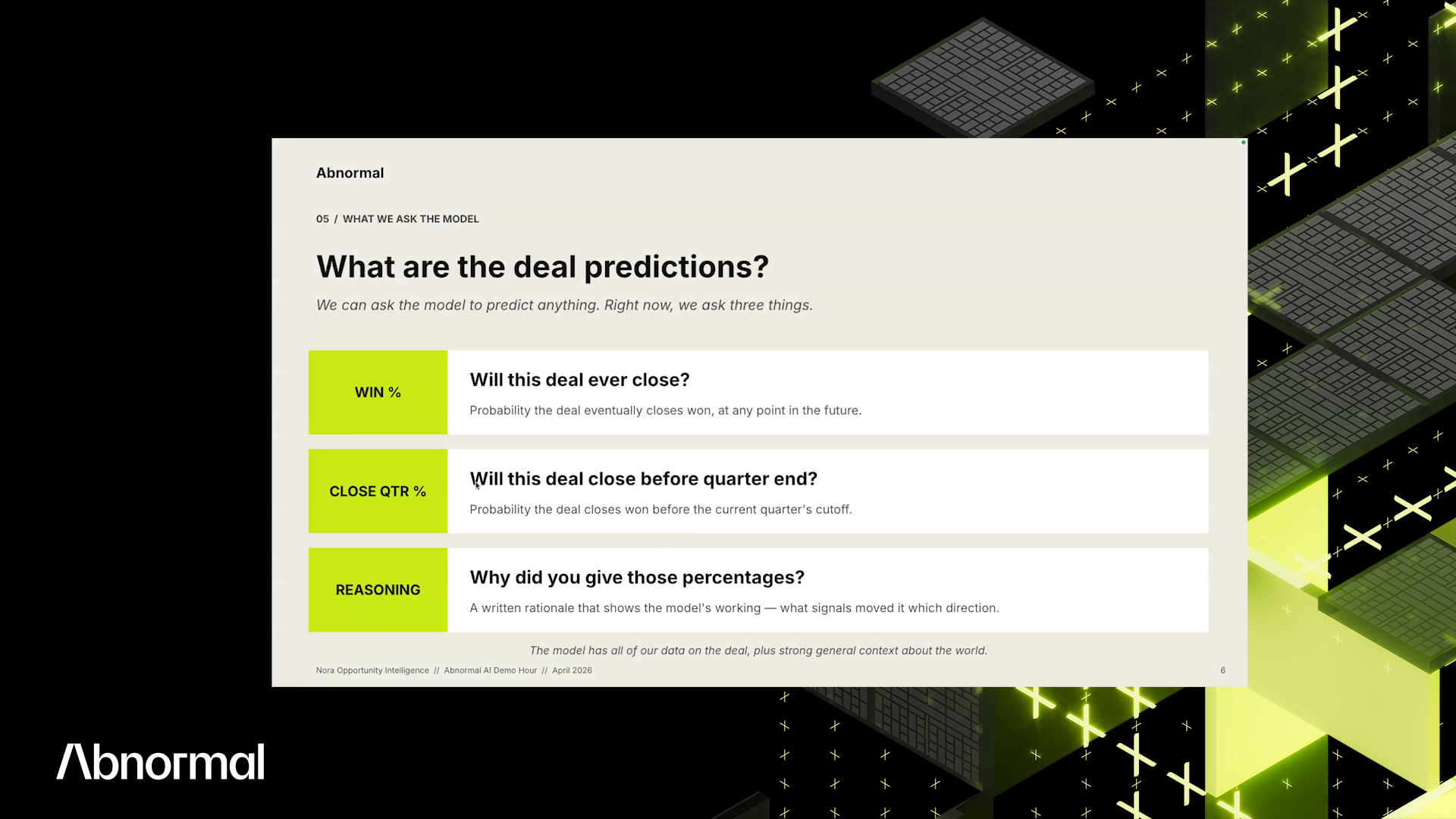
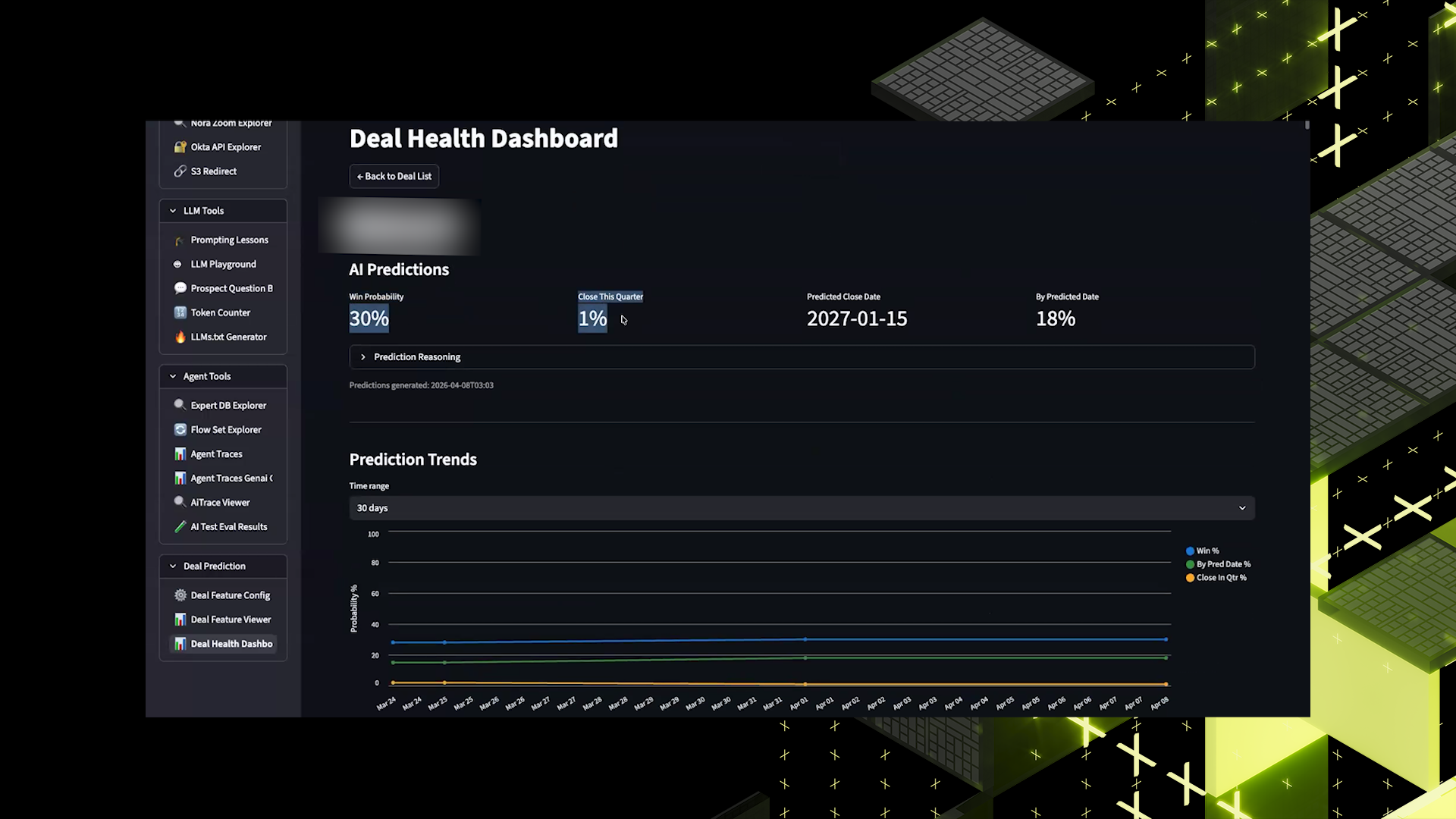
- Returns win probability, in-quarter close probability, expected close date, and reasoning per opportunity
- Surfaces predictions in a lightweight internal UI for revenue leaders to review
Zach leaned on the teachings of reinforcement learning guru Richard Sutton to frame the design choice. To paraphrase Sutton, "General methods that leverage computation always beat handcrafted domain knowledge in the long run."
The point of the single-shot design is to let the model weigh signal across systems in one pass, instead of stitching together hand-built features that go stale every time the sales motion changes.
A New Course for Prediction
On halfway-through-the-quarter deals, the Deal Intelligence Layer achieved correct predictions 80% of the time, compared with the existing traditional ML model's 60%. The accuracy held on both closed-won and closed-lost outcomes. Where it missed, it usually missed on deals where the team could not record enough source material, typically public-sector opportunities with regulatory constraints. More context, better predictions.
Two audiences benefit immediately:
- Revenue directors and sales leaders get a second opinion on every deal before the manual forecast call and a way to spend less time on the bookkeeping portion of those calls.
- Finance and IPO planning get a forecasting signal that tightens as the company collects more deal data, instead of a model that has to be retrained from scratch every time the sales motion shifts.
Key impacts of the Deal Intelligence Layer include the following:
- 80% accuracy on mid-quarter predictions versus 60% from the traditional ML model
- Wins held across both closed-won and closed-lost outcomes
- Misses concentrated on data-sparse deals, not data-rich ones
- Reasoning paragraph attached to every prediction supports manual review
- Sets a foundation for compressing manual forecast call time as confidence grows
In a future iteration, Zach aims to validate the model on a fresh quarter of deal data and start sharing predictions with a small group of go-to-market leaders for feedback.
Why it Lands
What makes this one land is the architecture bet behind it. Zach skipped the temptation to build a more complex traditional model and instead trusted that the best general model, given enough context, would outperform a hand-tuned one. The results for this quarter show he was right, and the design only gets stronger as Claude does.
Credit also belongs to the teammates who partnered on the build and the peers who pointed Zach toward the architectural research that shaped the approach. Forecasting touches revenue, finance, and IPO readiness, which makes it exactly the kind of internal surface where a smarter intelligence layer compounds over time. Expect this one to keep getting better.