
Demo visuals include blurred data or synthetic placeholders to protect customer privacy.
JohnJosh Romaro (JJR), an SDR operations builder on the AI Transformation team, showed Demo Hour a vibecoded Cowork skill called Map the Room. The skill drafts an account org chart on demand and structures contacts by MEDDIC role so reps can see, in one place, who they know, who they don't, and where the gaps are.
A Rough Draft for the Room
JJR opened with a deliberate framing: this is a rough draft, not a finished product. He built it because the team kept losing time rebuilding the same relationship maps in two places, and because he wanted something other AI Transformation projects could plug into.
Why the Old Way Hurt
The motion before Map the Room was duplicative and brittle. AEs and their SDRs would sketch what they thought an org chart looked like on the opportunity or the account in the CRM. The same reps would also build a parallel version inside Sales Navigator, which doesn't export anywhere useful. When an opportunity got disqualified, all the work attached to it had to be manually moved over to the account record, or it was lost.
JJR called out three specific frictions:
- The old CRM relationship mapper was deprecated, so reps lost a tool that enterprise sellers actively used as a strategic move.
- Sales Navigator org charts are not exportable, which forces reps to replicate the structure in the CRM manually.
- When an opportunity gets DQ'd, any attached mapping must be manually reattached to the account, or it disappears.
How Map the Room Works
In Cowork, a rep types the skill name and the account name. Map the Room then pulls signals from the Actively AI connector, supplements with web scraping, and adds internal context from Gong call transcripts.
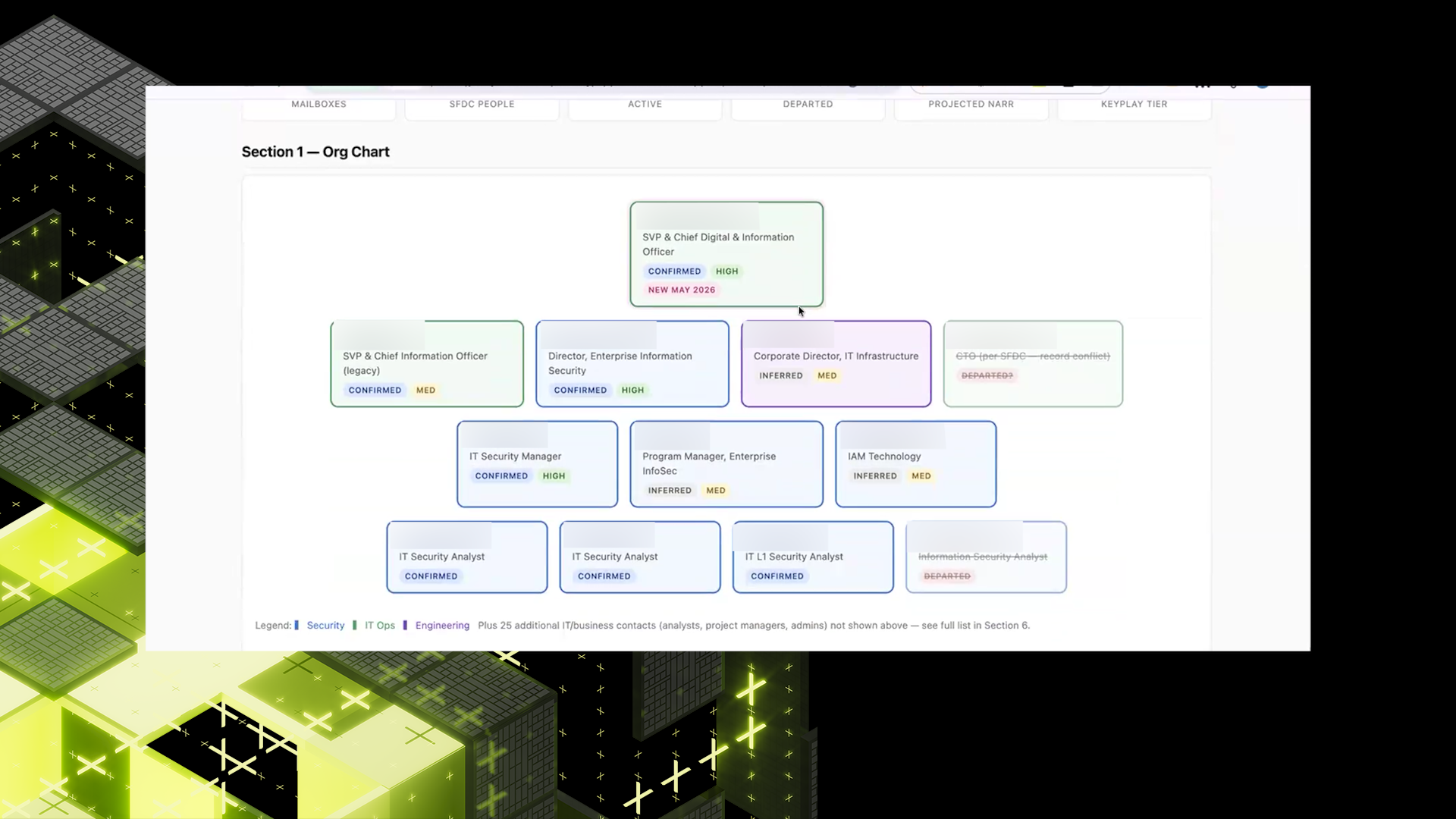
It compiles the contacts it finds, classifies each one against MEDDICC roles, and structures the results against the opportunity and account in Salesforce.
Capabilities JJR walked through:
- Drafts a starting org chart from Actively AI, web sources, and Gong call signals
- Tags contacts as economic buyer, champion, coach, or influencer using MEDDICC
- Ties the chart to the opportunity or account so it survives stage changes
- Surfaces gaps, like a missing economic buyer needed to push to qualified pipeline
- Recommends next-best outreach grounded in the Abnormal behavioral AI angle (account takeover, business email compromise)
"I just created an agent to think like Cherie Brew, and then I just asked it to help me in my job. That's basically what I did." — JohnJosh Romaro
Tying it back: instead of two parallel maps and a manual handoff every time an opp moves, reps get a single structured draft that already knows the role each contact plays.
Where the Value Lands
JJR didn't quote numbers. He framed the value in terms of who benefits and how.
For ramping SDRs, Map the Room is a learning tool. New reps often don't know what a SOC analyst, security architect, or engineering manager actually does, or how those roles ladder up. The skill gives them a tiered org view they can study before they dial.
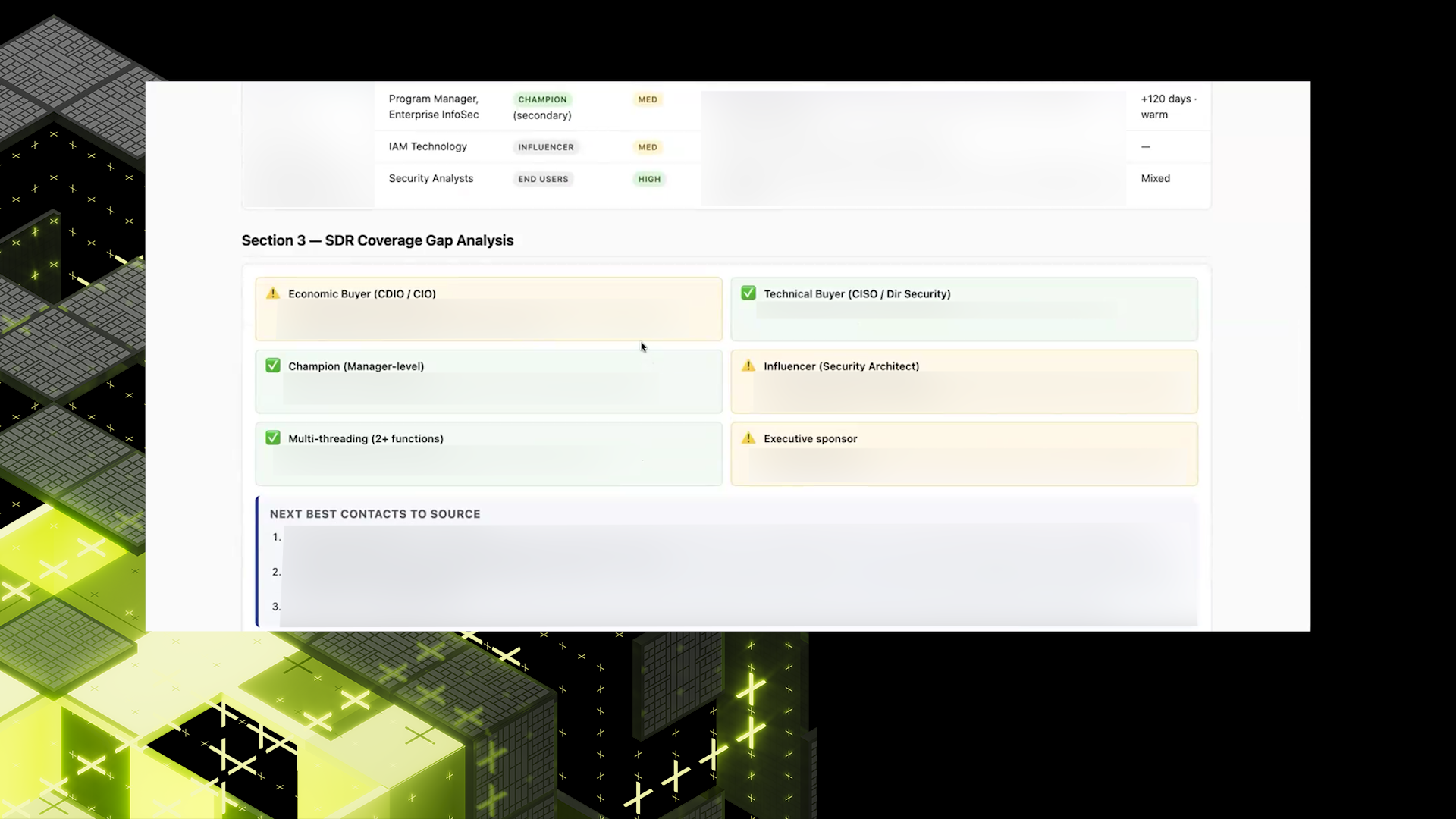
For AEs and revenue leaders, the value lies in multi-threading stalled deals. JJR's example: an open opportunity has been quiet for weeks, and the rep realizes through Map the Room that they have a relationship with Craig, the Director of Enterprise, or a regional director who can push the deal into the next bracket.
Impact JJR called out:
- SDRs ramp faster on persona and tiering inside a target account
- AEs find new threads to revive stale opportunities
- Gap detection surfaces the missing economic buyer required for a qualified pipeline
- Recommended outreach is grounded in the Abnormal behavioral AI story
- Account and opportunity stay aligned through stage changes
In the next phase, JJR wants Map the Room to live as a subset of a weekly smart alert, focused on one account per week rather than on-demand for every account, so reps spend their time learning the rooms that matter most.
A Seed for the Stack
JJR's explicit ask to the room was for other builders to layer onto Map the Room. He name-checked work from Andy Chen, Haroun Muwonge, Sam Cleasby's stage IQ, and Kevin Qi's definition of what a true champion looks like in the field. The idea is that each piece sharpens the others, and Map the Room becomes a hub that the rest of the go-to-market AI stack can plug into.
Sebastian Buffa picked that up live, calling out that the willingness to share before something is dialed in is the point of Demo Hour. Cross-collaboration was already showing up in the chat by the time JJR finished his Q&A, which is the signal AI Transformation is trying to build for inside Abnormal's go-to-market motion.