
NOTE: Demo visuals include blurred data or synthetic placeholders to protect customer privacy.
Keeping Salesforce Status Visible
SDRs often own dozens of in-flight opportunities while coordinating with AEs and SEs. The information is in Salesforce, but it is distributed across records and fields, and checking it takes time. That creates a real risk: an opportunity can sit quietly, lose momentum, and fall off the radar.
Three frictions showed up clearly:
- SDRs had to open each opportunity to check fields and infer status.
- “Working stage” opportunities could sit too long without a clear nudge to act.
- Updates and next steps were hard to keep centralized across many stakeholders.
A Scheduled Salesforce Recap
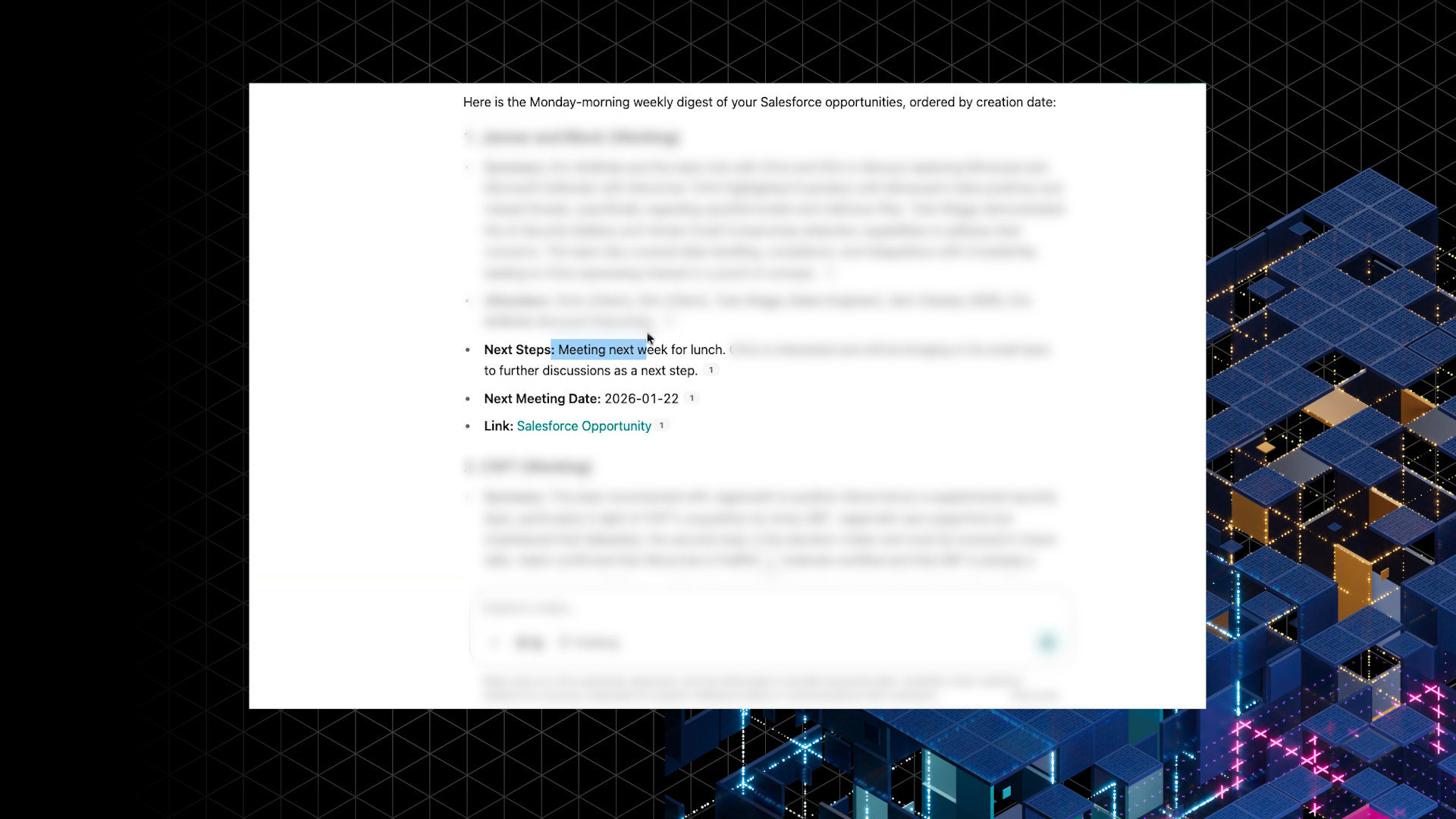
Sales to SQL Agent is a Glean-based agent that queries Salesforce on a schedule, compiles the SDR’s working-stage opportunities, and sends a structured email recap. Instead of hunting through records, the SDR gets a consolidated view of what is active, what changed, and what deserves attention next.
Key capabilities:
- Searches Salesforce for opportunities at the working stage (e.g., gross pipeline).
- Extracts relevant opportunity fields and recent activity signals.
- Summarizes what happened, who was involved, and what comes next.
- Ranks opportunities so the most time-sensitive items rise to the top.
- Emails a single digest with links back to each opportunity.
As Sam put it, “I’ve been running this thing on a schedule to run every single morning.” The practical outcome is simple: the agent does the scanning and summarizing, and the SDR starts the day with a prioritized follow-up plan.
Less Drift, More Follow-Up
No formal time-saving metrics were captured during the demo, but the value is clear from the workflow change. SDRs shift from reactive CRM checks to proactive daily or weekly prompts. Sales leadership and RevOps get a repeatable pattern for reducing pipeline aging without adding a new meeting or manual report.
Observed impact for different audiences:
- SDRs: fewer missed follow-ups because active opps stay visible and ranked.
- AEs and SEs: clearer handoffs when the SDR can quickly surface next steps and meeting context.
- Sales leaders: a scalable way to keep the working-stage pipeline moving using consistent summaries.
Looking ahead, Brandon aims to expand the pilot beyond the initial testers and standardize the cadence, ranking rules, and stage definitions so the digest aligns with how the broader SDR org runs the pipeline.
Built for Daily Pipeline Hygiene
Sam Cleasby, an SDR and early user, described the experience as set-and-forget. Once the schedule was in place, the agent became a dependable morning brief that kept active opportunities from fading into the background.
That pattern matters culturally because it rewards consistent follow-through over heroics. It also aligns with Abnormal’s focus on practical automation: remove the busywork, keep humans in the decision loop, and make the next best action easier to take.
