Wichtige Erkenntnisse
Email remains one of the most common attack vectors, yet traditional threat vulnerability management (TVM) programs often underrepresent it. IBM's 2025 breach report ranked phishing as the most common initial attack vector, and its 2026 report found that organizations take an average of 247 days to identify and contain a breach.
Most TVM programs prioritize infrastructure weaknesses: unpatched software, misconfigured systems, and exploits tracked as Common Vulnerabilities and Exposures (CVEs). These are critical areas that represent part of the attack surface modern enterprises face. A broader TVM scope helps organizations account for email-based, human-targeted exposure alongside infrastructure risk.
This article looks at why email creates a blind spot in traditional vulnerability management, what a modern TVM program needs to close it, and how behavioral analysis brings human-targeted threats into the same prioritization and response workflows already used for infrastructure risk. For security teams weighing where to invest next, the gap between what scanners see and what attackers actually exploit is where the most costly incidents tend to originate.
Key Takeaways
- Email remains one of the most common attack vectors, but most threat vulnerability management (TVM) programs are built around infrastructure weaknesses like unpatched software and Common Vulnerabilities and Exposures (CVEs), not email-based threats.
- Automated vulnerability scanners can confirm that internal systems are patched, but they can't tell whether a trusted vendor's email account has quietly changed hands.
- Business email compromise cost organizations $3.05 billion in 2025, according to the FBI's Internet Crime Complaint Center (IC3), and generative AI is making these attacks easier to produce.
- Closing the gap means treating mailboxes and privileged accounts as assets, building behavioral baselines for vendor and employee communication, and feeding email detections into existing incident response workflows.
What Is Threat Vulnerability Management?
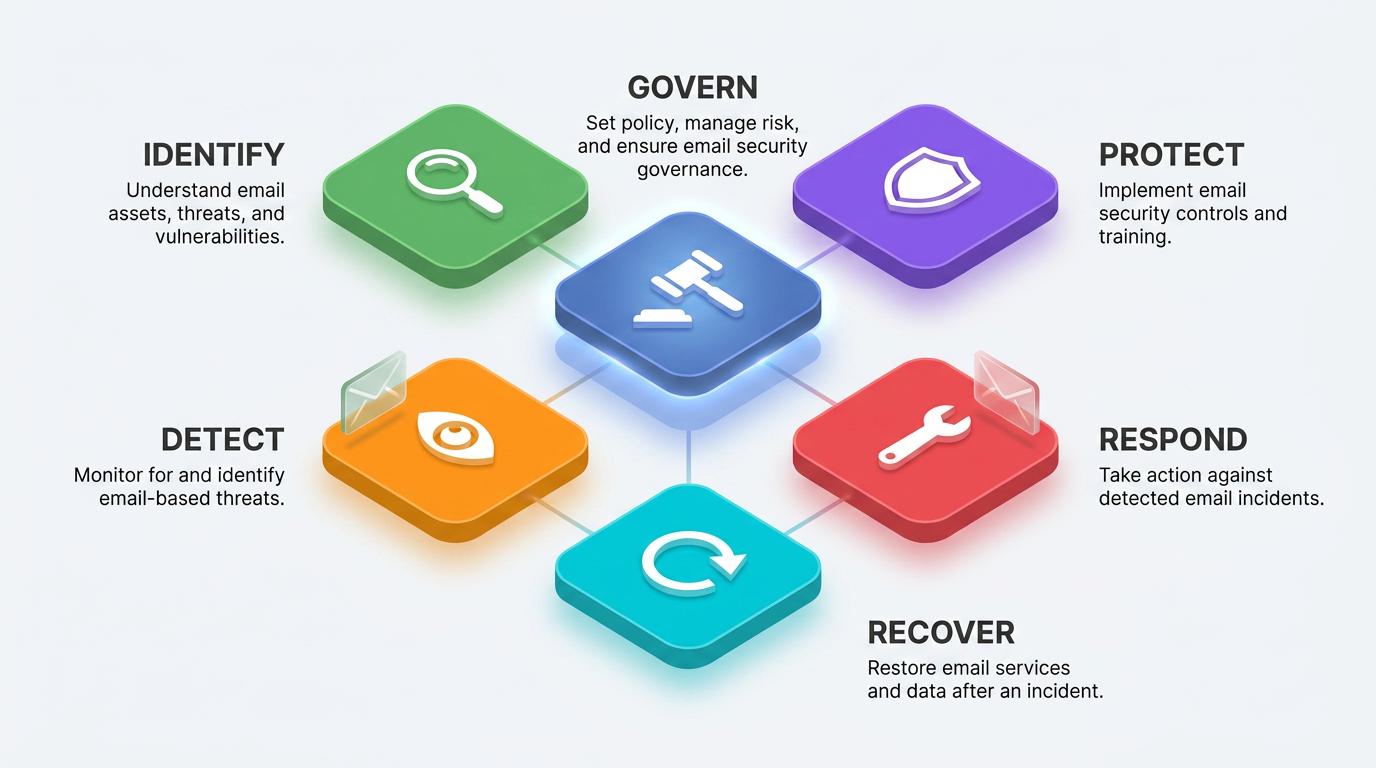
Threat vulnerability management continuously identifies, prioritizes, and remediates security weaknesses across an organization's systems. According to the National Institute of Standards and Technology (NIST) framework, effective TVM spans the core functions Govern, Identify, Protect, Detect, Respond, and Recover. Together these functions cover how organizations manage cybersecurity risk to systems, networks, and data. NIST places Govern at the center because it informs how an organization carries out risk management, and the Identify function's Risk Assessment category (ID.RA) calls for organizations to identify, validate, and record asset vulnerabilities, then weigh them by likelihood and impact.
Risk-based prioritization focuses remediation on the vulnerabilities most likely to be exploited by weighing threat intelligence, asset criticality, business context, and the Common Vulnerability Scoring System (CVSS).
Why Email Creates a Critical Attack-Surface Gap
Email expands the attack surface by targeting people and business processes. The FBI's Internet Crime Complaint Center (IC3) 2025 report documented $3.05 billion in business email compromise (BEC) losses in 2025.
Despite this, CVE-centric workflows often omit email threats. Email deserves equal priority in modern threat vulnerability management programs because of how these attacks work:
- Social Engineering: These attacks target human decision-making, leaving technical controls with little to inspect.
- Credential Phishing: Stolen credentials let attackers operate legitimate accounts that pass authentication checks.
- Business Email Compromise: These attacks exploit trust relationships between employees, vendors, and partners.
Understanding these attack patterns helps security teams allocate resources more effectively across their threat vulnerability management programs.
Automated vulnerability scanners identify weaknesses by comparing system states against known vulnerability databases. They give essential infrastructure visibility. Their design does not address email-based threats like BEC or account compromise, which rely on trust exploitation.
Vendor impersonation shows the gap. An attacker compromises a supplier's email account and sends fraudulent payment instructions. The email originates from a legitimate domain, passes authentication checks, and contains no technical indicators of compromise. Surfacing it depends on behavioral analysis that knows the normal pattern between the two parties, including workflow cadence and who typically approves banking changes.
That distinction shapes what each approach can actually tell you, as the comparison below shows:
| Approach | What It Catches | What It Misses |
|---|---|---|
| Vulnerability Scanning | Unpatched software, misconfigured systems, known CVEs | Trust-based attacks like BEC, account takeover, and vendor impersonation |
| Behavioral Email Analysis | Deviations from normal identity, vendor, and communication patterns | Vulnerabilities outside the email and identity layer |
Core Components Every Threat Vulnerability Management Program Needs
Modern TVM programs need components for human-targeted attacks as well as infrastructure vulnerabilities because email threats use different attack vectors. MITRE ATT&CK's entry for Internal Spearphishing (T1534), where an attacker uses an already-compromised account to phish colleagues, states that the technique "cannot be easily mitigated with preventive controls since it is based on the abuse of system features." Programs built only around patching have no natural place for that kind of finding.
Exploitability Signals That Sharpen Infrastructure Prioritization
On the infrastructure side, the Cybersecurity and Infrastructure Security Agency (CISA)'s Known Exploited Vulnerabilities catalog uses confirmed real-world exploitation to prioritize CVEs. Entry in the Known Exploited Vulnerabilities (KEV) catalog requires a CVE ID, reliable evidence of active exploitation in the wild, and a clear remediation action, though CISA frames KEV as one input into a broader prioritization framework, such as SSVC, rather than a standalone triage criterion. CISA's Stakeholder-Specific Vulnerability Categorization (SSVC) decision model sorts each vulnerability into Track, Track*, Attend, or Act. Exploitation evidence and business impact drive priority, and the same logic applies to a phishing campaign aimed at your accounts payable team.
Threat Intelligence That Captures Email Attack Patterns
Email-focused threat intelligence adds behavioral baselines and communication pattern analysis to traditional indicators. Traditional threat intelligence focuses on malicious IP addresses, known malware signatures, and suspicious domains. Email-focused analysis examines how employees typically communicate, which vendors they interact with, and what requests are routine. Deviations from those patterns, such as wiring instructions sent outside business hours or a sudden change to banking details, can signal potential attacks.
Vendor relationships deserve particular attention. Threat intelligence that models supplier interaction patterns alongside supplier domains gives security teams the context to separate a routine invoice from a redirected payment.
Risk-Based Prioritization for Email Threats
Email threats deserve equivalent priority to critical CVEs when their exploitation potential and business impact are comparable. Behavioral risk scoring helps identify high-risk messages by analyzing deviations from established user and organizational communication patterns. Messages targeting executives, finance teams, or employees with privileged access warrant elevated scrutiny given their asset criticality and financial exposure. Who receives the message changes its exposure: a lure impersonating a CFO and sent to an accounts payable approver carries far more risk than the same message landing in a shared inbox.
Email triage should weigh key factors about each flagged message: who was targeted, what authority that person holds over payments or system access, and whether the request breaks the established pattern for that relationship. A routine-looking invoice from a long-standing supplier contact deserves a closer look when the payment details change mid-cycle.
How Behavioral AI Strengthens Threat Vulnerability Management
Abnormal's behavioral AI is designed to help identify unusual email interactions that signal social engineering, account compromise, or impersonation attacks.
Abnormal's behavioral AI platform analyzes identity, behavior, and contextual signals in cloud email. It baselines normal activity for users, vendors, and the organization, then flags deviations. That analysis spans sender impersonation indicators, content patterns, and temporal signals. As Abnormal describes it, this API-based approach is designed to enable autonomous protection against BEC, credential phishing, and account takeover without requiring mail routing changes or complex configurations.
Legacy security solutions often struggle to detect sophisticated social engineering attacks because attackers use legitimate credentials and trusted infrastructure. The MITRE ATT&CK framework documents phishing (T1566) as involving social engineering techniques "such as posing as a trusted source, as well as evasive techniques such as removing or manipulating emails or metadata/headers from compromised accounts being abused to send messages." Generative AI lowers the effort further; the FBI IC3 report notes that "Chat generators can quickly create official-sounding emails mimicking a company's CEO or other officials." Behavioral analysis helps identify these threats by recognizing deviations from established patterns:
- Text-Only BEC Attacks: These contain no malicious payloads yet request urgent wire transfers or gift card purchases.
- Lookalike Domains: Subtle character substitutions pass casual inspection.
- Compromised Vendor Accounts: Messages arrive from legitimate infrastructure with authentic credentials.
These patterns give security teams behavioral context that content and signature analysis may not provide. When Abnormal identifies signs of account compromise in supported cloud environments, its response capabilities can help administrators initiate actions such as password resets, session termination, and access blocking through supported integrations.
How to Build a Threat Vulnerability Management Program That Includes Email
Extending TVM programs to email requires steps that fit alongside existing security investments:
- Map Email Assets: Consider treating email infrastructure and high-value accounts as assets in your vulnerability management framework, applying the same inventory rigor to mailboxes and privileged users that you apply to servers.
- Establish Behavioral Baselines: Organizations might analyze historical communication patterns at scale, including vendor interactions, recipient behavior, and timing, to give anomaly detection something concrete to measure against. Plan for ongoing baseline refinement as communication patterns naturally evolve over time.
- Align Remediation Workflows: You can treat email threats with the urgency of system vulnerabilities. CISA eviction guidance for compromised accounts states that administrators "should block the ability for the affected user(s) to login, reset the user's password(s), revoke the appropriate access session tokens, and take note of the forwarding address before removing forwarding rule(s) introduced by a suspected adversary."
- Prioritize Phishing-Resistant MFA: CISA's Black Basta advisory recommends prioritizing phishing-resistant multifactor authentication (MFA) on the accounts with the highest risk, such as privileged administrative accounts.
Together, these steps bring email assets, behavioral context, containment processes, and identity controls into existing TVM operations.
Abnormal's API-native architecture is designed to integrate with Microsoft 365 and Google Workspace without MX record changes or mail rerouting. This approach allows Abnormal to complement existing email security infrastructure. Incident response workflows can treat email compromises with the same rigor as system breaches.
Integrations with security information and event management (SIEM) and security orchestration, automation, and response (SOAR) security tooling let email detections and security telemetry feed analyst workflows. SOAR playbooks can automate quarantine actions and trigger broader incident response when email-based threats indicate potential account compromise. For the analyst on shift, the detection arrives in the same queue as infrastructure findings, carrying the identity, behavior, and context signals that triggered it. Responders can judge and act on the finding without switching consoles. Abnormal offers native API integrations across the cloud security stack.
Closing the Gap in Your Threat Vulnerability Management Program
Security teams can bring email into threat vulnerability management through three central practices:
- Map High-Value Email Assets: Include email infrastructure, privileged users, executives, and finance teams in asset inventories and risk assessments.
- Prioritize Behavioral Risk: Evaluate the target's authority, the business impact, and deviations from established vendor interactions, recipient behavior, workflow cadence, and timing.
- Connect Response Workflows: Feed email detections into existing SIEM and SOAR processes so analysts can coordinate quarantine, account containment, and broader incident response.
Abnormal was named a Customers' Choice in the 2026 Gartner® Peer Insights™ Voice of the Customer for Email Security — the only email security vendor to earn the distinction three years running. If you're ready to close this gap, book a demo to see how Abnormal's behavioral AI helps surface email-based threats that traditional vulnerability management approaches can miss.
Frequently Asked Questions
What Is the Difference Between Vulnerability Management and Threat Vulnerability Management?
Vulnerability management typically focuses on identifying and patching technical weaknesses in software and systems. Threat vulnerability management (TVM) extends that scope to weigh how likely each weakness is to be exploited, factoring in threat intelligence and business context, and can include human-targeted exposure like email alongside infrastructure risk.
Why Doesn't Email Show Up in Most Vulnerability Scans?
Vulnerability scanners look for known weaknesses in systems, such as outdated software or misconfigurations, by comparing system states against vulnerability databases. Business email compromise and account takeover attacks don't rely on a technical flaw; they exploit trust between people, so there's nothing in a scan for the tool to flag.
What Is Business Email Compromise?
Business email compromise (BEC) is an attack where someone impersonates a trusted contact, such as an executive or vendor, usually over email, to convince an employee to send money, change payment details, or share sensitive information.
How Does Behavioral AI Differ from a Secure Email Gateway?
A secure email gateway (SEG) primarily screens messages against known bad senders, malware signatures, and reputation data. Behavioral AI instead baselines normal communication patterns for an organization and flags deviations, which can help catch attacks that use legitimate accounts and carry no malicious payload.