重要なインサイト
Explainable AI helps security teams understand why the system flags threats. See how transparent reasoning gives analysts context for email threat detection.
Security tools designed to protect organizations often operate as black boxes, with no explainable AI layer between the model and the analyst. When an algorithm flags a threat or recommends blocking network traffic, analysts may lack visibility into why it reached that decision. For high-stakes security operations where alerts require justification, this opacity creates a trust problem.
Explainable AI addresses that problem by providing transparent reasoning alongside recommendations, helping security professionals validate, calibrate, and confidently act on AI-driven insights.
This article walks through how explainability techniques like SHAP, LIME, and behavioral context turn opaque threat scores into evidence analysts can defend, along with the compliance obligations, calibration practices, and program design choices that determine whether transparency actually changes SOC decisions. Without that foundation, organizations risk automating consequential actions they cannot justify to auditors, regulators, or the people affected by them.
Key Takeaways
Explainable AI provides transparent reasoning that security teams can validate before acting on AI recommendations.
Black box AI creates trust gaps that can slow incident response and complicate compliance requirements.
Explainable AI (XAI) techniques such as SHapley Additive exPlanations (SHAP), Local Interpretable Model-agnostic Explanations (LIME), and attention mechanisms help surface the reasoning behind threat detection.
Data quality and organizational context significantly affect AI accuracy, while transparency helps identify calibration needs.
Security teams can prioritize explainability for high-stakes decisions such as automated blocking, insider threat flagging, and threat prioritization.
What Is Explainable AI?
Explainable AI (XAI) makes model decisions understandable enough for security teams to validate, interpret, and review.
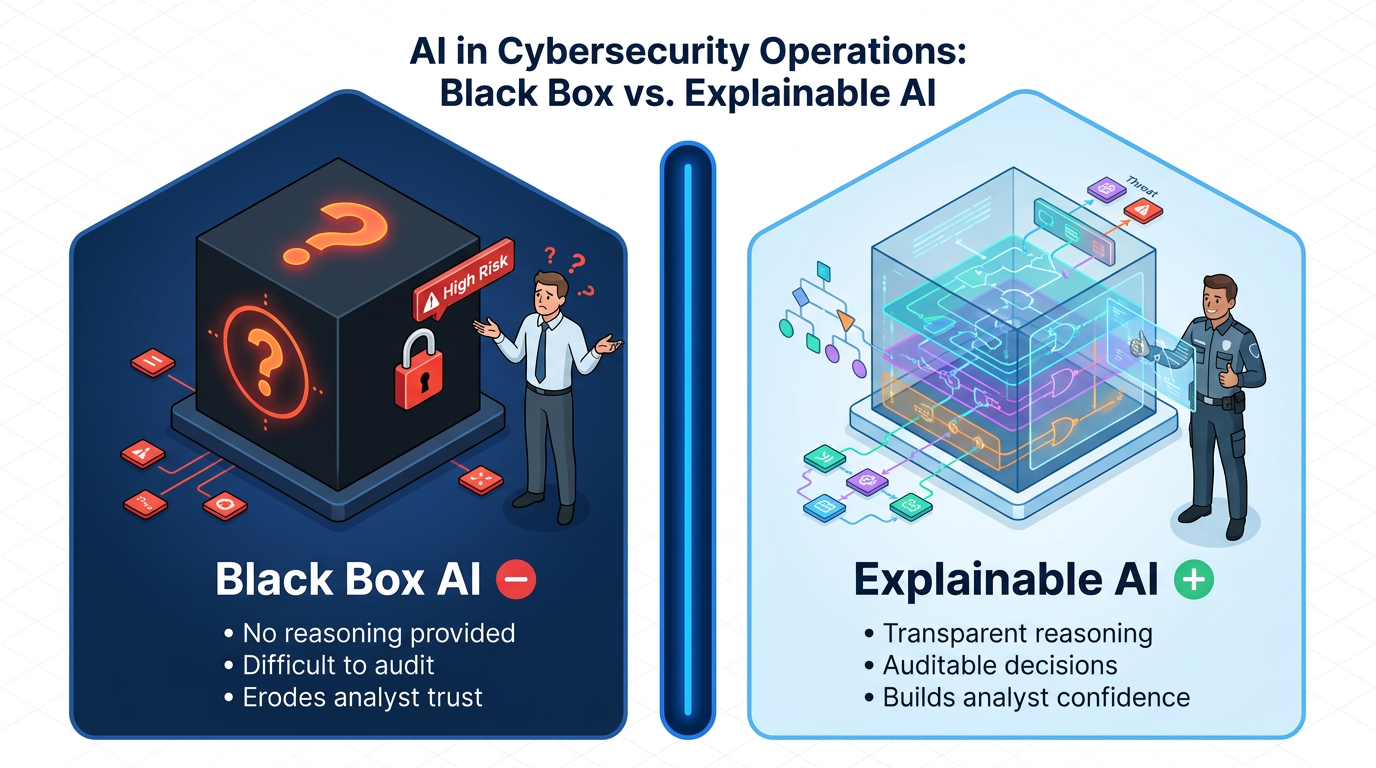
Traditional black box AI produces outputs without context or justification, while explainable AI surfaces the logic chain connecting inputs to conclusions. For example, when a security information and event management (SIEM) system generates an alert, analysts need to understand what behavioral patterns triggered the detection before disrupting business operations.
As Dan Scheebler, Head of Machine Learning at Abnormal, explained in the webinar: "Visibility, action traces, descriptions, reasoning, and justification for why decisions are made the way they're made are critical because they enable you to go back, inspect how a tool is operating, and make modifications."
This transparency supports three operational outcomes:
Post-Incident Review: Teams can analyze how detection systems performed after an incident.
Model Calibration: Teams can identify calibration needs when organizational context warrants adjustment.
Analyst Confidence: Analysts gain the confidence to act decisively during an active threat.
Together, these outcomes compound: better review sharpens calibration, and better calibration earns the analyst trust needed to act.
Explainability vs. Interpretability
Explainability, interpretability, and transparency describe related but distinct parts of the same decision chain. The NIST AI Risk Management Framework separates the three concepts: transparency answers what happened inside the system, explainability answers how the system reached a particular output, and interpretability concerns what that output means to the person reading it in the system's intended operating context.
When evaluating a vendor, ask which capability they offer, who can understand the output, and whether the explanation reflects the actual decision process.
Global vs. Local Explanations
Global and local explanations answer different questions about model behavior. A global explanation describes how a model behaves across a whole dataset, including which features typically carry the most weight. A local explanation accounts for a single prediction, such as why the model flagged one message as an account takeover attempt but not a similar one. Security teams usually need both views: local explanations support triage, while global explanations support model review.
Why Security Teams Need AI Transparency
Explainable AI can improve trust, calibration, auditability, and team learning when security decisions carry operational or legal consequences.
Building Analyst Trust
The gap between AI capability and human trust remains a significant barrier to effective security operations. Analysts may hesitate to act on alerts they do not understand, and that hesitation gives attackers more time to operate.
Many organizations have experienced AI tools that promised automated security operations but delivered incomplete solutions. Lamont Orange, CISO at Cyera, shared this reality: "We thought this would be great, you know, SOC in a box. But there's no silver bullet."
When AI recommendations lack transparency, security teams often return to manual investigation, which can add to analyst alert fatigue. Explanations give analysts a clearer basis for deciding whether the model's reasoning aligns with organizational context.
Supporting Compliance and Audits
Explainability helps security leaders document how automated decisions affect individuals and why those decisions follow defensible logic. General Data Protection Regulation (GDPR) Article 22 governs decisions based solely on automated processing that produce legal or similarly significant effects, and a process generally does not count as solely automated when a person meaningfully weighs the result.
The EU AI Act framework adds transparency obligations from 2 August 2026, while high-risk requirements in Articles 13 and 14 for Annex III systems are postponed to 2 December 2027. Because threat detection tools are not automatically high-risk under the Act, most security teams will encounter GDPR's automated-decision rules more directly.
Improving Calibration and Learning
Understanding AI reasoning helps teams identify false positive patterns and calibrate detection accuracy. Explanations expose false-positive drivers, such as quarter-end wire timing, first-time sender-recipient pairs during supplier onboarding, or unusual tone in payment requests, so engineers can tune specific signals rather than suppress entire categories. Analysts also internalize these patterns over time, often recognizing them before the model surfaces the next alert.
Tools such as AI Phishing Coach training can reinforce threat recognition across the workforce by providing contextual feedback.
How Explainable AI Works in Security Operations
Explainable AI applies attribution and contextual techniques that turn opaque model outputs into evidence analysts can evaluate.
Applying Explainability Techniques to Threat Detection
Several established techniques produce explanations for security detections, and each makes different trade-offs among computational cost, stability, and fidelity. The main approaches include:
SHAP Attribution: SHAP quantifies how each feature contributes to an anomaly score, indicating which user actions drove a user and entity behavior analytics verdict.
LIME Explanations: LIME explains individual predictions, highlighting which code characteristics led to a malware threat classification.
Attention Mechanisms: Attention layers surface which input elements most influenced an output, revealing which event sequences a log-analysis model weighted most heavily.
Behavioral Context: Abnormal's behavioral AI applies identity, context, and communication patterns to email-borne threats, surfacing deviations such as unexpected sender-recipient relationships, timing changes, or linguistic shifts.
Feature-attribution methods and behavioral context answer different questions, so a detection stack often benefits from both.
Moving from Scores to Decisions
These techniques turn opaque threat scores into actionable intelligence. Instead of seeing only a "High Risk" label, analysts can review which behavioral deviations triggered the score, how those patterns compare with a baseline, and what confidence the model assigns to each contributing factor.
That context lets SOC analysts validate a recommendation before blocking a legitimate business communication or isolating a production system. It also distinguishes an explanation from a restatement of the verdict by naming the relevant deviations, showing their relationship to the normal workflow, and exposing uncertainty.
Explainable AI vs. Black Box AI in Cybersecurity
Transparent and opaque AI systems offer different operational trade-offs, so security leaders can match explanation depth to decision consequences.
Balancing Simplicity and Debuggability
Black box systems offer apparent simplicity. They accept inputs, produce outputs, and may require less initial integration work. That simplicity can become a liability when the output is wrong, inconsistent, or difficult to defend.
A transparent system can add logging, explanation interfaces, and review steps, but those components give analysts and engineers specific evidence to inspect. Teams can trace which inputs influenced a verdict, identify whether a baseline needs adjustment, and compare the explanation with other security signals. A black box may still perform well for a narrow task, but limited visibility makes failures harder to diagnose.
Applying Proportional Explainability
Security leaders can map incident response decisions by consequence severity and apply proportional explanation requirements to each category. As a general rule, any consequential decision that executes without a person meaningfully weighing the result is a candidate for both an explanation requirement and a review step.
Building an Explainability Program: A Strategic Framework
A practical explainable AI program starts with high-consequence decisions, tests vendor claims against organizational data, and fits explanations into existing workflows.
Starting with High-Stakes Decisions
Four decision types deserve explanation requirements before lower-consequence use cases:
Threat Prioritization: Teams need to understand why certain alerts rank above others so analyst time follows actual risk.
Automated Blocking: Analysts need a defensible reason for traffic or communication restrictions before those controls interrupt business.
Insider Threat Flagging: Reviewers need to confirm that behavioral analysis accounts for legitimate variations in how people work.
Account Takeover Detection: Teams need to validate compromise indicators before locking a user out.
Starting with these categories keeps governance manageable so teams can define required evidence, review roles, and escalation paths for a focused set of decisions before extending the framework more broadly.
Evaluating Vendor Transparency
Specific questions can reveal how far a vendor has built explainability into its product and operating model:
Explanation Formats: What formats does the system provide for different decision types?
Compliance Exports: Can teams export explanations for compliance documentation?
Confidence and Factors: How does the system surface confidence levels and contributing factors?
Audience Customization: What options exist for changing explanation depth and format?
Detection Validation: Can analysts inspect the detection logic and validate a new detection before it goes live?
Decision Tracking: How does the system track changes in how it reaches decisions over time, rather than only changes in outcomes?
A proof of concept in the organization's environment offers the most reliable test.
Integrating with Existing Security Systems
Modern security stacks require integration across multiple platforms. Key integration considerations include:
Data Access: A data security platform approach that unifies information from endpoints, web gateways, cloud application activity, and collaboration tools gives detection models more context and gives their explanations more evidence to draw on.
Application Programming Interface (API) Deployment: API-based deployment integrates directly with cloud email and collaboration platforms, avoiding MX record changes and mail-flow disruptions while letting behavioral analysis and explanations operate on complete message data inside the tools analysts already use.
Workflow Integration: Teams should define where explanations appear, which systems retain them, how analysts provide feedback, and how audit records connect the original verdict to the eventual human decision.
Together, these considerations help explanations support existing security operations without creating a separate investigation workflow.
Common Challenges in Making AI Explainable
Explanations inherit weaknesses from the underlying data and models, while added transparency creates operational responsibilities of its own.
Managing Data Quality Limitations
AI explanation quality depends on data quality: inaccurate or biased training data produces misleading explanations alongside flawed detections, and a technically accurate explanation may still mischaracterize a legitimate workflow when the model lacks context about seasonal activity, role changes, supplier onboarding, or unusual business events. Analysts need a process for assessing data gaps and biases, challenging verdicts, documenting contextual exceptions, and feeding validated outcomes back into model governance.
Monitoring Model Drift
Detection models can lose accuracy as attacker tactics change and assumptions in their training data stop holding. National Security Agency (NSA) and Cybersecurity and Infrastructure Security Agency (CISA)'s joint AI data guidance describes drift as a natural change in the statistical properties of input data relative to the data used to train a model, a divergence that degrades accuracy and obscures early warnings of failure.
Stale reasoning produces stale explanations. Continuous monitoring of detection performance and explanation consistency, tracking shifts in dominant verdict factors, confidence levels, and analyst-model disagreement, can help teams catch that decline, so drift tracking belongs in vendor evaluation, model review, and incident analysis rather than a separate data-science exercise.
Balancing Complexity and Interpretation
Full explainability adds system complexity through additional integration points, detailed logging, review workflows, and analyst training. The proportional requirements in the decision map can contain that overhead without withholding context from high-consequence actions.
Interpretive capability matters as much as technical output. Security awareness training programs can extend beyond threat recognition to cover AI explanation comprehension and translate machine learning concepts into role-appropriate guidance so each audience understands what the explanation establishes, what uncertainty remains, and when human review should override or escalate the recommendation.
The Future of Explainable AI in Cybersecurity
Explainable AI will increasingly adapt its output to user expertise, emerging attack methods, and broader organizational context. Three developments will shape how security teams use these explanations:
Adaptive Explanations: Explanation formats should move beyond one static output so the same underlying evidence stays useful across analyst triage, compliance review, and executive reporting.
Emerging AI-Enabled Threats: The FBI's Internet Crime Complaint Center logged more than 22,000 complaints referencing AI in 2025, with adjusted losses exceeding $893 million. As phishing attacks use more polished language, explaining why a clean-looking message is malicious becomes central evidence for analysts.
Broader Contextual Integration: Integration with wider data security platforms will let explanations draw on endpoint behavior, communication patterns, access logs, and business workflows, and AI-powered data analysis tools can surface findings that inform both detection and explanation.
Organizations that establish practices around transparency, monitoring, and human interpretation now will have a clearer basis for evaluating future advances.
Turn Explainable AI Into Defensible SOC Decisions
Explainable AI is a prerequisite for handing consequential detection decisions to automation. Start by identifying the decisions where an unexplained error would cause the greatest disruption, define the evidence each audience needs, and test whether explanations actually change analyst workflows.
Abnormal is built for this standard. Its behavioral AI surfaces the identity, context, and communication signals behind every verdict, giving analysts defensible reasoning for blocking a message, locking an account, or escalating an incident, and giving compliance teams the audit trail regulators expect. That approach is why Abnormal was named a Customers' Choice in the 2026 Gartner® Peer Insights™ Voice of the Customer for Email Security.
See how transparent, behavioral detection performs in your environment. Book a demo to get started.
Frequently Asked Questions
Does the EU AI Act Require Explainable AI for Security Tools?
Most threat detection tools are not automatically classified as high-risk under the EU AI Act, and the high-risk transparency and human-oversight requirements in Articles 13 and 14 have been postponed to 2 December 2027. GDPR Article 22 governs a security decision that executes without meaningful human review and significantly affects an individual, unless an Article 22(2) exception applies. Organizations still need to assess each use case based on the system's classification, the effect of the decision, and the role of human review.
Why Do Explanations Sometimes Fail to Help Analysts?
Explanations help when they fit existing analyst workflows, reflect the model's actual reasoning rather than a rationalization layered on top, and rely on dependable data. An explanation built on drifted or biased training data may describe flawed reasoning accurately, which can send a team down the wrong path with more confidence than the evidence deserves.
Explanations that remain consistent for the same input, match the reader's expertise, identify uncertainty, and include a confidence indicator are more useful during investigation and audit.