重要なインサイト
Privilege escalation attacks turn limited access into broader control by exploiting credential abuse, email fraud, and hybrid identity flaws. Verizon's 2026 Data Breach Investigations Report found credential abuse somewhere in the attack chain of 39% of breaches. The FBI's 2025 Internet Crime Report recorded more than $3 billion in business email compromise (BEC) losses. CISA's Emergency Directive 25-02 addressed an Exchange hybrid flaw that enabled escalation from on-premises administrator access into Microsoft 365.
Email remains a primary entry point for these attacks. Security teams need a framework mapping detection to prevention across email, identity, and endpoint systems. Whether the end goal is network ransomware deployment, sensitive data exfiltration, or business email compromise, privilege escalation connects the first compromised inbox to broader damage.
This article draws from insights shared in Abnormal's Innovate Summer Update 2025 webinar on advanced email attacks. Watch the full recording to hear more from industry experts on how these threats evolve.
Key Takeaways
Email remains a primary entry point for privilege escalation, so stopping the initial compromise can break the chain before it starts.
Attackers compromise one account, then systematically elevate permissions to gain broader control.
Cloud role assignments, mailbox delegation, and AI agent identities have joined OS exploits as escalation paths security teams need to monitor.
Detection depends on baselining normal activity in email and identity systems so unusual escalation patterns stand out.
Prevention takes layered controls: least privilege, privileged access management, multi-factor authentication, and proactive threat hunting.
What Is a Privilege Escalation Attack?
Privilege escalation expands a threat actor's access rights beyond the initial entry point. The goal is to move from limited user access to administrator or system-level control, letting attackers execute commands, access sensitive data, and move laterally through systems.
The MITRE ATT&CK framework classifies privilege escalation as Tactic TA0004. The enterprise matrix spans Windows, macOS, Linux, Office Suite, Identity Provider, software as a service (SaaS), and infrastructure as a service (IaaS) platforms. Cloud and identity entries carry the most weight for email-centric defenders, since escalation paths run through cloud identity tenants.
Privilege escalation typically follows initial access: attackers compromise one account, often through credential phishing or theft, then seek elevation. As Piaush explained in the Innovate Summer Update webinar: "It might mean trying to elevate your privileges and going after other assets of the organization, whether it's for ransomware purposes, stealing data, or performing other actions."
Types of Privilege Escalation Attacks
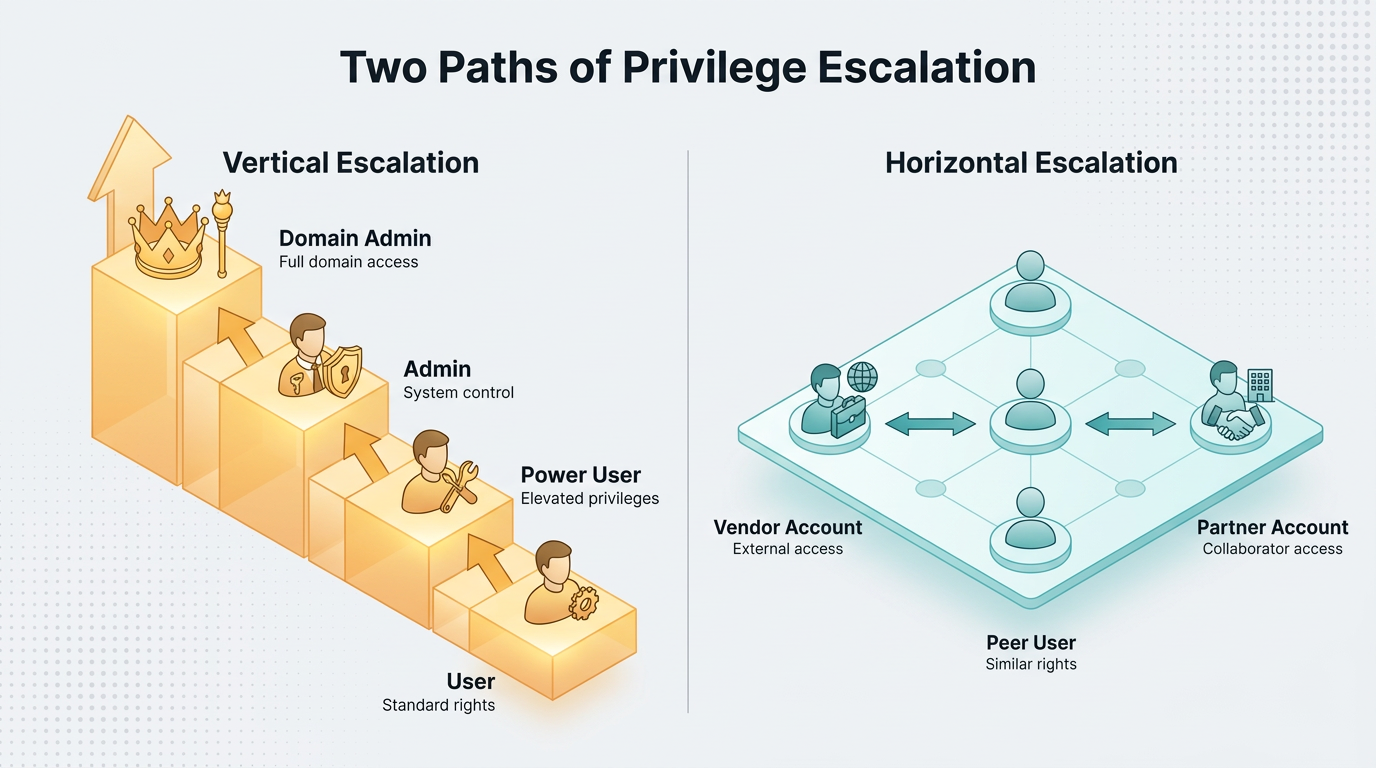
Privilege escalation attacks follow two primary paths. Vertical escalation gains higher-level privileges; horizontal escalation spreads access across peer accounts at the same privilege level.
Vertical Privilege Escalation
Vertical escalation moves from a lower-privilege account to a higher-privilege one, such as a standard user escalating to domain administrator, and can grant system-wide access. This type of privilege escalation is common in ransomware attack chains, where attackers need administrative rights to deploy encryption across network resources, disable tooling, create admin accounts, and erase evidence.
The path increasingly crosses into the cloud: CISA's August 2025 Emergency Directive 25-02 for CVE-2025-53786, a flaw in Microsoft Exchange hybrid configurations, shows an attacker with on-premises Exchange admin access could escalate into the connected Microsoft 365 environment, turning a compromised mail server into a path to the cloud tenant.
Horizontal Privilege Escalation
Horizontal privilege escalation involves moving laterally between accounts at similar privilege levels, reaching additional data without triggering the alerts tied to elevated privileges. This approach is particularly prevalent in vendor email compromise (VEC), where attackers lean on trust with vendors and partners rather than elevated permissions. Per the 2026 Attack Landscape Report, VEC now makes up the majority of all BEC, with billing account update requests the variant most likely to succeed.
Once inside, attackers may also launch lateral phishing attacks, mining compromised address books to pivot one account compromise toward multiple victims across an industry.
Common Privilege Escalation Techniques
Attackers combine OS, identity, cloud, and credential techniques to gain elevated access. Common privilege escalation techniques include:
Abuse Elevation Control Mechanisms: Attackers exploit built-in OS elevation features, such as UAC bypass on Windows or sudo exploitation on Linux.
Access Token Manipulation: Attackers steal or forge authentication tokens to support higher-privilege user impersonation.
Account Manipulation: Attackers modify existing accounts to add privileges or access rights, including admin roles or email delegate permissions in cloud environments; a new delegate on an executive mailbox can support both escalation and persistence.
Boot or Logon Autostart Execution: Attackers establish persistence that executes with elevated privileges at startup.
Credential Harvesting: Attackers use credential harvesting methods to reach higher-privilege accounts. File-sharing phishing rose 350% in one year, from June 2023 to June 2024, per the Innovate Summer Update webinar.
Mapping these techniques to identity, endpoint, and email controls shows where to interrupt an escalation path.
How Privilege Escalation Attacks Work
Privilege escalation attacks commonly progress through four ordered phases, from initial entry to persistent elevated access:
Phase One – Initial Access: The attacker gains a foothold through phishing, credential theft, or application vulnerability exploitation, often via email account takeover.
Phase Two – Reconnaissance: Attackers enumerate privileges, group memberships, and configurations to identify escalation paths and targets.
Phase Three – Exploitation: Attackers use misconfigurations, unpatched vulnerabilities, or stolen credentials to elevate access across identity and endpoint systems.
Phase Four – Persistence: Attackers establish backdoors to survive discovery, often a newly registered device, a mail forwarding rule, or a changed federation setting.
These phases can progress quickly, so detecting the earliest ones matters more than catching persistence later.
How to Detect Privilege Escalation Attacks
Effective detection correlates behavioral, authentication, endpoint, and cloud identity activity rather than relying on one alert source. Security teams can apply the following complementary approaches:
Behavioral Anomaly Detection: Monitor account activity for deviations from established patterns. Abnormal's behavioral AI detection is designed to help surface suspicious signals across Microsoft 365 and Google Workspace through Account Takeover Protection, which matters more as AI-enabled phishing uses generative AI to produce convincing messages. As Piaush noted: "AI-enabled agents can create emails in whatever language you desire... you can maintain the same style of communication."
Authentication Log Analysis: Track failed login attempts, unusual login times, and geographic anomalies, since sudden changes can indicate compromise.
Process Monitoring: Detect suspicious process creation with elevated privileges; unexpected sequences are useful leads.
Registry and Configuration Changes: Alert on modifications to user rights assignments or security policy configurations.
Identity Tenant Changes: Alert on new administrator role assignments, conditional access changes, and modifications to Security Assertion Markup Language (SAML) or Open Authorization (OAuth federation settings), which can signal elevated-privilege activity.
Other indicators include unusual administrative tool usage and new service installations, which help teams prioritize meaningful deviations.
Privilege Escalation Prevention Strategies
Prevention works best when organizations minimize standing access, tightly control privileged use, and connect email, identity, endpoint, and response controls.
Principle of Least Privilege
Granting minimum necessary permissions per job function limits the attack surface available to an escalating attacker; regular access reviews keep permissions current as roles evolve.
Regulatory guidance reinforces this: NIST calls for non-privileged accounts on non-security functions and logged privileged use, PCI DSS limits cardholder-data access to people whose jobs require it, and HIPAA applies the same principle to electronic protected health information (ePHI).
Supply chain breaches add another reason to enforce least privilege: overprivileged service accounts and vendor integrations create escalation paths that may never touch a domain administrator account, and periodic reviews can catch unnecessary permissions early.
Technical Controls
Privileged Access Management (PAM) solutions can control and monitor administrative access. Multi-factor authentication on privileged accounts is a baseline; phishing-resistant methods such as FIDO2 offer stronger protection, since adversary-in-the-middle phishing, as seen in a Tycoon 2FA voicemail attack, can relay one-time codes.
Teams can also disable unnecessary administrative tools and maintain rigorous patch management for privilege-related vulnerabilities. Beyond hardening what administrators can use, limiting when they hold elevated rights closes another gap. CISA's guidance on privileged accounts calls for reducing, restricting, auditing, and monitoring administrative accounts and avoiding non-essential use of elevated credentials. Just-in-time access applies that principle directly: provisioning permissions only when needed and running periodic entitlement reviews of IAM users, roles, and policies keeps temporary grants from quietly becoming permanent.
Defense-in-Depth Approach
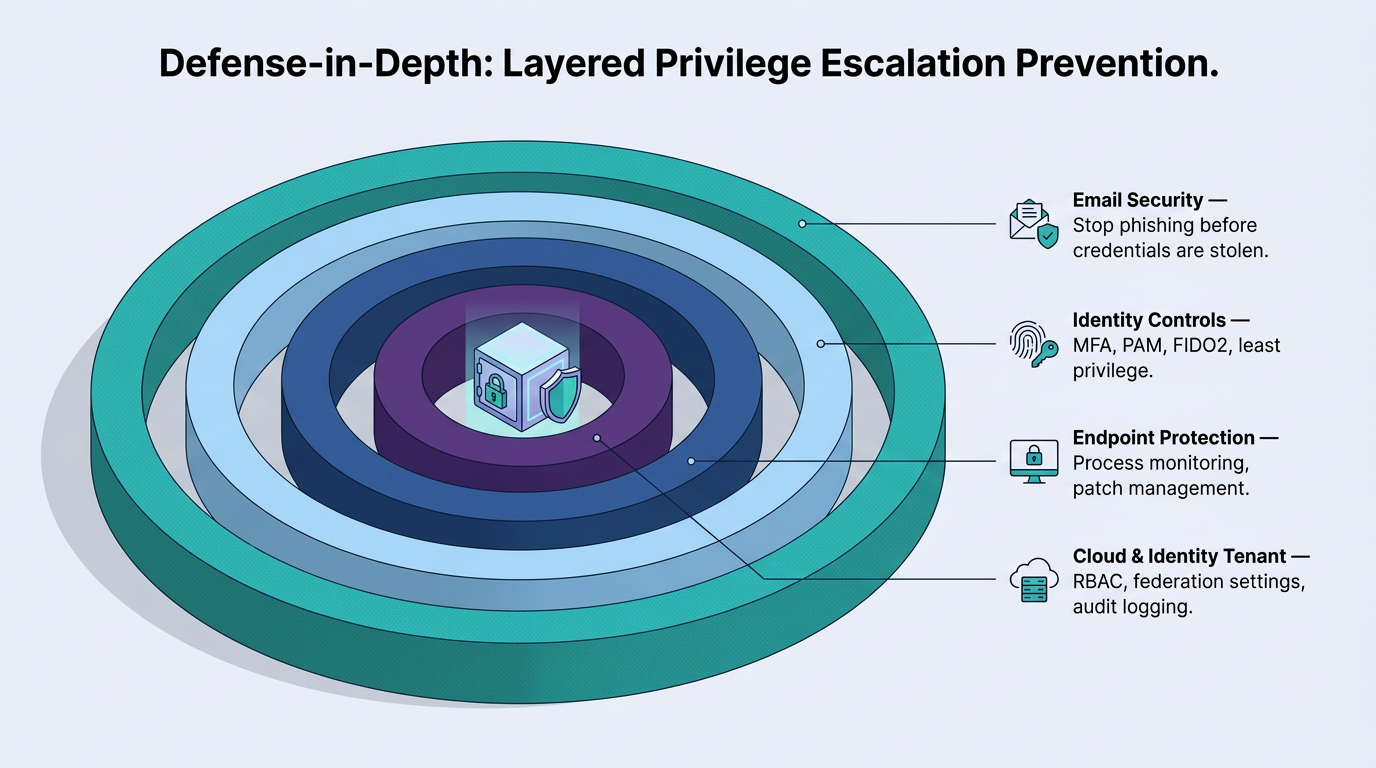
Defense in depth gives security teams more chances to interrupt an attack when one defensive layer misses the initial activity. As Piaush put it in the webinar: "If you can prevent things from happening in the first place, you're in a much better place."
Organizations can layer email security, endpoint protection, and identity management so each system adds context to one investigation. An inbound email security platform can stop credential phishing and file-sharing lures before they hand attackers valid accounts, while endpoint and identity controls monitor what follows a compromise.
API-based email security tools can feed compromise signals into existing SIEM and SOAR workflows, placing email, endpoint, and Active Directory alerts in a shared queue without replacing the existing stack.
Privilege Escalation Through AI Agents and Non-Human Identities
AI agents and service identities create privilege escalation paths that traditional privilege management programs often don't govern. OWASP's Top 10 for Agentic Applications names agentic identity and privilege abuse as a core risk, where leaked credentials let agents operate beyond their intended scope. A related category, Excessive Agency, from OWASP's separate Top 10 for LLM Applications, traces a similar problem to excessive permissions and autonomy.
Teams can assess agent authority and governance through two areas:
Agent Authority: An agent runs with real credentials, so prompt injection or a compromised peer agent can redirect it toward actions it's technically authorized to perform. Misconfiguration, overprivileged agents, excessive autonomy, and weak trust boundaries can turn automation into an escalation path.
Governance Controls: Teams assessing AI agent security risks can inventory each agent, tie it to a human owner, scope its permissions to the user's role, and require recorded approval for high-impact actions. Role-based access controls and reviewing agent credentials in the same entitlement process as human identities round this out.
These controls apply least privilege to non-human identities while preserving clear ownership.
Operational Validation and Response
Operational testing and centralized visibility help teams validate whether privilege controls work under realistic conditions. These practices focus on implementation and assurance, not the preventive controls covered above:
Implement Network Segmentation: Organizations can limit lateral movement by isolating sensitive systems and restricting inter-segment traffic.
Run Regular Penetration Tests: Teams can target escalation paths in red team exercises, including Active Directory Certificate Services (AD CS) and machine account quota abuse.
Maintain Complete Logging: Integrating logs with SIEM solutions supports correlation and alerting; security operations center (SOC) teams automating SOC operations can cut repetitive investigation steps.
Support Security Awareness Training: Training focused on credential protection can reduce initial compromise risk; tools such as AI Phishing Coach can personalize instruction to realistic attack patterns.
Pairing these with visibility into identity behavior, such as threat vector detection, connects the signals from testing, monitoring, and response.
Common Mistakes to Avoid
Privilege escalation programs often fail when teams overlook lateral movement, rely only on reactive alerts, or leave tools disconnected. Common mistakes include:
Ignoring Lateral Movement Indicators: Focusing solely on vertical escalation misses horizontal movement that may precede it; monitoring lateral activity helps spot attackers spreading across peer accounts.
Using Reactive-Only Detection: Waiting for isolated alerts gives attackers more time to establish access. Proactive hunting can catch threats earlier by testing hypotheses across telemetry.
Maintaining Siloed Security Tools: Disconnected tools miss attack chains spanning multiple systems and phases; shared workflows and email threat detection help analysts connect related events.
Leaving Agent Identities Unmanaged: Agents and integrations created without a documented owner can retain permissions long after a project ends, turning orphaned OAuth credentials into standing access for anyone who finds them.
Closing these gaps means extending existing privilege discipline to every identity that holds access.
Build a Layered Defense Against Privilege Escalation Attacks
Privilege escalation bridges initial compromise and significant impact, but coordinated identity, email, endpoint, and access controls can interrupt that progression. Security teams can combine least privilege enforcement, privileged access controls, and behavioral analysis of email and identity activity to catch unusual escalation attempts before attackers gain organization-wide control. An ongoing program should cover cloud roles, mailbox delegation, service accounts, and AI agent identities, not just domain administrator accounts.
Because so many escalation paths begin with a compromised inbox or hijacked identity, the earliest layer of that defense matters most. Abnormal integrates with Microsoft 365 and Google Workspace to baseline normal communication and sign-in patterns, then applies behavioral AI to surface the credential phishing, account takeover, and vendor compromise attempts that typically precede escalation, feeding those signals into the identity and endpoint controls already in place.
Abnormal earned recognition as a Customers' Choice in the 2026 Gartner® Peer Insights™ Voice of the Customer for Email Security. Ready to see how behavioral AI is designed to identify the email and account compromises that can precede privilege escalation? Request a demo to explore how Abnormal protects your organization.
Frequently Asked Questions
How Can Security Teams Detect Privilege Escalation That Crosses From On-Premises Exchange Servers Into Microsoft 365 Cloud Environments?
Watch Exchange hybrid bridge configurations for post-authentication activity crossing the trust boundary, including changes to hybrid connector permissions, new administrator assignments originating from on-premises credentials, and unusual remote PowerShell sessions from Exchange infrastructure. Correlate on-premises Exchange logs with Azure AD sign-in logs and Unified Audit Logs to gain visibility across both environments.
What Are the Most Effective Ways to Apply Least Privilege Principles to AI Agents and Non-Human Identities That Have OAuth Permissions?
Inventory each agent and service account with its business purpose, owner, and specific OAuth scopes, then tie its authority to the requesting user's role so it inherits only the permissions that person holds. Use time-bound sessions in place of standing credentials, and segregate responsibilities so a document-processing agent cannot touch email configuration or financial systems.
How Does Behavioral AI Detection Differ From Traditional Rule-Based Alerting When Identifying Privilege Escalation Attempts in Email and Identity Systems?
Rule-based alerting triggers on fixed thresholds that attackers evade by staying within set limits or using unseen infrastructure. Behavioral AI instead builds dynamic baselines per user and correlates session and device signals, workflow cadences, recipient patterns, and timing to catch subtle inconsistencies, even when individual actions look legitimate alone.
What Specific Steps Should Incident Responders Take to Verify All Persistence Mechanisms Have Been Removed After a Privilege Escalation Attack?
Incident responders should sweep identity, email, endpoint, and cloud infrastructure to confirm every persistence mechanism is gone:
Cloud Tenant Configurations: Audit for unauthorized SAML or OAuth federation changes, rogue OAuth applications, and modified conditional access policies.
Endpoints: Check scheduled tasks, registry run keys, and Windows Management Instrumentation event subscriptions running with elevated privileges.
Email Systems: Audit mailbox forwarding rules, delegate permissions, and inbox rules that auto-delete or forward sensitive messages.
Credentials and Monitoring Integrity: Rotate compromised credentials, rule out Kerberos ticket abuse, and confirm logging and EDR agents remain intact.
Feed each step into a central timeline so no mechanism survives undetected.
How Can Organizations Integrate Email Security Signals With SIEM and SOAR Platforms to Correlate Privilege Escalation Activity Across Identity, Endpoint, and Cloud Systems?
Use API connections to stream account compromise indicators, authentication anomalies, and suspicious mailbox activity into a central correlation engine, then build rules that link an initial credential phishing alert to subsequent Active Directory changes, cloud role assignments, or endpoint-detected lateral movement. Automated playbooks can trigger containment when multiple sources report related signals within a defined window, and unified investigation queues let analysts reconstruct attack chains without switching consoles.