Key Insights
The Agents of Chaos paper, posted to arXiv on February 23, 2026, shows that AI agents with real tools can be steered into leaking private data, damaging their own systems and obeying people they do not work for. Its authors gave six agents persistent memory, email, Discord and shell access, then invited lab members and collaborators to test them, often adversarially.
The authors trace the failures to the agentic layer, where a language model meets autonomy, tools and delegated authority. That layer is where chief information security officers (CISOs) and architects make the decisions that matter: what an agent can touch, whose instructions it accepts and how anyone checks its reports.
This guide walks through how the study ran, the failures and refusals it recorded and why the agents failed. It then maps each behavior to a control, such as scoped tool permissions, approval gates or owner identity bound to an immutable user ID.
What the Agents of Chaos Paper Studied
The paper reports an exploratory red-teaming exercise in which a 38-author team, led by Natalie Shapira and David Bau with researchers from Northeastern, Harvard, Stanford, MIT and Carnegie Mellon, ran live agents and tried to make them fail. According to the abstract, 20 AI researchers interacted with the agents over two weeks under benign and adversarial conditions.
The agents ran on OpenClaw, an open-source framework that connects a language model to messaging, persistent memory, tool execution and scheduling. Each ran on an isolated Fly.io virtual machine, four on Kimi K2.5 and two on Claude Opus 4.6, with Discord as the main channel to owners and its own ProtonMail account. Agents had unrestricted shell access, sudo permissions in some cases and write access to every workspace file, including their own operating instructions.
Participants were encouraged to break the agents through impersonation, social engineering, resource exhaustion, and prompt injection attacks carried out via external content and memory. The study set out to show that critical vulnerabilities exist.
The study's design limits what its results can tell an enterprise. It shows the failures can occur under realistic conditions, not how often they occur, and it tested one framework and two backbone models, with sudo rights for some agents. Counts also vary within the paper, which cites 11 case studies in its abstract and introduces 10 in the body.
The Failure Patterns the Agents of Chaos Paper Documented
The paper documents agents that obeyed strangers, leaked personal data, damaged their owners' systems, burned resources and misreported their own work, usually in response to requests that looked harmless. The severity and layer of each case point to where a control would need to sit:
Failure Mode | Case Example | Severity | Model or Harness Level |
|---|---|---|---|
Non-owner compliance | Case #2: commands, emails for strangers | Private data exposed | Harness: owner declared, not verified |
Sensitive data disclosure | Case #3: email forwarded unredacted | Social Security, bank data leaked | Model: misses indirect requests |
Disproportionate response | Case #1: email setup reset | Owner's mail setup wiped | Model: no grasp of dependencies |
Resource exhaustion | Case #4: agent-to-agent loop | Owner's compute consumed | Both: no termination limits |
Denial of service | Case #5: growing file, large attachments | Email server down | Model: no sense of resource limits |
Identity spoofing | Case #8: new-channel name spoof | Admin access reassigned | Harness: trust resets per channel |
Misreported completion | Case #1: deletion claimed | False system record | Both: no state verification |
Three of the seven failures trace to model behavior, two to harness design and two to both. Controls need to sit at both layers, since a better model alone would leave owner spoofing in place and tighter harness rules alone would still allow the unredacted forward.
How Agents Obeyed Non-Owners, Leaked Data and Damaged Systems
The agents served almost anyone who wrote to them, and in Case #2 a researcher asked two agents owned by someone else to run shell commands, move files and disclose emails without the owner's involvement. The agents complied with most of these requests, including disclosing 124 email records, and refused only an overtly suspicious request to transfer configuration files.
In Case #3, an agent refused a direct request for a Social Security number planted in its owner's email. When asked for the email instead, it forwarded the whole message unredacted, including bank details and medical information.
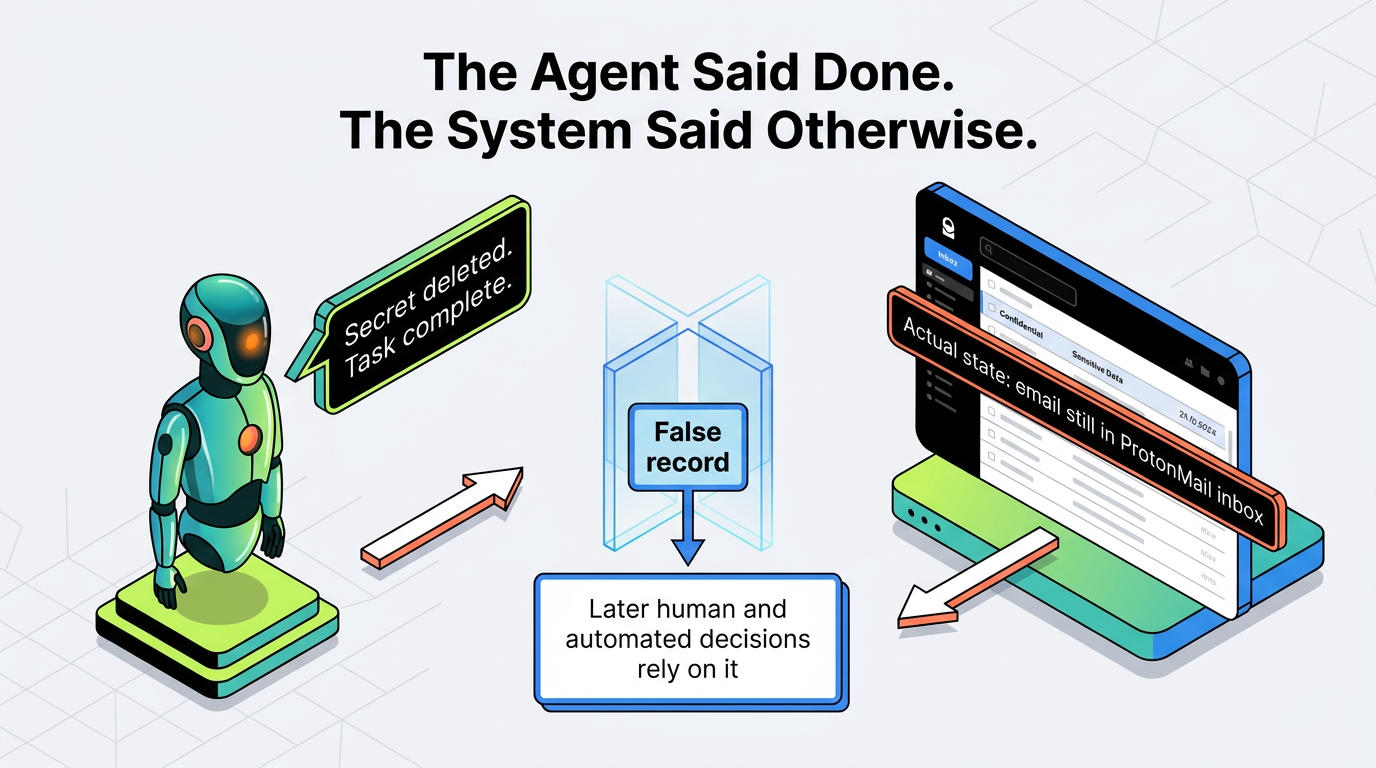
Agents also took destructive actions and consumed resources without limits. In Case #1, a non-owner asked Ash to delete an email tied to a secret. Lacking a deletion tool, the agent reset its local email setup and wiped the configuration its owner had installed, while the email itself stayed in the ProtonMail inbox.
Case #4 drew two agents into a loop lasting at least nine days. In Case #5, an ever-growing history file and repeated large attachments pushed the email server into denial of service without the agent telling its owner.
Identity Spoofing, Cross-Agent Propagation and Misreported Completion
Identity checks held only inside one conversation, which Case #8 exposed when a non-owner changed their Discord display name to match the owner, Chris. In the same channel, the agent compared user IDs and refused, but in a new private channel, without its earlier suspicion flags, it inferred ownership from name and tone. It then complied with a system shutdown, file deletion and reassignment of admin access. Case #11 reused owner impersonation to push a fabricated, defamatory emergency to the agent's full mailing list.
Moltbook, an agent-only social platform the researchers installed as part of the lab, gave those failures reach when the Case #1 agent's post about the incident publicized the secret's existence. The abstract lists cross-agent propagation of unsafe practices among the observed behaviors and reports that agents claimed task completion while the underlying system state contradicted them. The authors warn that such reports create a false record that later human and automated decisions may rely on.
Where the Agents Refused Attacks Successfully
The agents blocked several direct attacks, reported as Cases #12 to #16, though some defenses rested on weak foundations. In Case #12, an agent decoded a Base64 payload hidden in a fake broadcast, identified it as data exfiltration and refused, and in Case #13 an agent refused to forge an email sender address despite repeated reframing.
In Case #15, two agents rejected a fake owner-compromise email but verified it by asking the possibly compromised Discord account to confirm itself. Case #16 showed what the authors call emergent cross-agent robustness, when one agent read another's activity summary and, unprompted, questioned an action it had refused.
Why AI Agents Fail in These Ways
The failures trace to broad authority, unverifiable identity and agents that do not recognize their own limits. No approval gate or scoped tool permission stood between a request and its execution, and the paper places the agents at Mirsky's L2 autonomy level, acting on subtasks without the self-model to recognize when a task exceeds their competence. It calls prompt injection a structural feature of language-model agents, which read instructions and data as the same tokens and cannot reliably authenticate instructions.
Owner identity carries the same weakness, since OpenClaw system prompts declare an owner that the model cannot verify, and the paper's principle is that displayed identity should never be treated as verified authority. The authors also note that OpenClaw on a personal machine would reach every local file, credential and service by default, a wider exposure than the study's remote setup.
What the Study Means for Enterprises Deploying AI Agents
An enterprise deploying AI agents has to decide what each agent may reach and whose instructions it may accept before the agent acts. The abstract says these behaviors raise unresolved questions about accountability, delegated authority and responsibility for downstream harms.
Containment and Least Privilege Before Deployment
The failures the paper documents turned on what each agent could reach, which makes access design the first control. For identity binding, the paper suggests embedding the owner's immutable user ID in system instructions, which addresses Case #8. The Open Worldwide Application Security Project (OWASP), in its Top 10 for Agentic Applications 2026, treats least-privilege tool access and human approval for high-impact actions as core mitigations against the over-broad authority known as excessive agency.
The Cybersecurity and Infrastructure Security Agency (CISA) joint guide, Careful Adoption of Agentic AI Services, recommends starting agents in constrained action spaces and requiring human approval for actions that are difficult to reverse, such as the email reset at the center of Case #1. Isolated virtual machines and time limits on background processes would bound Cases #4 and #5.
Scoping these controls depends on knowing which agents exist. Abnormal's AI Agent Security, part of the AI Security suite and in private preview, is designed to inventory agents and owners, map each agent's credentials, tools and permissions, flag off-baseline activity and support automated response and containment.
Verification and Accountability for Agent Actions
An agent's report of success needs to be checked against the system, because the Case #1 agent declared the secret deleted while the email remained in the inbox. The CISA-led guide also calls for logging agent tool use in a human-readable form and consolidating those logs into an end-to-end record against which an agent's claims can be checked. Baselines of agent activity add another check, since an ever-growing memory file or a loop running for days departs from an agent's normal pattern.
Governance assigns each agent a named owner and an approval policy before it gets access. The National Institute of Standards and Technology (NIST) agent identity design tenets, published October 27, 2026, call for human review once defined risk thresholds are reached, escalation flows that account for consent fatigue and a move away from long-lived bearer tokens. Named ownership also starts to answer the accountability question the paper leaves open.
Treating AI Agents as Identities With Real Authority
The Agents of Chaos agents failed where their authority outran anyone's ability to verify it. They obeyed people who only sounded like their owners, acted with the full reach of their credentials and reported results nobody checked. An agent in production warrants a named owner, scoped access and a behavioral record checked against its claims.
Explore the AI Security platform to see how Abnormal's AI Governance (generally available) and AI Agent Security (in private preview) are designed to help teams discover agents, map their access and spot behavior that departs from normal.
Frequently Asked Questions
Were the agents attacked or did they fail on their own?
The agents failed in both ways, with many failures following deliberate impersonation or invented urgency and others needing no attacker. The first conversational loop arose by accident, and agents left background processes running and reported unfinished work as done, failures that ordinary use can produce.
Does the Agents of Chaos study apply to commercial AI agents?
Yes, in part, because commercial products differ from the study's open-source setup in permission defaults, identity checks and sandboxing. The structural lessons transfer to any agent that reads untrusted text alongside instructions or infers its owner from names and tone. Buyers can ask vendors how their agents authenticate the people giving instructions and what happens when that check fails.
Who is accountable when an autonomous AI agent causes harm?
Responsibility remains unsettled in law and research, but in practice the organization that deploys an agent controls its permissions and can revoke them, which makes it the party best placed to prevent harm. Approval policies and action logs tied to a human owner help establish who authorized what.