Key Insights
An IBM analysis of breach data from the 2026 Cost of a Data Breach Report found that 92% of organizations reporting an AI-related breach lacked what the study classified as proper AI access controls. AI assurance is the practice of measuring, evaluating and communicating evidence that an AI system is trustworthy and compliant with the rules that apply to it.
Assurance turns claims about a model, such as "it is fair" or "it resists prompt injection," into tested findings. A regulator, customer or board can then check those findings instead of taking the claim on trust.
This guide examines what assurance measures, the techniques that produce evidence and the frameworks and regulations that shape it. It also shows how an assurance program connects to AI governance and how to start one with the systems already in use.
Why AI Assurance Matters for Security and Compliance Leaders
AI assurance gives chief information security officers (CISOs) a defensible answer when auditors, regulators, insurers or the board ask how AI risk is controlled. The same IBM analysis found that security incidents involving unapproved AI use, often called shadow AI adoption, rose from 20% to 43% of organizations studied.
The missing access controls the study found were basics such as role-based access and multi-factor authentication. The IBM figures are associations from a breach sample and do not show that weak governance caused the breaches, but they do show where evidence tends to be missing.
What AI Assurance Measures
AI assurance measures security, reliability, fairness, transparency and compliance, and a system can pass one while failing another:
Security: Security teams test resistance to prompt injection attacks, data poisoning, model theft and misuse, along with access controls around models and training data.
Reliability: Teams demonstrate accuracy and consistent performance in conditions similar to deployment.
Fairness: Reviewers check whether inputs or outcomes show unfair bias across groups of people.
Transparency: The EU AI Act requires high-risk systems to be transparent enough for deployers to use their output appropriately.
Compliance: Evidence shows adherence to internal policy, sector regulation and laws such as the EU AI Act.
Assurance results can change after launch, because drift, where a production system no longer meets its original design assumptions, can turn a passing result into a failing one. Assurance catches drift by monitoring after deployment and comparing production inputs and predictions against pre-deployment test results.
Core AI Assurance Techniques
Assurance techniques range from qualitative reviews to quantitative tests, and because each one covers only part of a system's risk, programs combine them across the AI lifecycle. Each technique fits a different point in that lifecycle:
Risk and Impact Assessments: Both fit before a system is built or bought, and again when its use changes. A risk assessment identifies risks such as bias, privacy and malicious use, while an algorithmic impact assessment anticipates effects on equality and human rights. Under the EU AI Act, certain deployers of high-risk systems must also complete a fundamental rights impact assessment before use.
Bias and Compliance Audits: Audits fit once outputs can be sampled. They check for unfair bias and for adherence to policy and regulation, and both kinds produce a report with metrics, findings and remediation owners.
Red Teaming and Adversarial Testing: Adversarial testing fits any system exposed to untrusted input, especially large language model (LLM) applications and agents. Prompt injection, where crafted input changes a model's behavior, is the central risk for these systems, and because new attack variants keep appearing, continuous in-house red teaming produces stronger evidence than a one-time test.
Conformity Assessment and Certification: Third-party confirmation fits when a law or customer demands it. Under the EU AI Act, Annex III systems in points 2 to 8 follow internal controls, while biometric systems in point 1 may choose a notified body and must use one where harmonized standards do not apply. ISO/IEC 42001 certification is a separate, voluntary route in which a certification body audits the organization's AI management system rather than a single model.
The techniques also feed one another, since a risk assessment decides which systems need red teaming and audit findings show where certification evidence is still incomplete.
Frameworks and Standards That Shape AI Assurance
The National Institute of Standards and Technology (NIST) AI Risk Management Framework (AI RMF) supplies a risk process, ISO/IEC 42001 a certifiable management system, and the EU AI Act binding legal duties. NIST AI RMF 1.0, released January 26, 2023, organizes risk work around Govern, Map, Measure and Manage.
Govern is cross-cutting, Map builds context to identify risks, Measure analyzes and monitors risk, and Manage allocates resources to mapped and measured risks, which places most assurance evidence in Measure and Manage. NIST states that AI RMF 1.0 is being revised as part of the White House AI Action Plan, and programs mapped to it will need to track the revised text.
The EU AI Act entered into force on August 1, 2024, with prohibited practices applying from February 2, 2025 and general-purpose AI obligations from August 2, 2025. Regulation (EU) 2026/1744, the Digital Omnibus on AI, moved obligations for Annex III high-risk systems to December 2, 2027 and for high-risk AI embedded in Annex I products to August 2, 2028. High-risk providers need risk management, data governance, technical documentation, logging, human oversight, accuracy, robustness and cybersecurity, and post-market monitoring under Articles 9 to 15 and 72.
How AI Assurance Fits with AI Governance
AI governance programs set the rules for how an organization uses AI, and AI assurance produces the evidence that those rules hold for each system. The related disciplines answer different questions for a CISO:
Discipline | Question It Answers | Typical Output |
|---|---|---|
AI assurance | Is this system trustworthy and compliant? | Test results, certificates |
AI governance | Who decides how AI is used? | Policies, roles, approved tools |
Audit | Were the rules followed at a point in time? | Audit findings |
Risk management | Which AI risks matter most? | Risk register, treatment plans |
Software testing | Does the code work as specified? | Test cases, defect logs |
Governance operates at the organization level through policy, accountability and inventory, while assurance operates at the system level and feeds its results back to governance. Both depend on knowing which AI tools are in use, including ones employees adopted without a formal review. Abnormal's AI Governance, generally available as part of the AI Security suite, is designed to discover sanctioned and shadow AI tools through email signups, OAuth grants and identity signals and map compliance frameworks to controls and evidence.
How AI Assurance Works Across Organizations
AI assurance works as a chain of evidence in which developers, buyers, assurance providers, regulators and affected individuals each check that a system is trustworthy and pass what they find to the next party. A developer tests a model before release, and a buyer reviews that evidence before procurement.
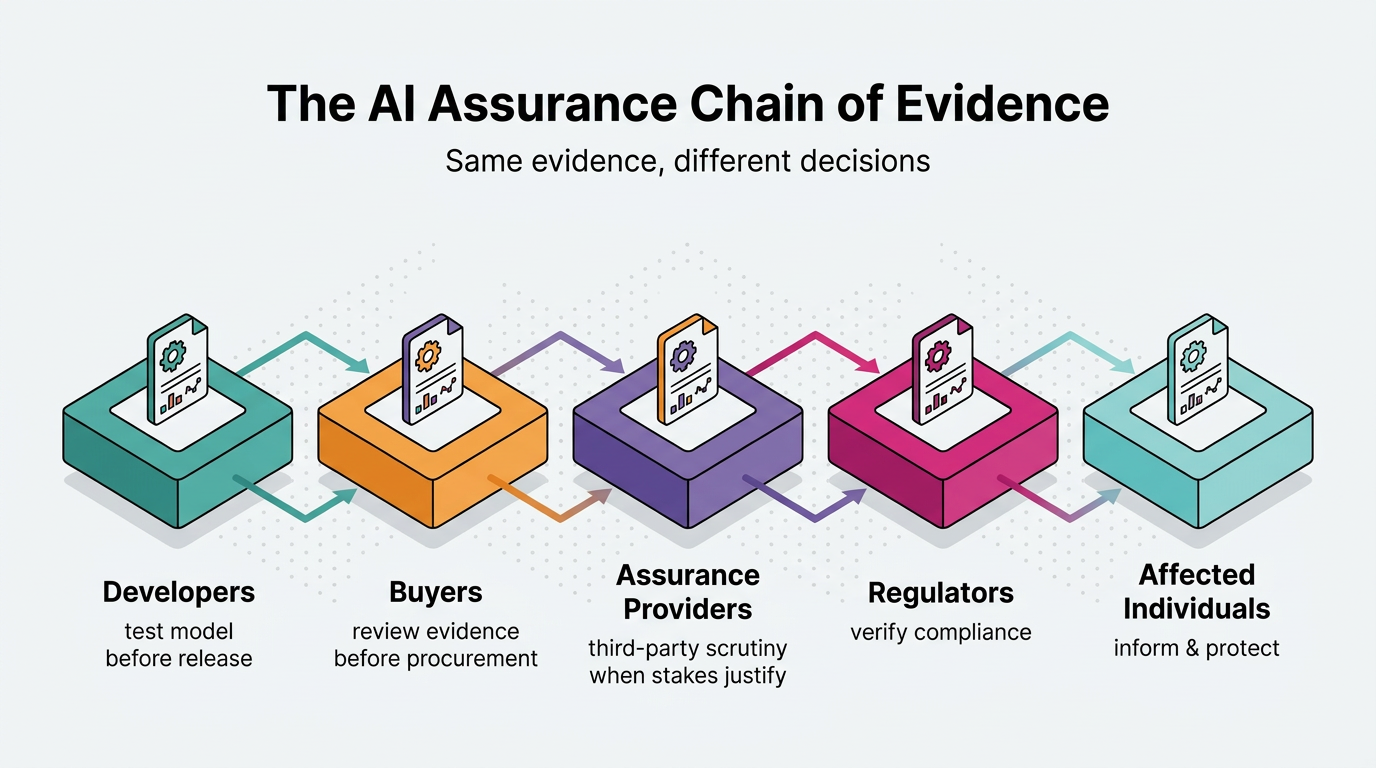
An assessor or regulator confirms that evidence when the stakes justify third-party scrutiny. Each party uses the same evidence for a different decision, with regulators verifying compliance, procuring organizations deciding what to buy and boards checking whether AI risk sits within their appetite.
Who Performs AI Assurance
Internal teams perform most AI assurance, and independent third parties step in when law, certification or customer trust requires an outside view. The CISO's team typically owns security testing, red teaming and access controls, while compliance maps systems to regulations and assembles audit evidence. Data science owns performance metrics, bias testing and drift monitoring, and legal leads impact assessments and AI vendor contracts.
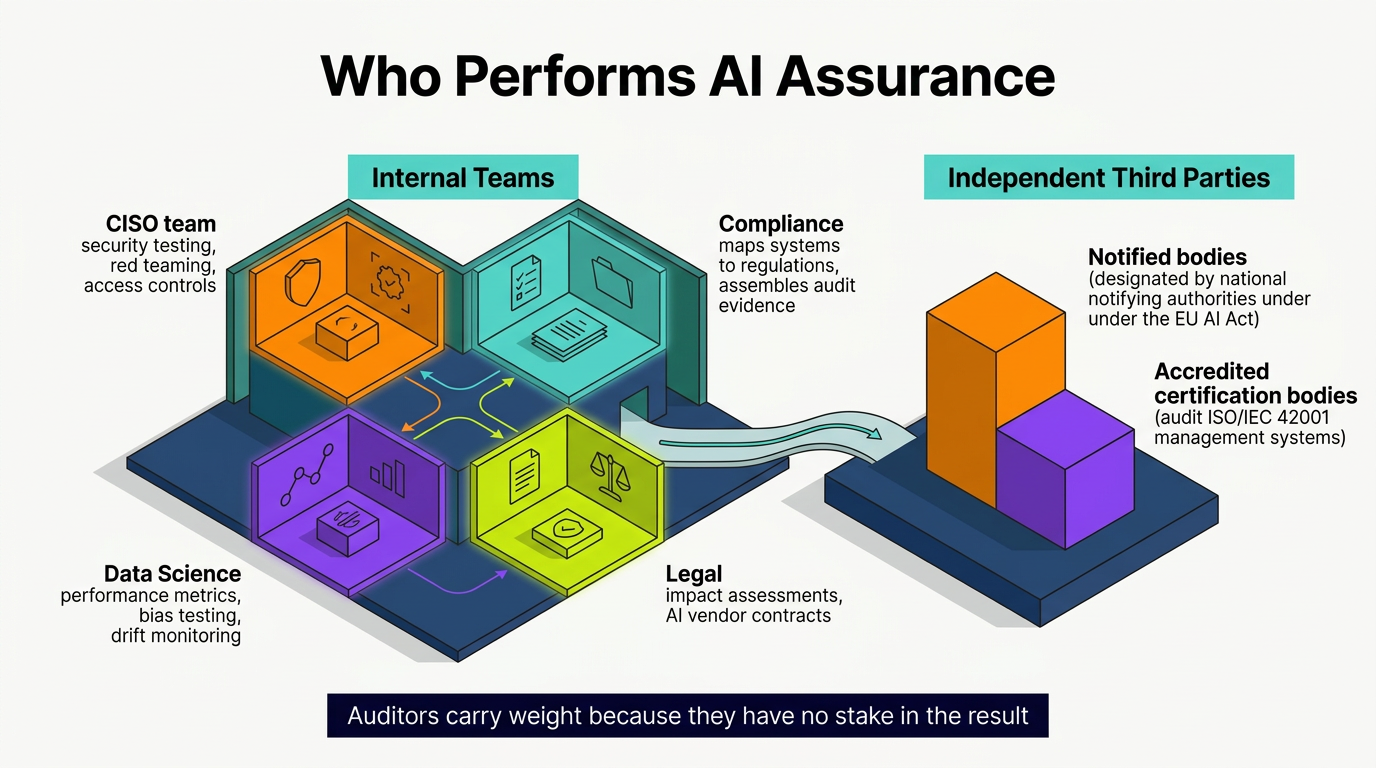
Third parties confirm what internal teams cannot credibly confirm about themselves. Under the EU AI Act, national notifying authorities designate notified bodies for third-party conformity assessment, and for ISO/IEC 42001, accredited certification bodies audit the management system. Their findings carry weight because the auditor has no stake in the result.
How to Start an AI Assurance Program
An AI assurance program starts with an inventory of AI systems, then scopes each one by risk, tests the highest-risk systems and monitors them for drift after launch. Each step produces evidence the next one relies on:
Inventory AI Systems: List every model, AI feature and AI tool in use, with owners, vendors and the data each touches.
Scope by Risk and Jurisdiction: Classify each system against EU AI Act Annex III, sector rules and internal risk appetite, and record the reasoning.
Assess Risk and Impact: Apply the NIST Map function to produce a risk register and, where required, a fundamental rights impact assessment.
Test and Audit: Run red teaming, bias audits and performance tests against defined benchmarks and keep the reports.
Document Evidence: Maintain technical documentation, test results and decisions in one audit trail that a regulator or certification body can review.
Monitor for Drift: Set alerts for when production inputs or predictions differ from pre-deployment test results, and feed findings into a post-market monitoring plan.
An AI tool that screens job applications shows how these steps play out under the EU AI Act. The Act lists systems that filter applications and evaluate candidates in Annex III, point 4(a), making such a tool high-risk. High-risk classification brings risk management, documentation, human oversight and post-market monitoring duties, and the evidence trail from the earlier steps is what shows a regulator those duties are met.
Building Evidence That AI Systems Deserve Trust
AI assurance gives security and compliance leaders a record they can defend: which systems exist, what was tested, what was found and what changed. Risk and impact assessments, NIST's Measure and Manage functions, ISO/IEC 42001 certification, and EU AI Act obligations all require the same underlying material, gathered once and maintained as systems change. Programs that begin with an accurate AI inventory have a foundation for every later test, audit and certificate.
Explore Abnormal's AI Governance to see how it is designed to keep a current record of sanctioned and shadow AI tools, with compliance mapping for each one.
Frequently Asked Questions
Is AI assurance the same as AI governance?
No, the two are related but answer different questions. A governance policy might require every customer-facing model to resist prompt injection, while assurance is the red-team result showing that one specific model does. An organization with well-written policy and little assurance cannot show an auditor that the policy works in practice.
Is there a professional certification for AI assurance practitioners?
No widely recognized practitioner certification exists yet, and most AI assurance practitioners come from adjacent disciplines such as cybersecurity, internal auditing, data science and privacy. Organizations hiring for assurance work typically pair that background with working knowledge of the NIST AI RMF, ISO/IEC 42001 and the EU AI Act.
Is AI assurance required by law?
No, not as a general duty, though specific laws require parts of it. The EU AI Act mandates risk management, documentation, conformity assessment and monitoring for high-risk systems. Elsewhere, sector rules and procurement contracts often require parts of assurance, such as bias testing or documentation, even where no AI-specific law applies.
How often should AI systems be reassessed?
Monitoring should run continuously, with formal reassessment triggered by events. Retraining, a model or vendor change, a new data source or a change in intended use should each prompt a fresh risk review. Under the EU AI Act, a substantial modification requires a new conformity assessment, although changes a provider predetermined and documented at the initial assessment do not count.