Key Insights
An agent can load a tool, a skill or a persona that no code review ever saw, which is why OWASP's 2026 agentic list gives agentic supply chain vulnerabilities an entry of their own at ASI04. AI agent supply chain security is the work of vetting, inventorying and monitoring the third-party components an AI agent relies on to reason, call tools and act.
The risks follow those components: poisoned tool descriptions, malicious Model Context Protocol (MCP) servers, skills and packages hiding a payload in setup instructions, model files that execute on load, and content that plants instructions. Teams reduce them by signing and pinning components before deployment, then scoping what each can reach at runtime.
This guide maps what an agent trusts, then traces how attackers get into those components and which controls and owners apply before deployment and at runtime.
What Is AI Agent Supply Chain Security, and What Does It Include?
An AI agent's supply chain is every external component that supplies code, instructions, credentials or data to the agent while it works. Some ship with the deployment, such as model weights and packages. Others load at runtime, such as MCP tool definitions, skills and the tickets or emails an agent reads. Each type carries its own way of being subverted and its own core control:
Component | What It Supplies | How It Is Subverted | Core Control |
Models and weights | Reasoning and outputs | File formats that run code on load | Signing, scanning, safe formats |
MCP servers | Tools, descriptions, credentials | Poisoned descriptions, post-approval swaps | Allowlist, pin, re-approve changes |
Skills and plugins | Instructions and helper code | Malicious setup steps in documentation | Review before install |
Open-source packages | Libraries and command-line tools | Typosquats, hijacked publish tokens | Pin with integrity hashes |
Development environment extensions | Coding-agent features | Compromised releases, fake listings | Approved marketplace, version pins |
Retrieved data and connected apps | Email, documents, tickets | Hidden instructions in content | Least privilege, egress limits |
The same questions recur in every row: where the component came from, what it can reach, and whether it has changed since approval.
How Is AI Agent Supply Chain Security Different From Software Supply Chain Security?
A software supply chain decides what code runs, while an agent's supply chain also decides what the agent does, because the components it loads carry instructions the agent will follow. ASI04 draws that line between the static dependencies a model supply chain covers and the external tools and agent personas an agentic system loads while it runs.
Agent components differ from code dependencies in how they carry instructions, change and inherit access:
Instructions Travel as Data: A tool description, skill file or retrieved email can steer an agent through plain language, which code scanners were not built to evaluate.
Tools Change After Review: An MCP server can alter its tool definitions after approval, and the agent picks up the new behavior in a later session.
Agents Act Without a Human Step: An agent that can call tools turns a planted instruction into an action, such as reading a file or sending data out.
Components Inherit Privileges: MCP servers often hold credentials for several downstream services, and coding agents run with the developer's own access.
In OWASP's agentic list, tampering with MCP tool descriptors or schemas falls under ASI02 Tool Misuse and Exploitation, while a tool that is malicious at its source falls under ASI04. Both differ from model-level AI security vulnerabilities because the weakness sits in a component the agent already trusts.
How Do Attackers Compromise AI Agent Supply Chains?
Attackers reach agents through what agents trust by default: the tools they call, the skills and packages they install, the model files they load and the content they retrieve, each one accepted without verification.
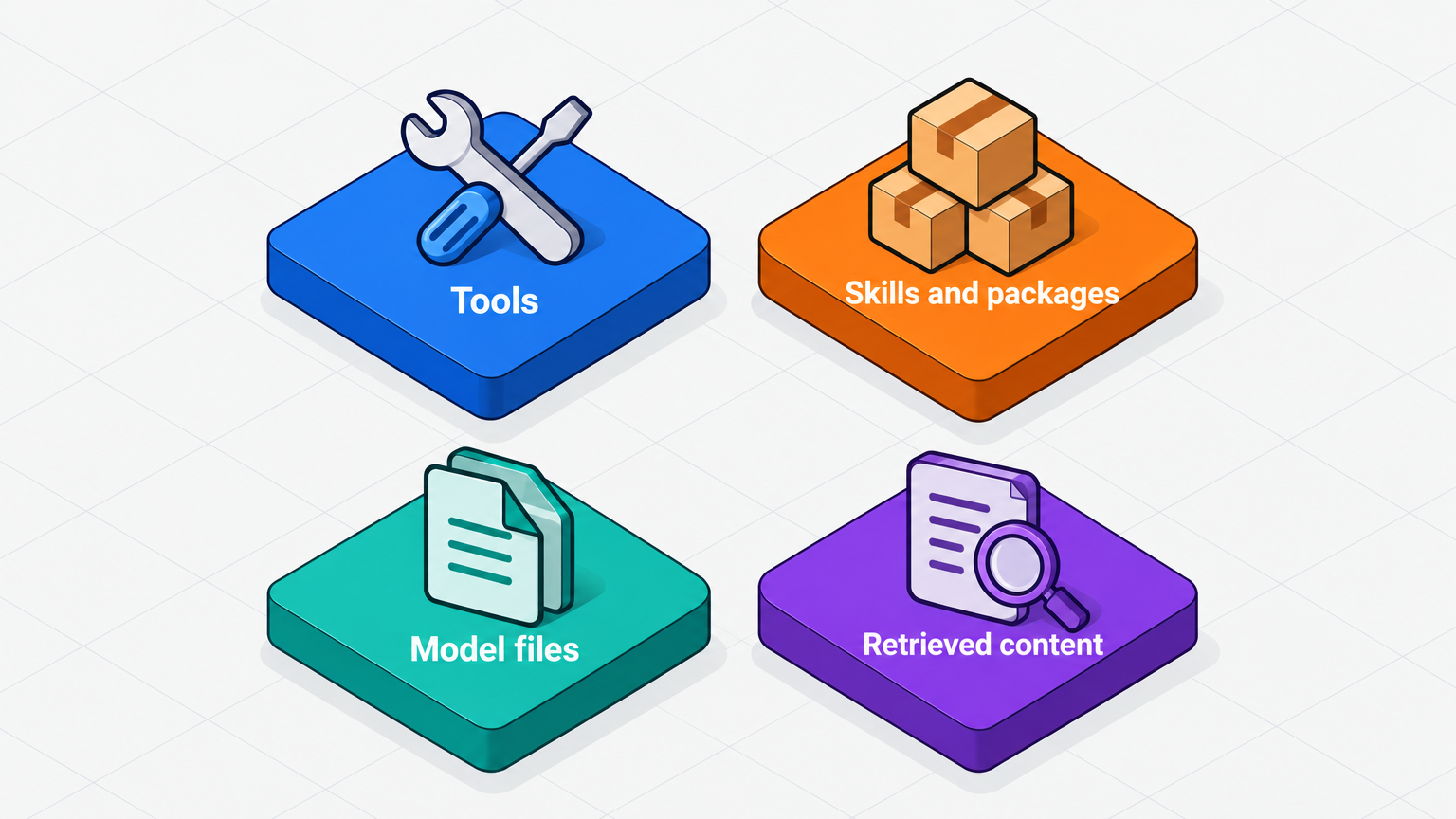
Malicious MCP Servers and Tool Poisoning
Tool poisoning hides instructions inside an MCP tool's description, where they steer the agent that reads it. The description sits in the agent's context as part of its instructions. A directive placed there can redirect a task the user never changed.
A rug pull turns on timing, where a server changes a tool description after a user approves it. Approval captures one version of a tool while the server controls every version after it, which is the argument for pinning tool definitions at approval and re-reviewing them when they change.
Poisoned Skills, Packages and Extensions
Skills and packages reach an agent through marketplaces and registries where listing is easier than vetting. A malicious skill can carry professional-looking documentation whose setup section tells the user to download a file or paste an installation script into a terminal, which puts the payload outside the skill's own code. Typosquatted packages work on name similarity, and a stolen publishing credential lets an attacker ship a malicious version of a package that passed review under an earlier one.
Extensions for development environments reach further still, because an extension inherits the developer's repository and cloud access. Pinning versions by content hash, restricting installs to approved marketplaces and preferring short-lived publishing credentials narrow each route.
Compromised Model Files and Injected Content
Model files can execute attacker code the moment they load, because some common serialization formats store executable content alongside weights. Scanners exist, and they do not catch every case, so pairing them with safer formats and sandboxed loading narrows the risk.
Retrieved content opens a route that is quieter still, since indirect prompt injection places instructions in a document, ticket or email that an agent later pulls into context on its own, with no attacker present when it fires. The content arrives through a channel the agent is supposed to read, which leaves least privilege over what it reaches and strict limits on where it sends data as the controls that help.
What Controls Reduce Agent Supply Chain Risk Before Deployment?
Before deployment the controls that count are inventory, allowlists of vetted tools, signing that proves origin, an AI bill of materials, and skill review that treats installation as code execution. Inventory comes first, because a team cannot pin, sign or restrict a component it does not know exists. A usable inventory covers sanctioned tools plus the agents, MCP servers and skills employees connect on their own, with an owner recorded for each. Abnormal's AI Governance, which is generally available, is designed to discover the AI tools and agents in use and attribute ownership for each one.
Each of these controls assumes that inventory is accurate:
Allowlists Confine Agents to Vetted Tools: Public registries verify less than teams assume, which leaves the real review to an internal allowlist or a private subregistry.
Signing Proves Origin: Signing standards and attestations let a team confirm an artifact came from the publisher it claims and has not changed since.
An AI Bill of Materials Records What an Agent Is Built From: Machine-readable inventory formats describe models and datasets, and agent inventories gain from recording MCP servers and tools alongside them.
Skill Review Treats Installation as Code Execution: A skill can act through plain-language instructions as well as code. Review covers those instructions, not a scan alone.
A weak answer on any of these checks is grounds to hold a component back:
Source confirmed as the official publisher, registry or marketplace.
Maintainer with a known identity and publishing history.
Versions pinned by content hash, with any change re-reviewed.
Requested permissions matched to the stated task.
Tool descriptions and skill instructions read in full for hidden directives.
Enabling a new MCP server is a dependency change, and reviewing it before it reaches development keeps that decision inside the process teams already run for code.
What Controls Reduce Agent Supply Chain Risk at Runtime?
Runtime controls assume a vetted component can still turn hostile, and they limit what it can reach while recording what it does. They form the runtime layer of AI agent security programs:
Least Privilege Caps What a Poisoned Tool Can Do: Per-tool scopes, rate limits and egress allowlists keep an email summarizer at read-only access with no send or delete rights.
Task-Scoped Identity Limits Credential Reuse: Short-lived credentials issued per agent run, not a standing key, shorten the window a stolen credential stays useful.
Tool-Call Logs Make Actions Traceable: Logging agent decisions, actions and external function calls, in storage that resists modification, gives investigators a record of what the agent did.
Human Approval Gates Irreversible Actions: Confirmation before destructive actions such as delete, transfer or publish keeps the consequential step with a person.
Behavioral monitoring surfaces what scoping misses, since giving agents the minimum access they need for the shortest time required narrows the window, and watching tool calls, memory interactions and actions for anomalous patterns catches the rest. A summarization agent that starts reading credential files is acting outside its task. Abnormal's AI Agent Security, in private preview as part of the AI Security suite, is designed to flag agent activity that departs from its expected baseline.
Who Should Own AI Agent Supply Chain Risk?
Ownership works best when shared: security sets policy and monitors behavior, platform engineering controls registries, pinning and credentials, and the teams building agents own what they add.
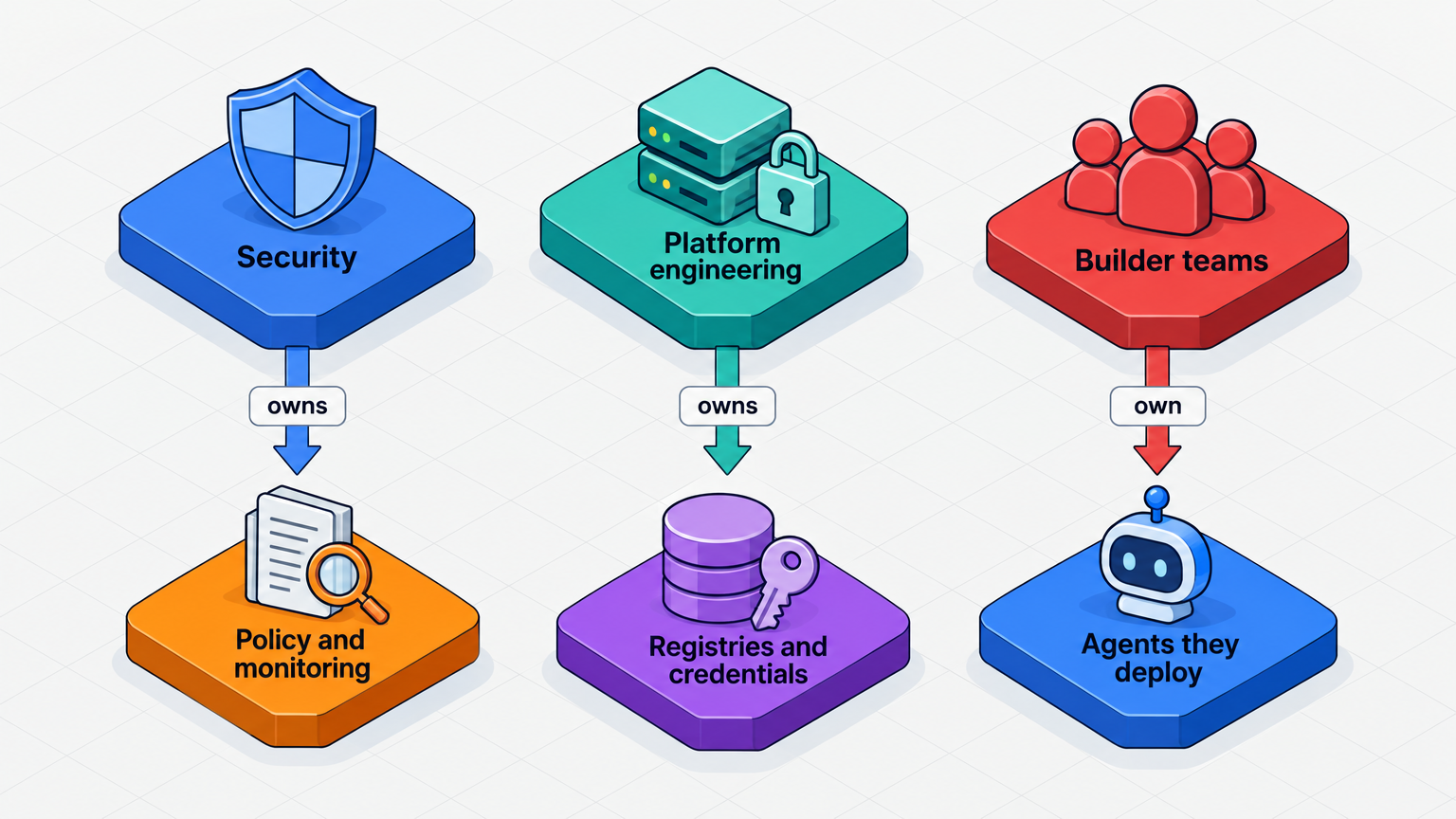
The NIST AI Risk Management Framework leaves that split to each organization. GOVERN 2 asks for documented roles and executive responsibility for AI risk decisions, and GOVERN 6 covers policies for risks arising from third-party software, data and other supply chain issues. It names no default department, leaving each organization to assign the three layers and record who holds them.
What a Trustworthy Agent Supply Chain Requires
An agent's supply chain reaches past its code to the models it loads, the tools and skills it calls, the packages and extensions around it, and the content it retrieves. The controls that hold are ordinary ones applied to new objects: know what is installed, confirm where it came from, pin it, scope what it can reach, and keep a record of what it did. Components that change after approval are the ones worth re-reviewing first.
Re-reviewing what changed depends on knowing what is installed. Abnormal's AI Governance, generally available, is designed to discover the AI tools and agents in use and attribute ownership, and AI Agent Security, in private preview, is designed to flag agents acting outside their expected behavior. Explore the AI Security platform to see how both fit alongside component vetting.
Frequently Asked Questions
What is an AI bill of materials (AI-BOM)?
An AI bill of materials is a machine-readable inventory of the models, datasets and related components in an AI system, with their versions, provenance and licenses. It extends a software bill of materials with AI-specific details such as training data and model parameters. Agent inventories gain further value when they also record the MCP servers and tools an agent can call.
Are MCP servers safe to use?
Yes, when an organization vets, pins and scopes them. A server from a verified publisher, pinned to a reviewed version, granted only the permissions its task needs and re-reviewed when its tool definitions change carries far less risk than one from an unvetted listing. Servers that run commands on the host belong only in trusted configurations.
How is a malicious skill different from a malicious package?
A malicious package hides harmful executable code that runs when it is installed or imported. A malicious skill can work through natural-language instructions alone, telling the agent or the user to download a file, run a script or send data elsewhere. A scanner may not catch an instruction written as plain prose. Skill review therefore includes reading the instructions themselves.
Do coding agents create supply chain risk?
Yes, coding agents add risk through the extensions, packages and MCP servers they load and the repository access they hold. A malicious extension or typosquatted package runs with the developer's privileges, and a planted configuration file in a cloned repository can point an agent at attacker-defined tools. Pinned versions, approved marketplaces and scoped credentials reduce that exposure.