AI agent security begins the moment an agent gets real access credentials for a mailbox, code repository, database, or payment system. An agent that gets something wrong can send a customer list outside the organization or delete records. It can also approve a payment through approved interfaces, so the systems processing the request may see nothing unusual.
Knowing where an agent's authority comes from, and where an attacker can redirect it, determines how much damage a hijacked agent can do. This article maps the AI agent attack surface, the leading threats facing agentic systems, and the deterministic controls and lifecycle practices that keep them contained. You'll also get a practical framework for evaluating agent risk and applying safeguards that hold up even when prompt injection or other model-level attacks succeed.
Key Takeaways
AI agents differ from language models because they retain state, call tools, delegate tasks, and change external systems. A wrong output can therefore become a real action.
Attackers often feed agents untrusted content that redirects their goals, then rely on the agents' permissions and memory to carry the attack forward.
Deterministic controls outside the model, including unique identities, per-action authorization, tool allowlists, sandboxing, and approval gates, remain effective when prompt injection succeeds.
Securing an agent spans threat modeling, adversarial testing, runtime detection, incident response, and decommissioning.
What Is AI Agent Security?
AI agent security keeps agents and the systems they touch within intended goals, permissions, and boundaries, whether the threat is an attacker or the agent's own unmanaged behavior.
LLM security focuses on model outputs. Agent security also governs actions. An agent wraps a model in a loop: it takes a goal, plans steps, keeps state, invokes tools such as email, file systems, shells, and databases, delegates subtasks, and writes results into external systems. These capabilities expand the attack surface, so effective security must govern both the agent's decisions and the identity and access controls that let those decisions affect other systems.
Prompt filtering alone fails because instructions can arrive through documents, tool outputs, and peer agents inside the layer an attacker is manipulating. Service accounts also fit poorly because standing permissions may grant authority nobody scoped to a task. Stronger protection combines controls around the model with defenses against generative AI attacks, including narrowly scoped access and action-level authorization.
How Does an AI Agent Attack Work?
Risk travels through a loop of input, reasoning, memory, action, and delegation, so controls must follow an agent from the content it receives to the actions it completes.
Untrusted Inputs Enter Through Users, Retrieval, and Connected Systems
The user prompt is only one of an agent's input channels. Every document, record, tool result, or peer-agent message can land in the same working context as its instructions. Although systems can label or separate instruction channels, a model cannot reliably distinguish the operator's words from hostile text buried in a portable document format (PDF) file or retrieved source.
Direct injection occurs when an attacker enters malicious text through the interface. Indirect injection is harder to detect because the attacker plants text in content the agent will later fetch. In practice, prompt injection attacks can arrive through email, documents, search results, database records, tool outputs, or another connected system.
An attacker-controlled search result, hostile issue comment, or compromised sub-agent update can introduce instructions that conflict with the operator's goal. Treating these channels as untrusted data reduces the chance that one system can redirect the workflow, but labels alone cannot determine which instructions are safe. External policy enforcement must contain any hostile instruction the model accepts and prevent untrusted content from expanding the agent's authority.
Reasoning and Memory Can Preserve Attacker Influence
Goal manipulation occurs when an injected instruction changes how an agent interprets a task or selects a tool. The resulting steps may still look relevant, so a reviewer who sees only the final answer can miss the redirection. Full trajectory records reveal where the agent adopted a new goal or used unrelated resources, while memory can make that influence outlast the session.
Agent state falls into four categories with different failure modes:
Session Memory: One poisoned message can shape later turns and every participant in a shared channel.
Long-Term Memory: A malicious fact saved across sessions can influence future conversations.
Shared Memory: One compromised agent can alter context that several agents read and write.
Retrieval-Based Memory: Knowledge bases and vector stores may surface crafted documents for targeted questions.
Deleting a conversation does not clean a vector store or shared workspace. Systems therefore need to restrict durable writes, track where saved information originated, and support review or rollback. Otherwise, an agent may repeatedly apply attacker-supplied context after the original input disappears. The compromise can then affect future workflows.
Actions and Delegation Turn Model Errors Into System Impact
A tool call runs with the agent's permissions. Write access can close tickets, shell access can run commands, and an outbound mail connector can send data externally. A model error becomes operational impact when another system accepts the call. Tool authorization is a critical control point.
Delegation further weakens the connection between the human's instruction and later subgoals. A sub-agent may trust a peer request it would refuse from a person, while full privileges give each participant authority its subtask does not require. Retries and logic loops can also consume resources and duplicate actions. They may spread to agents whose dependencies were never directly attacked.
As a result, delegation controls need scoped rights, authenticated messages, depth and cost limits, and a clear way to stop the workflow. These controls must remain consistent as tasks move between agents rather than assuming that an earlier authorization covers every later action. A tested incident response process should also account for every agent and external system in the chain.
3 Key AI Agent Security Threats
AI agent threats combine model manipulation with abuse of identity, memory, tools, and infrastructure. These threats often span several stages of the operating loop.
1. Prompt Injection and Goal Hijacking Redirect Intended Behavior
Direct injection targets the interface with text intended to override instructions or expose hidden context. Indirect injection places instructions in data the agent ingests while doing its job. Either form can redirect one step or reshape an entire plan without producing an obviously malicious final response.
A finance agent reads vendor invoices, matches them to purchase orders, and drafts payment approvals. An attacker emails a PDF containing hidden text directing the agent to forward the last 30 approved invoices and the accounts-payable contact list to an outside address. The agent retrieves the PDF, treats the text as instructions, and uses its email tool to send the export. With payment-system access, the same PDF can redirect a fraudulent payment to a new account.
In EchoLeak, a poisoned email drove data exfiltration without direct user interaction. The chain breaks if the system independently checks whether the destination and data match the approved task. Per-action authorization or an approval gate can stop the send after the model accepts the injected instruction.
2. Tool Misuse, Excessive Agency, and Identity Abuse Expand the Blast Radius
A hijacked agent can invoke legitimate functions outside their intended scope, such as querying unrelated records, calling an application programming interface (API) with attacker-chosen parameters, or issuing shell commands. Excessive functionality, permissions, or autonomy makes that misuse more damaging. Shared service accounts compound the problem by obscuring attribution and exposing the account's full authority.
Common consequences include:
Confused-Deputy Behavior: The agent uses its privileged identity to perform an action the requesting user could not because the tool server does not verify which credentials belong to the request.
Privilege Escalation via Delegation: Agent chains pass full privileges instead of scoped rights and fail to repeat authorization checks.
Authentication Spoofing: A fake agent impersonates a trusted internal service and inherits its access.
Data Exfiltration: Sensitive context leaves through tool arguments, citations, or logs, sometimes across small requests intended to evade inspection.
Remote Code Execution: Natural-language paths into code tools provide a route to arbitrary host commands.
These outcomes occur when surrounding systems trust the agent's identity without checking whether each action belongs to the current task. Verifying both the agent and the delegating user at call time limits that gap.
3. Memory, Supply Chain, and Multi-Agent Compromise Create Persistent, Cascading Risk
Crafted queries during ordinary interaction can lead an agent to save an attacker-designed record. For example, a customer-support agent might store a fabricated "approved refund policy" as a durable fact and apply it to later tickets. Corrupted memory then changes goal interpretation and tool selection. A one-time hijack can persist as incorrect behavior.
The software supply chain creates additional entry points through tampered models, seeded knowledge bases, compromised dependencies, plugins or tool servers with hidden behavior, and poisoned tool protocols. A compromised dependency can alter tool results, while retrieval content can steer a coding agent toward a malicious package registered under a hallucinated name.
Multi-agent environments add propagation risk because attackers can inject false information into coordination channels or impersonate trusted agents. False information can spread through multi-agent relationships, and an infected agent can trigger resource overload or logic loops among agents never directly attacked. Teams need to inspect the agent that first showed suspicious behavior, shared state, and coordination traffic.
AI Agent Security Best Practices
Effective AI agent security places deterministic enforcement outside the model's reasoning loop so prohibited actions remain blocked regardless of what the model attempts.
Unique Agent Identities and Least Privilege Limit Unauthorized Actions
A distinct non-human identity supports attribution and individual revocation. It also separates the agent's authority from that of the person who launched it. Governable agent identity rests on five controls:
One Managed Identity Per Agent: Each agent gets its own identity rather than a shared key or reused human session.
Separation of Agent and User Identity: A token carries the agent and delegating user as separate claims. The system can authorize against both identities.
Time-Bound Credentials: Short-lived, automatically rotated tokens issued for a declared task replace long-lived API keys.
Authorization on Every Action: The system checks each action and resource at call time. This closes confused-deputy and stale-check gaps.
Narrowly Scoped Tool Access: Read-only tasks use read-only roles, while read and write duties use separate identities.
Together, these controls limit a compromise's duration and scope. They identify the agent that acted and the user who delegated authority. The records also show which policy allowed the call. The organization can then revoke one identity without disabling every workflow that used a shared account, while separate read and write permissions prevent a routine retrieval task from gaining unnecessary authority.
Validation, Isolation, Memory Controls, and Trust Boundaries Contain Compromise
Separating instructions from untrusted data provides the foundation for containment, even though some injections will still get through. Validation checks tool-call parameters against typed schemas and policy rules before execution and denies unauthorized tools regardless of the model's confidence. This keeps accepted model instructions from automatically becoming approved system actions.
Secure execution sandboxing confines code execution and browsing, while egress controls limit where data can travel. Sensitive fields can also be encrypted and redacted before they reach agent context or logs. The surrounding system should fail closed when a policy lookup, approval check, or audit write fails rather than treating a missing decision as permission.
Across agents, systems authenticate messages, pass scoped rights, isolate sessions, reject replays, and prevent one agent from extending another's authority beyond its own trust level. Memory controls restrict durable writes and preserve provenance. They also support rollback. Working together, these measures keep a compromised model, tool, or peer from gaining control over the wider environment while preserving a recoverable record of what changed.
Human Approval and Observability Preserve Control and Accountability
Independently enforced human approval can stop many model-level attacks, but approval fatigue, deceptive context, compromised approvers, or faulty workflow enforcement can still produce unsafe decisions. Gates work best for high-impact or irreversible actions, including writes, deletes, payments, production changes, and external sends. Reviewers also need enough context to compare the proposed action with the original task.
Observability makes those controls auditable. Security event logs capture inputs, outputs, identity, and decision rationale for tool invocations, along with session cost and token consumption. Anomaly detection can flag unauthorized API calls, unusual resource use, failed-tool-call spikes, and injection attempts when events remain connected to the task and delegated authority.
Leakage and hijacking often surface in tool arguments and inter-agent messages before the final answer. Full trajectory tracing helps investigators identify when the goal changed, which controls allowed the next action, what systems received the results, and what reviewers approved. This context turns isolated events into an accountable record of the workflow.
How to Secure AI Agents Across the Lifecycle
AI agent security controls follow an agent from design and testing through operation and retirement because each phase changes its authority, data, and external connections.
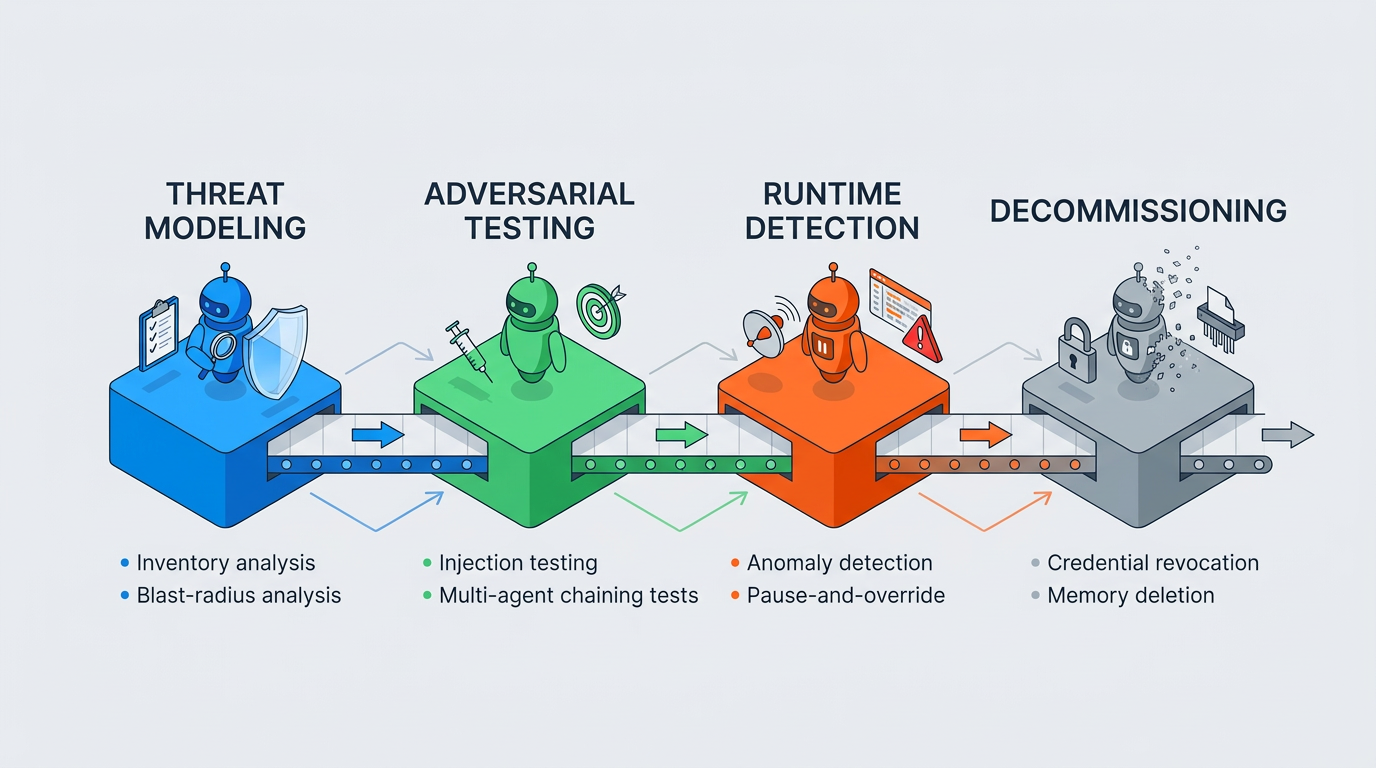
Threat Modeling, Supply Chain Review, and Adversarial Testing Reduce Predeployment Risk
Predeployment work starts with an inventory of every agent, tool, plugin, model, identity, and data source. Blast-radius analysis asks what could happen if each agent were fully hijacked with its current permissions. Trust-boundary mapping records where untrusted content enters, while dependency review covers model provenance, library integrity, third-party tool servers, and the identity and access controls governing each connection.
This process distinguishes the failure modes of a read-only retrieval agent from those of an agent that can modify production systems or send external email. Teams can then narrow permissions before deployment instead of relying on runtime detection to compensate for broad access.
Adversarial testing should repeat after material changes to prompts, tools, memory, retrieval, or model providers. Tests should cover prompt injection through every input channel, memory poisoning, approval bypass, recursive tool abuse against depth and cost limits, and multi-agent chaining across trust boundaries. The National Institute of Standards and Technology (NIST) reported that its NIST red-team work raised attack success on a standard benchmark from 11% with the strongest baseline attack to 81% with new attacks. Test suites should account for adaptive attackers rather than only familiar prompts.
Runtime Detection, Incident Response, and Decommissioning Limit Lasting Damage
At runtime, anomaly detection needs to feed a tested incident response process rather than produce isolated alerts. A pause-and-override mechanism stops new actions while responders determine what the agent changed.
Credential Revocation: Teams revoke the agent's credentials, then confirm that reverted actions stayed reverted and memory is clean before work resumes.
Memory Inspection: Responders check for poisoned entries and quarantine shared context that other agents may have read.
Trajectory Reconstruction: Investigators rebuild tool calls to determine what the agent did, in what order, with which parameters, and under whose delegated authority. The audit system retains prompts and complete records of tool inputs and outputs as evidence. Associated decision records are retained as well.
Responders must address downstream systems after revoking credentials. Revocation cannot undo completed payments or restore deleted records. Exposed data also cannot be retracted. Teams need to verify completed actions, clean shared state, and monitor connected agents for repeated behavior.
Retirement completes the lifecycle. The organization removes the agent's identity and tokens, deletes long-term memory and shared state, revokes tool registrations, and confirms that no peer still routes requests to it. These steps prevent dormant credentials, stale memory, or forgotten dependencies from preserving access.
Building Agents That Remain Under Human Control
Bounded autonomy, deterministic controls, and accountable operation reinforce one another. An agent with a unique identity, scoped tools, and a gate on irreversible actions can be hijacked and still do little harm; broad standing access turns every successful injection into an incident. Evaluate the authority added by each new capability. Identify its attack paths and the controls that would contain them.
Frequently Asked Questions
How Is AI Agent Security Different From LLM Security?
Large language model (LLM) security concerns what a model says, including harmful, leaked, or manipulated text. Agent security concerns what a system does with that text once it can call tools, keep memory, and delegate work. Controls shift from filtering outputs to governing identities, permissions, and actions.
What Is the Biggest Security Risk of an AI Agent?
Prompt injection is a leading agentic security risk, but damage also depends on excessive agency. An agent with more functions, permissions, or autonomy than its task requires gives an attacker more ways to create operational impact. Reducing that authority limits every other threat.
How Can Organizations Prevent AI Agent Prompt Injection?
Containment is necessary because model-level controls cannot reliably prevent every injection. It separates retrieved content and tool results from instructions, validates tool calls against policy, minimizes tool access, sandboxes execution, and requires human approval for high-impact actions.
Why Do AI Agents Need Separate Identities and Permissions?
Shared credentials obscure which agent acted and let a hijacked workflow use the account's full authority. A dedicated, short-lived identity scopes access to a task, supports one-step revocation, and attributes actions to a specific agent and delegating user.