Key Insights
Here's the paradox: as enterprise security stacks grow more sophisticated, certain attacks only get more successful. Firewalls, gateways, and authentication are stricter than ever, yet losses from socially engineered email attacks keep climbing.
The reason is counterintuitive: attackers stopped breaking through the walls and started walking through the front door, using credentials, conversations, and context that defenders have trained their systems to trust.
This dynamic exposes a widening gap between modern attacks and the defenses designed to stop them. Business email compromise (BEC), AI-generated phishing, vendor impersonation, and account takeover (ATO) all share a common trait: they carry no malicious payload for traditional tools to flag.
Effective cyber defense now requires a detection architecture that can identify deviations across email and cloud applications tied to identity, since legacy perimeter tools cannot correlate signals across the trusted identities and normal-looking communication these attacks rely on.
Key takeaways
- Legacy email gateways (SEGs) often struggle to detect socially engineered attacks because their detection logic depends on identifying a malicious artifact that these attacks deliberately omit.
- A unified defense architecture treats identity as the integration layer that connects email security and cloud application monitoring into a single, coordinated threat-detection posture.
- Behavioral detection models built on per-user and per-relationship baselines can surface anomalies that rule-based systems miss and use multi-signal correlation to reduce false positives.
- SOC automation should follow a phased approach: start with alert enrichment and deduplication, then progress to confidence-gated containment and human-in-the-loop actions for high-impact decisions.
Why modern cyber defense solutions require a new architecture
Modern cyber defense solutions need to account for attacks built on trusted identities and normal-looking communication. According to the FBI IC3 2025 Annual Report, BEC generated over $3 billion in reported losses in 2025. These attacks succeed because they impersonate trusted contacts and reference real business transactions, often without malware or weaponized links, even when authentication checks pass.
Two shifts in the threat landscape help explain why this gap has widened so quickly: the economics of phishing have changed, and attacks no longer stay confined to a single channel.
The volume-quality tradeoff has collapsed
Attackers can now scale convincing phishing without sacrificing message quality. Generative AI has eliminated the economics that once constrained phishing quality.
Attackers previously had to choose between high-volume, low-quality campaigns and targeted, labor-intensive spear phishing. Phishing content now regularly achieves native-level linguistic quality that rule-based content filters were never calibrated to evaluate.
Multi-channel attacks defeat single-channel defenses
Modern social engineering campaigns increasingly span more than one communication channel. A spoofed email can establish the fraudulent request, followed by a synthetic voice call that confirms the instruction.
While these campaigns span multiple channels, the primary control point remains the inbox, where the initial request originates and the attack narrative begins. Organizations need complementary controls for other channels such as voice or SMS alongside strong email-based detection.
Threat categories that affect cyber defense solutions
While the threat landscape is broad, three attack patterns account for a disproportionate share of enterprise risk and consistently slip past legacy detection logic. Each one exploits trust in a different way, and each one demands a detection approach that goes beyond signature-based inspection.
1. Business email compromise and vendor impersonation
BEC and vendor email compromise (VEC) rely on trusted context and legitimate-looking communication. BEC attacks compromise or impersonate legitimate business email accounts to conduct unauthorized fund transfers.
Because the messages originate from or closely mimic trusted accounts, they pass sender authentication checks (SPF, DKIM, DMARC) without alerts. VEC extends this approach by hijacking real email threads between organizations and their suppliers.
Attackers then insert fraudulent payment instructions into active financial conversations. The contextual trust embedded in an existing email thread makes VEC particularly difficult to detect through static inspection.
2. Account takeover and MFA bypass
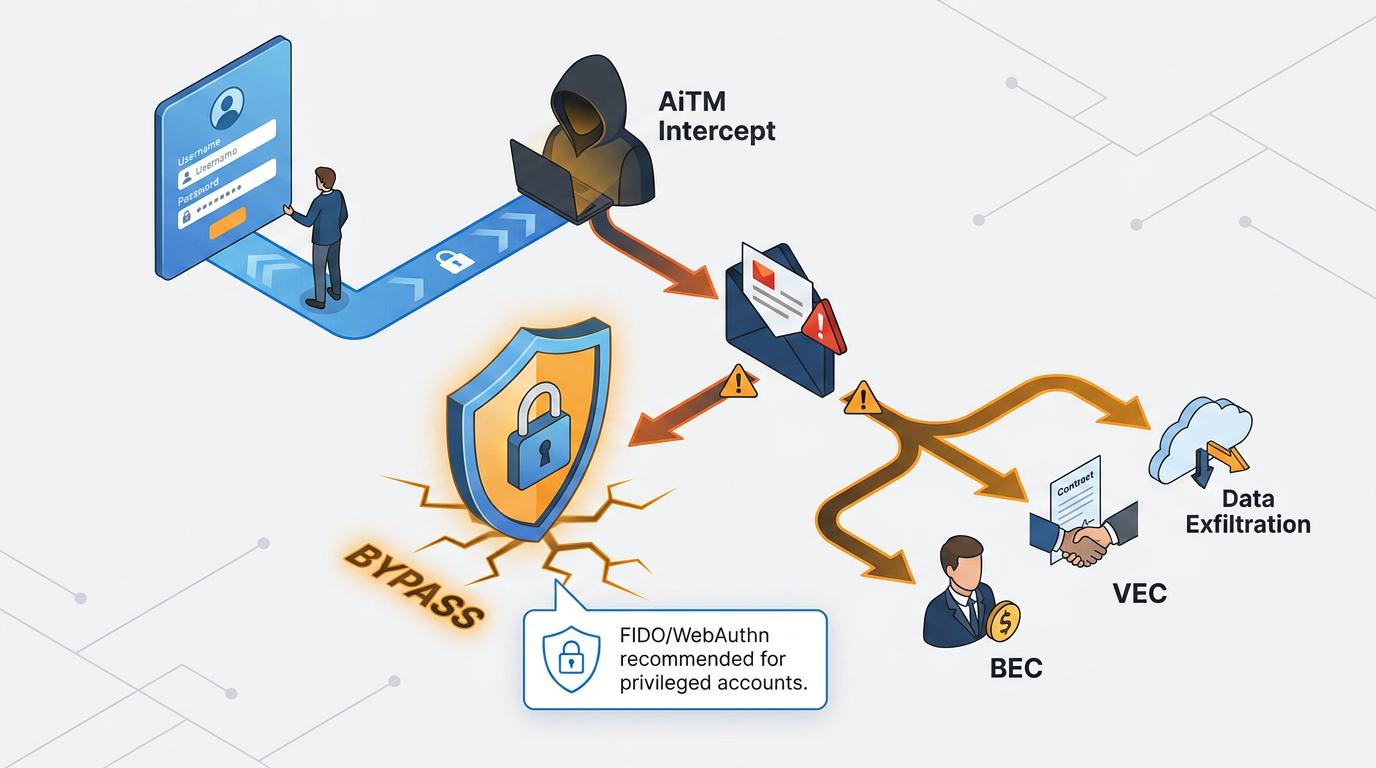
ATO turns a compromised identity into a platform for broader fraud and abuse. ATO has evolved from standalone credential theft into the gateway for follow-on BEC, VEC, and data exfiltration campaigns. Adversary-in-the-middle (AiTM) techniques intercept authentication sessions and steal session tokens even when MFA is enabled.
Once an attacker controls a legitimate inbox, outbound communications pass authentication checks and appear legitimate to downstream controls. CISA's Black Basta ransomware advisory distinguishes between standard MFA (push notifications and SMS) and phishing-resistant MFA (FIDO/WebAuthn and PKI-based authentication). The advisory recommends phishing-resistant MFA for privileged administrative accounts.
3. AI-generated social engineering
AI-generated social engineering makes fraudulent messages more convincing and less dependent on reusable templates. AI-generated phishing removes the grammatical errors, formatting inconsistencies, and implausible sender contexts that security awareness training taught employees to recognize.
Polymorphic campaigns continuously change messages, infrastructure, and payloads. The resulting attacks are unique in phrasing and structure. Hash-based and pattern-based matching produces no matches against messages that have never been seen before.
Where legacy email security falls short as a cyber defense solution
Legacy email security tools still play a role, but they often struggle with attacks built to look legitimate at delivery time. Their shortcomings cluster around five recurring weaknesses that together explain why socially engineered threats so often slip past traditional defenses:
- No malicious artifact to detect: Legacy SEGs are architected to identify malicious attachments, weaponized URLs, and known malware hashes. BEC and VEC attacks often exclude these elements by design, delivering a text-based request, often within an existing thread, with no payload for signature-based engines to flag.
- No model of normal behavior: SEGs inspect messages at the inbound perimeter without any model of what normal communication looks like for a given user, relationship, or business workflow. They cannot easily distinguish between a legitimate CFO request and a fraudulent one that mimics the CFO's typical tone and timing, and post-compromise behaviors like modifying forwarding rules or conducting internal phishing against trusted contacts fall outside the visibility of a delivery-time perimeter scan.
- Static rules against adaptive attacks: Rules and signatures encode patterns from prior attacks, creating a structural asymmetry: detection requires historical examples, while attackers need only construct something new. BEC attackers, for example, purchase locally generated IP addresses to mask login origin and circumvent the widely deployed "impossible travel" detection rule.
- One-time inspection at delivery: SEGs perform a single inspection when a message attempts delivery. Time-of-click URL manipulation, where a URL resolves to benign content during inspection and redirects to malicious infrastructure when clicked, occurs entirely outside the detection window, so single-gateway inspection at the perimeter may not meet detection requirements on its own.
- The alert fatigue tax: Every rule requires human authorship, validation, and maintenance. Rules tuned aggressively generate false positives that block legitimate communications and consume analyst capacity, while rules tuned conservatively increase missed detections, producing persistent pressure on the SOC and giving attackers more room to hide credential abuse and lateral movement.
These gaps make clear that perimeter-based, rule-driven email security cannot stand alone against today's threats; closing them requires a detection layer that understands behavior, context, and identity well beyond the moment of delivery.
How behavioral detection changes the equation for cyber defense solutions
Behavioral detection shifts the focus from inspecting message contents to understanding context. Instead of scanning for known-bad indicators, it learns what normal communication looks like for each user, relationship, and workflow, and then flags the deviations. The following three capabilities make this approach effective in practice:
Constructing per-user and per-relationship baselines
Strong baselines give defenders a way to spot suspicious communication that looks technically legitimate. For email specifically, this means profiling communication relationships over time and the business context in which those messages occur.
A message that claims to be from a trusted relationship but does not fit the usual timing or request pattern can be flagged even when the sender address appears legitimate.
Analyzing intent through natural language understanding
Language analysis can help surface manipulation tactics that simple keyword matching misses. Natural Language Processing (NLP) and Natural Language Understanding (NLU) assess the semantic content of email to identify manipulation tactics.
Semantic clusters can detect urgency and pressure language across related meanings. They can also detect authority exploitation that invokes executive power to bypass approval processes or tone deviations inconsistent with a sender's communication history.
The behavioral and structural indicators used to identify malicious emails persist even when AI-generated content quality improves: a message may look more legitimate, but if it arrives from an address that does not belong to the claimed sender, or references a request pattern outside the established workflow, those indicators remain meaningful.
Reducing false positives through multi-signal correlation
Correlation across models can improve accuracy and lower the analyst burden. Ensemble machine learning architectures combine multiple model outputs into a composite verdict.
Those outputs can include reputation classifiers, behavioral anomaly models, NLP content classifiers, and graph-based relationship models. Peer-reviewed research confirms that ensemble methods reduce both false positive and false negative rates simultaneously by aggregating predictions from diverse models whose individual errors cancel each other out.
This approach raises an alert after a cluster of correlated anomalies appears. This multi-signal approach produces higher-confidence verdicts that help reduce the triage burden of legacy rule-based detection engineering systems.
Building identity-first cyber defense across email and cloud
Identity is the integration layer that helps unify email security, cloud security monitoring, and threat detection. Identity has become the primary integration point for unified defense because credential abuse remains the most common initial access vector in breaches.
Putting identity at the center of defense translates into three practical disciplines that work together across the email and cloud layers, each addressed in the sections that follow.
- Connecting email signals to identity threat detection: Email security signals should feed into identity threat detection and response (ITDR) systems so that credential-harvesting attempts surface as anomalous authentication behavior. This integration requires API-native connectivity to mailbox history, communication patterns, and login signals.
- Implementing phishing-resistant MFA on high-risk accounts: Standard push-notification and SMS-based MFA is defeated by AiTM session hijacking and MFA prompt bombing. CISA recommends prioritizing FIDO/WebAuthn and PKI-based authentication on privileged administrative accounts to address the identity layer directly.
- Managing cloud security posture continuously: Misconfigured conditional access policies, overly permissive forwarding rules, and unmonitored third-party app permissions create openings attackers exploit after initial access. Continuous posture monitoring, benchmarked against established standards, replaces manual audits that quickly go stale.
These disciplines close the loop between what arrives in the inbox, who is authenticating into critical systems, and how the underlying cloud environment is configured, giving defenders a single identity-anchored view across the attack surface.
Sequencing SOC automation to maximize cyber defense impact
SOC automation delivers the most value when teams phase it in based on risk and operational maturity, starting with low-risk efficiency gains before extending into actions that directly affect users and systems. The two stages below outline how to build that progression deliberately, beginning with enrichment and deduplication and moving toward confidence-gated containment.
Starting with alert enrichment and deduplication
Enrichment and deduplication are often the safest first steps because they add context without forcing immediate automated remediation. Alert enrichment, which pulls identity context and cloud posture data into a single case view, is a useful starting point. It addresses the core problem of siloed alerts arriving without context, without requiring automated remediation actions that carry business risk. Deduplication across these domains reduces the raw volume analysts must process. ISACA recommends that organizations begin by automating routine tasks and gradually progress to more complex operations as the SOC matures.
Progressing to confidence-gated containment
Containment works best when confidence thresholds and human oversight are built into the workflow. Once enrichment workflows are stable, playbooks for high-confidence, low-impact actions can be introduced with confidence score thresholds as gates. Account suspension or service isolation can carry significant business impact and should retain human authorization in the workflow. ISACA emphasizes the importance of incorporating human oversight into automated remediation processes for actions that may significantly affect business operations.
Strengthening cyber defense solutions with behavioral AI for email
Behavioral AI can help close the email detection gaps that legacy tools often leave open. The detection gap at the center of modern cyber defense plays out primarily in the inbox, where socially engineered attacks can pass authentication checks and still look routine. Traditional email security tools often struggle to detect these threats because their architecture depends on artifacts that many modern attacks avoid. Behavioral AI, scoped to email, offers a different approach: modeling known-good behavior for each user and relationship, then surfacing deviations that indicate compromise or impersonation.
Abnormal is designed to detect the email and account-based components of these attacks by analyzing behavioral and identity signals. These signals include communication patterns across cloud email and collaboration platforms like Teams and Slack. Abnormal can help security teams close the detection gaps that legacy tools leave open, without replacing existing infrastructure.
Book a demo to see how behavioral AI can strengthen your email security posture.
