Key Insights
Previously unknown AI agents had turned up in the environments of 82% of organizations over the past year, according to a Cloud Security Alliance survey released in April 2026. Security teams secure AI agents at scale by replacing one-by-one review with controls that reach every agent automatically: a continuously updated inventory, one identity with least-privilege credentials per agent, a named owner and a retirement path for each agent, default policy by risk tier, automated monitoring against each agent's baseline, and containment wired up in advance.
This guide focuses on discovery, per-agent identity, default policy, automated monitoring and shared ownership, because each of those controls keeps working as agent counts grow.
Why Do Agent Security Controls Break Down at Scale?
Unrecorded agents, shared credentials, missing owners and stale reviews undermine per-agent review once agents outnumber the people available to review them. The practices for securing an individual AI agent still hold; what fails is the manual process wrapped around them. When a business team can build an agent in a cloud console or a code editor in an afternoon, the review queue grows faster than reviewers clear it, and agents go live without passing through it.
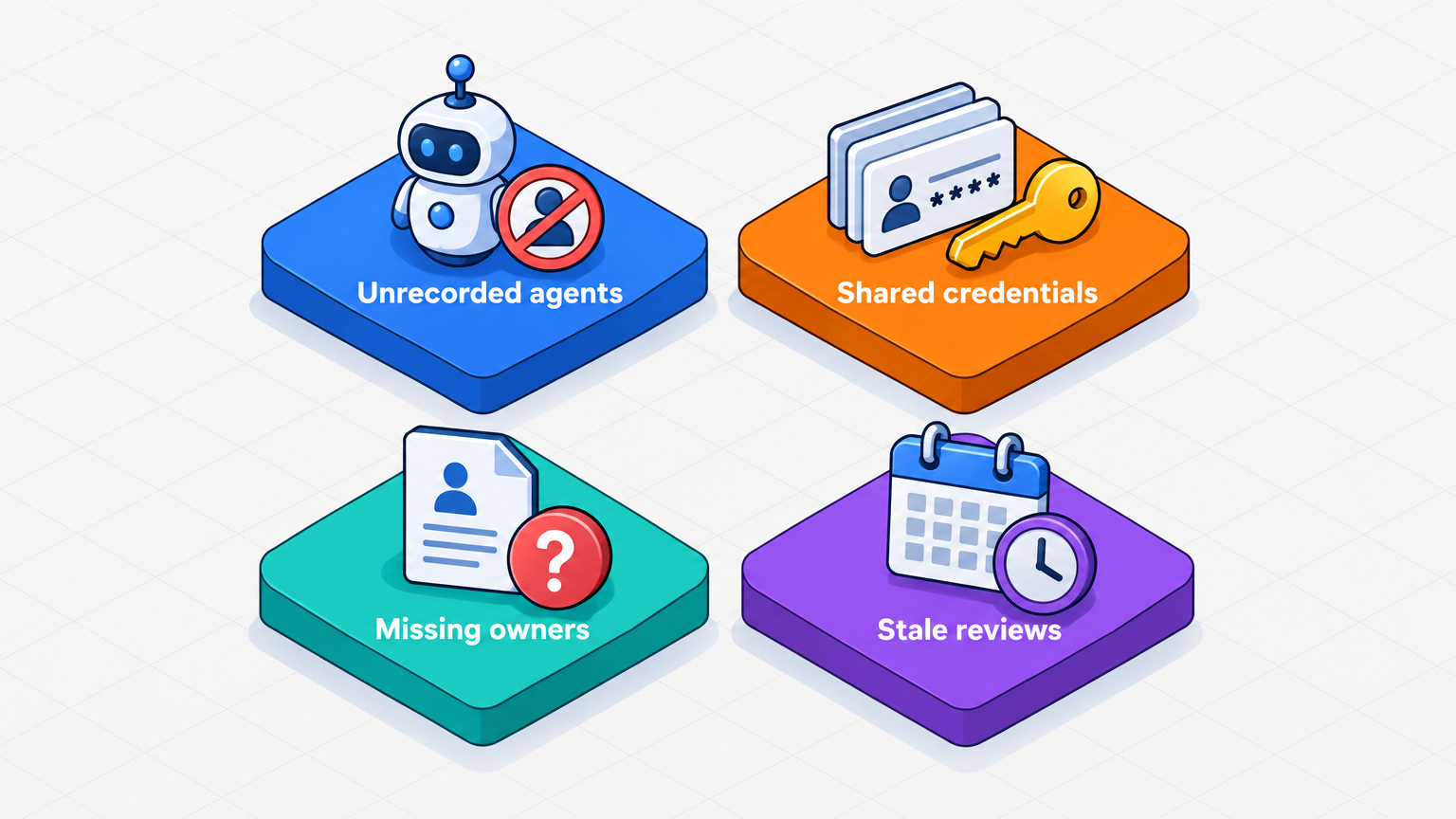
Unrecorded Agents and Shared Credentials
An agent built outside the review process has no record, and any control that depends on a record never reaches it. Agents also routinely borrow human or shared identities instead of holding distinct ones. An agent on a shared service account is hard to scope or revoke on its own, and its actions blend into everything else that account does.
Shared credentials feed excessive agency, which traces to excessive functionality, excessive permissions and excessive autonomy. A borrowed credential supplies the second by default, because the agent inherits whatever the original account could reach, not what its task requires.
Missing Owners and Stale Reviews
A one-time approval records an agent's state on the day of the review, while tools, prompts, connected data and the servers it calls keep changing. A Model Context Protocol (MCP) server that behaves safely during review can later change its tool definitions, and nothing in a completed review notices.
The NIST AI Risk Management Framework addresses this drift in GOVERN 1.5, which calls for ongoing monitoring and periodic review with roles clearly defined. Without a named owner, nobody re-reviews an agent when its scope changes, and orphaned agents keep their access after the project that created them ends.
How Do You Build and Keep an Inventory of Every AI Agent?
Security teams maintain an agent inventory at scale through continuous discovery feeding a registry that records each agent's owner, purpose and data access, because a one-time census misses every agent built after it.
Discovering Agents Across SaaS, Cloud and Developer Tools
Agents leave traces in systems security teams already operate, and each source catches agents the others miss:
Consent Logs Show Connected Apps: Identity provider consent logs record which apps users authorized and the APIs each accesses.
Sign-In Records Show Agent Identities: Sign-in records list agent identities with their granted permissions.
Signup Emails Reveal New SaaS Tools: New accounts trigger confirmation emails, a signal long used to find shadow apps.
Cloud Registries List Known Agents: Agent-building platforms catalog what is built on them, and several track MCP servers.
Repository Scans Find Unmanaged Configuration: MCP configuration committed to internal repositories reveals servers deployed without registration.
Platform registries miss agents built elsewhere, and consent logs miss agents that never request consent. Merging these feeds into one registry underpins governing AI tools and agents.
Recording Owner, Purpose and Data Access
Each record needs to be small enough to fill automatically and specific enough to act on: a responsible individual or team, human oversight roles, data provenance, the underlying models and access modes, the systems the agent can invoke, who authorized it and its operational scope.
Each record also needs an end, because decommissioning an agent safely means its identity and credentials retire with it. Abnormal's AI Governance, generally available, can help discover AI tools and agents and attribute an owner to each.
How Should Each Agent's Identity and Permissions Be Managed?
Each agent gets its own non-human identity, with credentials scoped to its task, short-lived and revocable without touching anyone else's. A shared service account removes that option, because every control applied to the account reaches everything else using it.
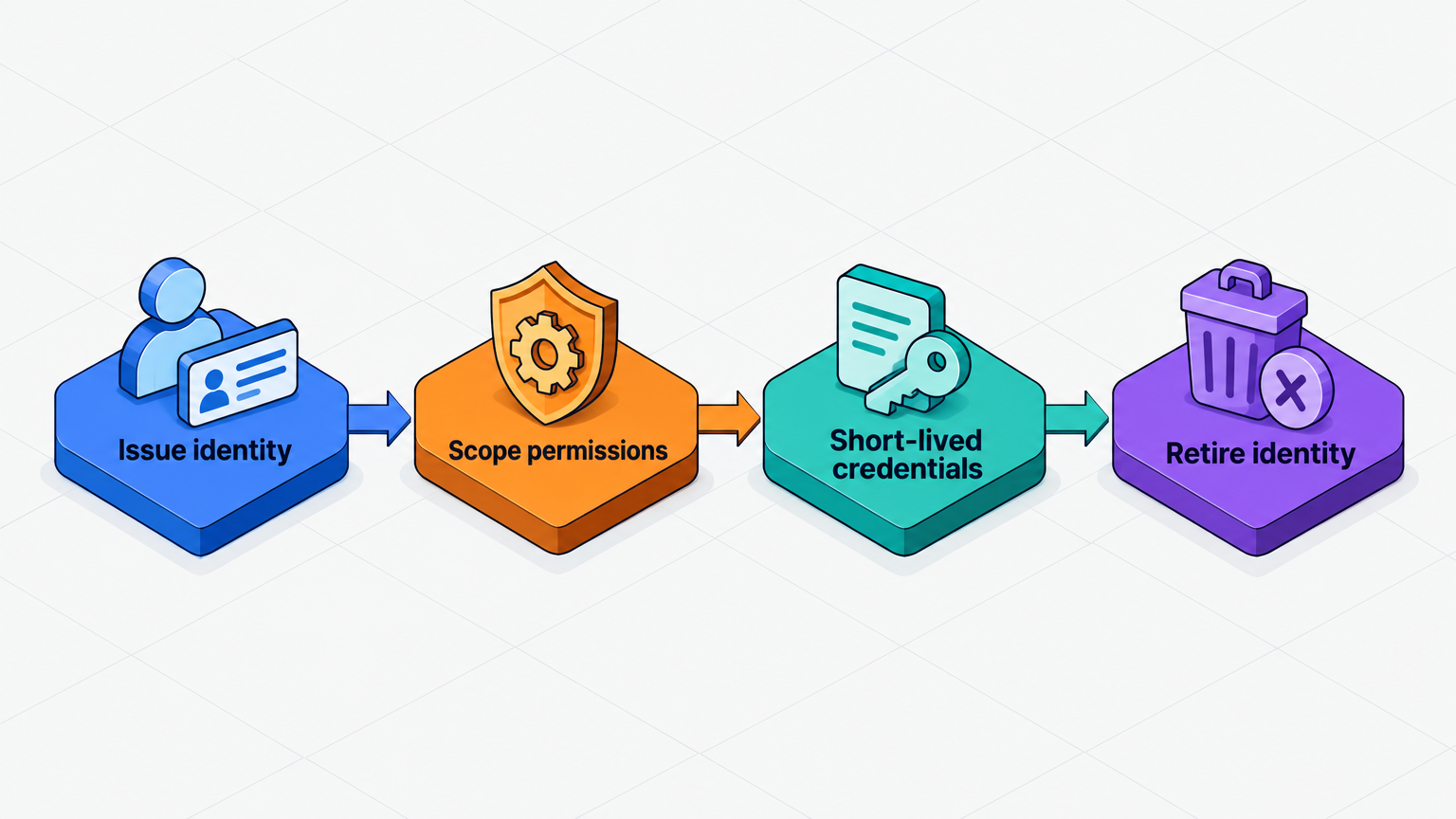
Issuing One Identity Per Agent
A distinct identity lets security teams scope, log and revoke one agent without affecting a person or another agent. Workload identity federation lets an agent trade a platform-issued token for cloud access without storing long-lived secrets, and token exchange can keep a user as subject while recording the agent as actor, giving an auditable delegation chain rather than an impersonation. Agent-specific standards are still in draft, which makes these building blocks the practical basis for agentic identity security practices teams can apply now.
Scoping Short-Lived Credentials With Least Privilege
Task-scoped, expiring credentials limit what a compromised or prompt-injected agent can do. Replacing static, long-lived secrets with ephemeral credentials, scoping privilege to the sub-task and revoking elevated rights when the task ends keeps each run's authority close to what that run actually needed.
The same principle runs through the protocol layer: a model's access stays at the minimum its operations need, and an MCP server does not pass a client's token to downstream APIs. Across hundreds of agents, rotation and revocation only keep pace when they run automatically.
What Policies Secure AI Agents at Scale by Default?
Baseline policy attaches to an agent at registration, so no agent waits for manual review and none runs without controls. Controls scale with the blast radius of unsupervised action, and human approval attaches to the riskiest actions: writes to financial systems, security configuration changes, regulated data access and anything hard to reverse.
Risk tiers set the defaults each agent inherits:
Risk tier | Example agents | Default controls |
Low | Read-only summarizer | Approved tools, read-only scopes, logging |
Medium | Agent writing to a CRM | Scoped writes, data loss prevention (DLP) rules, anomaly alerts |
High | Agent changing payments or security settings | Human approval per action, pinned tools, budgets |
Some defaults apply at every tier, starting with agents calling only approved tools and MCP servers from vetted sources, with tool definitions pinned by cryptographic hash and re-reviewed when they change. Data and DLP rules follow the classification of data an agent can reach, and budget ceilings halt any agent exceeding its allowance of tokens, calls or affected records until a human reviews it.
How Do You Monitor Agents When There Are Too Many to Watch?
Automated monitoring compares each agent against its own baseline and alerts only on deviations, letting a small team cover a large fleet.
Tool call logging is the raw material, and an agent activity record captures which agent ran, which tools it called and how many tokens it used, with prompt and tool-argument content captured only on an opt-in basis, because that content can hold sensitive data.
A baseline describes which tools an agent calls, which data it reads and at what volume, and these deviations carry most of the signal:
New Tool or Data Store: The agent reaches outside the scope its registration declared.
Volume Change: Call or token counts jump well outside the agent's own range.
Identity Change: The agent presents credentials other than those issued to it.
Monitoring covers all agent operations, not inputs and outputs alone, with rules or behavioral baselines triggering alerts or pauses. Immutable, signed audit logs make those alerts reconstructable afterward. Abnormal's AI Agent Security, in private preview as part of the AI Security suite, is designed to map each agent's credentials, tools and permissions and flag off-baseline activity.
How Do You Respond When an Agent Misbehaves?
Containment has to be wired up before an incident, because nobody has time to work out how to stop one agent among hundreds while it is still acting. A pre-wired response follows this order:
Revoke Credentials and Tokens: Kill switches and credential revocation disable rogue agents immediately, the control OWASP's Agentic Top 10 sets out for ASI10 Rogue Agents, and a stop mechanism works better when it also cuts network access.
Pause the Agent: Quarantining it in a sandbox halts further actions and preserves its state for forensic review.
Trace What It Touched: Investigators correlate agent traces, prompt logs and tool-call records by run identifier across identity, network and tool logs to establish which data the agent reached.
Restore or Retire: An agent acting outside its intended use should be disengaged or deactivated, and recovery includes rotating credentials before it returns.
Rehearsing these steps on a low-risk agent is the cheapest way to find out whether revocation reaches every token the agent holds.
Who Owns the Work to Secure AI Agents at Scale?
Agent security runs on shared ownership: security sets the rules, IT and identity teams run the identity plumbing, and builder teams answer for each agent they deploy. Roles for managing AI risk need to be documented and clear to every team involved. One workable split:
Security Sets Defaults and Runs Detection: Security defines risk tiers, approves tool and MCP server lists, owns monitoring and runs the response playbook.
IT and Identity Teams Issue and Retire Identities: Identity teams provision one identity per agent, enforce credential lifetimes and connect discovery sources to the registry.
Builder Teams Own Each Agent's Purpose: The building team names an accountable owner, declares its data needs and keeps the record current.
Writing that split down is what keeps each duty with a named team as agent counts grow.
An Agent Security Program That Grows With Adoption
As agent counts rise, security teams avoid a manual approval bottleneck by applying defaults at registration rather than relying on a review queue. Program health shows up as coverage: the share of known agents registered, owned, running on a least-privileged identity, feeding telemetry to monitoring, and with a containment path someone has actually tested.
Registration only scales once discovery has found the agents. Abnormal's AI Governance, generally available, is designed to discover AI tools and agents and attribute ownership, and AI Agent Security is in private preview. Explore the AI Security platform to see how Abnormal applies behavioral analysis across AI tools and agents.
Frequently Asked Questions
How many AI agents does a typical enterprise run?
The number varies with how far a company has adopted AI and how easily its platforms let employees build agents. It is usually higher than the count security teams can see, because agents created in SaaS tools, cloud consoles and code editors rarely pass through central review.
Should AI agents have their own identities?
Yes, each agent should have its own non-human identity instead of a shared service account or a borrowed human login. A distinct identity lets security teams scope permissions to the agent's task, attribute its actions in logs and revoke access without affecting anyone else.
Can existing identity and access management (IAM) tools govern AI agents?
Partly, in that identity providers can issue and revoke agent identities, enforce scopes and log sign-ins. They are weaker at discovering agents created outside managed platforms and judging whether an authenticated agent's behavior matches its purpose. An inventory and runtime monitoring handle both tasks alongside identity tooling.
What is the first step for a team with no agent inventory today?
The first step is discovery from sources already in place: OAuth consent grants, identity provider sign-in logs and the agent registries in cloud and SaaS platforms. Each agent found gets a record and a named owner, starting with those holding write access or reaching sensitive data.