Key Insights
Cost-effective threat detection in construction has to work for an industry where every job site, subcontractor, and cloud platform introduces a new point of failure, often without the budget or headcount to secure each one individually. In 2020, Maze ransomware forced Bouygues Construction to shut down its global IT network, halting operations across multiple countries while attackers threatened to leak stolen files. Construction remains one of the most targeted sectors for ransomware, ranking third globally with 228 reported victims in a one-year industry analysis.
Five practical, budget-conscious strategies can build threat detection into daily operations without slowing project delivery, each addressing a specific gap that distributed, multi-party construction environments create for security teams.
Key Takeaways
- Construction companies face heightened ransomware and business email compromise risk because distributed job sites, subcontractor networks, and connected equipment expand the attack surface beyond what traditional security tools can monitor.
- Legacy signature-based tools struggle to catch sophisticated impersonation and vendor-compromise attacks because they cannot distinguish legitimate subcontractor communications from fraudulent requests.
- A construction-specific risk assessment should map digital assets, data flows, and payment-approval workflows across corporate offices, job sites, and cloud platforms to identify where attackers are most likely to strike.
- Behavioral analysis and continuous incident-response improvement help construction organizations catch account compromise and payment fraud faster while adapting to seasonal and project-based communication patterns.
Why Threat Detection Matters for Construction
Construction companies operate through distributed, collaborative models that create security challenges beyond what traditional cybersecurity tools were built to handle. Cyberattacks trigger cascading operational failures when ransomware encrypts building-information-modeling files, payment systems freeze, and subcontractors lose access to essential documentation. The financial impact compounds quickly in an industry where data breaches carry steep costs: the average US data breach reached an all-time high of $10.22 million in 2025.
Construction projects also run on thin margins where every hour of downtime translates to thousands in losses. A single incident can eliminate project profitability through insurance claims, regulatory investigations, and contract penalties.
What Makes Construction Companies Vulnerable to Cyberattacks
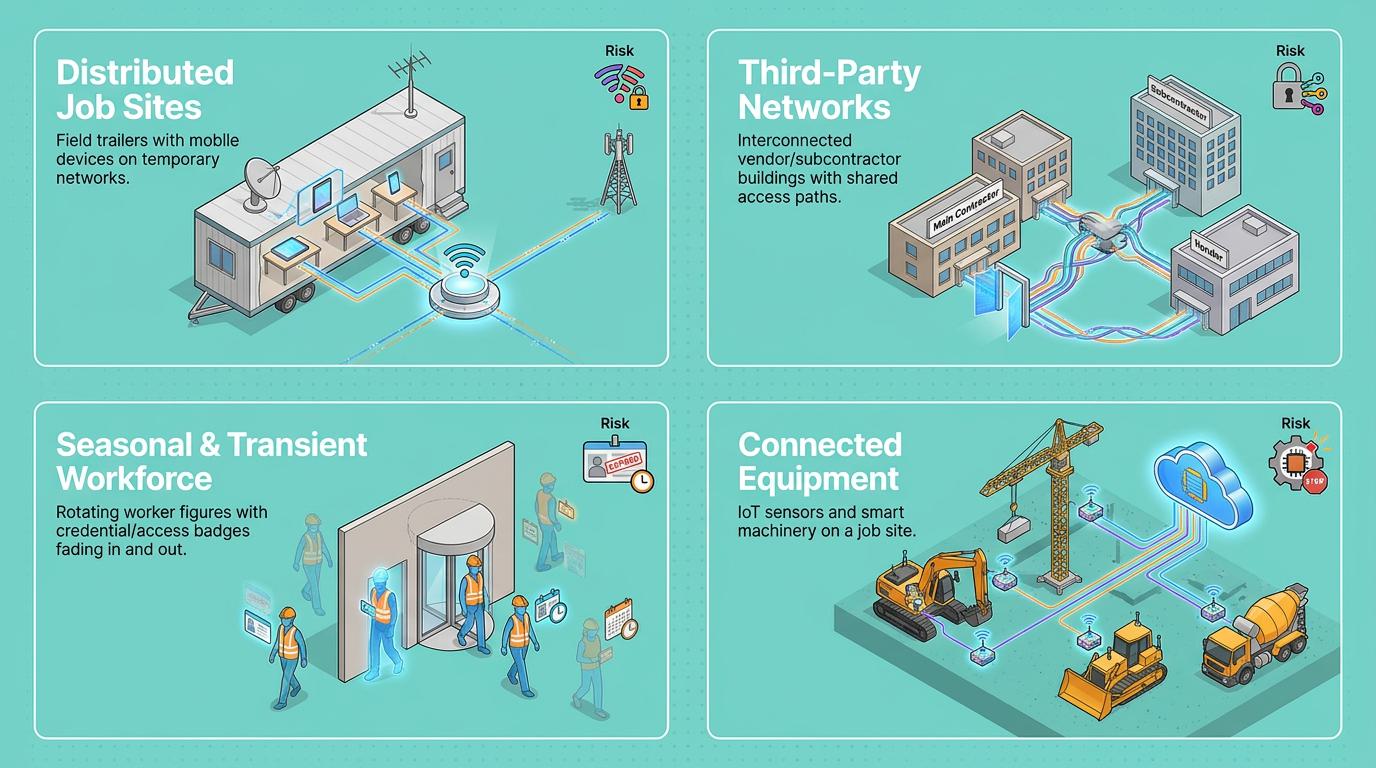
Construction companies are vulnerable because their day-to-day operations depend on scattered locations, shared vendor access, shifting crews, and connected equipment that few security tools were designed to protect. Four structural features of the industry create most of the exposure.
Distributed Job Sites
Active construction projects span dozens of locations with varying infrastructure quality and security controls. Mobile devices connect to temporary networks at job sites while field-based systems operate without corporate firewall protection. Each location represents a potential entry point that attackers exploit to reach corporate systems.
Third-Party Networks
Every project involves multiple independent companies sharing access to systems and networks. General contractors work with specialty subcontractors, equipment vendors, and design consultants, and cybercriminals use vendor email compromise to move across these connected organizations once they gain a foothold. High-value payments routed through relatively insecure email channels make this web of contractors and suppliers an especially attractive target.
Consider a project accountant who receives an email from what looks like a longtime steel supplier, asking to update the routing number on file days before a scheduled draw payment. Nothing about the message looks unusual on its own: the tone matches past correspondence, the invoice number is real, and the request arrives during a normal business week. Without a way to flag that the new account breaks from the vendor's established payment history, the funds move before anyone questions the change.
Seasonal and Transient Workforce
Construction relies heavily on seasonal labor, temporary subcontractor crews, and staff who rotate between projects as work ramps up or winds down. That churn makes consistent access provisioning difficult: workers need system credentials fast when a project starts, and those credentials often outlast the assignment because offboarding rarely keeps pace with onboarding. Dormant accounts left active after a crew moves to another job site or another employer give attackers a quiet way into project systems that no one is actively watching.
Connected Equipment
Modern construction relies on IoT sensors, building-automation systems, and smart-equipment monitoring that prioritize uptime over security. These operational-technology systems often run legacy protocols without built-in protections, which lets attackers disrupt physical operations while accessing broader corporate networks through converged infrastructure.
Poor separation between IT and OT systems is a recurring factor in incidents involving connected job-site equipment. Many of these devices were installed years before security teams considered them part of the attack surface, so they often lack basic controls like credential rotation or network segmentation that would otherwise contain a breach.
Why Traditional Security Approaches Fall Short
Legacy security tools fail in construction environments because they assume centralized operations and static infrastructure that don't exist in this industry. That mismatch, combined with the industry's thin IT staffing, creates specific gaps:
- Signature-Based Detection: Misses targeted attacks customized for construction workflows.
- Static Email Filters: Secure email gateways cannot distinguish between legitimate subcontractor communications and sophisticated impersonation attempts.
- Alert Overload: Volume overwhelms lean IT teams managing infrastructure across corporate offices, job sites, and cloud platforms without dedicated security analysts.
- Constant Manual Tuning: Traditional tools demand ongoing rule-writing that construction companies rarely have the staff to provide.
- Generalist IT Coverage: Many firms rely on IT generalists splitting time between help-desk support, vendor onboarding, and security, leaving little room for detection work.
A methodical approach tailored to construction's operational realities can close this gap.
Five Strategies for Cost-Effective Threat Detection in Construction
Effective threat detection in construction layers assessment, compliance, monitoring, analysis, and response into one continuous process, with each of the five strategies below building on the last.
Conduct a Construction-Specific Risk Assessment
A construction-specific risk assessment maps digital assets, data flows, and high-value targets across every corporate office, job site, and cloud platform to show where security investment should go first. Document data flows between contractors, subcontractors, and clients, and flag high-value targets such as Building Information Modeling (BIM) files, project financials, and client data.
Focus particularly on email security gaps by evaluating payment-approval workflows, subcontractor onboarding, and project communication patterns that attackers might exploit. This assessment typically reveals that most vulnerabilities originate from third-party access and email-based threats, which should shape where security resources go first. Business email compromise remains one of the costliest categories of cybercrime reported to federal law enforcement, and contracting firms are consistently among the industries most affected by ransomware complaints.
Establish a Framework Compliance Foundation
Implement the NIST Cybersecurity Framework 2.0 as a foundational structure for identifying, protecting against, detecting, responding to, and recovering from incidents. Federal contractors should integrate Cybersecurity Maturity Model Certification (CMMC) requirements from the earliest design phases of any system touching government work.
The CMMC Phase II suspension took effect in 2026 pending a review, but underlying NIST SP 800-171 obligations and DFARS contractual requirements to safeguard covered defense information remain fully enforceable. Layering in construction-specific controls reduces audit-preparation time and satisfies insurance requirements that increasingly mandate structured cybersecurity programs:
- Mobile Device Management: Protocols covering devices used at job sites.
- Subcontractor Security Requirements: Baseline security terms written into contracts.
- Data Classification: Schemes that categorize project documentation by sensitivity.
Cyber insurance underwriters have grown more specific about what they expect to see before issuing or renewing a policy, often asking for documented access controls, incident-response plans, and evidence that subcontractor agreements include baseline security requirements. Firms that can point to a framework-aligned program rather than an informal set of practices typically move through underwriting faster and avoid coverage gaps that surface only after an incident.
Deploy Monitoring and Data Collection Infrastructure
AI-based detection systems need complete visibility to establish behavioral baselines across distributed operations. Centralized logging that captures security events from all locations, fed by lightweight collection agents at job sites rather than new on-site hardware, gives security teams that visibility at a fraction of the cost of a traditional sensor rollout.
Prioritize email-security monitoring since most construction attacks originate through email channels. Capturing communication metadata, attachment analysis, and user-interaction patterns, alongside monitoring payment-approval workflows and vendor communications for anomalies, lets detection systems learn what normal operations look like for a given organization. Ransomware and human error remain present in a large share of confirmed breaches industry-wide, which makes monitoring both endpoints and communication channels essential rather than optional.
Integrate AI-Powered Behavioral Analysis
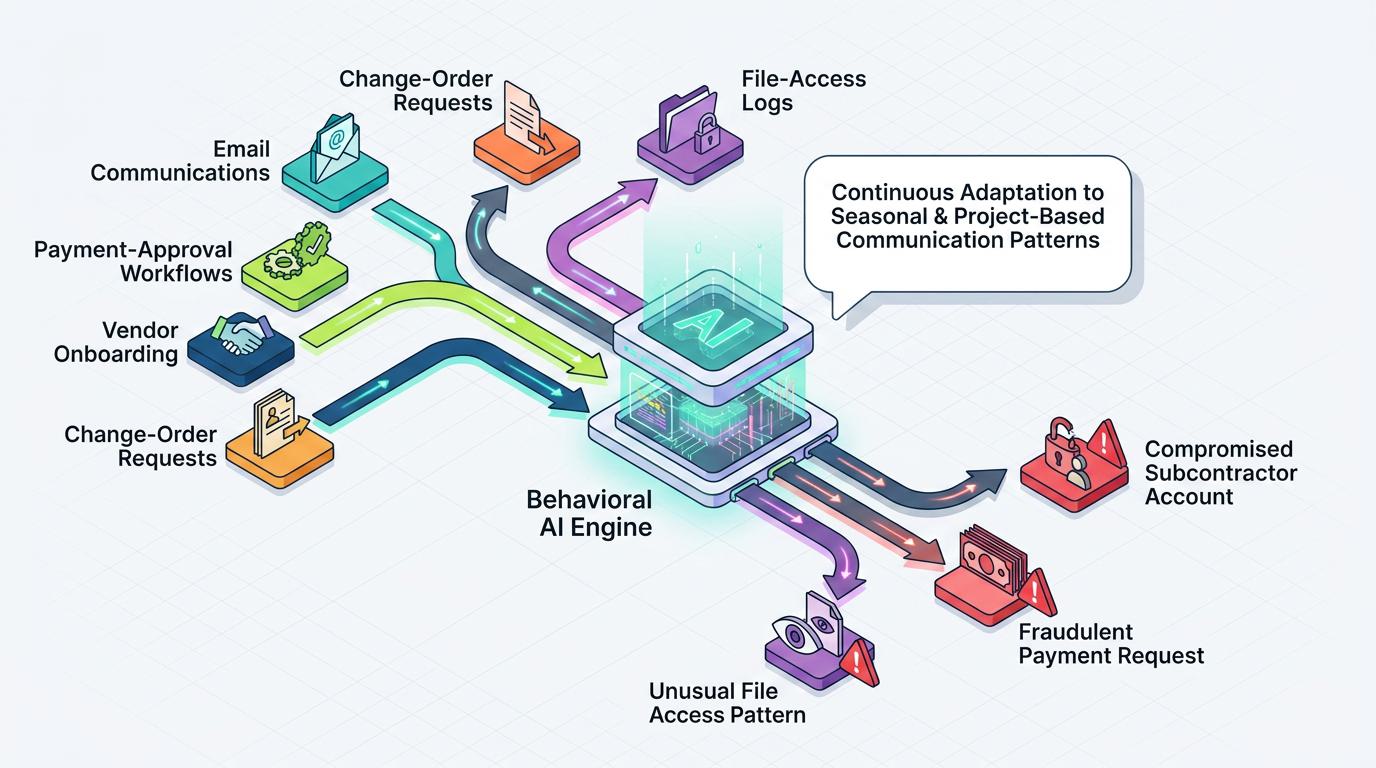
Deploy behavioral AI tools built for distributed environments that adapt to seasonal variation, project-based communication patterns, and multi-party collaboration. Configure these systems to recognize construction-specific activities including milestone-payment processes, change-order workflows, and request-for-information patterns.
Behavioral analysis identifies threats such as compromised subcontractor accounts sending fraudulent payment requests and unusual file-access patterns that suggest data theft. Because it continuously adapts, this kind of analysis improves detection accuracy over time while reducing the false positives that waste analyst hours and drive up the cost of running a lean security team.
Establish Response and Continuous Improvement Processes
Develop construction-specific playbooks, with clear communication protocols for subcontractors, clients, and regulators, that cover:
- Ransomware Containment: Steps for isolating affected systems and preserving evidence.
- Business Email Compromise Response: Procedures for business email compromise incidents.
- Data-Breach Notification: Requirements for notifying clients, regulators, and partners.
- Automated Response: Capabilities that isolate compromised accounts, revoke suspicious access, and activate backup communication channels while limiting the operational disruption and recovery costs a manual response would add.
Establishing feedback loops between incident response and detection systems turns each incident into an opportunity to refine detection rules and behavioral models. Over time, this continuous-improvement cycle closes gaps that a one-time deployment would leave open.
Building Detection That Matches Construction's Complexity
Construction's distributed job sites, layered vendor relationships, and connected equipment will keep creating security gaps that static, centralized tools cannot close. The strategies outlined here work together: a clear risk assessment shows where to focus, compliance frameworks set the baseline, and monitoring paired with behavioral analysis catches what signature-based tools miss. Feeding incident data back into detection rules keeps defenses current as projects, vendors, and threats change. Construction firms that treat threat detection as a continuous process, not a one-time project, are best positioned to protect the margins their industry depends on.