
Key Insights
Phishing defense remains fragmented.
Employees report suspicious emails, analysts manually review them, awareness teams run simulations from generic templates, and leadership tracks click rates in the hope that all of this will lead to improved security behavior.
And yet:
99% of organizations still experience human-error incidents.
83% of security leaders say their awareness training is ineffective and too time-consuming.
Security teams are overwhelmed with user-reported email, and awareness programs struggle to drive measurable behavior change. At the executive level, CISOs lack clear visibility into whether reporting activity translates into actual risk reduction.
The problem isn’t a lack of effort. It’s the way phishing defense is structured.
Detection, remediation, and training function as separate workflows rather than a coordinated system.
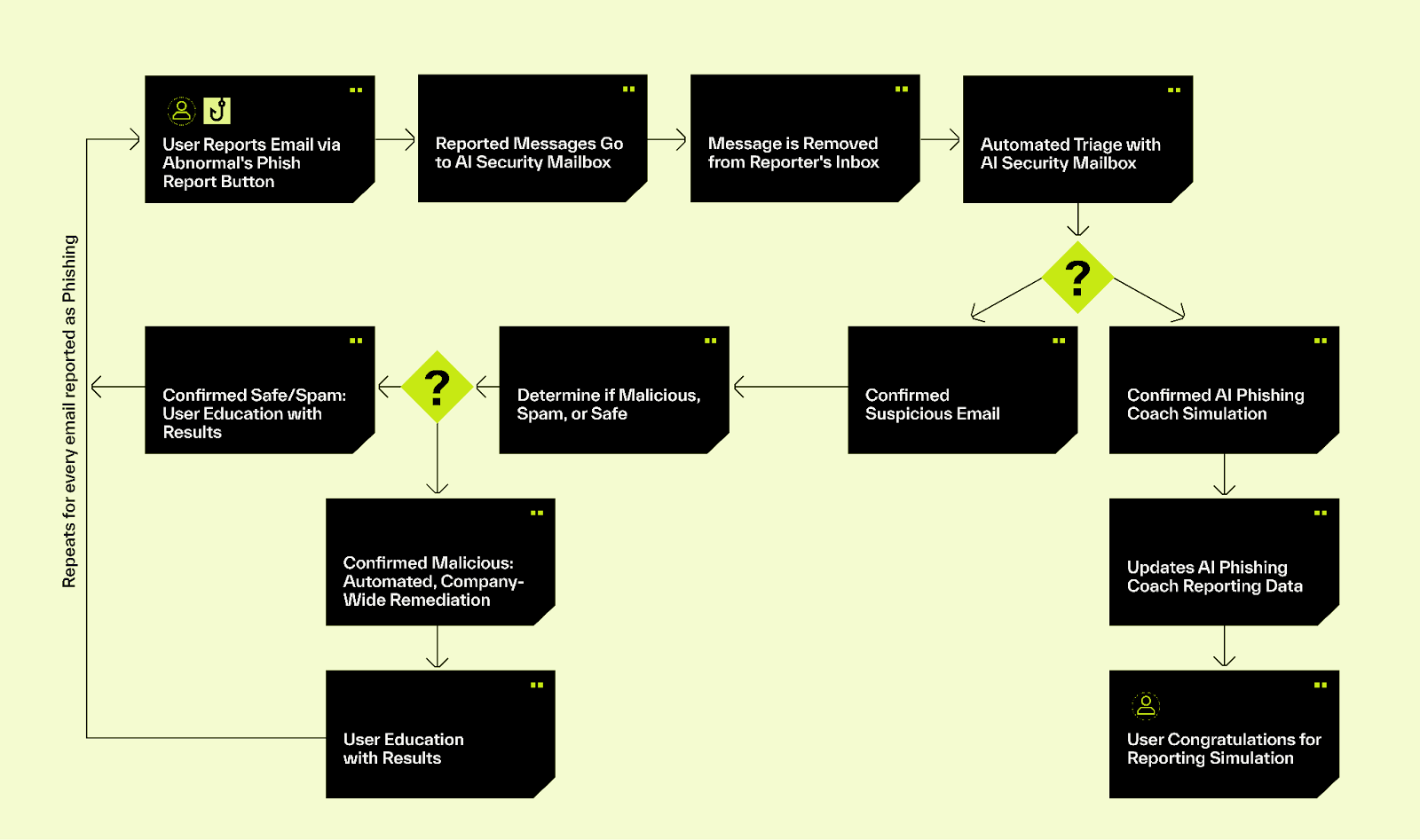
AI Security Mailbox and AI Phishing Coach address this structural gap by connecting remediation and coaching into a single, closed-loop system. Every reported email triggers automated remediation and adaptive coaching, aligning operational response with behavioral improvement.
Reporting Without Automation Creates Noise
Most organizations already have a phishing report button. But what happens after someone clicks it determines whether reporting reduces risk or creates more work.
In many environments:
Reports land in a shared mailbox.
Analysts manually triage and classify each message.
Confirmed threats require separate remediation workflows.
Awareness programs run independently from real attacks.
Security teams remediate real threats while awareness teams simulate hypothetical ones, and the two workflows rarely inform each other.
That disconnect has measurable consequences.
SOC teams spend hours reviewing emails that could be classified automatically. Security awareness leaders struggle to make training feel relevant, and at the executive level, reporting metrics offer little evidence that risk is actually declining.
When reporting fails to drive remediation—and remediation fails to inform coaching—phishing defense remains reactive rather than adaptive.
Step 1: One-Click Reporting That Drives Action
The Abnormal Phish Report Button provides a consistent, simple mechanism for employees to report suspicious emails. But unlike traditional report buttons, it doesn’t route messages into a manual queue.
Instead, each submission is forwarded to an Abnormal-managed abuse mailbox, where AI Security Mailbox immediately analyzes it alongside other detected and user-reported attacks in real time. Classification begins immediately, with full context preserved.
For employees, reporting remains a single click. For security teams, that click initiates automated triage at scale.
Step 2: AI Security Mailbox Eliminates Manual Triage
AI Security Mailbox operates continuously, replacing manual review queues with round-the-clock classification and remediation. It automatically:
Classifies each reported email as malicious, spam, safe, or simulation
Identifies related emails across the organization
Removes confirmed threats at scale
Surfaces complete attack context
Organizations reduce user-reported email review time by up to 95%, saving thousands of SOC analyst hours annually.
Threats are remediated in minutes rather than hours, campaigns are contained before they spread, and analysts are freed to focus on higher-value investigations instead of repetitive review tasks.
Automation resolves the triage bottleneck. But reducing phishing risk also requires influencing employee behavior.
Step 3: Train On Real Attacks, Not Generic Simulations
Most awareness platforms rely on template-driven simulations that measure click rates and assign follow-up modules, yet those simulations often feel disconnected from the threats employees actually face.
AI Phishing Coach connects real attacks to real-time coaching.
When AI Security Mailbox confirms a malicious email, AI Phishing Coach immediately:
Defangs the real threat
Converts it into a realistic phishing simulation
Delivers contextual, personalized coaching
Incorporates the threat into future simulation generation
Employees don’t just receive a warning; they see why the email was malicious, which signals indicated risk, and what actions were taken. Correctly reporting a simulation reinforces positive behavior, while reporting a real attack provides immediate context and feedback.
Training becomes continuous, personalized, based on real threats, and embedded into daily workflow.
Because AI Phishing Coach is powered by AI Security Mailbox’s classification engine, simulations evolve alongside the threat landscape targeting the organization. The training reflects reality, not a static content library.
Step 4: Close the Loop with Real-Time Feedback
For every reported email, employees receive a clear explanation of the outcome and the remediation steps taken. They can ask follow-up questions and receive plain-language responses aligned with company policies.
This feedback loop reinforces learning in context. Employees understand what occurred, security teams demonstrate responsiveness, and trust increases across the organization.
Over time, each reported email strengthens both detection accuracy and employee behavior. This is the difference between activity and measurable improvement.
A System That Reduces Risk Over Time
Many vendors offer a report button and a training platform, but adjacent capabilities are not the same as integrated outcomes.
AI Security Mailbox delivers automated classification, campaign-wide remediation, and full attack context, while AI Phishing Coach builds on that foundation to deliver adaptive, threat-driven coaching. Together, they align detection, response, and training within a single closed-loop system.
Every reported email fuels automated remediation, adaptive simulation generation, personalized feedback, and measurable behavior change—without increasing analyst workload.
From Operational Efficiency to Measurable Risk Reduction
By pairing AI Security Mailbox with AI Phishing Coach, organizations are able to:
Automate the majority of user-reported email triage
Save thousands of SOC hours annually
Deliver personalized, real-time coaching
Strengthen phishing awareness across the workforce
Security teams recover meaningful time, employees receive actionable feedback, and leadership gains measurable visibility into human risk reduction. This is the structural benefit of a closed-loop phishing defense.
Closing the Loop
Organizations already using AI Security Mailbox can extend automated remediation into adaptive, threat-driven coaching with AI Phishing Coach.
For teams evaluating awareness platforms, the critical consideration is whether simulations operate in isolation or as part of a broader system. Reporting, remediation, and coaching should function as a unified system rather than disconnected workflows.
To explore how Abnormal AI Security Mailbox and AI Phishing Coach reduce phishing risk while eliminating manual triage, schedule a personalized demo.