Wichtige Erkenntnisse
The average cost of a data breach climbed to $4.88 million in 2024, a 10% jump and the highest total on record, according to IBM's Cost of a Data Breach Report. Phishing and stolen or compromised credentials rank among the costliest initial attack vectors behind that number, and both sit at the heart of how business email compromise now plays out.
As sophisticated modern email threats grow more convincing and advanced business email compromise (BEC) attack tactics evolve, legacy security measures may no longer offer sufficient protection. AI-based business email compromise prevention tools close that gap by analyzing how people actually communicate, flagging requests that break from established patterns before money moves or data leaves the organization.
What follows is a practical look at how AI and behavioral analysis change the detection equation, where the hardest gaps remain, and what effective implementation looks like in day-to-day operations.
Key Takeaways
Legacy tools like spam filters and signature-based detection often struggle to stop BEC attacks that contain no malicious links, attachments, or malware.
AI-driven solutions are designed to identify novel attacks by flagging deviations from behavioral patterns rather than matching known threat signatures.
Email authentication standards reduce domain spoofing but leave gaps around compromised accounts and lookalike domains that behavioral analysis helps close.
A phased rollout can prioritize executives and finance teams because of their roles in payment workflows and executive impersonation.
General Data Protection Regulation (GDPR), Health Insurance Portability and Accountability Act (HIPAA), and California Consumer Privacy Act (CCPA) breach-notification requirements raise the stakes for missed threats.
Why Organizations Need Advanced BEC Solutions
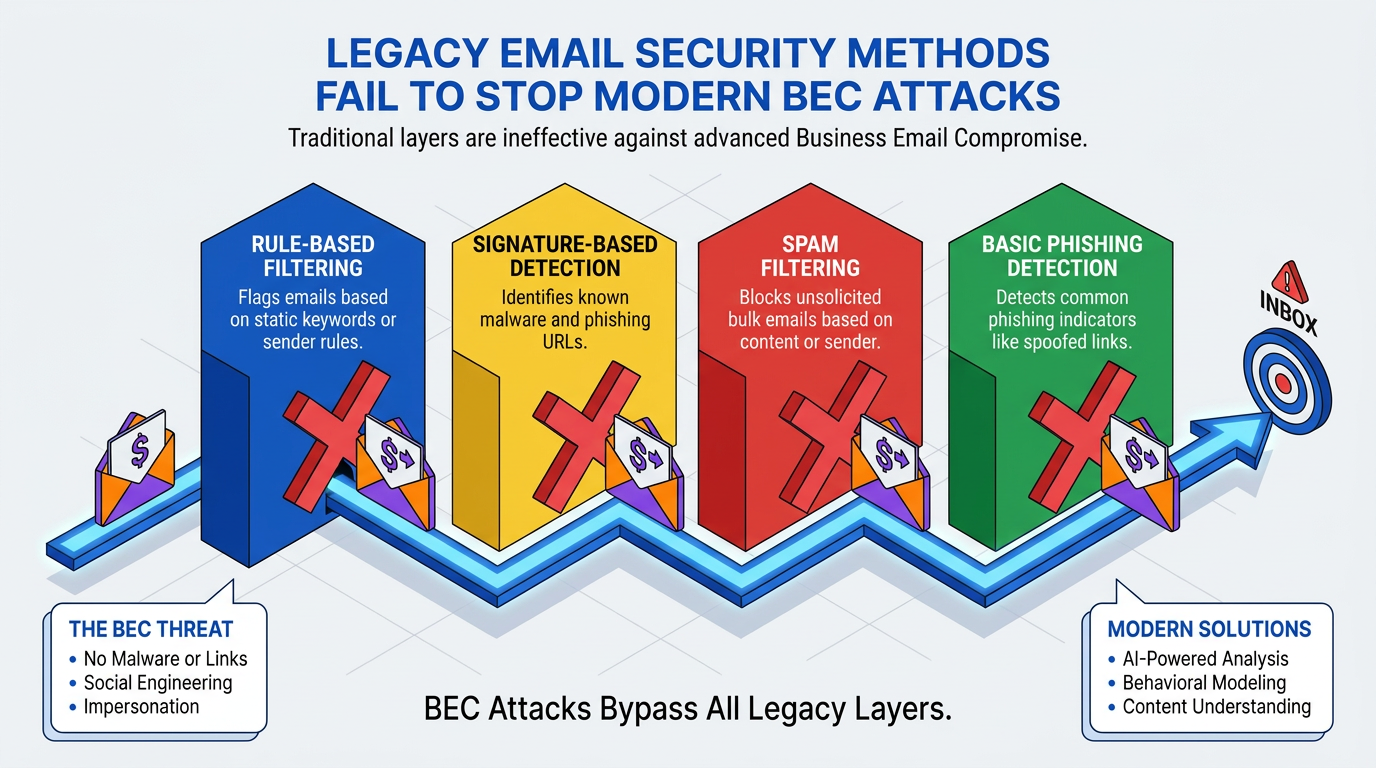
Advanced BEC solutions proactively detect suspicious behavior, analyze anomalies in communication between senders and recipients, and help stop attacks before they reach end users.
Basic email security solutions rely on older methods:
Rule-Based Filtering: This method blocks emails based on predefined parameters.
Signature-Based Detection: This method identifies known malware patterns.
Spam Filtering: This method uses keywords or blacklists.
Basic Phishing Detection: This method focuses on suspicious links or domains.
These reactive approaches may miss threats that do not match known indicators, which leaves organizations exposed to never-before-seen attack methods, including advanced BEC attack schemes. The financial toll of that exposure is substantial. According to the Federal Bureau of Investigation (FBI) Internet Crime Report, BEC losses reached $3.046 billion in 2025.
Organizations increasingly need advanced BEC solutions because:
Threat Actors Are Using AI and Social Engineering: Cybercriminals now use generative AI content creation to produce convincing material and correct errors that would otherwise signal fraud.
Attack Volumes Are Overwhelming Security Teams: Manual investigation alone can no longer keep pace with the volume of threats security teams face.
Attacks Are Spreading Beyond the Inbox: FBI reporting describes criminals compromising legitimate accounts instead of only spoofing them, then reinforcing requests over phone calls and video meetings, so behavioral email defenses can pair with out-of-band verification for those follow-ups.
Compliance Pressures Are Increasing: GDPR breach notification guidance, HIPAA's breach notification rule, and California's approved CCPA cybersecurity audit regulations all raise the stakes for a missed compromise.
By applying AI, machine learning, and behavioral analysis, modern email security solutions can adapt as attacker tactics change.
Abnormal is designed to enhance this protection through cloud-native API integrations, anomaly detection, and behavioral AI that learns how executives, vendors, and finance teams normally communicate through email. It works alongside existing email gateway (SEG) technology, security information and event management (SIEM) platforms, and identity tools. Wiring instructions sent outside business hours, for example, or a sudden change to a supplier's banking details would stand out against established vendor patterns and surface for review.
Core Components of Modern Email Security Solutions Against Advanced BEC
Effective advanced BEC solutions combine several technologies to address sophisticated email impersonation attacks, and these components work together to deliver complete protection.
AI and Machine Learning for Threat Detection
AI and machine learning technology form the backbone of modern email defenses. These technologies:
Analyze large datasets to identify emerging threat patterns.
Establish patterns of normal communication behavior, including recipient behavior, workflow cadences, and typical timing.
Detect subtle anomalies without relying on static threat signatures.
Prioritize suspicious messages for investigation.
AI-driven email security solutions are designed to detect never-before-seen attacks based on deviations from expected behavior, which matters most for BEC, where the malicious element is usually a request rather than malware. A compromised vendor account asking to update payment instructions can pass content scans; behavioral patterns show whether the request fits how that vendor normally communicates.
Advanced Threat Prevention Against Sophisticated Attacks
Advanced BEC solutions layer multiple detection techniques to help stop the delivery of malicious emails. Effective platforms offer:
Pre-delivery inspection of content, URLs, attachments, and sender reputation.
Zero-day detection using sandboxing, machine learning, and heuristic analysis.
Post-delivery monitoring to identify threats missed at first glance.
This multi-layered email prevention model helps address sophisticated phishing, invoice fraud, vendor compromise, and impersonation attempts. Post-delivery monitoring can also catch a follow-up wire transfer or payment-change request that a compromised account sends after a clean opening message.
Data Loss Prevention (DLP) Integration
Enterprise DLP safeguards help keep sensitive information from leaving the organization unintentionally. Leading platforms:
Classify sensitive content and apply appropriate protection policies.
Detect risky behavior, such as sending sensitive data to unauthorized recipients.
Integrate with enterprise DLP strategies across cloud environments.
Behavioral insights from outbound email patterns further strengthen DLP by spotting unusual outbound activity that could signal insider threats or account compromise, helping teams distinguish routine sharing from activity that warrants review.
User Authentication and Identity Protection
Authentication confirms where a message came from, but not whether the account behind it is behaving like its real owner. That is the gap advanced email identity security closes. Solutions reinforce protection by:
Enforcing Domain-based Message Authentication, Reporting, and Conformance (DMARC), Sender Policy Framework (SPF), and DomainKeys Identified Mail (DKIM) standards to verify sender authenticity.
Monitoring login behaviors to detect account takeover attempt patterns.
Integrating with multi-factor authentication systems to block unauthorized access.
Analyzing behavioral, session, device, and identity signals.
SPF, DKIM, and DMARC reduce malicious email sent from spoofed domains but may not stop email sent from a compromised legitimate account, and DMARC addresses domain spoofing rather than lookalike domains or display-name abuse.
Hijacked accounts and lookalike domain attack methods are tactics BEC attackers rely on, and behavioral analysis of who is sending, to whom, and with what request can help identify compromised accounts before damage occurs.
6 Steps to Successfully Implement an Advanced BEC Solution
Deploying an advanced email security solution successfully requires alignment with your organization's infrastructure, operational priorities, and broader security strategy. Choices around deployment models, integration workflows, phased rollouts, automation, user education, and continuous optimization all directly affect your ability to defend against sophisticated BEC threats.
1. Select the Right Deployment Model
Choosing a deployment model, cloud, on-premises, or hybrid, shapes how your email security platform operates and scales. Organizations can evaluate three primary deployment options:
Cloud-Native Deployments: Cloud-native email security solutions offer automatic updates, lower maintenance overhead, and scalability for distributed workforces.
On-Premises Deployments: Organizations may choose on-premises deployments for greater control over data privacy, customization, and strict sovereignty requirements.
Hybrid Deployments: Organizations may choose hybrid approaches to keep sensitive data in-house while using cloud-based threat detection for scale.
Selection criteria can include:
Assess their data sensitivity and compliance obligations.
Review existing infrastructure, cloud maturity, budget, and integration needs.
Consider the geographic distribution of users and assets.
The right model helps defenses evolve alongside both operational needs and the way attackers operate.
2. Integrate Tightly with Existing Security Systems
Email security works best when it integrates tightly with your broader security architecture, maximizing visibility and coordinating detection and response.
Leading platforms use API-based security integrations that connect directly to cloud email and security environments without rerouting email traffic. This approach supports efficient deployment and deeper automation across the security stack.
Critical email integration points include:
SIEM Platforms: These platforms centralize telemetry.
Security Orchestration, Automation, and Response Systems: These systems support automated workflows.
Identity and Access Management Tools: These tools help correlate user behaviors.
Threat Intelligence Platforms: These platforms enrich detection with external data.
A fully integrated system helps the security operations center (SOC) act faster against sophisticated email-based attacks.
3. Start with Phased Deployment
A phased, risk-based rollout can protect high-value users early while minimizing operational disruption.
A rollout can begin with executives, finance and accounting teams, and other users involved in payment workflows. Pilot deployments allow teams to:
Confirm that the platform delivers legitimate emails properly.
Confirm security controls do not block critical communications.
Test user reporting and remediation workflows.
Effective change management means communicating the plan, explaining the benefits, and preparing users for how email threats will be handled.
An illustrative enterprise deployment roadmap can include:
Setup and Configuration: Teams configure the platform for the organization's environment.
Pilot Deployment: Teams introduce protection to high-risk departments.
Evaluation and Adjustment: Teams collect feedback and adjust the system.
Gradual Rollout: Teams extend protection to remaining departments.
Operational Handoff: Security and IT teams move the platform into standard operations.
API-based email security platforms can compress this work, introducing advanced protection without rerouting mail traffic or interrupting workflows.
4. Automate Response and Remediation
Automating detection, investigation, and remediation processes can reduce response times, shorten attacker dwell time, and lighten the load on security teams. Capabilities to prioritize can include:
Automated quarantine of suspicious emails before user interaction.
Dynamic analysis of unusual communication patterns after delivery.
Post-delivery remediation to retract identified threats from affected mailboxes.
Account lockout automation when signs of credential compromise appear.
Abnormal provides automated remediation once the system detects a threat. This can retract dangerous messages without relying on user reporting processes alone. This shrinks attackers' window of opportunity while improving response consistency.
5. Prioritize User Training and Awareness
AI-powered email security and educated users are complementary defenses.
Teams can strengthen user awareness with:
Short, regular security training sessions tied to real-world threat examples.
Clear, accessible reporting mechanisms for suspicious emails.
Recognition programs that reward threat reporting.
Communication of success metrics to reinforce program value.
Out-of-band verification of payment or banking-detail change requests through a known phone number before money moves.
Teams can also update security awareness training programs regularly and run simulated phishing exercises that mirror real attack techniques. CISA phishing prevention guidance also supports combining technical controls with user education. Training should teach users that polished grammar no longer signals legitimacy, and that a request reinforced by a call or video meeting still deserves scrutiny.
6. Refine Protection Continuously
Maintaining effectiveness requires proactive tuning and threat intelligence platform integration.
Key practices include:
Reviewing quarantined emails to fine-tune filtering accuracy.
Creating safe sender lists with dynamic monitoring for changes in behavior.
Implementing user-driven feedback loops for false positives.
Adjusting sensitivity based on threat trends and risk tolerance.
Integrating external threat intelligence sources can further improve detection through:
Subscribe to industry-specific intelligence feeds.
Participate in threat-sharing communities.
Use vendor-provided threat intelligence gathered across a broad customer base.
Quarterly reviews of detection metrics and user feedback, plus simulations folded into annual penetration testing, help validate system performance.
Because it continuously learns what normal communication looks like, the platform is designed to maintain high accuracy with minimal manual tuning and reduce email false positives as it adapts to new threats.
How to Evaluate the Impact of Advanced BEC Solutions
Security teams can measure how an advanced BEC solution performs against key security and operational benchmarks.
Track the Right Performance Indicators
Teams can monitor key email security metrics to validate the effectiveness of a solution:
Threat Detection Rate: The percentage of phishing, malware, and BEC attempts blocked before reaching user inboxes.
Mean Time to Detect (MTTD): The average time to identify a malicious email after it enters the environment.
Mean Time to Respond (MTTR): The average time from detection to complete remediation of an email-based threat.
False Positive Rate: The percentage of legitimate emails that the system incorrectly flags as threats, affecting user productivity.
Helpdesk Ticket Volume: Employee-reported email security incidents requiring IT or security team intervention.
High detection accuracy combined with low disruption maximizes the impact of an advanced BEC solution.
For board reporting, MTTD and MTTR show how quickly an incident is contained relative to regulatory notification windows, and false positive rate shows the alert burden a tool creates or reduces. Teams can review shared metrics monthly to catch gaps before they become incidents.
Analyze Total Cost of Ownership
A total-value analysis can go beyond upfront licensing costs by evaluating:
Evaluate deployment speed and ease of integration with existing infrastructure.
Assess administrative workload and ongoing management needs for security teams.
Determine whether long-term scalability supports organizational growth and rising threat volumes.
Weigh avoided breach costs against licensing fees.
AI-driven solutions can minimize maintenance and adapt as attacker tactics change. Comparing operational outcomes, such as ticket volume, remediation time, and integration effort, alongside licensing cost gives security leaders a clearer view of whether a solution reduces risk without adding administrative work.
Build a Stronger Defense Against Advanced BEC Threats
Modern email security starts with defenses that account for identity, behavior, and communication context. By combining native cloud protections with intelligent behavioral-based email security platforms, organizations can address advanced BEC threats that authentication and signature-based tools were never designed to catch.
Abnormal uses Human Behavior AI technology to learn how executives, vendors, and teams normally communicate through email, then helps surface deviations, often before significant damage occurs, strengthening protection against AI-driven and social engineering BEC tactics. Abnormal earned a Customers' Choice distinction in the 2026 Gartner® Peer Insights™ Voice of the Customer for Email Security.
Security and IT teams evaluating an advanced BEC solution can see this behavioral approach applied to their own environment. Book a demo to get started.
Frequently Asked Questions
How Does Behavioral AI Detect BEC Attacks Differently From Traditional Signature-Based Email Security Tools?
Signature-based tools compare emails against known threat indicators like malware hashes or phishing templates, which leaves them blind to novel attacks with no detectable payload. Behavioral AI instead shifts the question from what the email contains to whether the request fits the established context, which matters most for BEC, where the dangerous element is usually a fraudulent instruction rather than a technical exploit.
What Are the Most Effective Strategies for Protecting Executive and Finance Teams From Business Email Compromise?
Pair technical defenses with policy controls that remove single points of failure in high-risk workflows:
Dual-Approval Requirements: Require two approvers for payment changes or wire transfers above a defined threshold.
Restricted Channels: Keep financial communications on designated channels such as a secure portal, and train teams to reject urgent payment demands that arrive elsewhere.
Conditional Access Controls: Deploy session timeouts and reauthentication requirements for finance systems accessed from new devices or locations.
Tabletop Exercises: Simulate BEC scenarios with finance and executive teams to test response protocols and surface process gaps before attackers exploit them.
How Can Organizations Measure the ROI of Implementing an AI-Powered BEC Prevention Solution?
Weigh avoided breach costs, such as wire transfer losses prevented and regulatory fines sidestepped, against licensing, integration labor, and ongoing maintenance. Factor in efficiency gains like reduced analyst triage hours and fewer helpdesk tickets, and track false-positive rates since blocked legitimate emails carry their own hidden costs. A six-to-twelve-month measurement window typically provides enough data to establish clear trends while accounting for seasonal business cycles.
How Should Organizations Handle BEC Compliance Requirements Under GDPR, HIPAA, and CCPA Breach Notification Rules?
Align detection and response timelines with regulatory windows (roughly 72 hours for GDPR and 60 days for HIPAA), and route suspected BEC incidents directly to compliance officers so legal review runs alongside technical response. Document every incident end to end, including timestamps, affected data types, and remediation steps, and maintain system activity logs to satisfy CCPA cybersecurity audit requirements.