Key Insights
Email security for education has become a board-level concern as ransomware and phishing attacks against schools and universities keep escalating. On February 2, 2025, a ransomware attack knocked the University of The Bahamas offline, canceling online classes and email access campus-wide.
This incident reflects a disturbing trend targeting educational institutions worldwide. Eight months earlier, on June 13, 2024, cybercriminals exposed the personal data of 46,169 university students across the United States on a cybercrime forum. The breach compromised names, email addresses, and other sensitive identifiers, leaving students vulnerable to identity theft and ongoing cyber exploitation.
As a result, it comes as no surprise that educational institutions face mounting pressure as email-based attacks create operational chaos, regulatory scrutiny, and significant financial losses when security defenses fail. Phishing campaigns serve as the primary gateway for adversaries seeking initial network access, with ransomware attacks following close behind. Phishing remains the primary way attackers gain a foothold in campus networks, and that combination of high exposure and thin security budgets is what makes education one of the most consistently targeted sectors in cybercrime — and why AI-driven detection is becoming a practical necessity rather than an upgrade.
Key Takeaways
- Educational institutions paid an average of $4.15 million per data breach in 2026, and legacy, signature-based defenses increasingly miss the attacks that cause them.
- Constant turnover among students, faculty, and contractors makes it difficult to build lasting security awareness, since few users have the institutional knowledge to spot subtle impersonation.
- Behavioral AI models normal communication patterns for every mailbox, which lets it flag account takeovers and impersonation attempts that static filters and blocklists miss entirely.
- Closing the gap requires pairing smarter detection with role-specific training, since the same public faculty directories and open communication culture that make campuses collaborative also make them easy to research and impersonate.
Why Email Security Matters in Education
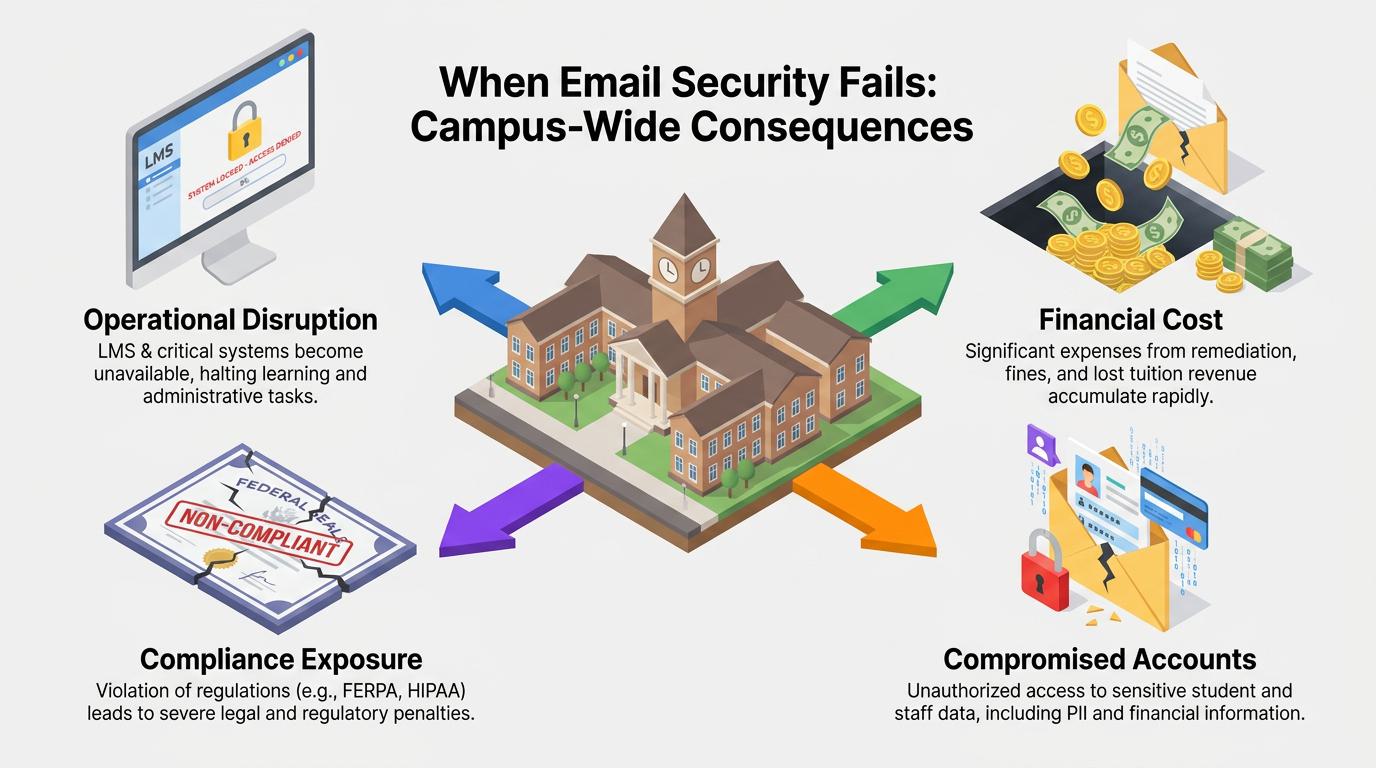
Email security failures immediately paralyze campus operations, and the damage rarely stays contained to the inbox:
- Operational Disruption: Ransomware locks learning management systems, cancels classes, freezes financial platforms, and compromises research data that can stall critical grant timelines.
- Financial Cost: The average data breach cost educational institutions $4.15 million in 2026, according to IBM's Cost of a Data Breach Report, up from $3.80 million the year before — an expense most schools never budget for.
- Compliance Exposure: Leaked student records can jeopardize federal funding, while international programs face additional GDPR disclosure requirements.
- Compromised Accounts: Compromised accounts allow cybercriminals to reroute financial aid, generate fraudulent vendor invoices, and spread malware across entire campus networks.
Any one of these outcomes is expensive to unwind; together, they explain why email security has become a board-level line item rather than an IT afterthought.
Educational institutions present unique targets with their combination of valuable student financial records, research intellectual property, and donor information. The sector's rapid digital transformation has expanded attack surfaces through remote learning platforms and cloud collaboration tools, yet security budgets often haven't kept pace with these expanding digital infrastructures, leaving schools vulnerable to increasingly sophisticated threats.
Let's understand the reasons why.
What Makes the Education Industry a Target
Education's open, data-rich, and resource-constrained environment creates optimal conditions for email attackers. The sector's structural vulnerabilities make it an attractive target for cybercriminals seeking both immediate financial gain and long-term access to valuable information.
Revolving Door of Users
Every semester brings waves of new students, adjuncts, visiting researchers, and contractors. This constant turnover makes enforcing security awareness nearly impossible. Would you recognize a spoofed "Student Financial Aid" email if it landed in an inbox you'd only had for a semester? When an email appears to come from "Student Financial Aid" or "Research Administration," even cautious users often click without verifying the sender's authenticity. The transient nature of academic communities means many users lack institutional knowledge to recognize subtle impersonation attempts.
High-Value Data Repositories
Schools store treasure troves of sensitive information beyond basic academic records, and each repository creates its own path to exploitation:
- Financial Aid Databases: Contain social security numbers and banking details that cybercriminals package into complete profiles and sell on dark web marketplaces.
- Research Repositories: Hold proprietary findings worth millions in commercial applications, making them a target for competitors and nation-state actors looking to acquire technology without the investment.
- Alumni Networks: Include donor financial information and contact details for prominent individuals, which attackers use to craft sophisticated social engineering attacks.
This concentration of high-value data is what turns a single compromised mailbox into a multi-front breach.
Business-Critical Email Workflows
Critical institutional processes rely heavily on email communication. Admissions decisions, financial aid disbursements, vendor payments, and research collaborations all flow through inbox channels.
Attackers who infiltrate these conversations can redirect substantial funds or manipulate sensitive processes without triggering traditional security alerts. The informal nature of academic communication often lacks the verification protocols found in corporate environments.
Technical Complexity on Limited Budgets
IT teams manage hybrid environments spanning legacy on-premises systems, cloud applications, and thousands of unmanaged student devices.
Resource constraints prevent full security implementations, creating gaps that attackers exploit. QR-code phishing campaigns specifically target this weakness, bypassing traditional email filters through image-based attacks that students scan on personal devices.
Sustained Attack Frequency
Several higher-education institutions face cyberattacks and among them, vendor email compromise is a recurring part of the threat mix — at schools targeted by this tactic, 32% of recipients engage with the fraudulent messages. This relentless pressure keeps security teams in constant reaction mode, preventing the strategic planning necessary for full defense improvements.
Why Traditional Defenses Fall Short
Legacy secure email gateways cannot adequately protect educational institutions because they rely on static threat indicators while missing the behavioral signals that matter most in complex academic environments.
Let's understand some of the reasons:
- Volume Overwhelms Static Controls: Educational environments process tens of thousands of external messages each semester from parents, alumni, vendors, and partner institutions. This volume overwhelms traditional blocklists and sender-reputation checks, creating exploitable gaps that attackers systematically target.
- Sophisticated Attack Techniques Bypass Signatures: Attacker innovation outpaces signature-based detection capabilities. QR code campaigns hide malicious links inside images, completely bypassing URL scanners, while cyberattacks that use AI generate flawless academic prose that perfectly mimics legitimate institutional communications requiring advanced semantic analysis.
- Impersonation Exploits Public Information: Public faculty directories and research profiles provide attackers with detailed context for convincing impersonation attempts. Once mailboxes are compromised, outbound messages appear completely legitimate, yet most institutions lack real-time monitoring capabilities for internal traffic.
- Resource Constraints Limit Response Capabilities: Underfunded IT departments managing complex hybrid infrastructures lack resources to fine-tune security rules or investigate every alert, creating widening gaps between threat volume and institutional response capacity.
Traditional defenses cannot match the sophistication and automation that modern attackers deploy against educational targets.
7 Ways to Use AI to Protect Your Institution
Modern educational threats demand intelligent defenses that evolve as quickly as the attackers themselves. Here are seven ways AI-driven security closes the gap between sophisticated attackers and resource-constrained campus teams:
1. Deploy Behavioral AI for Account and Sender Impersonation Detection
Behavioral AI learns the normal communication patterns, timing, and relationships for every mailbox, from bursar staff to adjunct professors, then flags anomalies in milliseconds. For instance, when a finance clerk suddenly requests a $50,000 "emergency equipment wire," the system recognizes the deviation from established behavioral patterns and quarantines the message before funds transfer.
2. Implement Adaptive, Context-Aware Content Analysis
Natural language processing models parse intent, sentiment, and role-specific vocabulary to identify social engineering that both human users and signature-based tools miss. AI analyzes whether a message about "grade adjustments" legitimately originated from a faculty account or represents an outsider exploiting publicly available staff directories.
This semantic inspection catches AI-crafted phishing attempts that fit smoothly into academic workflows, protecting against threats that traditional content filters cannot identify. The system understands academic terminology and communication norms across different institutional departments.
3. Baseline Normal Communication Patterns to Flag Anomalies
Temporal, geographic, and device baselines provide early warning when attackers reuse stolen credentials. If a registrar's account signs in from two continents within minutes or sends mass emails at unusual hours, anomaly scoring triggers immediate lockout and automated email remediation.
For student services and financial aid offices where bulk communications are routine, AI adjusts thresholds based on actual activity patterns. This prevents alert fatigue while surfacing genuinely malicious spikes in sending behavior.
4. Integrate Predictive Threat Intelligence With Automated Response
Machine learning models digest global threat telemetry to preempt emerging campaigns before they reach institutional inboxes. When the platform detects ransomware lures surging at peer universities, it automatically rewrites suspicious URLs, quarantines attachments, or revokes OAuth tokens across managed mailboxes.
This combination of predictive insights and automated incident response saves the investigation hours that lean security teams would otherwise spend manually tracing attack scope and impact.
5. Deploy Intelligent Filtering That Learns From User Feedback
Modern AI filtering systems evolve with every user-reported phishing attempt. If athletics compliance staff repeatedly flag scholarship scams, the model refines detection for similar lures without blocking legitimate communications.
Continuous feedback loops reduce false positives that slow admissions workflows while minimizing false negatives that lead to successful breaches. This learning approach creates the precision balance essential for educational operations, where both over-blocking and under-blocking create operational disruptions.
6. Personalize Human Risk Management and Training
AI-driven simulation engines craft role-specific phishing tests, financial aid refund attempts for students, grade-change requests for faculty, and assign targeted micro-lessons to individuals who engage with simulated threats. This approach targets actual vulnerabilities rather than deploying generic awareness programs.
Personalized security training increases engagement and behavioral change while providing administrators with granular metrics on which staff members require additional coaching.
7. Add Defenses Against Emerging Attack Vectors
Modern attackers embed malicious links in QR codes, deploy deepfake audio for urgent payment requests, and weaponize zero-day file attachments. Additionally, machine learning classifiers inspect images and media files for hidden threats, detonate unknown attachments in secure sandboxes, and analyze potential deepfake indicators in voice messages.
Schools experience sustained QR-code phishing campaigns because students routinely scan codes on unmanaged personal devices. AI that analyzes image content itself, rather than just message text, blocks this compromise pathway that traditional filters cannot detect.
How Abnormal Supports Education Teams
Abnormal's behavioral AI solves unique security challenges in educational settings by modeling typical communication patterns across students, faculty, staff, and vendors. This approach allows detection and blocking of unusual activities, such as business email compromise and account takeovers, that traditional secure gateways often miss. Through rapid API-based integration with Microsoft 365 and Google Workspace, Abnormal speeds up deployment, improving protection in minutes.
Protecting Student Success and Community Trust
Virginia Beach City Public Schools exemplifies how educational institutions benefit from behavioral AI protection. Managing 192,000+ mailboxes, the district faced sophisticated impersonation attacks while operating with limited security resources and heightened data protection requirements.
After implementing Abnormal, they achieved:
- Quicker deployment through fast API integration
- 187,000+ attacks blocked over nine months of protection
- 16,000+ credential phishing attempts automatically stopped
- 59 compromised vendor accounts detected through VendorBase intelligence
- Instant remediation replaced hours-long manual investigation processes
The platform's unified approach protects both student and faculty systems simultaneously, automatically catching impersonation attempts that previously bypassed traditional security measures. CIO David Din emphasized the broader organizational impact: "By stopping impersonation emails targeting our superintendent and staff, Abnormal helps us maintain our reputation in the community while freeing our small security team to focus on strategic educational initiatives."
Want to know how Abnormal can support your educational mission, like offering protection against email threats? Explore our customer stories or request a demo to learn more.
Closing the Gap Between Attackers and Campus Defenses
Education's exposure won't shrink on its own: the same open, high-turnover, resource-constrained environment that makes campuses collaborative also makes them easy to research and impersonate. What changes the equation is pairing behavioral AI, which catches the account and sender anomalies static filters miss, with training aimed at the specific roles attackers target most. Institutions that combine both close the widest gaps first, rather than spreading thin security budgets across every possible threat at once.
