Key Insights
AI social engineering attacks are changing email security by stripping away the obvious red flags that once made phishing easy to spot. Attackers now personalize impersonation, coordinate pressure across channels, and make malicious requests look like routine business, so security teams face messages that read like they came from a real colleague, because artificial intelligence wrote them to sound that way.
Key Takeaways
- AI lets attackers generate personalized, expert-quality phishing messages in far less time than manual campaigns require.
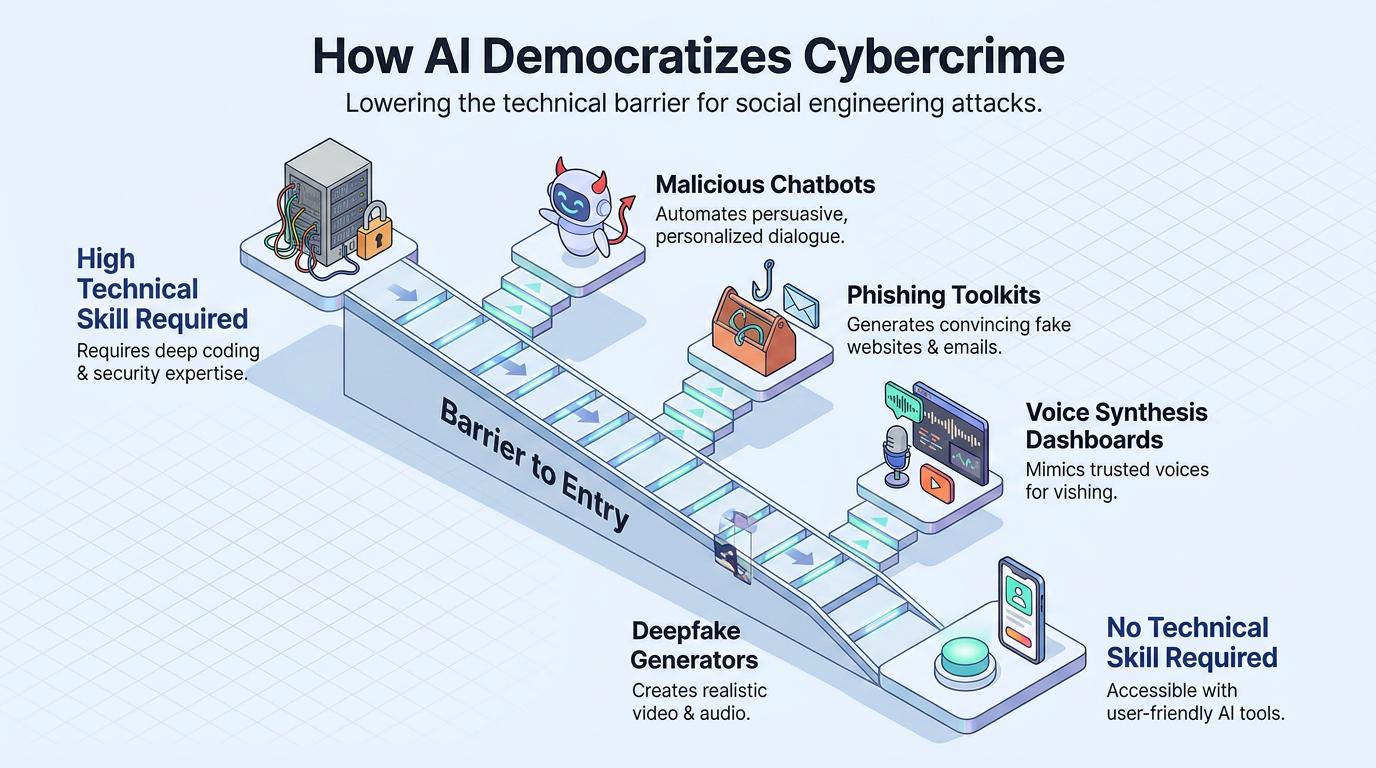
- Criminal marketplaces package voice synthesis, chatbots, and phishing toolkits into simple dashboards that require no technical skill to use.
- Real-time voice synthesis allows attackers to impersonate a target on live calls, undermining callback verification as a standalone control.
- Phishing-resistant authentication methods, such as hardware keys and passkeys, block many credential-based attacks that rely on convincing but fake login pages.
What Makes AI-Powered Social Engineering Different
AI-powered social engineering changes the defender's problem by making routine-looking business messages carry more context, pressure, and credibility than template-based campaigns. Traditional phishing relied on volume and obvious mistakes. AI attacks succeed through quality and subtle manipulation.
The core differences are clear:
- Personalized Context: Attackers can reference roles, projects, business events, and internal terminology that make messages feel familiar.
- Channel Coordination: Campaigns can move from cloud email to text messages, collaboration platforms, video platforms, and voice calls with a consistent story.
- Faster Preparation: AI systems can analyze public information and produce credible lures with less manual research.
- Psychological Pressure: Synthetic voice, fabricated urgency, and believable executive language can compress the time employees have to verify requests.
Consider this scenario: an employee receives an email from their "CEO" about an urgent acquisition, followed immediately by a text message with additional "confidential" details. A phone call using AI voice cloning comes next, pressuring them into authorizing a wire transfer before anyone can complete standard verification.
The sophistication extends beyond the message itself. Public business context can become the basis for lures that reference current projects, deadlines, and internal terminology with uncanny accuracy. These capabilities explain why defenders need to understand the main attack patterns before selecting controls.
The Core Pillars of AI-Enhanced Social Engineering
AI-enhanced social engineering builds on familiar attack types, but artificial intelligence makes each technique more convincing and easier to scale. These pillars include phishing, business email compromise, spear phishing, and deepfake-driven impersonation.
Phishing at Massive Scale
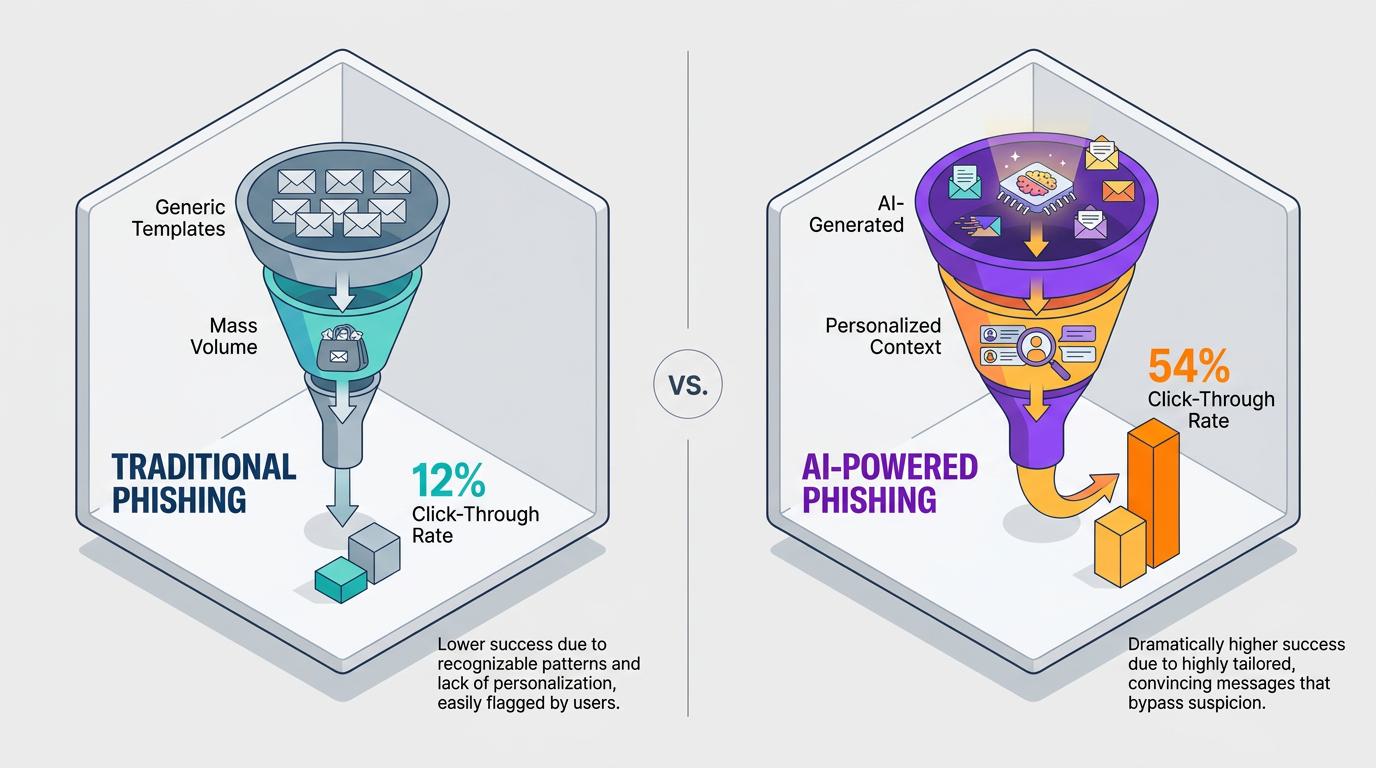
Large language models have transformed generic phishing campaigns into mass customization engines. AI can turn public signals into polished emails, texts, and social posts that mention specific job responsibilities, current projects, local events, or recent business activities. Each message features unique wording and personalized context that strains rule-based security systems designed to catch obvious mistakes.
The effectiveness is documented: in a controlled study by Harvard researchers, fully AI-automated phishing emails achieved a 54% click-through rate versus 12% for generic phishing, performing on par with emails human experts wrote. Because AI can automate unique, personalized phishing messages at that success rate, even lower per-message conversion can still produce more total victims than a human-run campaign could.
Business Email Compromise
AI models can analyze executive communication patterns, including writing styles, favorite phrases, signature formats, and decision-making language, so convincingly that finance teams may struggle to distinguish authentic from synthetic communications. When targets question suspicious invoices or transfer requests, attackers can escalate by using deepfake voice calls or video clips that show the "CFO" personally approving transactions.
Business email compromise (BEC) remains one of the costliest categories of cybercrime tracked by federal law enforcement, and case data increasingly shows attackers pairing AI-drafted messages with cloned voices to push through wire payments. Catching these attempts means evaluating sender behavior, timing, and workflow context rather than the message content alone.
Spear Phishing
AI examines professional updates, code repository activity, corporate announcements, and leaked internal communications to craft targeted attacks that reference recent team meetings, upcoming contract renewals, or specific project challenges. A single compromised partner account can launch many ultra-personalized attacks within an organization, each tailored to individual targets based on their role, recent activities, and communication patterns. Since these emails originate from trusted addresses and use internal terminology, static reputation scoring and traditional content analysis provide limited protection.
Deepfakes and Real-Time Voice Synthesis
Synthetic media tools now create real-time video calls where fake executives appear to give urgent instructions, or produce voicemail deepfakes that weaken traditional phone verification procedures. The financial stakes are no longer hypothetical: in a case CNN reported, a finance employee at engineering firm Arup authorized $25.6 million in transfers after joining a video conference in which every participant, including the CFO, was a deepfake.
The technology has reached a point where attackers can impersonate people whose voices appear in publicly available recordings, such as earnings calls, conference presentations, or social media videos. Live voice synthesis raises the risk further because attackers can respond naturally to follow-up questions instead of relying on a prerecorded clip.
How AI Transforms Attack Economics and Scale
Artificial intelligence has altered the economics of social engineering by lowering technical barriers, reducing operational costs, and enabling attack scales that overwhelm traditional defensive approaches.
Democratization of Advanced Attack Capabilities
The most significant change is accessibility. Criminal marketplaces now offer user-friendly platforms that package sophisticated attack tools into simple dashboards requiring no technical expertise. Malicious chatbots and phishing toolkits put AI-generated content, voice synthesis, and deepfake capabilities within reach of low-skill actors. Specialized tools designed to remove ethical constraints from language models improve phishing content generation, letting attackers bypass safety measures built into commercial AI systems.
Scale and Speed Advantages
AI attacks draw on capabilities that increase efficiency compared to traditional human-operated campaigns. Security teams should evaluate how these capabilities appear in real incidents:
- Enhanced Data Mining: Algorithms analyze social media profiles, data breach information, corporate announcements, and publicly available documents to craft messages referencing specific business trips, pending invoices, project deadlines, or internal terminology.
- Cross-Platform Coordination: Attackers coordinate campaigns across email, SMS, voice, video, and social media, creating consistent narratives that build credibility through multiple touchpoints.
- Real-Time Adaptation: AI systems can support rapid changes to messaging strategies, timing patterns, and communication approaches based on victim behavior.
- Continuous Learning: Machine learning algorithms can help attackers refine tactics, improve personalization, and identify new vulnerability patterns across target organizations.
Threat groups already run this playbook. The Federal Bureau of Investigation (FBI) and Cybersecurity and Infrastructure Security Agency (CISA) have reported that Scattered Spider actors search targeted organizations' collaboration and cloud email platforms for conversations about intrusions, and even join incident response calls to learn how security teams are hunting them. The next step is translating those attack economics into controls that raise attacker cost and reduce employee exposure.
Actionable Defense Strategies Against AI-Enhanced Social Engineering
Defending against AI-enhanced social engineering requires layered controls that address both technological vulnerabilities and human psychology while maintaining operational efficiency. The following measures give organizations a practical starting point.
Deploy Phishing-Resistant Multi-Factor Authentication
Hardware security keys and passkeys are among the most effective defenses against credential theft, which is often the goal of AI-driven phishing attacks. Organizations can enforce phishing-resistant multi-factor authentication (MFA) methods, such as Fast Identity Online 2 (FIDO2)-based hardware keys for users accessing sensitive systems, and phase out SMS-based authentication due to its susceptibility to MFA bypass techniques.
To strengthen access security further, configure conditional access policies that require phishing-resistant MFA for sensitive actions and enforce device trust policies that validate hardware keys. Cryptographic authentication resists sophisticated AI-generated lures in a way passwords and SMS codes cannot, which is why the National Institute of Standards and Technology's (NIST) updated digital guidelines now exclude manually entered passcodes from the phishing-resistant category and add support for syncable passkeys.
Strengthen Email Authentication Infrastructure
Email security infrastructure forms the foundation of anti-impersonation defenses by blocking the fake domains that generative AI uses to scale phishing attacks. Organizations can configure Sender Policy Framework (SPF) records with "-all" hard fail policies for organizational domains, implement DKIM signing using DomainKeys Identified Mail, and set Domain-based Message Authentication, Reporting, and Conformance (DMARC) policies to "p=reject" to prevent unauthorized sending.
A practical email authentication program should cover both configuration and operations:
- Domain Enforcement: Configure SPF, DKIM, and DMARC policies for organizational domains, then align them with authorized sending services.
- Subdomain Coverage: Configure message authentication for subdomains and establish DMARC failure notifications for attack detection.
- Legacy Protocol Review: Disable legacy SMTP authentication protocols and verify that MX records point exclusively to authorized mail servers.
- DNS Audits: Conduct regular DNS security audits, maintain inventories of organizational domains and subdomains, and establish secure procedures for domain transfers and DNS changes.
- DMARC Monitoring: Monitor DMARC reports routinely to gain visibility into impersonation attempts targeting organizational domains.
IT staff training on email authentication troubleshooting supports rapid resolution of legitimate sending issues while these controls reduce exposure to domain impersonation.
Deploy Behavior-Based Email Security
Traditional email filters often struggle to detect AI-generated social engineering attacks that rely on payloadless content and credible business context. Organizations can layer behavior-based detection on top of existing email security systems to surface the subtle deviations typical of AI-enhanced attacks. Modern solutions use API-based integration to protect cloud email and collaboration platforms without impacting performance.
These systems learn typical patterns for each user, including workflow cadences, vendor interaction patterns, recipient behavior, and message timing, then flag deviations such as wiring instructions sent outside business hours or sudden changes to banking details. They also analyze linguistic patterns to help identify AI-generated content. While these campaigns increasingly blend email with voice calls, text messages, and deepfake video, the primary control point remains the inbox. Organizations should pair email and account-based controls with additional safeguards for voice, SMS, and videoconferencing channels.
Implement Executive Protection and Anti-Impersonation Controls
Executive impersonation represents the highest-risk attack vector in AI-enhanced social engineering, requiring specialized protection measures that address display name spoofing, urgency manipulation, and executive-specific workflows. Organizations can create rules that block messages with fake executive display names, while implementing fuzzy matching algorithms to catch variations and typos that traditional filters miss.
Anti-impersonation controls should focus on the messages and workflows attackers commonly abuse:
- Display Name Spoofing: Create detection rules for fake executive display names, lookalike variations, and typos in sender identity.
- Urgency Language: Flag messages containing urgent financial language, emergency framing, or confidentiality pressure combined with external senders.
- Financial Requests: Route wire transfers, payment changes, and sensitive information requests through documented authorization procedures.
- Executive Channels: Maintain secure channels for executive communication verification and define escalation procedures for suspected impersonation.
For voice-based threats, the FBI advises listening "closely to the tone and word choice to distinguish between a legitimate phone call from a loved one and an AI-generated vocal cloning." Advanced protections include video call security protocols using secure meeting platforms and documented procedures for responding to deepfake communications that impersonate executive leadership.
Conduct Advanced AI-Generated Phishing Simulations
Traditional phishing simulations using template-based approaches do not fully prepare organizations for AI-generated attacks built with the same models attackers use. Research increasingly shows that completing a static awareness training module has little bearing on whether an employee later falls for a phishing simulation, which supports a broader shift toward adaptive programs that include AI-specific tasks.
Modern simulation platforms generate content reflecting current threat intelligence, targeting different user groups with role-specific attack scenarios that reference actual job functions and current projects.
Simulation programs become more useful when they reflect how employees actually work:
- Role-Based Scenarios: Create industry-specific and department-specific simulations that align with actual job functions.
- Seasonal Campaigns: Reflect current events and business cycles that attackers could use as pretexts.
- Leadership Exercises: Develop executive-targeted simulations for leadership awareness and decision-making practice.
- Immediate Feedback: Deliver just-in-time coaching when a user fails a simulation and create remedial programs for repeated failures.
- Resilience Metrics: Measure security awareness training effectiveness across user groups and feed executive dashboards showing organizational risk posture.
These exercises help security teams move from static awareness checks to adaptive training that reflects AI-enabled social engineering tactics.
Establish Dual-Channel Verification for Critical Operations
Critical operations need verification paths that are independent from the channel where the request began. Organizations should establish dual-channel verification for critical operations, requiring voice verification for wire transfers exceeding defined internal thresholds, secure chat confirmation for payroll and banking changes, and ticketing system requirements for vendor payment modifications.
Regulatory guidance on deepfake fraud points institutions in the same direction, recommending phishing-resistant MFA and live identity checks conducted over audio or video before high-risk transactions proceed.
Operational workflow design should define where verification occurs, who approves it, and how teams document the decision:
- Financial Workflows: Use documented approval processes for high-risk operations and require confirmation for payment changes.
- Data Protection: Require dual authorization for personal data breach prevention, cloud storage sharing changes, and system access modifications.
- Secure Communications: Designate secure platforms for sensitive business discussions and set encryption requirements for confidential information sharing.
- Escalation Paths: Create backup communication channels for emergency scenarios and clear procedures for handling verification failures.
- Audit Trails: Deploy workflow automation tools that enforce verification requirements and create records for verification activities and approvals.
Training finance teams on verification procedures and escalation protocols helps maintain business efficiency while reducing the risk of pressure-driven approvals.
Verification Is the Real Defense
AI has closed the gap between amateur and professional social engineering, turning personalization, speed, and convincing impersonation into everyday features of ordinary attacks. Static defenses built for obvious, templated phishing cannot keep pace with messages that mirror internal language and voices that sound authentic. Organizations that pair phishing-resistant authentication and strong email authentication with adaptive training and out-of-channel verification put real friction back into the attacker's process. Teams that treat verification as a first-class control, not an afterthought, will catch what AI-generated content is designed to slip past.
