Key Insights
Credential harvesting is the systematic theft of usernames, passwords, and authentication tokens through phishing pages, fake login portals, and malware, giving attackers a way to move through systems undetected. It has become the most common entry point into corporate networks: stolen credentials served as the initial access vector in 22% of breaches analyzed in the Verizon 2025 DBIR, still the top single method even as vulnerability exploitation closes the distance.
Once inside, attackers deploy ransomware, hijack inboxes, and extract sensitive data, frequently without triggering traditional alerts, since static rules and outdated filters cannot keep pace with these tactics. Modern defense against credential harvesting instead requires real-time visibility, behavioral analysis, and automated response across email and identity systems.
Key Takeaways
- Credential harvesting has become the primary entry point for ransomware, business email compromise, and data breaches because a single stolen password can unlock lateral movement across cloud and email systems.
- Attackers now use phishing-as-a-service platforms, freshly registered domains, and AI-generated lures that outpace static, signature-based security tools.
- Behavioral detection that profiles identity signals, login patterns, and message content catches credential theft attempts that traditional filters miss.
- Layered defense, combining phishing-resistant authentication, automated response, and ongoing employee training, closes the gaps that credential harvesters rely on.
Common Credential Harvesting Techniques
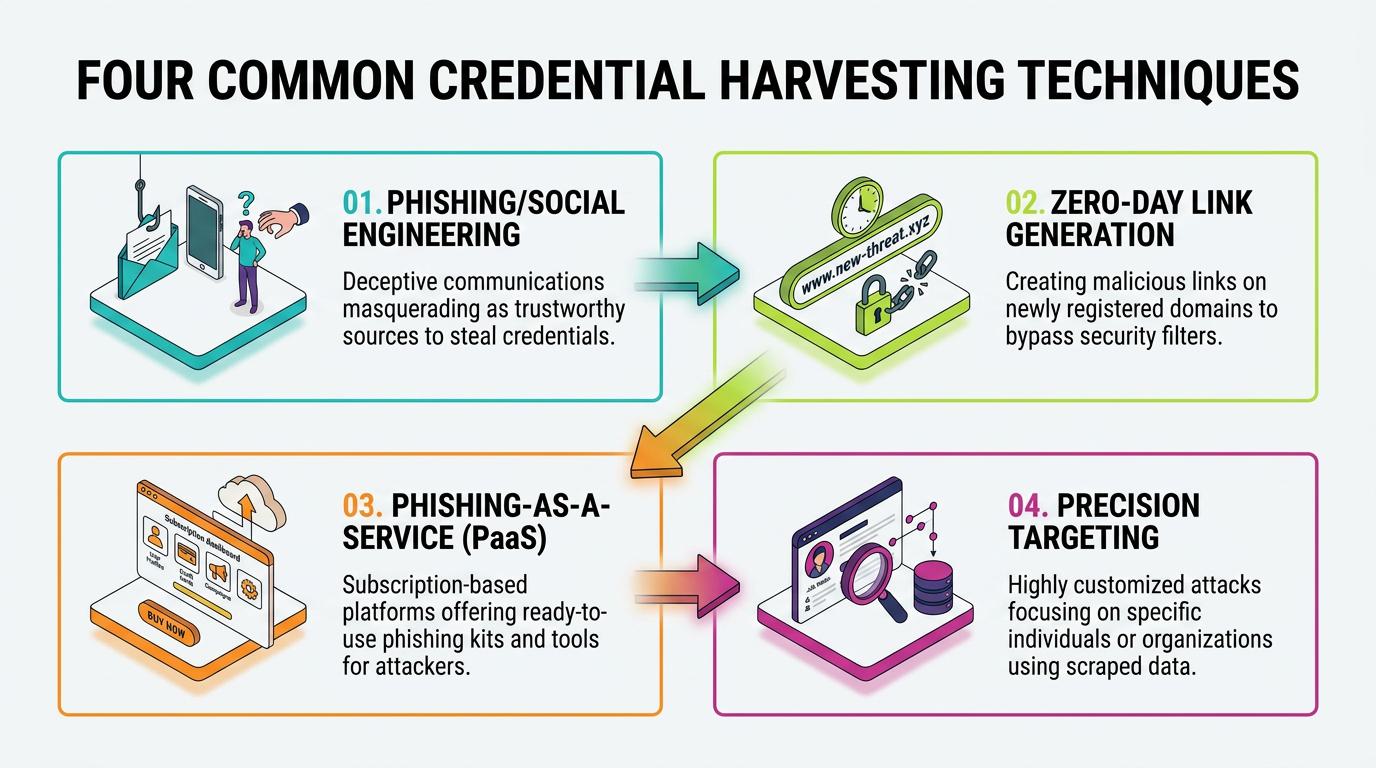
Attackers steal credentials through a mix of deceptive login pages, disposable phishing infrastructure, subscription-based crime kits, and precisely targeted social engineering. From polished phishing sites to AI-generated lures, threat actors use a wide range of tactics to steal login information and bypass security controls.
Phishing and Social Engineering
Modern phishing attacks have evolved into sophisticated operations that bypass traditional detection methods. These campaigns deploy polished emails that redirect targets to pixel-perfect replicas of Microsoft 365 or Okta login portals, capturing credentials in real time and often validating logins immediately to confirm the password works. Business email compromise takes this approach further by hijacking or spoofing executive mailboxes to request wire transfers or payroll updates. A single compromised inbox gives attackers full access to corporate communications and the credibility to execute high-value fraud.
Zero-Day Link Generation
Attackers create fresh phishing domains minutes before launching campaigns, bypassing URL reputation systems that rely on known-bad lists. These links often use legitimate cloud infrastructure, making them appear trustworthy to secure email gateways. The timing ensures that security tools have no prior intelligence about the threat, allowing malicious pages to reach inboxes undetected.
Phishing-as-a-Service Tools
Criminal organizations now offer turnkey credential theft operations through subscription-based platforms. Monthly services include ready-made templates that clone banking and SaaS portals, automated dashboards that test stolen credentials against target sites, and one-click modules that bypass MFA. These platforms handle infrastructure management and updates, letting operators focus solely on victim selection and profit collection. Tycoon2FA, described by Microsoft as a leading phishing-as-a-service platform, generated tens of millions of phishing messages a month before a coordinated Microsoft and Europol takedown in early 2026.
Precision Targeting Tactics
Modern credential harvesting combines technical sophistication with targeted social engineering. Attackers scrape professional networking profiles to gather employee titles, reporting structures, and vacation schedules. Generative AI then crafts messages that match corporate communication patterns and timing, which increases success rates by making each interaction feel legitimate and contextually appropriate. The result is a credential network where stolen login information fuels follow-on attacks across cloud workloads, email systems, and sensitive data repositories.
Why Traditional Detection Methods Fail
Traditional detection methods fail against credential harvesting because they depend on outdated threat intelligence and overworked human reviewers, and attackers move faster than either can adapt:
- Threat Intelligence Limitations: Signature-based filters look for yesterday's bad indicators, so they rarely flag phishing emails using brand-new URLs on clean cloud domains with no negative reputation, and even when payloads appear, their code differs just enough to avoid matching known hashes.
- The Human Factor: A single inbox may receive hundreds of ambiguous messages each week, pushing employees into decision fatigue, while analysts face the same overload triaging alerts that pull them into low-value investigations as genuine compromises slip by.
IBM's X-Force Index documented an 84% increase in emails delivering infostealers in 2024 compared to the prior year, a direct sign that attackers are scaling delivery methods faster than signature databases or human reviewers can track. Without automation to absorb the routine workload, both end users and security teams remain outpaced by campaigns that iterate faster than humans can react.
Modern Detection Approaches
Modern detection approaches combine behavioral analysis, direct API integration, and automated workflows to catch credential harvesting attempts that static filters miss. Together, these methods replace reactive, list-based defense with continuous, adaptive monitoring.
Behavioral Analysis
Behavioral analysis builds a baseline of each user's typical activity, such as how they send email, log in, and navigate applications, then flags deviations from it. Weaving identity signals, communication behavior, and message content into a single picture catches subtle attacks that any one indicator would miss on its own. That same layered profiling also filters out graymail and low-risk spam that usually bury genuine threats, leaving a smaller, higher-confidence queue for review.
API-Based Integration
Traditional gateways that reroute email or rely on endpoint agents introduce complexity and visibility gaps. API-based integrations solve both by connecting directly to cloud email platforms, streaming real-time telemetry, headers, content, and login context straight into detection engines. This approach requires no MX record changes, no added hardware, and no downtime, and it uses token-based authentication, minimal access scopes, and end-to-end encryption so the integration layer does not become a new attack surface. When a threat is confirmed, these systems can trigger logouts, revoke tokens, and alert responders within seconds.
Automated Workflows
Timely action matters more than detection alone, so automation turns alerts into immediate responses, revoking tokens, resetting passwords, and blocking source IPs before attackers can move laterally. This closed-loop system handles routine steps at speed and scale without expanding the security team, leaving analysts in control of policy thresholds while they spend their time investigating real threats instead of triaging every alert.
Prevention Strategies
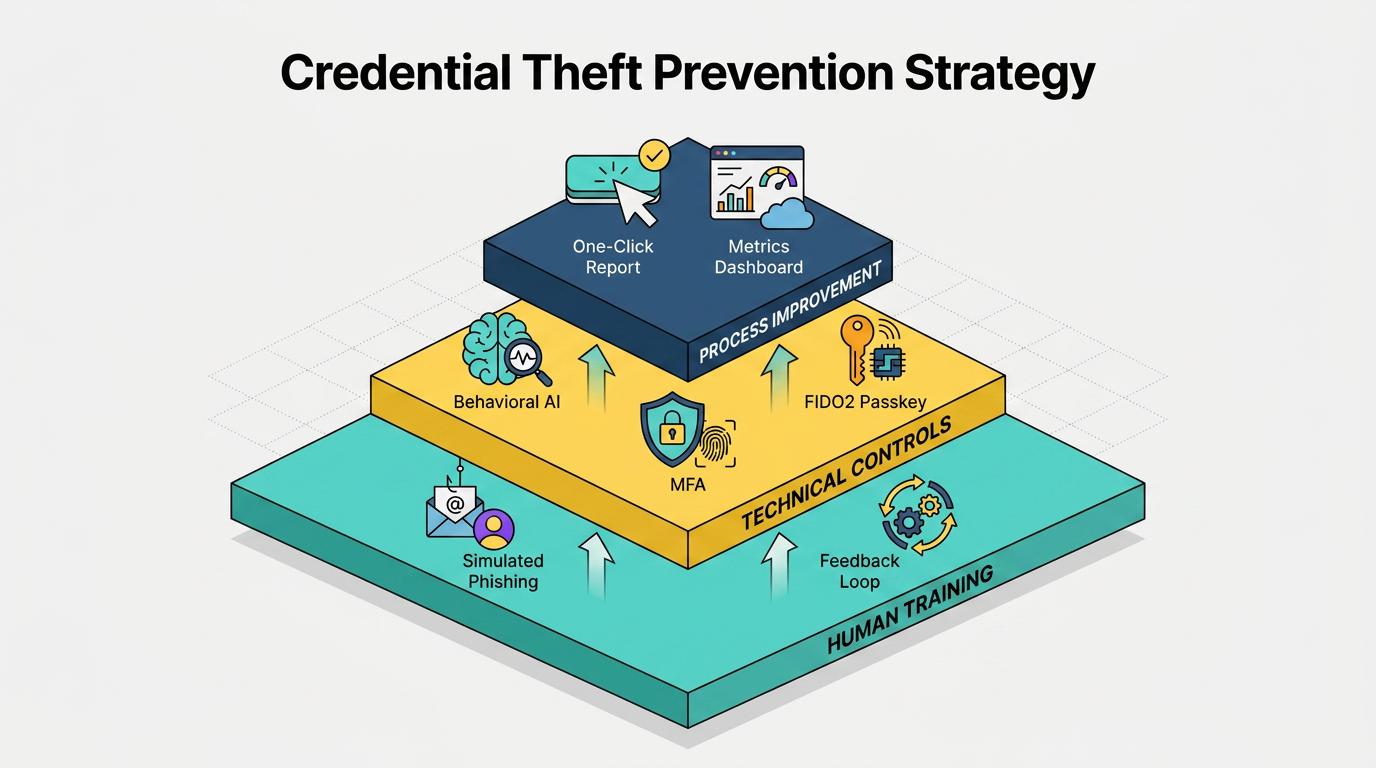
Credential theft prevention requires three coordinated defense layers: human training, automated technical controls, and disciplined operational processes.
Human Training and Awareness
One-size-fits-all training does not change behavior. Simulated phishing attacks that mimic real threats teach users to pause before clicking links or entering credentials, and instant, targeted feedback highlighting exactly what they missed makes the lesson memorable. Interactive awareness campaigns also generate telemetry, helping security teams identify risk patterns across departments and roles.
Technical Controls and Automation
Behavioral AI embedded at the API layer analyzes sender identity, message content, and engagement patterns to detect sophisticated threats that traditional filters miss. When attacks are flagged, automated workflows step in to quarantine emails or trigger password resets within seconds, though a reset only helps if attackers haven't already reused the credential.
Multi-factor authentication (MFA) and browser-level anomaly detection back up that response: with both active, a stolen password alone is not enough to gain access. That said, not all MFA is equal, since adversary-in-the-middle phishing kits and token-theft techniques can defeat traditional one-time-code and push-notification methods, which is why phishing-resistant implementations such as FIDO2 and passkeys are increasingly recommended as the standard to meet.
Process Improvement
Simplified reporting mechanisms accelerate threat response while reducing user friction. A one-click "Report Phish" button pushes suspicious messages into an automated triage queue, giving security teams fresh indicators for machine-learning models and employees a positive feedback loop. Organizations should track metrics such as report-to-remediation time to prove progress and justify further investment.
Implementation Considerations
Deploying API-based email security successfully requires both technical setup and internal coordination.
- Integration Requirements: Connect directly through Microsoft 365 or Google Workspace APIs, with no need to reroute MX records or install agents. Confirm API scopes, secure token management, SIEM rules, and data residency requirements before activation.
- Organizational Readiness: Assign clear ownership early. IT should handle service-account provisioning, while security teams configure automated responses like quarantines or MFA triggers, and help-desk staff must be ready to answer user questions about blocked messages or banner alerts.
- Validation and Sign-Off: Demonstrate value by tracking metrics such as reduced triage time. Once normal mail flow is confirmed and actions are auditable, leadership can approve go-live.
Successful implementation depends on aligning technical integration with operational readiness to deliver fast, auditable protection without disrupting mail flow.
Modern Credential Harvesting Defense: How to Stay Ahead of Evolving Threats
Credential harvesting remains one of the most common paths into ransomware, business email compromise, and large-scale data breaches. Static threat feeds and manual review processes cannot keep pace with attackers who rotate infrastructure and messaging faster than any blocklist can update. Pairing behavioral detection with API-based visibility and automated response lets organizations contain compromised accounts before attackers move laterally. The strongest defenses treat prevention as an ongoing discipline that adapts alongside the techniques attackers use to steal the next password.
