Bayesian spam filtering helps separate spam from legitimate email even when both use similar language. Spam can resemble legitimate email closely enough that rigid keyword rules miss changing tactics or misclassify valuable email. Turning those subtle word patterns into a verdict that both an inbox and a human reviewing quarantine can trust is what separates a Bayesian filter from a blunt keyword list.
This article unpacks how that verdict is built, why it holds up under adversarial pressure, and where it belongs inside a modern email defense. The payoff is a clearer view of a technique that quietly shapes what reaches the inbox and what never arrives.
Key Takeaways
A Bayesian filter compares how strongly a message's tokens have appeared in spam versus legitimate mail and converts that comparison into a probability.
Every message a user labels as spam or not spam changes the stored token counts, so future verdicts move toward that user's actual mail.
The threshold that turns a probability into a verdict is a cost decision, since blocking a legitimate message usually hurts more than letting one junk message through.
Probabilistic content scoring works best as one interpretable, low-cost signal inside a layered defense that also authenticates senders and checks reputation.
What Is Bayesian Spam Filtering?
Bayesian spam filtering classifies email by comparing how often each word appears in known spam against how often it appears in legitimate mail, then combining those comparisons into a probability. A keyword rule either fires or it doesn't; a Bayesian filter weighs evidence and reports its confidence.
Four terms carry the method:
Spam: Unsolicited bulk mail.
Ham: Legitimate mail during training.
Token: A unit the filter extracts, usually a word, although filters may also extract header values and parts of URLs.
Training Corpus: The labeled spam and ham from which the filter counts tokens.
Both classes are required because spam counts alone cannot show whether a word is rarer in ham. The approach traces to an academic paper by Sahami, Dumais, Heckerman, and Horvitz. Paul Graham's "A Plan for Spam" made it a practical per-user method, and Gary Robinson published combining refinements.
How Does Bayesian Spam Filtering Work?
A Bayesian filter breaks a message into tokens, estimates their spam and ham likelihoods, combines the most informative evidence, and compares the result with a cutoff. A threshold turns the resulting score into a verdict, while the token counts and probabilities derived from them remain inspectable.
The math behind that verdict is Bayes' theorem, but the intuition is simpler. The filter starts with a prior belief about how likely any message is to be spam, which is usually just the fraction of training mail already labeled spam. Each token in a new message then acts as evidence that nudges that belief up or down, depending on how strongly the token has appeared in spam versus legitimate mail. The filter's final confidence is that starting belief updated by everything the tokens together suggest.
Combining that evidence cleanly requires a simplifying assumption: Naive Bayes treats each token as independent of the others once the class is known. Email words plainly violate that assumption, since terms like "free" and "offer" travel together far more often than independence predicts, but Cornell lecture notes note that "the resulting classifiers can work well in practice even if this assumption is violated." The ranking usually survives the double-counting, which is why the technique remains useful despite the shortcut.
Tokenization and Per-Token Likelihoods
Tokenization decides what the filter can see. Practical filters split the body into words and keep header tokens separate. Some create a token for a structural fact such as a missing subject or From line, while others drop common words such as "the" and "and." These tokenization practices, including stopword filtering, appear in practical Bayesian systems.
For every surviving token, the filter needs a spam probability and a ham probability. Graham's method deliberately reduced the risk of false positives by doubling the ham count when estimating those probabilities.
Rare tokens can receive unjustifiably extreme raw probabilities. Robinson's estimator pulls sparse estimates toward a neutral probability until more examples arrive and gives unseen tokens a neutral value; Laplace add-one smoothing serves the same purpose in textbook Naive Bayes. Filters commonly retain only tokens farthest from neutral because midpoint probabilities contribute little.
Probability Combination and Decision Thresholds
Graham combined the selected token probabilities into a single spam score using a product-based rule, and later refinements proposed alternative combining formulas to handle cases where spam and ham evidence cancel out. The exact combining method matters less than what happens next: the score gets compared against a threshold that decides the verdict.
That threshold is a cost decision, not a mathematical one. Setting it high means fewer legitimate messages get blocked but more spam slips through, while setting it low does the reverse. Some filters use a single cutoff; others use separate spam and ham cutoffs and route messages in the middle range to review rather than forcing a verdict when the evidence is weak.
How Do Bayesian Filters Learn from Feedback?
Feedback changes future verdicts by revising the spam and ham counts behind each likelihood.
Feedback Updates Counts and Probabilities
A Bayesian filter stores spam and ham totals plus per-token counts for each class. When a user rescues a false positive, the filter increments the ham total and ham counts for that message's tokens while revising the earlier spam label. The filter stores this training information in a count-based database. Because the counts are local, the same token can carry different meaning across mailboxes. "Invoice" may be strong ham evidence for an accounting team and meaningless for someone who never receives invoices. Likewise, "unsubscribe" can be routine in one mailbox and spammy in another.
Representative Training Supports Future Accuracy
A filter with no training data has no evidence, so every token begins neutral and early verdicts are guesses. Unrepresentative or incorrectly labeled training also hurts because the prior and token likelihoods no longer reflect the mail the filter will classify. Class proportions may legitimately mirror the actual prevalence of spam and ham. Smoothing, calibration, and cost-sensitive thresholds address different parts of the decision.
Vocabulary changes over time as legitimate senders adopt new terms and spammers rotate theirs. This shift is called concept drift, which is why filters retrain continuously and may expire tokens that have not appeared recently. Fresh, representative, correctly labeled counts help the model follow the user's current mail rather than outdated patterns.
Error Tradeoffs, Scores, and Decision Thresholds
Choosing a threshold trades spam blocked against legitimate mail lost, and those errors carry unequal costs.
False Positives, False Negatives, and Error Costs
A false positive is a legitimate message classified as spam; a false negative is spam delivered as legitimate. A false negative may cost a few seconds, while a false positive can hide a customer order or job offer. Blocking legitimate mail is usually worse than missing spam. Raising the threshold therefore reduces false positives but allows more spam through. Would you rather lose a few seconds rereading a junk message, or lose the one email carrying a signed purchase order?
Precision, Recall, and the Unsure Range
Raw accuracy hides that trade. When spam dominates a corpus, flagging everything can appear accurate while misclassifying every legitimate message. Precision and recall move in opposite directions as the threshold changes: precision asks how much flagged mail was spam, while recall asks how much real spam was flagged. Maximizing raw accuracy can still produce an unacceptably high level of ham misclassification. An unsure band offers an alternative by holding messages between the ham and spam cutoffs for review rather than deleting them.
Evasion Tactics and Bayesian Filtering Limitations
A Bayesian filter reasons from observed token patterns, so attackers who control message tokens or training labels can bend its verdicts.
Good-Word Attacks, Obfuscation, and Image Spam
Evasion generally falls into three categories:
Good-Word Attacks: Padding spam with words associated with legitimate mail pulls the score down token by token. An arXiv adversarial attack survey reports that adding a relatively small number of easily identifiable words can let around 50% of currently blocked spam through.
Obfuscation: Targets the tokenizer directly, so "Mortgage" becomes "M0rtgag3," or a Latin "o" becomes a look-alike Cyrillic character the filter has never scored.
Image Spam: Removes usable text altogether by placing the pitch in a noisy image, defeating filters that ignore image-based message content.
Each tactic targets a different weak point in the pipeline rather than the tokenizer's math itself.
Training-Data Poisoning and Layered Countermeasures
Poisoning corrupts training rather than evading a trained filter. The National Institute of Standards and Technology (NIST) attack taxonomy of adversarial machine learning describes attacks on Bayes-based spam classifiers "by generating training samples of 'spam' emails containing long sequences of words that appear in legitimate emails," which increases false positives. Label flipping has a similar effect by mislabeling training samples directly. Common countermeasures include:
Optical character recognition (OCR) on rendered messages
Regular retraining
Withholding delivery feedback from senders
Noise-reduction methods that detect appended word blocks
Together, these controls make poisoning attempts harder to sustain without detection.
Where Does Bayesian Spam Filtering Fit in Modern Email Security?
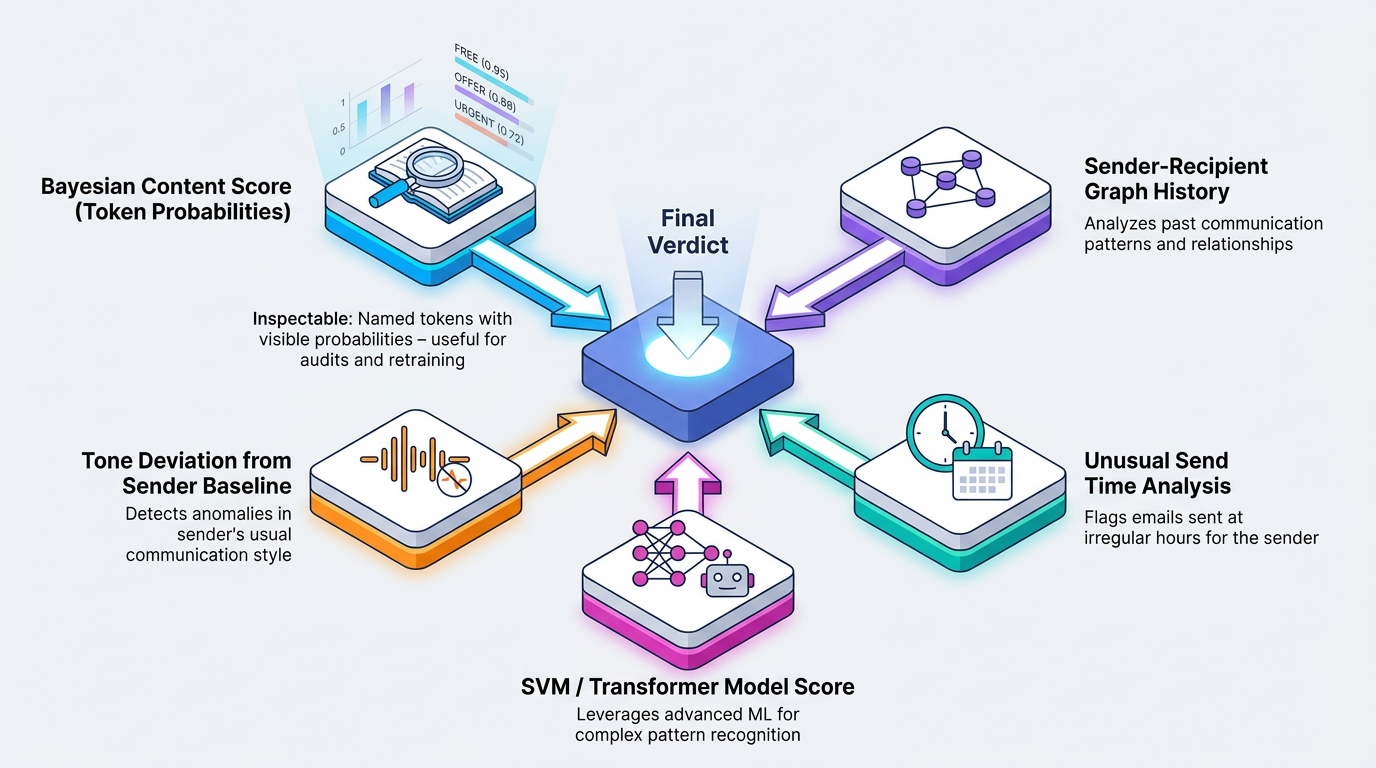
Bayesian content scoring works best as one signal in layered email security: it answers a content question while other controls verify senders and infrastructure.
Content Scoring and Complementary Security Controls
A token probability says nothing about who sent the message. Sender authentication handles that.
Three protocols cover that layer:
Sender Policy Framework (SPF): Confirms the connecting server is authorized for the envelope domain.
DomainKeys Identified Mail (DKIM): Verifies a digital signature over the message.
Domain-based Message Authentication, Reporting and Conformance (DMARC): Lets the domain owner publish message-handling policy for authentication results.
Each layer catches a failure mode Bayesian scoring can't see. SPF checks envelope-level identity, confirming the sending server is authorized. DKIM verifies cryptographic integrity, proving the message wasn't altered in transit. DMARC enforces policy on what to do when SPF or DKIM fails. The blind spot they share is content: a message can pass all three and still carry a payload only tokenization would flag.
Ordering matters for cost. A failed SPF result is a cheap Domain Name System (DNS) lookup, while tokenizing a full body is expensive, so authentication and reputation checks run first and content classification only sees what survives. None inspects content, and an authenticated message can still be spam. Reputation systems and DNS blocklists assess senders, while greylisting temporarily rejects an initial delivery attempt and accepts a later retry from a compliant mail server. Content classification often follows these cheaper checks.
Bayesian Scores and Advanced Machine Learning
Within the content layer, Naive Bayes competes with support vector machines and transformer models. In an arXiv benchmark against small language models, a support vector machine outperformed Naive Bayes on a public corpus. Naive Bayes remains inexpensive enough to train and score on a device, and its verdicts break down into named tokens with inspectable probabilities.
In a modern scoring pipeline, the content probability becomes one input among several. Sender-recipient graph history establishes whether the pair has corresponded before, tone deviation flags language that doesn't match the sender's baseline, and unusual send times raise the weight of other signals. The Bayesian score enters that mix as the content vote, not the final verdict.
Interpretability is what keeps it there. A reviewer clearing a quarantine can point to the exact tokens that drove a Bayesian score, while a transformer offers an embedding rather than an explanation. That auditability makes the score defensible in incident review and useful as fresh labels for retraining.
Better Filtering Starts with Better Evidence
A Bayesian filter improves through the labeled mail it receives. Useful evaluation questions include whether its influential tokens are visible, whether its threshold reflects real error costs, how quickly it absorbs corrections, and which controls operate alongside it. Those criteria help determine whether a probabilistic score is dependable evidence rather than an isolated verdict.
Frequently Asked Questions
Is Bayesian Spam Filtering the Same as Naive Bayes?
Naive Bayes is a classifier built on a conditional-independence assumption and is the most common engine inside Bayesian spam filters. Bayesian spam filtering is the broader practice of turning token evidence into spam probabilities, with choices such as Bernoulli or multinomial event models and product or chi-square combining methods.
Can Bayesian Filtering Stop Phishing Emails?
Partially. Phishing that reuses familiar lures or urgency phrases can accumulate spammy tokens. Messages written in ordinary business language, hidden in an image, or reduced to a lone link give the tokenizer less evidence. Those cases require link and sender signals plus evidence about whether the request fits the recipient's normal correspondence.
Do Modern Email Systems Still Use Bayesian Filtering?
Bayesian ideas persist inside larger systems more often than standalone filters do. Providers combine machine learning models with sender reputation and authentication, and a lightweight token score can be an inexpensive early signal. Its role has changed: the score informs a broader decision, while user reports help train the full filtering system.