Modern phishing attack techniques have evolved far beyond the mass-blast scams of years past. Today's threat actors chain multiple methods together: compromised legitimate accounts, multistage redirects, CAPTCHA gates, and AI-generated lures, combined into attacks engineered specifically to evade the security stack most organizations already have in place.
Email remains a primary entry point for cyberattacks, and the methods behind it have transformed dramatically. As Dan Nickolaisen, Solutions Architect at Abnormal AI, put it: "We start to see attacks that are very personalized, very targeted, and are going after really specific individuals, really specific organizations with very specific lures that are looking for engagement." Understanding popular phishing attack techniques, and why they increasingly slip past traditional defenses, is essential for protecting your organization against campaigns built to beat your existing controls.
This article draws from insights shared in our webinar "Automating Email Security with Behavioral AI." Watch the webinar recording to see these techniques demonstrated live.
Key Takeaways
Phishing attack techniques have evolved from broad "spray and pray" blasts to personalized, AI-generated campaigns that maximize both scale and engagement.
Attackers increasingly combine technical evasion (CAPTCHA gating, sandbox detection, multistage redirects) with social engineering to beat automated analysis.
Many of the most effective techniques abuse legitimate infrastructure and security tools themselves, which is why payload and reputation analysis alone can miss them.
Behavioral context, such as how a sender, domain, or request compares to established patterns, can help security teams evaluate messages that pass every traditional check.
What Are Phishing Attack Techniques?
Phishing attack techniques are the methods threat actors use to deceive recipients into revealing credentials, downloading malware, or taking other harmful actions by email. These techniques have evolved from broad, identical mass-mailings into highly personalized, often AI-generated attacks designed to maximize engagement while evading security controls.
Today's phishing techniques pursue two objectives at once: evading automated security controls and maximizing human engagement. Attackers know that a secure email gateway (SEG) relies on specific detection mechanisms (payload analysis, reputation scoring, sandbox verdicts) and they engineer campaigns to exploit the blind spots in each one.
Artificial intelligence has changed the economics of that engineering. During the webinar, Nickolaisen cited Microsoft's finding that engagement with AI-generated attacks may run as high as 54%, compared with the 8–12% engagement rates typical of older, more generic campaigns. AI tooling lets attackers produce highly personalized, well-written lures at a fraction of the manual effort a human researcher would need. The result is more targeted attacks, sent more often, with less work behind each one.
How These Attacks Have Evolved Over Time
Phishing has progressed through three broad phases: mass blasts, targeted social engineering, and now AI-accelerated personalization.
Early campaigns sent identical messages to large recipient lists, accepting a low response rate as the cost of scale. Attacks then shifted toward personalization: attackers began crafting messages for specific individuals using lures tied to their job function, recent activity, or organizational relationships, a more effective approach but far more labor-intensive per target.
AI has collapsed that trade-off. Attackers can now generate tailored, well-written content for many targets at once, at a fraction of the effort personalization used to require. The result is a shift from payload-focused to behavior-focused attacks: when the sender domain, authentication, and hosting infrastructure all look legitimate, security teams need additional context, not just technical signals, to identify the threat.
15 Common Phishing Attack Techniques
The most relevant phishing attack techniques combine credential theft, security-control evasion, and social engineering across coordinated attack stages.
Credential Harvesting Techniques
Credential-harvesting techniques use trusted senders and layered interaction flows to move recipients toward fraudulent login pages.
1. Compromised Legitimate Sender Accounts: Attacks originating from real, compromised email platforms carry good reputation scores and typically pass Sender Policy Framework (SPF), DomainKeys Identified Mail (DKIM), and Domain-based Message Authentication, Reporting, and Conformance (DMARC) checks. Because the sending infrastructure is genuinely authorized, downstream detection tools continue to treat the sender as trusted even after it's been taken over.
2. Multistage Credential Phishing: Modern credential phishing often requires several rounds of human interaction: clicking a link, waiting through a fake "security check," solving a CAPTCHA (Completely Automated Public Turing test to tell Computers and Humans Apart), and entering an email address, before credentials are ever requested. Sandboxes typically don't complete multistep flows like this, so the actual phishing page never gets analyzed.
3. SafeLink Smuggling: Attackers wrap malicious URLs in links rewritten by legitimate email security tools, so the reputation check evaluates the rewriting service's domain rather than the true phishing destination. In one documented case, a security tool's own link-scanning service scanned a "character entry" page while the real credential-theft page sat one redirect further down the chain.
4. CAPTCHA-Gated Phishing: CAPTCHA and bot-detection services (including tools like Cloudflare Turnstile) block automated sandbox analysis while letting a human victim proceed. A security scanner may get redirected to a benign page (even a legitimate church or nonprofit website) while a real recipient is routed to the credential-theft infrastructure.
5. Brand Impersonation With Legitimate Hosting: Attacks that spoof well-known brands like Adobe or Microsoft while hosting on trusted cloud platforms or compromised websites inherit the credibility of that underlying infrastructure, making them harder to flag by domain reputation alone.
Evasion Techniques
Evasion techniques conceal malicious destinations or prevent automated tools from ever reaching the real phishing content.
6. Sandbox Detection and Redirect: Campaigns can fingerprint sandbox environments, often by connection or device characteristics, and redirect that traffic to an innocuous destination. In one real-world example shared during the webinar, sandboxed clicks were quietly redirected to Apple's MacBook Air product page, while genuine victims were routed to a fake Adobe login.
7. Bot and Scraper Detection: Beyond sandboxes, sophisticated campaigns identify traffic patterns associated with web crawlers and security researchers, filtering that traffic out before it can reach the malicious payload.
8. Legitimate Infrastructure Abuse: Threat actors host payloads on trusted cloud services, SaaS applications, and compromised websites specifically because that infrastructure already carries an established reputation with security tools.
9. Multi-Redirect Chains: A single attack may hop from a compromised domain through a security-vendor check to another intermediate page before reaching the final phishing site. Each additional hop complicates single-point URL analysis and obscures the ultimate destination. In one case reviewed in the webinar, a URL that had been live for months still showed only 12 of 98 VirusTotal vendors flagging it as malicious.
10. QR Code Phishing: Attackers place phishing links in QR codes to conceal the destination from plain-text URL analysis and shift the click from a desktop inbox to a less-monitored mobile device.
Social Engineering Techniques
Social engineering techniques exploit familiar business processes and human trust to drive engagement once a message reaches the inbox.
11. Blind Carbon Copy (BCC) Mass Targeting: Sending to hidden recipient lists lets attackers reach scale while avoiding detection rules built around visible mass mailings.
12. Financial Request Lures: Invoice, remittance advice, and payment-update themes exploit routine business processes where clicking a link and entering information is the expected behavior.
13. Display Name Spoofing: Using a trusted brand or executive name in the display field creates instant credibility, even when the underlying sender address doesn't match.
14. Internal Email Bursts From Compromised Accounts: After an account takeover, attackers can launch phishing campaigns from inside the organization, evading controls that focus primarily on external mail.
15. AI-Generated Deepfake Voice Calls: Voice phishing that convincingly mimics an executive's voice can reinforce an email-based pretext with a human, real-time interaction. These calls happen outside the inbox and require complementary voice-channel controls: email and identity security can flag the account and messaging activity around them, but not the call itself.
Why These Combined Methods Demand a New Defense Approach
Combined phishing techniques expose the limits of defenses that evaluate message components (sender reputation, URL reputation, payload content) in isolation, without behavioral context.
Even a small volume of missed attacks creates outsized downstream work. In the webinar, Nickolaisen cited internal benchmark data from Abnormal showing organizations of roughly 3,000 employees averaging 1,100 to 2,400 missed attacks a year reaching user mailboxes, representing more than $100,000 in residual risk left on the table by the SEG layer alone. That same 1–3% of unwanted messages that slips through tends to generate 70–90% of the security operations center's (SOC) downstream workload: writing custom detection rules, investigating user-reported messages, and managing abuse-mailbox queues.
Existing controls still matter here. Abnormal is built to complement, not replace, a SEG or native Microsoft 365 and Google Workspace protections, adding a layer of behavioral context designed to catch what reputation, signature, and payload analysis miss. Deployment uses an application programming interface (API) and typically takes a few clicks and a couple of minutes to connect, without requiring any change to mail flow or Mail Exchange (MX) records.
How to Detect These Combined Techniques
Abnormal's behavioral AI evaluates cloud email and identity signals across tens of thousands of data points to help identify suspicious activity that technical checks alone miss.
Key detection signals include:
Unusual Sender Patterns: Domain, sending frequency, display name, and even brand-name mismatches can flag activity outside a sender's normal behavior.
BCC Indicators: Hidden recipient lists can suggest mass targeting disguised as a one-to-one message.
Sender-Body Misalignment: When the sender's domain doesn't match the domains found in the message's own links, that mismatch is itself a signal.
Suspicious Financial Requests: Payment or invoice themes from new, uncommon, or subtly altered senders warrant a closer look.
The approach starts by building a behavioral baseline: profiling the employees, vendors, and customers an organization actually interacts with, then modeling normal workflow cadence, vendor relationships, recipient behavior, timing, and engagement patterns. From there, detection becomes a matter of asking focused questions: Is this user in accounting? Do they normally interact with this third party? What does that communication usually look like? Those questions surface anomalies even in messages that pass every authentication and reputation check.
A Decision Framework for Prioritizing Phishing Defenses
A structured framework helps security teams prioritize phishing controls based on their organization's actual risk surface rather than generic best practices.
Step 1: Map Your Attack Surface. Identify the roles most exposed to phishing: finance staff processing invoices, human resources (HR) staff handling sensitive employee data, and executive assistants with calendar and inbox access. Document the third-party relationships and vendor communication patterns tied to each. Cataloging which legitimate platforms your organization actually uses (Microsoft, Adobe, and Amazon Web Services (AWS)) also matters, since these are exactly the brands attackers weaponize.
Step 2: Map the Technique Combinations Most Likely to Target Your Environment. Heavy use of document-sharing tools raises brand-impersonation risk; a large vendor network raises exposure to supply-chain and invoice-fraud lures.
Step 3: Evaluate Current Security Stack Gaps. Understand what actually passes your SEG, and where URL scanning, sandbox sophistication, and reputation sources fall short against multistage and CAPTCHA-gated attacks specifically.
Step 4: Layer Behavioral Detection Alongside Existing Controls. Combining signature-based detection with contextual, behavioral anomaly identification covers more ground than either approach running alone.
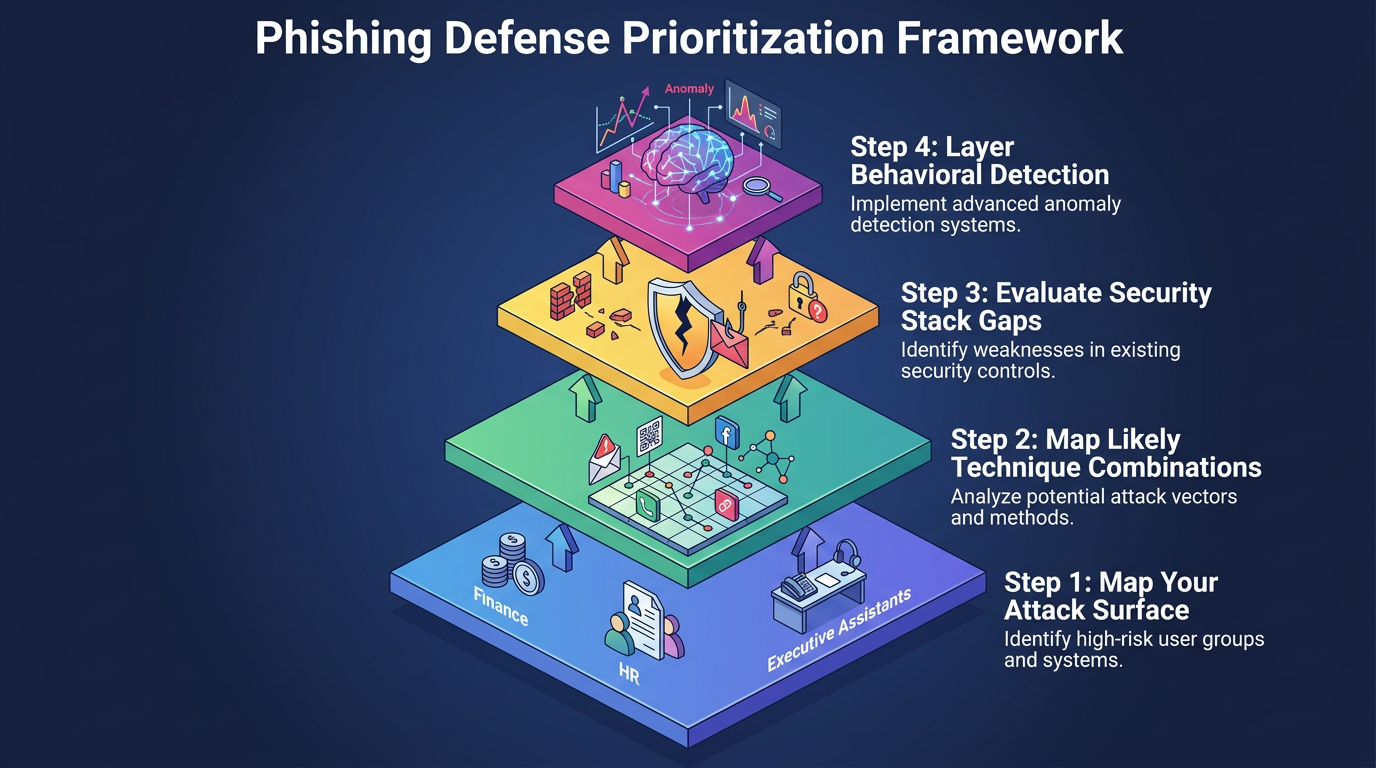
No security team has unlimited budget, headcount, or attention, so prioritization is what separates a defense strategy that actually reduces risk from one that spreads controls too thin to matter. Working through a few focused questions helps clarify where your exposure is greatest and which techniques warrant the most immediate investment:
Which employee roles handle financial transactions or sensitive data?
What legitimate platforms could attackers weaponize inside your own environment?
Where are sandbox-evading techniques most likely to succeed against your current stack?
Answering these questions honestly is what turns a generic checklist into a defense plan tailored to your organization's real risk surface. Without that grounding, even well-funded security programs end up protecting the wrong things while attackers exploit the gaps that were never mapped.
Where Phishing Attacks Are Headed Next
Phishing will keep combining AI-powered personalization with coordinated evasion, and it won't stay confined to email. Deepfake voice calls are already extending email pretexts into real-time voice verification fraud, and similar campaigns are moving across collaboration platforms like Microsoft Teams. As Nickolaisen noted in the webinar, "The way that you defend against these types of attacks also needs to update as well." A defense posture built for the mass-blast era of email phishing won't hold up against coordinated, cross-channel, AI-generated campaigns.
That update means pairing behavioral email and identity detection with complementary controls for voice, messaging, and video, plus the same automation focus applied to account takeover, abuse-mailbox handling, and SaaS posture monitoring, so the SOC isn't manually chasing every new channel attackers add.
Strengthen Your Email Security Against These Threats
Abnormal integrates with existing security infrastructure and applies behavioral AI to cloud email and identity signals, with support for connected collaboration platforms where deployed.
Gartner named Abnormal a Customers' Choice in the 2026 Gartner® Peer Insights™ Voice of the Customer for Email Security.
Abnormal's behavioral AI helps identify combined phishing attack techniques that evade traditional defenses. Request a demo to see how it helps evaluate threats across the full attack chain, from compromised senders to CAPTCHA-gated payloads.
Frequently Asked Questions
How Should Security Teams Evaluate CAPTCHA-Gated Phishing?
Automated sandboxes often stop at the CAPTCHA challenge itself. Pairing automated inspection with controlled human review of the full multistep flow helps analysts see what an actual recipient would encounter after solving it.
Why Should URL Analysis Follow the Entire Redirect Chain?
Rewritten URLs and multi-redirect chains obscure the true phishing destination. Following the chain to its end lets teams evaluate the actual landing page instead of relying on the reputation of an intermediary domain.
What Makes Behavioral Detection Different From Traditional Approaches?
Traditional detection typically analyzes individual components (sender reputation, URL reputation, attachment signatures) on their own. Behavioral detection adds context from cloud email and identity signals: whether a message fits established workflow cadences, vendor relationships, recipient behavior, timing, and engagement patterns.
How Does AI Affect Phishing Campaign Development?
AI lets attackers produce personalized, well-written messages with far less manual effort, tailoring language and pretexts to specific recipients while running more campaigns in less time.
Does Behavioral Detection Replace an Existing SEG?
No. It's designed to run alongside a third-party SEG or a native Microsoft 365 or Google Workspace deployment, adding behavioral context to whatever email infrastructure is already in place.