Key Insights
Deepfake fraud can create convincing video and voice interactions that appear to involve trusted executives. In one prominent scenario, a finance employee at a Hong Kong-based company transferred company funds after joining what appeared to be a routine video call with company leaders. The call looked legitimate: multiple executives were present and discussing an urgent financial matter. Yet every participant except the targeted employee was a deepfake, complete with realistic voices and mannerisms.
These attacks can leave victims certain that they interacted with real people. Security teams need a tactical response framework that supports rapid detection, containment, forensic analysis, and recovery when synthetic media influences a financial or operational decision.
Abnormal's webinar, "Supercharged Deception: How AI is Accelerating Social Engineering," features cyberpsychologist Dr. Mary Aiken and other industry experts discussing how attackers weaponize trust.
Key Takeaways
Deepfake fraud combines AI-generated synthetic media with psychological attack vectors such as authority bias and theory of conformity.
Standard incident response frameworks may not address synthetic media forensics or the verification challenges deepfakes create.
Financial recovery opportunities can narrow quickly, making rapid response protocols important.
Post-incident hardening requires technological controls and a culture that supports independent verification.
Organizations should preserve relevant digital artifacts promptly for forensic analysis and potential legal proceedings.
What Is Deepfake Fraud?
Deepfake fraud uses AI-generated video, audio, or images to impersonate trusted individuals for financial theft, data exfiltration, or corporate espionage. Traditional phishing attacks rely on text-based deception, while deepfake fraud creates multimedia experiences that exploit trust in face-to-face communication.
Two psychological attack vectors make deepfake fraud particularly persuasive:
Authority Bias: People may feel pressure to comply with instructions from someone in a position of power. When an apparent CFO requests an urgent wire transfer, the employee may hesitate to challenge the request.
Theory of Conformity: When several apparent executives support a decision, an individual may agree with the consensus even when something feels wrong. Attackers can create an entire fake meeting environment that surrounds the target with apparent agreement.
Together, these factors distinguish deepfake fraud from traditional social engineering tactics. In conventional attacks, victims might recognize that an email or text message could be fabricated. With sophisticated deepfakes, victims may believe they are having a live conversation with colleagues they know and trust.
Why Deepfake Fraud Demands a Dedicated Response Playbook
Deepfake fraud demands a dedicated response playbook because it creates verification, forensic, and psychological challenges that standard procedures may not address. Traditional incident response frameworks often focus on technical vulnerabilities or text-based deception, while a deepfake incident can leave a victim certain that the interaction was legitimate.
The main response challenges are:
Psychological Confidence: When someone has seen and heard an apparent CFO on a video call, asking them to question that interaction can feel unreasonable. This confidence may delay reporting and complicate initial triage. Security teams should prepare to support employees who believe the interaction was authentic while independently validating what occurred.
Specialized Forensics: Synthetic media forensics also requires specialized tools and expertise. Determining whether someone artificially generated a video or audio recording calls for capabilities beyond traditional malware analysis or email header examination.
Financial Speed: Speed compounds these challenges. Proceeds from wire fraud schemes can move through a series of accounts, making recovery progressively more difficult. Response playbooks should prioritize rapid financial escalation without waiting for the forensic investigation to conclude.
Addressing these challenges together helps teams verify the event without delaying containment or recovery.
How Deepfake Fraud Attacks Unfold
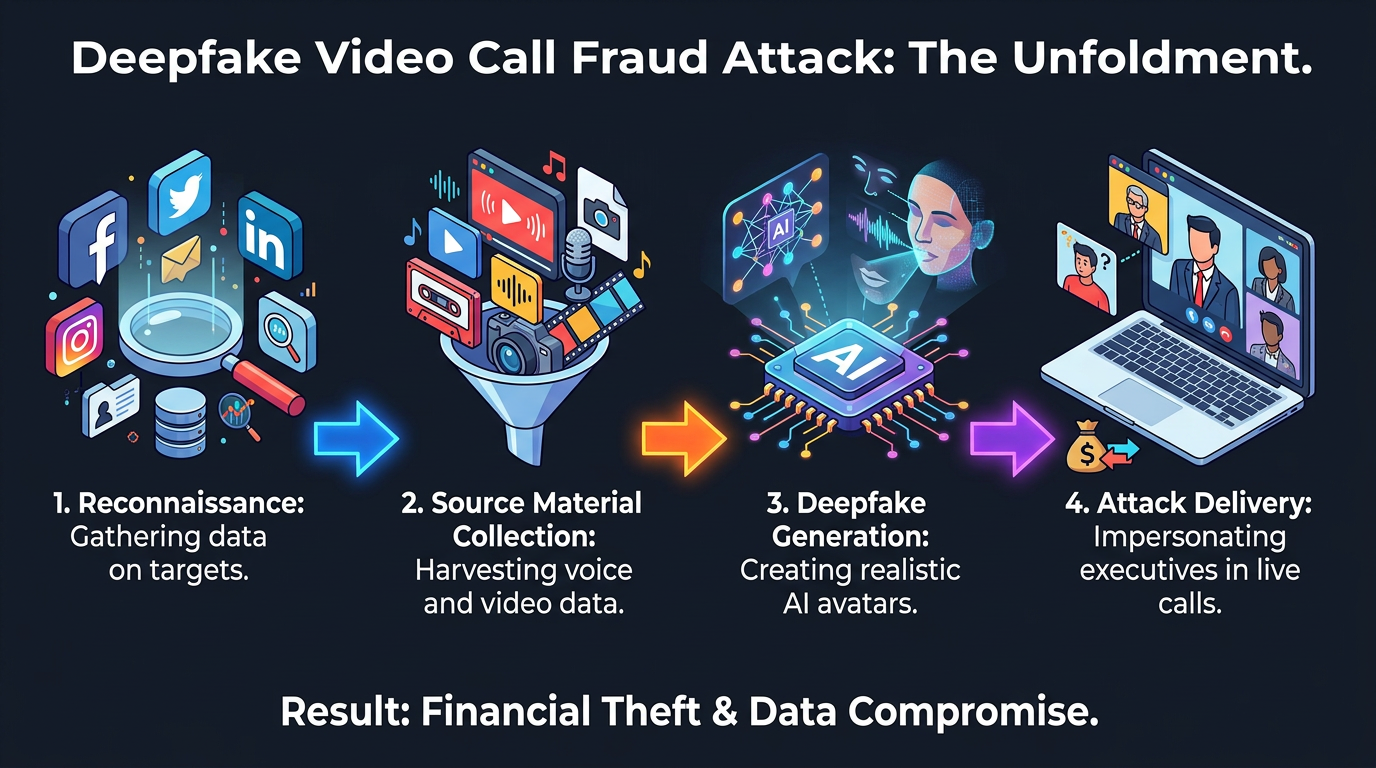
Deepfake fraud attacks typically progress from targeted reconnaissance to synthetic content generation and psychologically manipulative delivery.
Reconnaissance and Target Selection
Deepfake fraud reconnaissance maps organizational relationships, identifies high-value targets, and gathers source material before the direct interaction. The main activities include:
Organizational Mapping: Threat actors mine LinkedIn, social media, corporate websites, and corporate data breaches to map organizational hierarchies and identify high-value targets. They seek employees with financial authority, access to sensitive systems, or influence over important decisions.
Target Assessment: AI models can rapidly correlate public information across platforms, identify reporting relationships, and assess which employees may respond to specific requests. This process can reduce the manual effort required to prepare a targeted attack.
Source Material Collection: Attackers also gather source material for deepfake generation, including public videos, earnings calls, conference presentations, and social media posts featuring executives. A larger collection of source material can support more convincing synthetic media.
Together, these activities give attackers the organizational context and media inputs needed to prepare a targeted interaction.
Content Generation and Delivery
With reconnaissance complete, attackers generate synthetic content for a specific scenario. Deepfake technology can support live video calls as well as prerecorded messages.
The delivery mechanism typically combines several social engineering pressure tactics, including urgency, authority, and conformity. Attackers frame requests as time-sensitive opportunities or compliance requirements that call for bypassing normal approval workflows. A just-in-time premise such as "this must be done immediately or we'll miss the opportunity" pressures the target to act before seeking independent verification.
The resulting interaction may appear to include several trusted executives discussing an urgent financial matter. By combining realistic voices and mannerisms with apparent group agreement, attackers can make a wire transfer or sensitive-data request seem consistent with an authentic business decision.
How to Respond to Deepfake Fraud
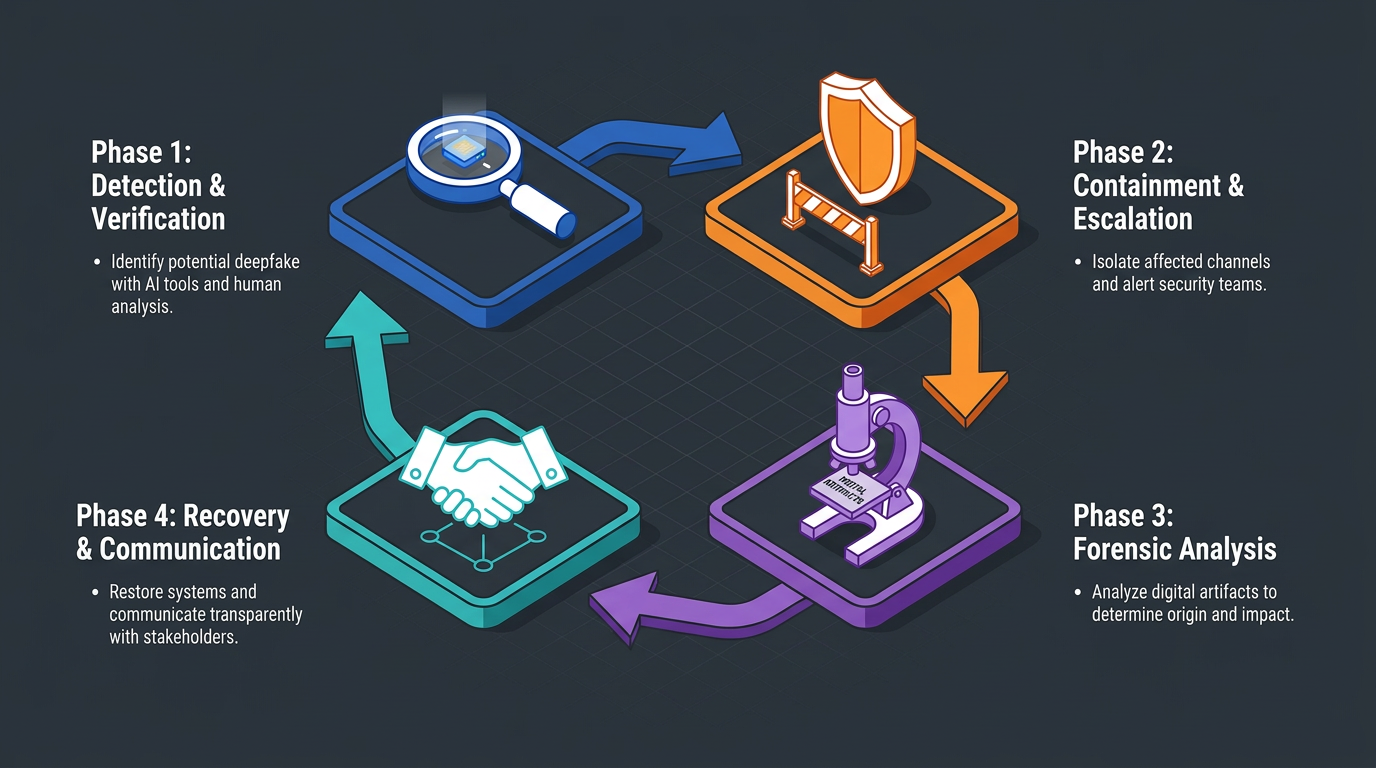
A phased response works because it sequences the decisions that matter most under pressure: verify before acting, contain before investigating, preserve evidence before remediating, and recover while supporting the people involved. Each phase hands off cleanly to the next, so teams move quickly without skipping the controls that protect financial recovery, legal standing, and employee trust.
Phase 1: Immediate Detection and Verification
The first response phase should focus on independent verification and prompt documentation of the suspected interaction.
Establish out-of-band verification protocols as soon as someone reports a suspicious request. Teams can confirm an urgent wire fraud request through a separate communication channel, regardless of how legitimate the original interaction appeared. If the request came through a video call, call the executive directly using a known phone number rather than contact information provided during the suspicious interaction.
The following red flags warrant escalation:
Unexpected Requests: An unplanned video call asks for a wire transfer or access to sensitive data.
Workflow Pressure: The requester introduces unusual urgency or asks the employee to bypass an approval process.
Uncharacteristic Involvement: An executive requests an operational financial action that they do not typically handle.
Discouraged Verification: The requester tells the employee not to follow a normal confirmation process.
These behavioral indicators can help teams recognize when verification should take precedence over speed.
Document the interaction promptly. Screenshots, recordings where legally permissible, timestamps, participant information, and the specific requests can become important evidence. Relevant indicators of compromise may include communication platform metadata, IP addresses, and files or links shared during the interaction.
Phase 2: Containment and Escalation Procedures
If independent verification fails or cannot be completed promptly, teams can treat the event as a suspected incident and begin containment.
Pause related financial transactions and contact the financial institution's fraud department. Early notification gives financial institutions and law enforcement more opportunity to trace or recall a transfer while the security team continues its investigation.
Isolate communication channels that may be compromised. If attackers gained access to video conferencing platforms or email systems, they may continue monitoring the response. Move incident response coordination to verified channels.
Activate the response team with a clear escalation matrix. Effective containment requires coordinated responsibilities across several groups:
Security: The security team can investigate accounts, communication channels, and technical evidence.
Legal: Legal counsel can assess disclosure, evidence-handling, privacy, and law enforcement requirements.
Finance: Finance leaders can coordinate with banks, insurers, and internal transaction owners.
Executive Leadership: Leadership can authorize business decisions and reinforce employee reporting protections.
Predefined roles and communication protocols can reduce confusion during a time-sensitive response.
As Dr. Mary Aiken explained in the webinar, "Those who are at the C-level in the organization should never punish employees for resisting those commands or orders with that level of urgency attached to them." This cultural foundation helps employees report suspicious activity without fear and can improve detection speed.
Phase 3: Forensic Analysis and Evidence Preservation
Forensic analysis should preserve the integrity of relevant evidence while distinguishing synthetic-media indicators from email and account signals.
The core forensic workstreams are:
Evidence Preservation: Preserve digital artifacts with a documented chain of custody, including video files, audio recordings, email headers, email header metadata, and communication platform logs. These materials may support legal proceedings, insurance claims, and an internal root-cause analysis.
Synthetic Media Analysis: Engage deepfake detection tools designed for synthetic media analysis. These tools examine artifacts in video compression, audio waveforms, facial movements, and other indicators of artificial generation. They provide a separate control layer for video and voice channels.
Email Analysis: For email-borne components of a campaign, Abnormal behavioral AI technology can help identify suspicious email patterns surrounding social engineering requests. This capability applies to cloud email and supported account or collaboration signals; it does not authenticate video, voice, or SMS content.
Attack Vector Analysis: Coordinate with IT to analyze potential attack vectors. Determine how attackers obtained source material, whether they compromised any accounts, and what reconnaissance preceded the attack. This analysis informs immediate remediation and long-term hardening.
Together, these workstreams support evidence integrity, channel-specific analysis, and informed remediation.
Phase 4: Recovery and Stakeholder Communication
Recovery should address financial remediation, legal obligations, operational continuity, and the effect of the incident on targeted employees.
The main recovery and communication workstreams are:
Financial Recovery: Begin financial recovery work in parallel with forensic analysis. Coordinate with banks, law enforcement, and cyber insurance providers, and document losses and attempted recovery actions. Clear incident response documentation can support claims, regulatory reviews, and internal reporting.
Internal Communication: Internal communication requires sensitivity. Employees targeted through social engineering deception may feel responsible despite being victims of a sophisticated attack. Provide psychological support and communicate clearly that deepfake fraud exploits human trust mechanisms rather than individual failure.
External Disclosure: External disclosure requirements vary by jurisdiction and industry. Publicly traded companies may face SEC reporting obligations, while healthcare organizations should evaluate HIPAA implications. Legal counsel can help the organization meet applicable requirements without compromising the integrity of an ongoing investigation.
Coordinating these workstreams helps the organization pursue recovery while supporting employees and meeting applicable legal requirements.
Post-Incident Hardening Against Deepfake Fraud
Post-incident hardening should combine transaction controls, channel-specific detection, employee training, and consistent verification procedures.
Implement multi-factor verification for high-value transactions. This goes beyond multifactor authentication controls for system access. Teams can establish prearranged code words, mandatory callback procedures, and dual authorization requirements for financial requests above defined thresholds.
Deploy channel-specific detection systems. Synthetic-media tools can analyze video and audio artifacts, while email defenses can assess email behavior surrounding a suspicious request. Email behavioral analytics tools can help surface requests that deviate from established workflow cadences, vendor interaction patterns, recipient behavior, timing, or engagement flows. Organizations should pair these capabilities with separate controls for voice, SMS, and videoconferencing channels.
Update security awareness training programs with deepfake-specific scenarios. Generic phishing training may not address the psychological challenges created by synthetic video and voice. Employees need realistic examples and clear instructions for invoking verification protocols.
Most importantly, establish a verification culture that supports employees who pause and question unusual requests. Urgency, executive authority, or apparent group consensus should not override established approval and callback procedures.
Build a Repeatable Deepfake Fraud Response
A repeatable deepfake fraud response starts with documentation: define how teams verify requests, escalate incidents, pause transactions, preserve evidence, and coordinate legal review before an incident forces improvised decisions. Pair that documentation with regular exercises using realistic synthetic-media scenarios so employees and response teams can identify process gaps while the stakes are still low.
Documented procedures address the human and process side of the response, but security teams also need detection depth on the channels attackers use to set up these campaigns. While deepfake video and voice require separate controls, the reconnaissance, pretexting, and follow-through almost always touch cloud email and connected accounts. This is where platforms like Abnormal apply behavioral AI to detect the deviations that precede or accompany a synthetic-media incident.
Abnormal models the workflow cadences, vendor interaction patterns, and recipient behavior inside each environment to surface requests that deviate from established norms, such as sudden wire instructions, out-of-pattern approvals, or unusual executive outreach that may be setting up a deepfake call. Account Takeover Protection extends the same approach to session and identity signals, flagging compromised accounts attackers often use to seed credibility for a synthetic-media handoff. Abnormal was recently named a Customers' Choice in the 2026 Gartner® Peer Insights™ Voice of the Customer for Email Security, reflecting consistent feedback from security teams using the platform to catch socially engineered attacks that evade legacy defenses.
See how Abnormal's behavioral AI can strengthen your deepfake fraud response. Book a demo today.
Frequently Asked Questions
Can We Recover Funds Lost to Deepfake Fraud?
Recovery depends on how quickly the organization acts and the path the funds traveled. Transfers routed through several accounts or jurisdictions can become more difficult to trace and recall.
Should We Inform Employees About a Deepfake Incident?
Yes, with careful messaging. Transparency can support organization-wide vigilance while protecting targeted employees. Avoid language that implies individual blame, and reinforce established security awareness training practices.
What Technical Capabilities Do We Need for Deepfake Detection?
Teams may need synthetic media analysis tools for video and audio, behavioral analytics for email, and external forensic expertise. Organizations can establish relationships with forensic providers before an incident occurs.