Email security compliance is harder than it looks because email sits at the intersection of daily business and complex obligations. A routine message can create consequences long after it leaves the sender's mailbox. Organizations must therefore turn overlapping legal language into a program they can consistently apply and defend when regulators or auditors ask questions.
Key Takeaways
Which rules apply to an organization's email depends on the data it carries, the industry it operates in, the jurisdictions it touches, and the channels employees actually use.
Some regulations mandate specific safeguards outright, while others permit risk-based decisions or documented alternatives, and that distinction changes both implementation and paperwork.
A safeguard only counts if it can be proven. Assign each control to an owner and retain its test records.
Obligations shift as laws, sender requirements, and business systems change, which makes periodic review of the control map part of the program itself.
What Email Security Compliance Requires
Email security compliance requires organizations to identify in-scope email data and obligations, apply suitable safeguards, and preserve proof that those safeguards work. Organizations must protect, handle, retain, and disclose email data under every applicable legal, regulatory, contractual, and internal policy obligation. Applicability depends on several factors:
Message data
Sender and recipient jurisdictions
Industry
Participants
Transmission method
Storage location and retention duties
Encryption and retention requirements vary by rule. Encryption may be mandatory, addressable with documented justification and an equivalent alternative, or one of several acceptable measures; retention can range from none for transitory messages to permanent for certain records.
Email Security Compliance Requirements by Regulation
Email requirements vary by the data a regulation covers, the organizations it binds, the jurisdiction it applies in, and whether each safeguard is mandatory, addressable, or risk-based.
HIPAA and FERPA Apply Risk-Based Rules to Sensitive Records
The Health Insurance Portability and Accountability Act (HIPAA) Security Rule permits sending electronic protected health information (ePHI) by email. Covered entities must restrict access to ePHI, protect its integrity, and guard transmissions against unauthorized access. Encryption sits in an unusual category: it is an "addressable" implementation specification, not a mandatory one. An organization that decides encryption is not reasonable and appropriate must document that determination and implement an equivalent alternative measure where appropriate. Skipping encryption without the paperwork is a violation.
HIPAA's six-year retention rule applies to Security Rule documentation such as policies, procedures, and assessment records, not to patient email generally; no federal HIPAA provision sets a retention period for patient messages themselves.
The Family Educational Rights and Privacy Act (FERPA) takes a similarly risk-based posture toward student records. Schools need signed, dated written consent before disclosing personally identifiable information from education records, must use reasonable methods to verify the identity of anyone receiving that information electronically, and must record disclosures as required, subject to applicable exceptions. FERPA mandates no specific technical controls, so a school's safeguards are judged on reasonableness rather than a checklist.
GLBA, SOX, SEC, and FINRA Create Financial-Sector Duties
The Federal Trade Commission (FTC) Safeguards Rule under the Gramm-Leach-Bliley Act (GLBA) takes the opposite approach to HIPAA: covered financial institutions must encrypt customer information both in transit over external networks and at rest. Where encryption is infeasible, the rule permits compensating controls only when a designated Qualified Individual reviews and approves them. This exception therefore requires both an alternative control and evidence that the responsible individual evaluated it.
Retention duties dominate the rest of the sector. Under the Sarbanes-Oxley Act (SOX), auditors must keep records connected to an audit, including correspondence and electronic records, for seven years after the audit concludes, whether or not those records support the final conclusions. SEC Rule 17a-4, issued by the Securities and Exchange Commission (SEC), requires broker-dealers to retain certain records for six years and communications for three. Broker-dealers must preserve those records in either a write once, read many (WORM) format or a complete, time-stamped audit trail. Financial Industry Regulatory Authority (FINRA) rules add supervision by requiring retained records to identify those who prepared and reviewed correspondence. These rules require financial organizations to distinguish customer information from audit records and broker-dealer communications because each category carries different duties.
GDPR, PCI DSS, and CCPA/CPRA Tie Protection to Data and Risk
The General Data Protection Regulation (GDPR) leaves the encryption protocol unspecified and uses a risk-based standard. Article 32 requires technical and organizational measures appropriate to the risk and lists encryption and pseudonymisation as examples, while Article 25 requires data protection by design and by default. The GDPR sets a precise breach-notification deadline.
The Payment Card Industry Data Security Standard (PCI DSS) is far more specific. Requirement 4.2.2 requires that a primary account number (PAN) be secured with strong messaging cryptography whenever it is sent through end-user messaging technologies such as email, even when a customer requests it that way. Since March 31, 2025, Requirement 5.4.1 also makes anti-phishing processes and automated mechanisms a requirement rather than a best practice.
California's California Consumer Privacy Act (CCPA), as amended by the California Privacy Rights Act (CPRA), creates a different kind of exposure: a private right of action when nonencrypted, nonredacted personal information, or an email address combined with a password or security question and answer, is breached because a business failed to maintain reasonable security. That exposure can scale quickly across a large breach.
Regulation | Covered Data | Encryption Status | Retention Duty | Breach Notification
|
|---|---|---|---|---|
HIPAA | ePHI | Addressable, with documented alternatives | 6 years for Security Rule documentation | Within 60 days of discovery |
FERPA | Student education records | No specific controls mandated | Disclosure records kept with student records | Not specified |
GLBA Safeguards Rule | Customer financial information | Mandatory, in transit and at rest | Documented safeguards program | Within 30 days to the FTC (500+ consumers) |
SOX | Audit and review records, including email | Not specified | 7 years after the audit | Not specified |
SEC 17a-4 / FINRA | Broker-dealer communications | Not specified | 3 to 6 years, WORM or audit trail | Not specified |
GDPR | European Union (EU) personal data | Risk-based, "as appropriate" | Not specified | Within 72 hours to the supervisory authority |
PCI DSS | Payment card PAN | Strong cryptography required in messaging | Not specified | Not specified |
CCPA/CPRA | California consumers' personal information | Unencrypted data triggers private lawsuits | Not specified | Private right of action |
Security Controls That Map to Email Obligations
Effective email controls combine identity, authentication, access, encryption, filtering, monitoring, and data protections, and each one needs evidence that it operates as intended.
Identity, Authentication, and Access Controls Reduce Unauthorized Use
Because stolen credentials and impersonated domains can enable email compromise, identity controls come first. Phishing-resistant multifactor authentication (MFA) on mailboxes closes the credential-theft path at sign-in, and Fast Identity Online (FIDO), through FIDO/WebAuthn authentication, is the only widely available phishing-resistant method. Three additional controls limit what a single compromised account can reach:
Least-Privilege Mailbox Permissions: Restrict access to what a role actually requires, limiting an account's reach after compromise.
Recipient Verification: Confirm the intended recipient before sensitive disclosures to reduce accidental exposure.
Periodic Access Reviews: Show auditors who had mailbox rights, who approved them, and when the organization removed unnecessary access.
Together, these records give auditors a documented trail of who could reach what, and when that access changed.
Encryption, Filtering, Monitoring, and Data Controls Protect Message Content
Transport encryption and content encryption require separate audit checks. Transport encryption, typically Transport Layer Security (TLS) through STARTTLS, protects a message between mail servers. Intervening hops may be under autonomous control, so transport protection alone cannot guarantee an encrypted end-to-end path. Content encryption, such as Secure/Multipurpose Internet Mail Extensions (S/MIME), protects the message body so no intermediary system can read it. The distinction matters when an obligation requires protection in transit, at rest, or for the content itself. Organizations need configurations and test records that show which layer applies, where encryption begins and ends, and what happens when a receiving server does not support it. For the most sensitive data, a secure portal or managed file transfer may be more defensible than ordinary email.
Filtering and monitoring handle inbound threats and outbound leaks:
Anti-Phishing Controls: Reduce malicious messages that reach user inboxes.
Attachment and Link Inspection: Screen incoming content for malicious payloads before delivery.
External-Sender Banners: Flag messages that originate outside the organization.
Data Loss Prevention (DLP) Rules: Catch regulated data leaving in message bodies and attachments.
DLP testing should cover both message bodies and attached files so the organization can identify inconsistent enforcement. Logging and alert review then turn these controls into an investigable record that connects detected activity to the actions taken in response.
How to Build an Email Security Compliance Program
A verifiable program moves from scope and risk assessment through policy, implementation, testing, training, and evidence collection.
Scope, Risk, and Policy Establish the Compliance Baseline
The technical scope includes every sending domain, mail system, and third-party integration that sends or reads mail. Organizational scope covers user groups, regulated data categories, jurisdictions, and approved communication channels. Employees may also conduct business through personal email, text, and chat, so these belong in the channel scope.
An email-specific risk assessment addresses threats that reach mailboxes:
Domain spoofing
Malware delivery
Misdirected messages
Excessive mailbox access
Weak encryption
Unmanaged retention
For each applicable obligation, the assessment should document whether it is mandatory, addressable, risk-based, contractual, or voluntary, and identify a control owner. That classification drives implementation: mandatory controls are implemented, addressable controls are implemented or formally justified, and voluntary controls receive a deliberate adopt-or-decline decision.
Policy converts those decisions into rules people can follow. It should cover acceptable use, sensitive-data handling, encryption, retention, legal holds, off-channel communication, exceptions, and incident escalation. A policy nobody can trace to a regulation, or a regulation nobody can trace to a policy, is a finding waiting to happen.
Implementation, Testing, and Evidence Keep Controls Verifiable
Technical safeguards work best when each stage informs the next. A staged DMARC rollout starts with SPF and DKIM, followed by a monitoring-only DMARC policy. Aggregate reports reveal legitimate senders that fail authentication. Organizations can correct those failures before tightening the policy from none to quarantine to reject. Transport protection, content encryption, MFA, filtering, logging, and retention can follow the same deploy-observe-tighten pattern.
Testing should verify that controls work instead of trusting settings or vendor assurances. Three checks illustrate the approach:
Send test payment data to confirm DLP catches it.
Spoof the organization's domain from an outside account to confirm rejection.
Attempt to delete an archived record to confirm the attempt fails and gets logged.
Each test should produce repeatable evidence and a remediation record when the outcome differs from expectations.
Training deserves the same evidence standard. Consistent phishing simulation with brief refreshers throughout the year is more useful than relying on one-time annual training alone, though training lowers risk without eliminating it. Each item in the evidence register should connect back to the obligation it satisfies:
Policies
Approvals
Configurations
Test results
Access reviews
Training records
Alerts
Incident reports
Remediation status
A register this complete turns a claimed control into a defensible one when a regulator or auditor asks for proof.
Retention, Incident Response, and Breach Notification
Compliant email handling requires record-specific retention, tested preservation and export processes, and incident workflows that assess notification duties on time.
Email retention periods vary. Schedules have to account for record type, industry rules, active legal holds, accessibility, and integrity, and they must reach the mail server and every other approved channel. Federal agencies show how granular this gets: under NARA guidance from the National Archives and Records Administration (NARA), senior Capstone officials' email is retained permanently and transferred to the National Archives, while other federal email is kept for at least seven years. An employee who conducts federal business from a personal account must copy an official account or forward a complete copy within 20 days. Fixed periods coexist with event-driven duties because organizations must preserve messages when litigation becomes reasonably foreseeable, regardless of the schedule.
Retention can also fail quietly. Archives need periodic testing of deletion controls, audit trails, and export capability.
When an incident occurs, the response lifecycle runs through five stages, in order:
Preparation
Detection and analysis
Containment
Eradication and recovery
Post-incident activity
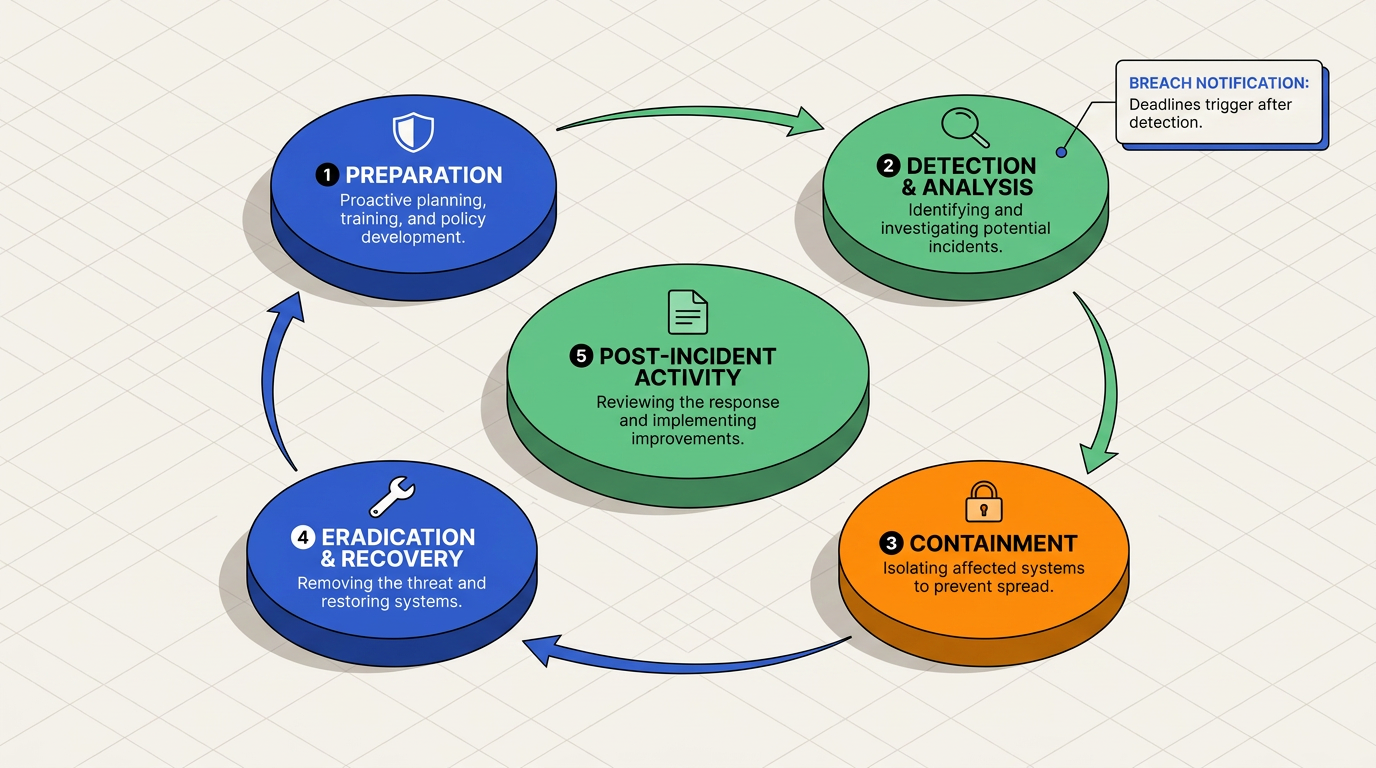
Notification deadlines then diverge by regulation:
GDPR Notification: Required within 72 hours of awareness, where feasible.
HIPAA Notification: No more than 60 days after discovering a breach of unsecured protected health information.
FTC Notification: Within 30 days for events involving 500 or more consumers' unencrypted information.
Whether notice is owed at all depends on encryption status, the data affected, the number of people, assessed risk, jurisdictions, and materiality. HIPAA can provide a safe harbor when encryption renders data unreadable.
A Compliance Program That Can Adapt
An email compliance program holds together when every applicable obligation connects to a named control, an accountable owner, a testing method, and an evidence record. Those connections change as regulations are amended, mailbox providers raise sender requirements, employees adopt new channels, and incidents expose unexpected gaps. Reviewing the control map after any material system, legal, data, or incident change keeps the program aligned with the obligations it exists to meet.
Frequently Asked Questions
Is Encryption Mandatory for Email Security Compliance?
It depends on the regulation. The GLBA Safeguards Rule makes encrypting customer information mandatory, with a narrow compensating-controls exception. HIPAA treats encryption as addressable, so an organization may decline it only with a documented rationale and an equivalent alternative where appropriate. The GDPR takes a risk-based approach that names encryption as one suitable measure, and PCI DSS requires strong cryptography whenever payment account numbers travel through email.
What Is the Difference Between Secure Email and Compliant Email?
Security controls reduce the chance a message is intercepted, spoofed, or leaked. Compliance adds everything a regulator or auditor checks on top of that: correct scoping of which rules apply, written policies, retention matched to record types, oversight, and evidence that controls operate. An organization can run excellent security and still fail an audit because it cannot document its decisions or produce its records.
Do SPF, DKIM, and DMARC Satisfy Regulatory Requirements?
SPF, DKIM, and DMARC support anti-phishing expectations by authenticating the sending domain and reducing spoofing. SPF, DKIM, and DMARC are one control family within a broader program. Other controls must protect message content, restrict mailbox access, enforce retention, and support breach reporting.
How Long Must Organizations Retain Business Email?
Retention periods vary by record type, the sector's rules, applicable legal duties, active litigation holds, and internal policy. Financial audit records, broker-dealer communications, federal agency email, and healthcare compliance documentation each carry different periods, and organizations must preserve messages relevant to foreseeable litigation regardless of any schedule.
What Evidence Demonstrates Email Security Compliance?
Evidence should form a trail rather than rest on a claim: risk assessments, current policies, control configurations, access review records, test results, mail-flow and security logs, retention and archive records, approved exceptions with rationale, training completions with simulation results, and incident documentation showing how notification decisions were made.