Identity theft security addresses the risk that someone may use your personal information as if it were their own. Misuse can remain hidden until an unexpected bill, notice, or application brings it to light, often after the information has moved through several hands or systems. Understanding the scale and mechanics of that risk provides a clearer foundation for deciding what protection should accomplish.
The sections ahead trace how stolen data becomes usable in the wrong hands, which controls actually interrupt that path, and what an effective response looks like once misuse surfaces. Personal information rarely stays contained after a single exposure, so the value of any protection depends on how well its layers fit together.
Key Takeaways
Identity theft is a supply chain that starts with stolen personal data and ends with money or benefits drawn in the victim's name.
A credit freeze and phishing-resistant multi-factor authentication (MFA) mechanically block common forms of identity theft.
Credit, transaction, and dark web monitoring report activity after it happens, so they belong behind preventive controls.
Recovery follows a recommended federal process, and a faster response can limit financial exposure and shorten the cleanup.
What Is Identity Theft Security?
Identity theft security covers prevention, detection, and recovery when personal information is used without permission.
The information involved may include a name and address, card or bank account numbers, a Social Security number (SSN), or medical insurance details. With enough of it, someone can impersonate another person when applying for credit, accessing an account, filing a tax return, obtaining medical care, or claiming benefits. In 2024, more than 1.1 million identity theft reports reached the Federal Trade Commission (FTC) through IdentityTheft.gov, according to FTC data.
The crime generally takes three forms, and each surfaces in a different system:
Existing-Account Misuse: Using an account the victim already holds, which may surface in a transaction alert.
New-Account Fraud: Using personal information to open a new account, which may remain hidden until a credit check or collection call.
Use for Another Purpose: Using an identity for something else entirely, such as claiming government benefits.
Tax, medical, and criminal identity theft can bypass the credit system entirely.
Effective identity theft security combines controls that prevent access with alerts that expose suspicious activity. Legal processes then correct records. These layers address different stages of misuse rather than relying on one service to cover every financial, government, or healthcare system.
How Does Identity Theft Happen?
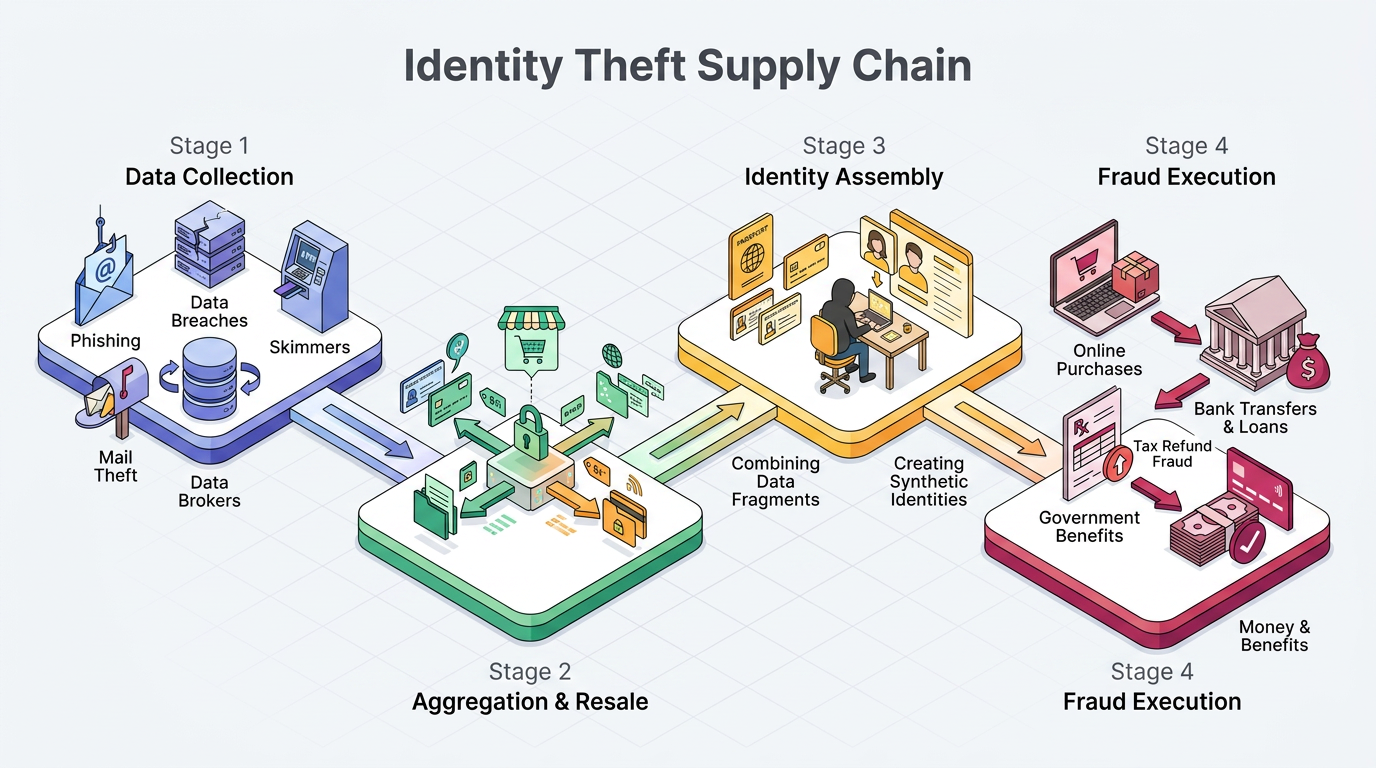
Identity theft works as a supply chain. Criminals gather personal data and combine it into a usable identity. They then convert the identity into money, services, or benefits.
Personal Data Collection and Resale
Criminals gather personal information from several recurring sources, both digital and offline:
Phishing Campaigns: Messages imitate trusted organizations and push recipients toward fake login pages or malware downloads, or request sensitive information directly, arriving by email, text, phone call, or quick-response (QR) code.
Public Websites and Data Brokers: Aggregated public records and broker databases supply names, addresses, and other identifying details.
Stolen Accounts and Data Breaches: Compromised accounts expose stored personal data directly, and large breaches provide records in bulk.
Skimmers and Stolen Mail: Skimmers copy card data, while stolen mail may contain checks, statements, or pre-approved credit offers.
Underground Marketplaces: Stolen data from any of these sources circulates for resale once collected.
Artificial intelligence (AI) can make impersonation more convincing on top of these collection methods.
In a May 2025 alert, the Federal Bureau of Investigation (FBI) warned that criminals increasingly use AI-generated audio to impersonate public figures or people a target knows.
The criminal who steals the data may sell it to someone else. Buyers can then combine fragments from separate incidents into a more complete identity. Reused passwords increase each leak's value because credential stuffing tests one exposed login across banking, email, retail, and other accounts. This combination of collection, resale, and reuse turns isolated pieces of information into material that can support impersonation.
Account Access, New Applications, and Benefits
Criminals generally cash out through an existing account, a new application made in the victim's name, or government and healthcare systems that sit outside consumer credit entirely: tax refund fraud, medical and insurance fraud, and criminal-record fraud, each covered in more detail in the next section. These routes may not produce a credit alert because the misuse occurs in a different record system.
Phone numbers can also become a point of attack. In a subscriber identity module (SIM) swap, a criminal persuades a carrier to move the victim's number to a SIM card the criminal controls. This redirects texted security codes. Since July 8, 2024, the Federal Communications Commission (FCC) has enforced FCC rules requiring carriers to authenticate customers before moving a number and notify them of SIM changes or port-out requests.
The Main Types of Identity Theft
Identity theft includes existing-account misuse, new-account fraud, synthetic identities, and forms that operate outside conventional credit accounts.
Account Takeover and New-Account Fraud
Account takeover begins with an account the victim already holds. A criminal who obtains the login through phishing, malware, a breach, or credential stuffing can enter a bank, card, email, or retail account. The activity often appears on a statement or in a transaction alert, and established dispute processes may make individual unauthorized charges relatively straightforward to address.
New-account fraud follows a different timeline. Armed with identifying details, the criminal applies for credit or services the victim never requested. Statements may go elsewhere. The first sign may be a denied loan or unfamiliar inquiry. Some victims first learn of the account through a collection call. Consider an employee who gets a call from a collection agency about a credit card they never opened: often the first concrete sign that someone else applied using their information. Creditors must watch for warning signs at account opening under the Red Flags Rule, but identity checks can still fail.
Recovery also differs. A fraudulent charge usually starts with a dispute through the issuer. A new account requires the victim to prove to an unfamiliar lender that someone else applied, close the account, and remove the resulting debt from the credit file. The distinction matters because controls that flag spending on an existing account may not reveal an application submitted elsewhere.
Synthetic, Child, Tax, Medical, and Criminal Fraud
This category covers several variants, each requiring its own correction path:
Synthetic Identity Fraud: Combines a real SSN with an invented name, birth date, or address. A criminal may build a normal-looking credit history, max out every available line, and abandon the identity. An April 2025 report from the Federal Reserve Bank of Boston described generative AI as an accelerant for this fraud.
Child Identity Fraud: Children's SSNs are attractive targets because they may have no credit history and may not be checked for years.
Tax Identity Theft: Occurs when a criminal files a fraudulent return using a stolen SSN.
Medical Identity Theft: Occurs when a criminal receives care or prescriptions under another person's insurance, which can add incorrect information to the victim's record.
Criminal Identity Theft: Occurs when a criminal's arrest creates a record under the victim's name, which may surface through a background check, court summons, or suspended license.
These variants require different corrections because no single credit control reaches every system. A credit report may reveal an account created with a synthetic identity, but it will not necessarily show a fraudulent tax return or altered medical record. An arrest recorded under another name may also remain outside the credit report.
How Do Identity Theft Security Measures Work?
Identity theft security measures either block a fraud path before it opens or reveal misuse after it occurs, with preventive controls providing the strongest first layer.
Credit Freezes and Fraud Alerts
A credit freeze restricts access to a credit report at each of the three nationwide bureaus. Because lenders usually review a report before extending credit, a freeze interrupts a key dependency in new-account fraud. It prevents anyone, including the consumer, from opening a new credit account while the freeze remains active.
Federal law has made freezes free since 2018. They remain in place until consumers remove them, do not affect credit scores, and allow temporary lifts for legitimate applications, according to the FTC. Consumers must contact each bureau separately. The limitation is scope: a freeze applies to new credit, not misuse involving an existing account, tax return, medical care, employment, or government benefits.
A fraud alert instead tells businesses to verify the applicant's identity. An initial alert lasts one year, while a victim with an Identity Theft Report can request an extended alert lasting seven years. A freeze creates a stronger barrier because it restricts report access, while an alert preserves access and depends on the business completing additional identity checks. The choice therefore affects both the strength of the barrier and the ease of applying for legitimate credit.
Passkeys, MFA, and Password Managers
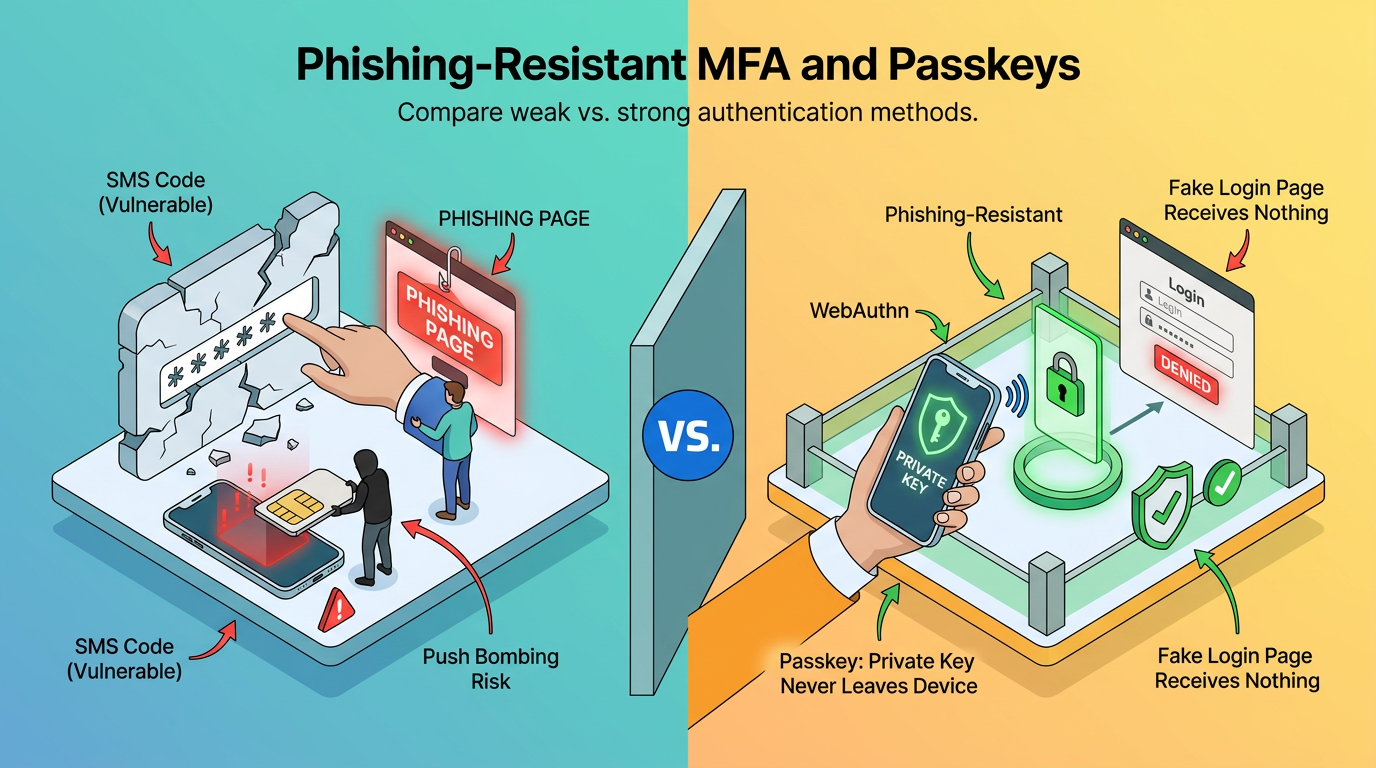
Multi-factor authentication (MFA) asks for proof beyond a password, such as a device, hardware key, authenticator, or biometric. Texted codes can be redirected through a SIM swap, while repeated push notifications can lead to push bombing, in which an attacker floods the user with requests until one is accepted.
Passkeys based on WebAuthn standards (a web standard that lets a device sign in without ever transmitting a password) provide stronger phishing resistance. A device holds a private key that does not leave it and signs in only to the website for which the passkey was created. A fake bank page therefore receives no reusable password or code. The Cybersecurity and Infrastructure Security Agency (CISA) identifies authentication based on these standards in CISA guidance as the widely available phishing-resistant option.
A password manager can generate a unique password for every account, so a breach at one service does not automatically expose others. Long passwords also provide more protection than short, predictable choices, while routine forced changes can encourage users to make minor variations. Unique credentials and phishing-resistant authentication reduce the value of passwords captured through breaches, reuse, or deceptive login pages.
Credit, Transaction, and Dark Web Monitoring
Monitoring shortens the time between suspicious activity and a response, but it does not stop the initial event. Credit monitoring watches reports for new accounts, late payments, inquiries, or identity changes. Transaction alerts flag charges as they clear.
Dark web monitoring looks for exposed personal information in criminal marketplaces. Criminals may test a stolen card with a small purchase before attempting larger transactions. A prompt alert can limit the run and allow the issuer to replace the card. For debit cards, Regulation E ties potential liability to how quickly the consumer reports a lost card or unauthorized transfer.
Prevention nevertheless belongs first because monitoring reports activity after it appears. A freeze can stop a fraudulent credit application, while a passkey can prevent a phishing site from capturing reusable login material. Monitoring then covers activity those controls cannot block and gives the consumer an opportunity to respond.
Measure | Control Type | Fraud Path Addressed | Main Limitation |
|---|---|---|---|
Credit Freeze | Prevention | New-account fraud | Applies mainly to new credit. |
Fraud Alert | Soft prevention | New-account fraud | Depends on identity verification. |
Passkey MFA | Prevention | Account takeover | Cannot prevent a service-side breach. |
Password Manager | Prevention | Credential stuffing | Stored passwords may still be stolen. |
Credit Monitoring | Detection | New-account fraud | Alerts only after activity appears. |
Transaction Alerts | Detection | Existing-account fraud | Arrive after a transaction occurs. |
Dark Web Monitoring | Detection | Data exposure | Cannot recall exposed information. |
Everyday Habits for Residual Exposure
Everyday routines help close gaps left by credit and authentication controls:
Secure Document Handling: Keep a Social Security card in a secure place, and shred documents that contain financial and medical account details.
Daily Mail Monitoring: Collect mail daily to limit access to statements, checks, and credit offers. United States Postal Service (USPS) Informed Delivery can make missing mail easier to recognize by showing what should arrive.
Automatic Software Updates: Keep phones, computers, applications, and home routers updated to close known flaws. Unique passwords and multi-factor authentication (MFA) remain useful on patched devices because many attacks rely on deception rather than software vulnerabilities.
Regular Record Review: Free credit reports from all three bureaus are available through AnnualCreditReport.com and can reveal unfamiliar accounts, inquiries, addresses, or payment problems, while statements, insurance explanations of benefits, tax notices, and earnings records provide similar visibility beyond credit.
Document security, device security, and record review each close a different gap, and together they help identify which organization holds the incorrect information and where a correction needs to begin.
Common Misconceptions About Identity Theft Security
Common misconceptions blur the difference between prevention, detection, and recovery. People may then overestimate some services and overlook stronger controls. Would you assume a monitoring subscription alone keeps a new account from being opened in your name?
Monitoring Prevents Theft: Monitoring usually reports activity after information has been exposed or used. A security freeze performs the preventive work many people expect monitoring to provide.
A Freeze Hurts Your Credit Score: A freeze does not affect a credit score. It restricts access to the report and allows temporary lifts when a legitimate application requires a credit check.
Only Careless People Get Hit: Breaches at employers, retailers, insurers, and service providers can expose people regardless of their personal habits. Good security reduces risk but cannot control every organization holding personal data.
A Strong Password Is Enough: Passwords provide little protection when entered into a convincing fake page. Unique passwords limit reuse, while phishing-resistant MFA keeps a stolen password from becoming sufficient for access.
Children and the Deceased Are Safe: Rarely checked SSNs may be attractive because misuse can remain hidden. A parent or guardian can freeze the credit file of a child under 16, including when the bureaus must create a file for that purpose.
Paid protection creates another misunderstanding. These services may combine monitoring, recovery assistance, and insurance for eligible expenses, but they cannot make exposed information secret again. Their value lies in convenience and support rather than replacing a freeze, strong authentication, account alerts, or record review. Compare services by the capabilities they add beyond the controls already available.
What to Do After Identity Theft
Recovery begins with recognizing and containing active fraud. Documentation then supports the correction of each affected record.
Detection Through Bills, Reports, and Notices
Identity theft usually becomes visible through routine paperwork or account activity. An unfamiliar charge, account, inquiry, or address can indicate financial misuse. Missing mail may mean someone changed a billing address, while collection calls about unknown debts can point to a fraudulent account.
Government and medical systems produce their own warning signs. A tax return may be rejected because someone already filed under the same SSN, or the Internal Revenue Service (IRS) may request identity verification. Medical statements may list care or prescriptions the insured person never received. A background check, court notice, or license problem can expose criminal identity theft. Because these records sit outside routine credit monitoring, the notice may come directly from the organization involved.
Not every unfamiliar item proves identity theft. Merchants may bill under unexpected names, and family members may use shared accounts. Administrative errors can also affect records. The relevant organization can verify whether the activity has a legitimate explanation. When it does not, prompt review can establish what happened, identify which records require correction, and show whether the misuse remains active.
Containment, Documentation, and Record Repair
Contact the fraud department of each company where misuse occurred. The company can restrict affected accounts, replace cards, preserve records, and begin its dispute process. Fraud alerts and freezes at all three bureaus can reduce the chance of additional credit accounts appearing during cleanup.
The federal recovery portal, IdentityTheft.gov, generates a personalized plan and an Identity Theft Report. The report supports requests to remove fraudulent information. With the report, proof of identity, and a letter identifying the disputed debts, a credit bureau must block qualifying information within four business days under federal law, according to the CFPB.
Follow-up depends on the misuse:
Tax Identity Theft: May require an affidavit. An IRS Identity Protection PIN (IP PIN) prevents future returns from being filed without the assigned number.
Medical Identity Theft: Requires records and written correction requests.
Criminal Identity Theft: May involve courts, law enforcement, and motor vehicle agencies.
Copies of letters, reports, statements, and call notes create a record if fraudulent information resurfaces or another organization requests proof of the theft.
Building Protection That Outlasts the Next Breach
A layered identity theft security plan combines freezes, phishing-resistant authentication, unique passwords, account alerts, careful document handling, and regular record review. No single measure reaches credit, banking, tax, medical, and criminal systems at once. Placing prevention first, detection behind it, and a documented recovery process within reach reduces risk even when personal information is exposed elsewhere.
Frequently Asked Questions
Does a Credit Freeze Stop All Identity Theft?
No. A credit freeze primarily blocks new credit accounts by restricting access to a credit report. It does not stop misuse of an existing card or login, nor does it cover tax, medical, employment, or criminal fraud.
What Is the Difference Between a Credit Freeze and a Credit Lock?
A credit freeze is a free right established by federal law and comes with deadlines the credit bureaus must follow. A credit lock is a bureau product governed by the provider's service terms and may require payment.
Is Paid Identity Theft Protection Worth It?
Paid protection may help people who value consolidated monitoring, recovery assistance, or eligible expense coverage. Its main benefit is convenience, and it does not replace free preventive measures such as freezes, fraud alerts, unique passwords, or strong MFA.
What Should I Do if Someone Is Using My Social Security Number?
Report the misuse through IdentityTheft.gov and contact each affected organization. An earnings review can identify wages reported under the number, while the IRS handles tax-related misuse. Credit freezes may prevent additional credit accounts.
How Long Does Identity Theft Recovery Take?
The timeline depends on the type and number of records involved. A single unauthorized card charge may clear relatively quickly. New-account, synthetic, medical, tax, or criminal identity theft often takes longer because several organizations may need to investigate and correct separate records.