The trusted people already inside an organization now account for a growing share of its most expensive breaches. Ponemon's 2026 Cost of Insider Risks Global Report analyzed 7,490 insider incidents across 354 organizations, more than twice the 3,269 counted in 2018, and the cost to contain each one keeps rising.
Insider threat management protects an organization from harm that arrives through authorized access. The consequences can reach across the organization and endure long after an event. A coordinated approach creates the clarity and consistency needed to manage that exposure while protecting the organization and its workforce.
This article walks through what an effective program looks like in practice, from establishing authority and governance to preventing, detecting, and responding to insider activity. Readers will come away with a clear framework for building a program that reduces risk without eroding trust in the workforce.
Key Takeaways
A named senior executive and multidisciplinary working group provide decision rights beyond a security team's authority.
Prevention and detection carry equal weight because programs must address accidental and deliberate harm.
Response uses decision gates to validate context before action, so unusual activity never proves intent.
Risk-reduction metrics and periodic maturity reviews turn incidents into input for improvement.
What Is Insider Threat Management?
Insider incidents can affect data, operations, people, compliance, and trust because authorized access may reach several parts of an organization.
IBM's 2025 Data Breach Report found that malicious insider attacks averaged $4.92 million per incident, the costliest initial threat vector for the second year running. Verizon's 2025 Investigations Report found that among breaches involving internal actors, unintentional errors occurred roughly two to one relative to deliberate privilege misuse, with misdelivered information leading the errors.
Together, the two numbers frame the problem: the deliberate incidents cost the most per event, but the accidental ones happen more often and add up quickly. A program focused only on deliberate sabotage therefore misses much of what goes wrong, including compliance exposure from accidental disclosure of regulated data.
Addressing that full range of harm is what insider threat management sets out to do. The discipline coordinates deterrence, detection, and response to harm from authorized access, integrating monitoring tools with access-control policies so both deliberate and accidental incidents fall within scope.
Insider Risk and Insider Threat Differ in Intent and Impact
An insider is anyone who has, or once had, authorized access to an organization's people, facilities, information, equipment, networks, or systems. That includes contractors, partners, and former staff as well as employees. An insider threat is the potential for one of those people to use their access or knowledge to hurt the organization, whether deliberately or accidentally. Examples include espionage, sabotage, theft, unauthorized disclosure, workplace violence, and the loss of a capability the organization depended on.
Insider risk sits one level up. It describes how likely it is that an insider threat will be realized and how much damage would follow. That distinction shapes where a program spends effort. A threat attaches to a person or an account; a risk attaches to an asset, weighted by likelihood and impact. A finance analyst with read access to payroll and a database administrator with full rights to the customer platform are both insiders, but the risk each represents differs because their access reaches different assets.
Some definitions limit the term to malicious acts; this definition includes unintentional harm to keep prevention at the center of the program.
Malicious, Negligent, Unintentional, and Compromised Insiders Create Different Risks
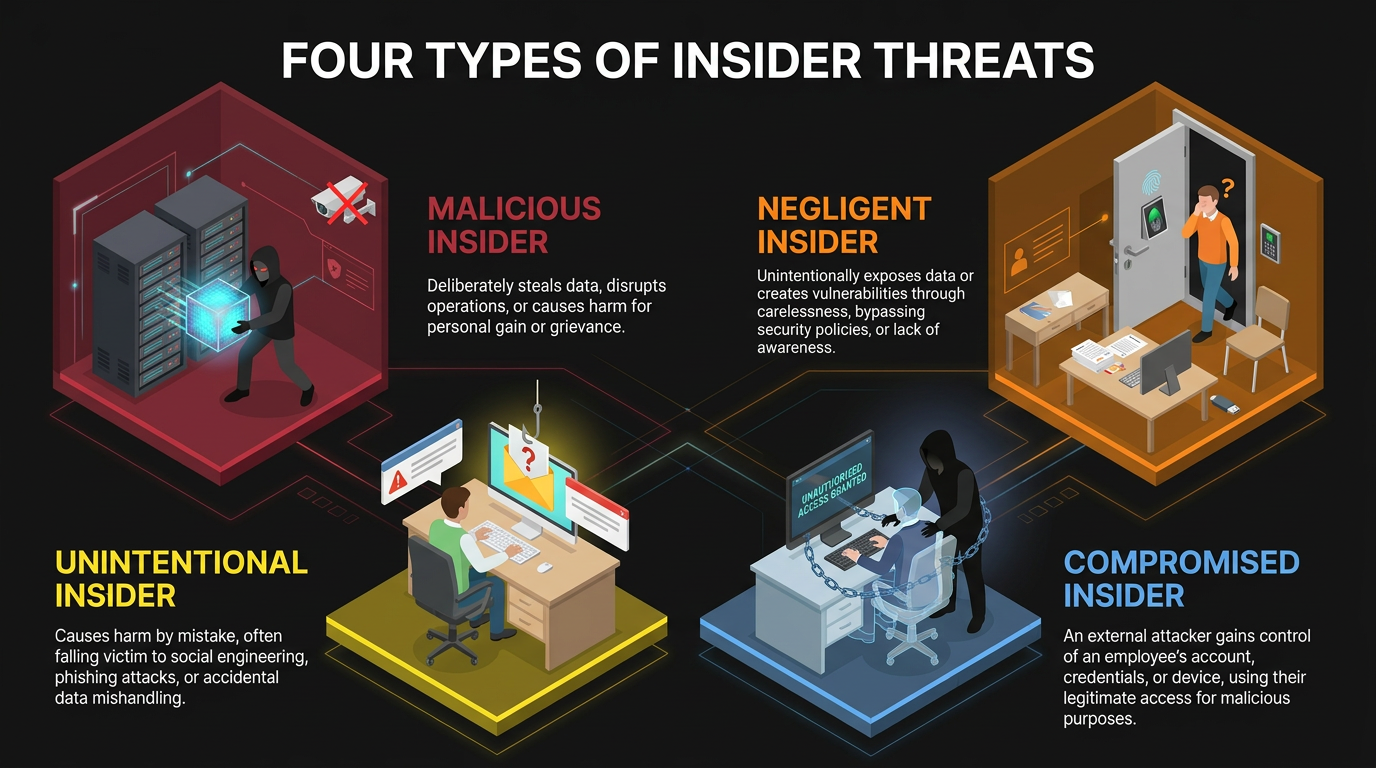
Four insider types show up in practice, and each produces a recognizable harm pattern.
Malicious Insiders: These people decide to act against the organization. Typical outcomes include intellectual property theft and fraud for financial gain. Sabotage can also occur, sometimes around the time of a departure.
Negligent Insiders: These people know the rules and skip them. Examples include letting a colleague badge through a secure door or losing a USB drive of customer records. Ignoring patch prompts is another example.
Unintentional Insiders: These people do not realize they are causing harm. They may send a spreadsheet to the wrong recipient or click a phishing link. They may also paste a confidential contract into an unsanctioned artificial intelligence (AI) assistant.
Compromised Insiders: Here the person is a bystander. An attacker has taken over the person's credentials or session. Subsequent actions look like legitimate activity from a trusted account.
Deterrence cannot address unintentional or compromised insiders because threats cannot prevent an unknown mistake, and discipline cannot stop an account takeover. Access design and training do most of the preventive work, while detection must distinguish the person from the account acting in their name.
How to Build an Insider Threat Management Program
Effective insider threat management programs establish scope, authority, policy, and multidisciplinary governance before selecting supporting technology.
Critical Assets, Program Scope, and Interlocking Policies Establish the Foundation
Build the business case from an asset inventory. Customer records, source code, pricing models, and the identity infrastructure guarding them often top the list. Naming those assets, their owners, and who can reach them defines what the program protects and keeps its scope from expanding into general workforce surveillance.
Several documents then establish how the program operates:
Charter: States the program's mandate and names the leader.
Acceptable-Use Policy: Tells the workforce what it may do with systems and data.
Data Classification Scheme: Labels information by sensitivity so access and detection rules have something concrete to use.
Monitoring Notice: Explains what the program observes, why it does so, and how it protects that data, and reaches the workforce before monitoring begins.
Implementation Plan: Sequences pilots and milestones.
Communications Plan: Establishes who informs whom when an event occurs.
Incident Response Plan: Defines how alerts move from triage to disposition, sets timelines, and identifies the point at which a case leaves the program's hands.
Together, these documents connect behavioral expectations with monitoring authority and response responsibilities.
Executive Ownership and Cross-Functional Roles Turn Policy Into Decisions
A senior accountable official sits at the top. Guidance from the National Insider Threat Task Force identifies a responsible executive with access to the organization's head as a key element of a mature program. A program manager runs daily operations under that executive, while a steering committee approves policy changes and reviews oversight findings.
A hub-and-spoke model gives the working team shape. The program office is the hub, receiving signals and opening cases and coordinating response.
Security And IT: Own telemetry and account actions.
Human Resources (HR): Owns personnel context and employment decisions.
Legal And Privacy: Determine what data the program may gather.
Compliance: Tracks regulatory duties.
Physical Security: Contributes badge data.
Contracting: Manages third-party agreements.
Data Owners: Judge whether access fits a role.
Decision rights follow that ownership:
Program Office (Hub): Requests and recommends.
HR: Decides employment consequences.
Legal: Decides referrals.
IT: Executes containment.
Oversight Function: Reviews the hub's activity.
For example, an employee gives notice and then opens customer contracts her job never touched. The hub validates the alert with the data owner and confirms the departure with HR, then briefs legal. HR and the manager decide whether to reduce access during the notice period, while IT executes and records the approved change.
How to Prevent Insider Threats Across the Workforce and Access Lifecycle
Prevention combines workforce practices, training, access governance, and technical controls from onboarding to offboarding.
Onboarding, Role Changes, Third-Party Access, and Offboarding Limit Exposure
Every stage of the employment lifecycle changes what a person can reach, and each transition is a chance to keep access aligned with the job. Onboarding sets the baseline, role changes reshape it, third parties extend it beyond employees, and offboarding closes it out.
Handling each stage deliberately keeps privileges matched to current responsibilities:
Onboarding: Screening, signed access and nondisclosure agreements, an acceptable-use acknowledgment, and a monitoring notice set the baseline, with provisioning following least privilege. Separation of duties keeps one person from initiating and approving a sensitive transaction, and privileged access management places administrative rights behind approval and time limits.
Role Changes: Privileges quietly accumulate here. Someone moving from support to engineering may retain old ticketing rights alongside new repository access. Data-owner reviews catch this drift, and a role change should trigger the same review immediately.
Third-Party Access: Contractors and vendors require equivalent treatment through defined scope, a named sponsor, an expiration date, and consent to monitoring on organizational systems.
Offboarding: The organization retrieves property, uses an exit interview to restate confidentiality obligations, and disables system access within a business day, as required by federal personnel security standards, while revoking credentials as part of the same process. The period before a departure, especially an involuntary one, warrants closer attention because access remains active while circumstances are changing.
Applied consistently, these lifecycle controls shrink the pool of standing access an insider could misuse and give the program fewer surprises to investigate later. That discipline is what turns access management from a reactive cleanup task into a durable form of prevention.
Training, Reporting, and Positive Deterrence Strengthen Organizational Resilience
Controls stop the actions their configurations cover; people stop the rest. Role-based awareness training gives each group relevant guidance. Training for general staff and managers covers warning signs and reporting channels, with added guidance for managers on responding supportively to changes in a team member. Privileged users receive guidance on the obligations attached to elevated access. Security awareness training programs like this one are most effective when they're role-specific rather than generic.
Reporting works only when people trust the channel. Confidential and anonymous options and an amnesty policy for self-reported mistakes reduce fear that colleagues will label someone a snitch. Visible follow-up addresses other common barriers, such as uncertainty about whether something matters or where to report. Visible feedback about resolved reports further reinforces trust in the process. Managers often see stressors first, so employee assistance programs give them a constructive way to support a struggling colleague before the situation deteriorates.
Positive deterrence addresses what monitoring cannot. Frustration and perceived unfairness can motivate sabotage or theft, so practices that increase organizational support and apply rules consistently can reduce motive. Handling discipline with dignity supports the same goal. Technical controls detect an act; fair workplace practices reduce the reasons someone might commit one. A workforce that expects consistent treatment is also more likely to report concerns and mistakes early.
Detection and Response Across the Insider Threat Lifecycle
Detection and response correlate lawfully gathered human and technical signals and check context. They apply interventions no heavier than the evidence warrants.
Behavioral Signals and Technical Controls Build Context Without Profiling
Human signals often arrive before technical ones. Chronic policy violations, escalating conflict with supervisors, disciplinary actions, or vocalized financial stress can provide context, but they never prove harmful intent. Most people who experience stressful periods do not become disruptive. A stressor should help analysts interpret a technical anomaly. A stressor alone should not trigger action.
The technical layer supplies the anomalies:
Identity Logs: Show who authenticated, when, and from where.
Endpoint Telemetry: Shows files moving to removable media, personal cloud storage, or printers.
Data Loss Prevention (DLP): Inspects content leaving through email, web uploads, and messaging.
Privileged Access Management (PAM): Records activity that users perform with elevated rights.
Centralized Logging And Behavioral Analytics: Connect these events and compare activity against user and peer-group baselines.
A single unusual event may carry little weight, while a related cluster over several days provides stronger context.
Hybrid work makes off-hours and off-network activity ordinary. Third-party and machine identities have no HR record. Unsanctioned generative AI tools create data paths older content rules may not inspect. Analytic models also produce false positives. For these reasons, a score informs a human decision, and a human analyst makes the final determination.
Alert Triage, Evidence Preservation, and Decision Gates Create a Repeatable Response
A repeatable response follows the same steps in the same order, with a decision gate between them.
Validation: An analyst confirms that the alert reflects real activity and checks it against the person's role and current projects. The analyst also considers relevant context. Most alerts close at this stage.
Case Opening And Evidence Preservation: Unexplained activity opens a case; analysts preserve relevant logs, files, and system images with a documented chain of custody. The incident response guidance from the National Institute of Standards and Technology (NIST) notes that records containing sensitive user information require protection of their own.
Multidisciplinary Assessment: The program office, HR, legal, and the data owner review the evidence and select a proportionate intervention.
Containment And Handoff: During containment, IT restricts access where needed. Handoff assigns employee conversations to HR and referral decisions to legal.
Disposition And Review: The case closes with a formal finding and recommended changes to controls, policy, and, where relevant, training.
An unusual-download alert illustrates the process. Analytics flags a designer who moved hundreds of project files to personal cloud storage overnight. Validation confirms that he works on the project, but the destination is unapproved, so analysts preserve the relevant records. HR and the manager learn that he wanted to work remotely and did not understand the storage rule. He deletes the files, IT verifies the deletion, and the case closes as a policy violation without malice. The review then identifies a training gap for remote staff.
Privacy Guardrails for Proportionate Monitoring
Monitoring needs a lawful, defined purpose and a scope limited to that purpose. It also requires independent oversight. The program targets anomalous activity, not targeting individuals.
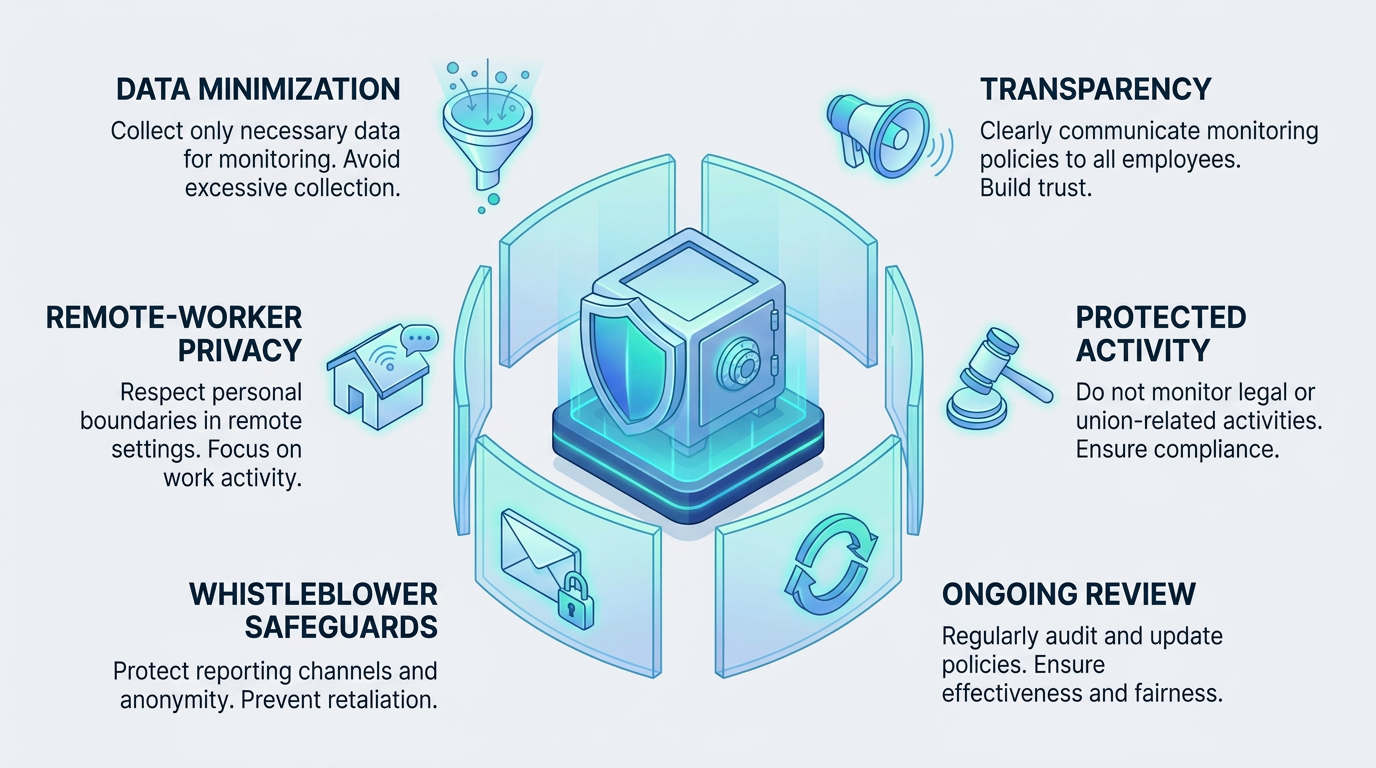
Effective safeguards against insider threats include:
Data Minimization And Retention: The program limits collection to signals tied to protected assets and follows defined retention and deletion schedules.
Transparency And Access: The workforce receives notice before monitoring, and the program restricts case data to people with a specific need to know.
Remote-Worker Privacy: Home environments carry higher privacy expectations, so monitoring avoids personal devices and household activity.
Protected Activity And Nondiscrimination: Assessments focus on behavior and exclude protected characteristics, and monitoring must not chill concerted activity that the National Labor Relations Board's general counsel has warned electronic surveillance can impair.
Whistleblower Safeguards And Consultation: Controls prevent monitoring from identifying lawful disclosures.
Ongoing Review: Legal and privacy teams review the program during design and deployment. They also conduct a review when material changes occur.
These safeguards keep monitoring proportionate to its purpose and defensible under scrutiny from regulators, auditors, and the workforce itself. Without them, even a well-intentioned program risks eroding the trust it depends on to function.
Metrics and Maturity for Continuous Improvement in Insider Threat Management
The program measures effectiveness against risk-reduction goals. Alert volume remains an operational count. Three tiers keep the picture honest:
Operational Metrics: Measures include alert-to-triage time, alert-to-case conversion, false-positive reduction, and training completion by role.
Risk Metrics: Measures include recurring access gaps, ownerless privileged accounts, departure-related revocation time, and repeated policy violations.
Business Metrics: Measures include disruption avoided and audit findings closed. They also cover incidents resolved without employment litigation.
Periodic self-assessment gives these numbers a reference point. The Cybersecurity and Infrastructure Security Agency (CISA) provides a fillable program evaluation, while the National Insider Threat Task Force's maturity framework lists elements a program can adopt beyond the minimum. Tabletop exercises and after-action reviews reveal gaps and inform revisions to controls and policy. They also guide training revisions.
Build Trust Into Every Stage
Clear authority defines who decides, and lawful signals keep evidence usable. Lifecycle controls remove unnecessary access. Proportionate interventions treat an anomaly as a question while reserving judgment, and meaningful metrics show whether the program works. Each improvement should protect critical assets and support consistent, fair decisions.
Frequently Asked Questions
What Is the First Step in Building an Insider Threat Management Program?
Identify the critical assets whose loss would cause the most harm, define the program's scope around them, and assign a senior executive to own the outcome. Technology choices follow.
Which Teams Should Participate in an Insider Threat Program?
Security and IT, human resources, legal, privacy, compliance, physical security, contracting, and sensitive-data owners should participate. A program office coordinates their work without replacing their authority.
How Can an Organization Detect Insider Threats Without Invading Employee Privacy?
An organization can explain monitoring in advance, collect only necessary data, assess behavior rather than personal characteristics, restrict case-file access, and require regular privacy and audit review.
How Should an Insider Threat Management Program Measure Success?
Success requires measures such as triage speed, alert accuracy, recurring control gaps, reporting behavior, access-revocation times, and progress against a maturity target.