An attacker doesn't need to guess a password to take over someone's session. Planting a token before login or stealing one after login both work just as well, and session fixation versus session hijacking can look like a vocabulary quiz right up until one of them hits a real application. In both cases, someone other than the legitimate user gains access through a token the application trusts, often while evading the login defenses meant to stop them. Understanding how that access develops makes it easier to identify the weakness, recognize relevant log activity, and select a control that breaks the attack chain.
Key Takeaways
Fixation plants a known session identifier before authentication; hijacking abuses a valid token after issuance, even if interception occurs during authentication.
Whoever holds the session token may control the account, so sessions need protection as carefully as logins.
Detection depends on session-lifecycle logging and token-replay signals because neither attack requires a failed login.
Regenerating the session identifier at login ends fixation, while limiting token exposure and binding sessions to devices address hijacking.
Session Fixation vs. Session Hijacking: Definitions and Key Differences
The two attacks differ in who supplies the session token and when: in fixation the attacker supplies it before login, while in hijacking the attacker acquires and abuses a valid authenticated token.
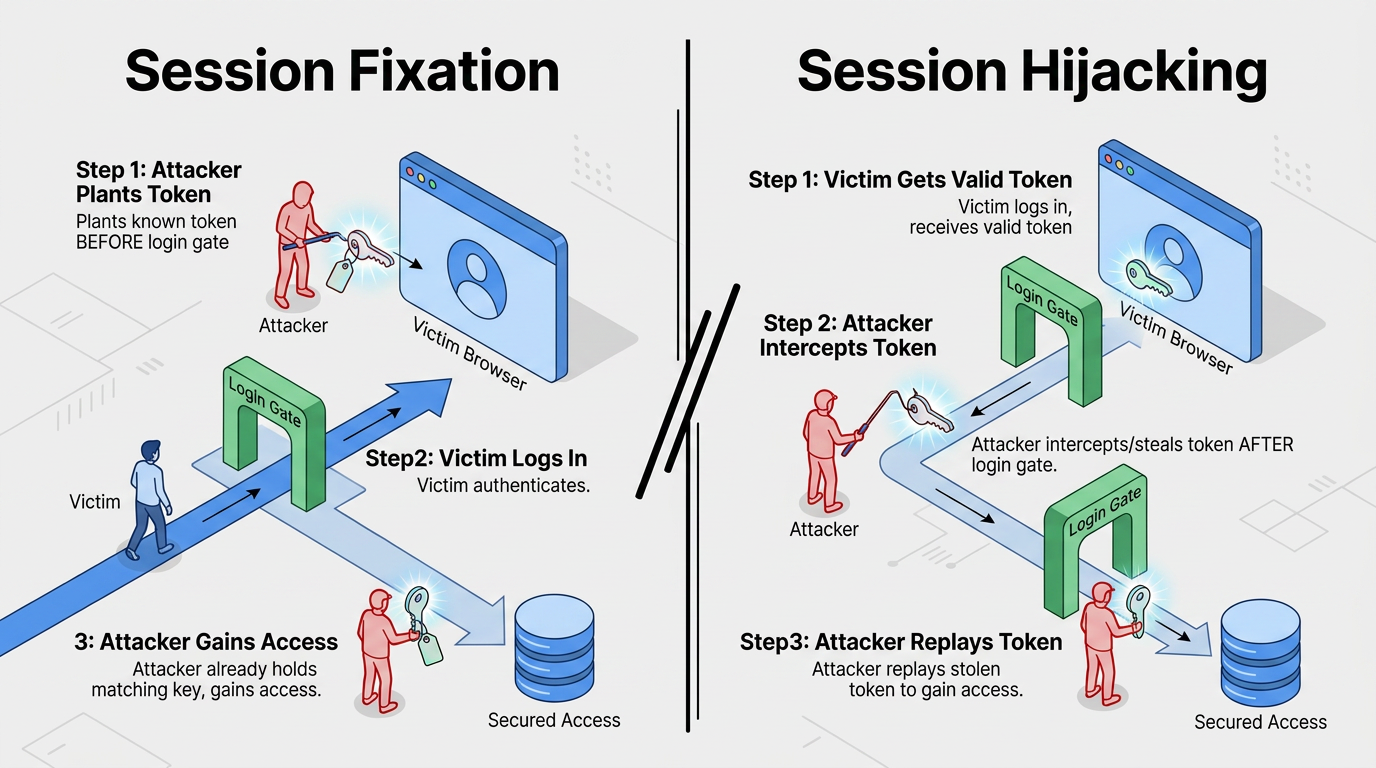
Session Fixation Forces a Known Token Before Authentication
Session fixation works because the application keeps the same session identifier across the login boundary. The attacker obtains or invents a session identifier, gets the victim's browser to adopt it, and waits. When the victim signs in, the application promotes the anonymous session into an authenticated one without replacing the identifier. The attacker already knows that session identifier, so the authenticated session becomes available without capturing the victim's credentials.
The pre-authentication session is the asset being planted, and login is the event that increases its privileges. This makes fixation a session-lifecycle flaw rather than a weakness in the password or multi-factor authentication (MFA) process.
The setup depends on how the application handles session identifiers. A permissive application accepts any session identifier the browser presents. The attacker can therefore invent one. A stricter application honors only session identifiers it generated, so the attacker must request an anonymous session, record its identifier, and keep it alive until the victim logs in. In both cases, replacing the identifier at authentication separates the anonymous and authenticated sessions and breaks the attack chain.
Session Hijacking Captures or Predicts an Active Token After Authentication
Session hijacking compromises a valid session token by stealing or predicting it and using it to reach the server as the victim. The attacker may intercept the token as the application issues it during authentication or acquire it later, but abuse begins once it is an authenticated session token.
The server honors a bearer token when a client presents it and ordinarily cannot distinguish a copied token from the original. A replayed session token can therefore work from another device and bypass the controls that protected sign-in, including MFA.
Attackers may read tokens from unencrypted traffic or extract them through injected scripts and malware. They may also predict session tokens that lack sufficient randomness. Long session lifetimes extend the opportunity for abuse.
Five practical differences separate the attacks:
Dimension | Session Fixation | Session Hijacking
|
|---|---|---|
Attack Timing | Establishes token control before authentication | Abuses a token after the application authenticates it |
Token Control | The attacker forces a known identifier onto the victim | The attacker steals or predicts the victim's session token |
Prerequisites | Requires identifier reuse across a privilege change | Requires an active token that the server honors on presentation |
Primary Vectors | URLs, forms, cookie injection, headers, or cross-subdomain cookies | Sniffing, cross-site scripting (XSS), adversary-in-the-middle activity, prediction, brute force, or malware |
Chain-Breaking Controls | Regeneration at login | Transport Layer Security (TLS), HttpOnly cookies, short lifetimes, and device-bound sessions |
Each of these distinctions plays out in a specific attack chain, which the next sections break down step by step.
How Session Fixation vs. Session Hijacking Works
Fixation sets up a known session identifier before the victim logs in, while hijacking exploits an authenticated token after issuance.
Fixing the Session Identifier Through URLs, Forms, Cookies, Headers, or Subdomains
The canonical fixation chain has three phases:
Setup: The attacker establishes a trap session and records its identifier, or picks a session identifier if the application accepts one.
Fixation: The attacker gets that identifier into the victim's browser.
Exploitation: The victim logs in, the application reuses the session identifier, and the attacker's copy becomes authenticated.
Common vectors include:
Session Identifier in the URL: Applications that accept a session ID on the query string may let an emailed link fix the identifier.
Hidden Form Field: The victim authenticates through a login form controlled by the attacker.
XSS Cookie Injection: Injected script writes the session identifier into the browser's cookie property. Hypertext Transfer Protocol (HTTP) response splitting may also inject a cookie-setting header.
META Tag Injection: Some legacy, browser-dependent techniques use injected META tags to set cookies where browsers restrict script execution.
Cross-Subdomain Cookies: A cookie scoped to a parent domain may let one subdomain set a session cookie honored by another application.
Every vector creates the same condition: the victim reaches login with an identifier the attacker knows. Rejecting identifiers from unapproved channels reduces the setup options, while regeneration at login prevents the shared token from becoming authenticated.
Stealing the Token Through Sniffing, XSS, AiTM, Prediction, Brute Force, or Malware
The attacker discovers an authenticated user's session token and tests it by inserting it into traffic. Once confirmed, the token can be used to impersonate the victim. Invalid-session activity during confirmation may provide an early detection signal.
Sniffing is the classic route. Sites that encrypt login but fall back to HTTP expose the session cookie in plaintext. XSS instead reads the browser's cookie property and sends the session token out, which is why the HttpOnly attribute exists. An adversary-in-the-middle (AiTM) proxy relays traffic between a legitimate site and a phished user and captures credentials, authentication tokens, and session cookies even when MFA protects login.
Prediction and brute force target the token itself. Session tokens that encode a username or timestamp may reveal neighboring values, while attackers can enumerate session tokens with too few random bits. Malware skips the network: infostealers lift session cookies from browser storage. An attacker can import active cookies into another browser.
Across these methods, the application treats possession as proof. The original user may continue using the same session. The resulting concurrent activity can reveal replay. Without monitoring or client binding, the copied token can resemble another valid request.
Real-World Risks and Examples
Published vulnerabilities and incident advisories show both attack types with their root causes intact.
A Framework Vulnerability Reveals Failures in Token Acceptance and Regeneration
The Common Vulnerabilities and Exposures (CVE) vulnerability record numbered CVE-2024-38513 documented a web framework flaw that let users supply their own session identifier. In affected versions before 2.52.5, the server accepted attacker-controlled identifiers instead of insisting on values it generated. That behavior created session fixation because an attacker could choose the value that the server would later associate with the victim's authenticated session.
The vulnerability illustrates why token acceptance and regeneration are separate safeguards. Rejecting externally supplied identifiers prevents an attacker-chosen value from becoming a valid session. However, an attacker might still obtain an anonymous identifier legitimately and persuade the victim to use it. Regenerating the identifier at authentication addresses that path by discarding whatever value entered the login process.
Either control interrupts part of the attack, while using both provides defense in depth. Strict acceptance rules narrow the channels through which an identifier can enter the application, and regeneration creates a firm boundary between anonymous and authenticated activity. The corrected release shipped in version 2.52.5. Affected users therefore have a specific remediation threshold.
Stolen Sessions Enable Account Access and MFA Bypass
The Cybersecurity and Infrastructure Security Agency (CISA) detailed a widely exploited vulnerability in a 2023 CISA advisory. The flaw allowed unauthenticated retrieval of session tokens from network access appliances. Attackers used those tokens to bypass MFA and hijack user sessions, with exploitation observed as early as August 2023. Attackers needed no credentials, phishing, or endpoint malware because possession of the readable token was sufficient.
A later ransomware operation reached the same outcome differently. Attackers manipulated traffic on a Secure Sockets Layer virtual private network (SSL-VPN) appliance to collect credentials and session information from users signing in to a corporate virtual desktop infrastructure (VDI) portal. They used stolen session cookies to impersonate users and access the internal network. They also modified authentication files so an attacker-chosen one-time password would always succeed and continuously bypass MFA.
The incidents involved different product categories and entry methods. One flaw disclosed tokens directly, while the other collected them during authentication. In both cases, the session cookie replaced the need to repeat the login process.
How to Detect Session Fixation and Session Hijacking
Neither attack necessarily produces a failed login, so detection has to watch the session rather than only the authentication event.
Session-Lifecycle Logs Expose Reuse, Manipulation, and Failed Regeneration
Logging each session's lifecycle is the foundation. Useful events include:
Creation, renewal, and destruction
Login, logout, and privilege changes
Timeout expirations and invalid activity
Critical business operations
Records can include a timestamp, source IP, requested resource, User-Agent, username, and session ID so investigators can connect authentication with later requests.
Fixation creates a recognizable pattern. Defenders can compare the identifier on the login request with the one on the first post-login request and flag an unexpected match. Identifiers the application never issued expose permissive acceptance, while a token that remains unchanged through a privilege increase reveals failed regeneration.
Hijacking produces different anomalies. A session that appears after expiration may indicate replay, but defenders should assess its severity through context, frequency, and surrounding activity rather than defaulting to critical. A nearby login failure can strengthen the case. Session-ID brute force creates another pattern: many sequential requests carry different identifiers from one address or a small set of addresses.
Separating session creation from authentication also shows whether an anonymous token became privileged, whether a destroyed token returned, and whether one identifier moved between clients.
Token-Replay Signals Reveal Client Changes, Impossible Travel, and Concurrent Use
Once an attacker steals a token, the same identifier may behave like two people. Associating the session ID with properties such as IP address or User-Agent turns mid-session changes into indicators. A client certificate can provide another binding signal. These properties should support risk decisions rather than act as proof because legitimate client characteristics can change.
Cookie-Level Signals: A user, application, or attacker may modify or delete an existing cookie, add a new cookie, or introduce one user's session ID into another user's traffic.
Concurrency Signals: Simultaneous logons and impossible travel may show the same session appearing in distant geographies within an unrealistic interval.
Geographic and device signals need practical thresholds. Changed IP geolocation does not prove an attack, and unchanged geolocation does not prove safety. Mobile users roam between carrier IPs, and corporate network address translation places many users behind one address. Attackers can also forge User-Agent strings.
Impossible travel becomes more actionable when paired with a User-Agent change or unexpected cookie set. Another alert can flag a spike in distinct session identifiers from one source address, baselined against normal traffic. Giving users a view of active sessions and the ability to invalidate unfamiliar ones turns those signals into a practical response.
How to Prevent Session Fixation and Session Hijacking
Fixation has a decisive fix, while hijacking requires shrinking the window in which an attacker can use a stolen token.
Standards-Based Controls Reduce Token Exposure and Eliminate Fixed Sessions
Session ID regeneration ends fixation. Applications should generate a new identifier after authentication or any other privilege change, including password changes, permission changes, and switches from user to administrator. Complementary controls reject session IDs submitted through mechanisms the application did not choose and validate every identifier against issued sessions.
The rest of the control set limits what a stolen token is worth:
Entropy and Generation: Session identifiers need at least 64 bits from a cryptographically secure generator and a minimum of 16 hexadecimal characters. The National Institute of Standards and Technology (NIST) session guidance sets a comparable 64-bit floor for session secrets generated by an approved random bit generator.
Transport and Cookie Attributes: TLS should cover every authenticated page. Applications should mark cookies Secure, make them inaccessible to JavaScript, limit them to the minimum practical hostnames and paths, and set SameSite to Lax or Strict where practical.
Timeouts: Organizations can combine overall and inactivity timeouts, with idle ranges of 2 to 5 minutes for high-value applications, 15 to 30 minutes for lower-risk ones, and 4 to 8 hours absolute.
Logout and XSS Defense: Applications should erase or invalidate session secrets at logout. HttpOnly cookies and disciplined input handling help stop scripts from reading identifiers.
Regeneration blocks planted identifiers, while secure transport and cookie settings reduce theft. Timeouts shorten the value of copied tokens.
Post-authentication Protections Address the Security Gap Left by MFA and Passkeys
Passkeys secure sign-in, but the session that follows remains exposed to hijacking and malware. The cookie issued after a passkey login is still a bearer token, so possession may be enough unless the application requires additional proof from the client.
Two cryptographic approaches make possession insufficient:
Device-Bound Session Credentials: The browser proves possession of a securely stored private key and periodically refreshes the session with proof that it remains on the original device. An attacker who copies a cookie cannot use it independently without the key.
Sender-Constrained Tokens: These provide similar protection for application programming interfaces (APIs). The Internet Engineering Task Force (IETF) defines Open Authorization (OAuth) 2.0 Demonstrating Proof of Possession in an IETF standard. The client holds a private key and signs a short-lived proof header on each request. When the resource server correctly validates the proof and its binding to the token, an attacker cannot successfully replay a leaked access token on its own.
Both approaches prevent cheap replay of a copied string from another device, although malware on the legitimate device and implementation mistakes can weaken the protection.
Build Security Around the Full Session Lifecycle
Authentication proves identity at one instant, but the following session is a separate asset with its own failure modes, logs, and controls. A useful evaluation traces each session from creation to destruction: where the identifier originates, whether it changes at login, how it travels, what gets logged, and how it expires. That lifecycle view reveals where an attacker could gain control and which safeguard can close the gap.
The signals that resolve a hijacked session are the same ones behavioral AI already tracks for account takeover: login and device behavior, impossible travel, and mid-session changes to identity signals. In cloud email and connected SaaS environments specifically, Abnormal is designed to help identify compromised accounts based on this kind of behavioral anomaly and can help automate remediation once one is confirmed. It isn't a substitute for TLS, HttpOnly cookies, or device-bound credentials at the application layer, but it can add a detection layer for the account-takeover outcome those controls are meant to prevent. See a demo of how it applies to email and cloud accounts.
Frequently Asked Questions
Is Session Fixation a Type of Session Hijacking?
It depends on the taxonomy. Session fixation can be classified separately because it plants a token before login, while session hijacking captures one afterward. Fixation can also be classified as a form of hijacking because both enable unauthorized use of another person's session.
Can MFA Prevent Session Hijacking?
MFA protects login only. An attacker holding the resulting session token may never receive a second-factor prompt. Short lifetimes, tight cookie handling, replay monitoring, and device binding protect the session after authentication.
Does HTTPS Stop Session Fixation?
HTTPS protects identifiers from eavesdroppers while they are in transit. Session fixation plants the value rather than intercepting it. An HTTPS-only application that accepts a session ID from a URL can remain vulnerable. Regeneration at authentication is the decisive fix.
What Is the Clearest Sign of a Hijacked Session?
One session identifier in simultaneous use from two distinct clients is among the strongest signals. Supporting indicators include a mid-session User-Agent change, unexpected cookie changes, impossible travel, and requests presenting an expired or destroyed session.