Información clave
Attackers increasingly target enterprise applications and the security vulnerabilities inside them through the inbox. Verizon also reported that exploiting software flaws surpassed stolen credentials as the leading initial access method for the first time in the report's history. Four categories of application security vulnerability carry those attacks from the inbox into enterprise applications, and each one leaves signals that may reveal exploitation attempts early.
Email now functions as the connective tissue between social engineering and application compromise. But the perimeter tools most organizations rely on were never built to catch attacks that ride in on a trusted message and land on the application layer.
The application security vulnerability categories below map the routes attackers take from an opened message to a compromised application, alongside the detection signals that expose each move. Left unaddressed, these paths turn everyday inbox activity into a standing source of authorization abuse, credential loss, and long-lived access that outlasts password resets and account lockdowns.
Key Takeaways
- Email connects application-layer risk to credential theft, session abuse, malicious authorization, and exposed developer access.
- Credential abuse still factors into 39% of breaches, even after vulnerability exploitation overtook it as the leading initial access method for the first time in the report's history.
- Email can carry attacks from the inbox into enterprise applications through stolen authentication tokens, malicious authorization requests, and exposed developer credentials.
- Cloud email and identity signals can help security teams identify suspicious account activity, while application-layer monitoring requires complementary controls.
Why Email Remains the Gateway to Application Compromise
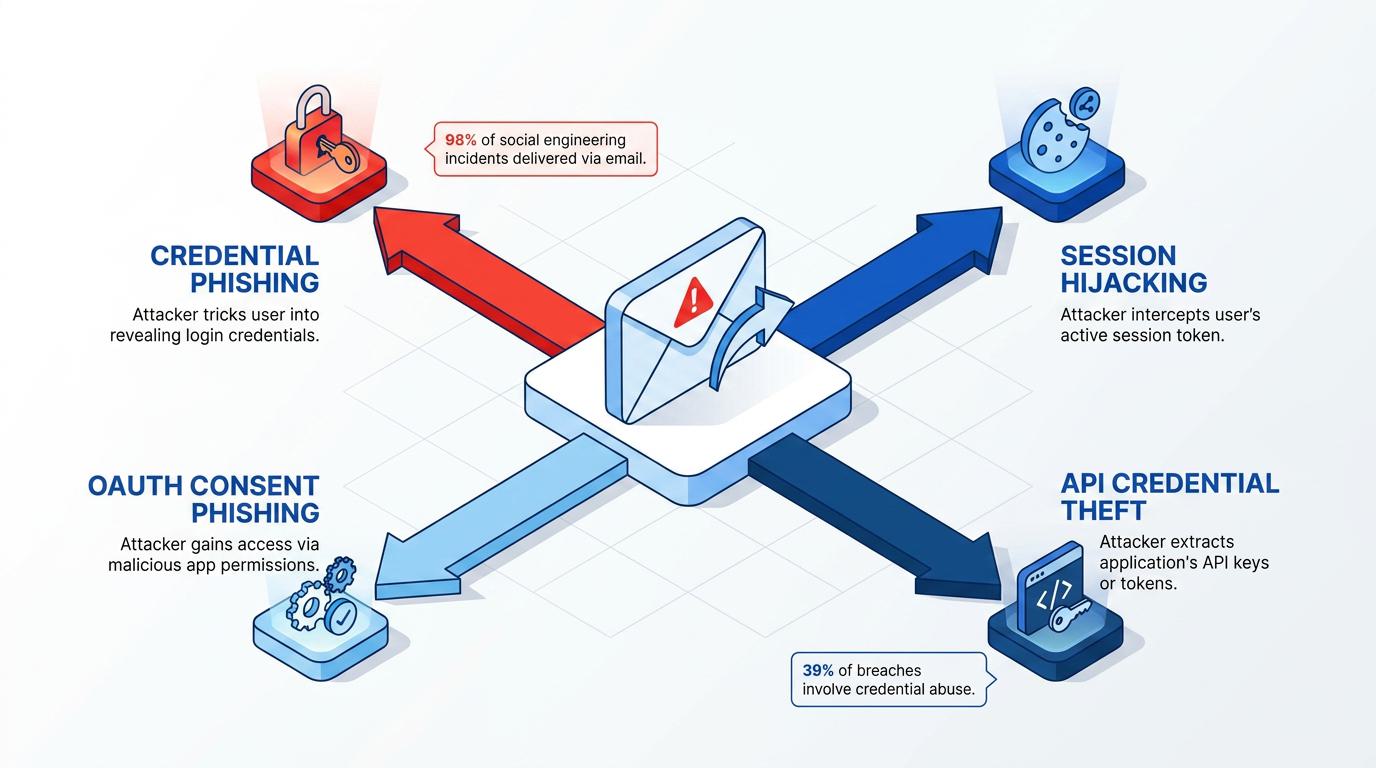
Email remains a primary entry point for cyberattacks because it carries threats past network security controls to the people who hold application access. Modern application architectures create specific attack pathways that exploit the trusted nature of email communication. SC Media coverage of the 2026 DBIR reported that email delivered 98% of social engineering incidents. Credential abuse still played a role in 39% of breaches overall, according to the Verizon 2026 Data Breach Investigations Report (DBIR), even as vulnerability exploitation overtook it as attackers' leading way in.
An email provides direct access to four critical vulnerability categories, including abuse of OAuth (Open Authorization), the protocol many cloud applications use to grant access without requiring a password:
- Credential Phishing Campaigns: Emails target user credentials tied to enterprise applications.
- Session Hijacking Attacks: Email lures can lead to the theft of authenticated sessions.
- OAuth Consent Phishing: Email prompts seek unauthorized application consent.
- API Credential Theft Campaigns: Emails target developer credentials and secrets.
Authentication is where these categories first surface, since attackers increasingly steal a live session instead of guessing a password.
Application Security Vulnerabilities in Authentication
Email-delivered attacks exploit authentication processes by stealing valid sessions or manipulating users rather than relying only on password guessing.
The Open Web Application Security Project (OWASP) tracks this weakness class as A07:2025 Authentication Failures, defined as any case where "an attacker is able to trick a system into recognizing an invalid or incorrect user as legitimate."
Three techniques dominate how these attacks play out, including a form of multi-factor authentication (MFA) fatigue:
- Proxy-Based Session Hijacking: Attackers position proxy servers between victims and legitimate services, then capture session tokens once authentication completes to gain full account access without the victim's password or additional authentication factors.
- MFA Fatigue Attacks: Attackers overwhelm users with repeated push notifications through persistent social engineering until they approve a request; the Cybersecurity and Infrastructure Security Agency's (CISA) number matching guidance confirms that users often approve requests by accident or simply to stop the notifications.
- Browser-Based Token Theft: Malicious scripts or malware extract authentication tokens directly from the browser and gain authenticated access without triggering additional authentication challenges.
Each technique reaches the same outcome: bypassing password-based defenses by targeting the session or the approval step instead.
Main Access and Configuration Vulnerabilities That Attackers Reach via Email
Authorization failures and exposed configuration details can turn an emailed link or compromised mailbox into a pathway toward sensitive application resources. The vulnerabilities below share a common trait: they sit far enough downstream of the initial email that traditional inbox defenses rarely flag them, yet each one gives attackers a durable route into customer records, internal systems, and technical infrastructure once the message lands.
Insecure Object References
Insecure direct object references show how an emailed link can become the opening move in an authorization bypass. Broken access control remains the top web application security risk in the OWASP Top 10:2025, according to OWASP testing data. Insecure direct object references, cataloged as Common Weakness Enumeration (CWE) entry CWE-639, sit inside this category, and email is one practical delivery mechanism for exploiting them.
A phishing email with a legitimate-looking invoice or document link can put a victim on a page whose web address the attacker then edits while the session is still live. Applications that fail to verify user authorization for each resource request create direct pathways to other customers' accounts and sensitive business information.
In a representative scenario, an attacker sends an invoice notification email with a web address containing a resource identifier. By modifying that identifier, the attacker reaches invoices, documents, or customer records belonging to other users if the application lacks proper authorization validation. This vulnerability becomes particularly dangerous when combined with compromised accounts that already possess legitimate system access.
Security Misconfigurations
Development teams can expose sensitive configuration data through email, including database connection details, application endpoints, and temporary access credentials. This gives attackers who monitor corporate communications or run business email compromise (BEC) campaigns valuable intelligence. Organizations frequently overlook the security implications of technical discussions conducted through email. This risk becomes particularly dangerous during incident response, when technical teams share diagnostic information and system access details through unencrypted communication channels under time pressure.
Email archives containing configuration details create persistent security exposures. Attackers who gain access to mailboxes through account takeover campaigns can search historical messages for credentials, system architecture details, and security control configurations that enable broader network compromise. A CISA directive documented this pattern: attackers used authentication details shared between a cloud provider and its customers by email to gain, or attempt to gain, additional access to customer systems.
Application Security Vulnerabilities in Authorization and APIs
Authorization abuse and stolen API credentials can create durable access to enterprise applications without repeated password theft. Both vectors exploit the trust that applications extend to already-authenticated identities and machine credentials, which is what lets attackers persist quietly across password resets, account lockdowns, and even routine identity hygiene.
OAuth Consent Abuse
OAuth consent abuse can survive password resets and account lockdowns because it exploits legitimate authorization systems. Malicious apps sit outside standard credential-remediation workflows, so security teams need to revoke their permissions explicitly.
These attacks have moved from manual operations to automated phishing frameworks. Sophisticated campaigns impersonate trusted applications and combine phishing techniques to manipulate the OAuth device authorization flow itself.
Attackers craft convincing authorization requests that appear to come from trusted services. When users grant permissions, malicious applications gain access to email, files, and collaboration platforms. Security teams can review application grants, restrict high-risk scopes, and explicitly revoke unauthorized consent during remediation.
API Credential Theft
Targeted phishing campaigns harvest developer credentials through sophisticated social engineering techniques. Technical personnel handle powerful credentials as part of routine job functions, which makes them high-value targets for credential theft operations.
Attackers craft emails that mimic legitimate developer communications, security notifications requiring immediate credential validation, and platform update announcements requesting verification. These messages use the terminology and scenarios developers see daily, increasing the likelihood that recipients will trust the request.
The enterprise impact of stolen developer credentials extends beyond individual accounts. Compromised API keys and OAuth tokens can unlock customer data without requiring attackers to compromise individual user passwords. Attackers can also use the stolen access to maintain persistent connections, extract intellectual property, and establish footholds for broader supply chain attacks.
Security teams can reduce this risk through several complementary controls:
- Credential Lifecycle Controls: Limit how long API keys and tokens stay valid and rotate them on a regular basis.
- Narrowly Scoped Permissions: Grant each credential only the access it needs, not broad standing access.
- Secure Secret Storage: Keep keys and tokens out of code repositories, email, and chat messages.
- Developer Training: Teach technical staff to recognize email-based credential requests.
None of these controls work without visibility into how attackers actually behave once inside the inbox.
How to Detect Email-Based Exploitation Attempts
Detecting email-based application security vulnerabilities requires visibility into cloud email and identity signals, paired with complementary application-layer controls.
Abnormal's behavioral AI evaluates observable patterns such as workflow cadences, recipient behavior, timing, engagement flows, and identity activity. It can help identify deviations associated with credential phishing, account compromise, and malicious authorization requests while complementing application-specific security controls.
The platform is designed to help surface suspicious patterns across several dimensions:
- Authorization Activity: Abnormal can help identify suspicious authorization activity associated with email-borne attacks. Security teams still need application governance tools to validate permissions and revoke unauthorized access.
- Email Manipulation Indicators: Abnormal can help surface suspicious account activity and email behavior that may indicate an attacker is concealing security messages. MITRE ATT&CK, a framework that catalogs known attacker techniques, documents how attackers may create inbox rules that automatically delete messages from security products.
- Identity Signal Deviations: Abnormal can help identify suspicious session, device, and identity signals associated with compromised cloud email accounts. File-access sequences, application-resource authorization, and data-download activity occur within separate systems and require complementary application or data-security controls.
Together, these signals give security teams an early warning system, though they still need controls purpose-built for the applications themselves to close the loop.
Defending Applications Against Email-Based Attacks
Email-based application exploitation is a threat vector that perimeter security was never designed to address on its own. Security leaders can combine email-specific behavioral detection with application authorization governance, credential lifecycle management, developer training, and continuous application access controls.
Abnormal works alongside existing email gateways (SEGs), identity controls, and application-security tools to strengthen visibility into the email and account-based components of these attacks. Named a Customers' Choice in the 2026 Gartner® Peer Insights™ Voice of the Customer for Email Security, Abnormal is designed to help security teams identify sophisticated email threats without replacing the rest of their security stack.
Ready to protect your enterprise applications from email-based attacks? Get a demo to see how Abnormal's behavioral AI can help detect application authorization attacks and credential exploitation attempts, often before significant damage occurs.
Frequently Asked Questions
What Is Application Security in the Context of Email?
Application security in this context means protecting the sign-in, authorization, and API layers of business applications from attacks that arrive through email. Email trades directly on trust, which makes it one of the most common ways attackers deliver a link, an authorization request, or a message that ultimately compromises those application-layer defenses.
How Is Email-Based Application Exploitation Different From Traditional Phishing?
Traditional phishing usually aims to steal a password. Email-based application exploitation goes further, targeting live sessions, OAuth consent, or API credentials so attackers can bypass authentication entirely or gain access that survives a password reset.
Can a Secure Email Gateway Stop These Attacks on Its Own?
Secure email gateways were built to catch known-bad senders, links, and attachments, and they often struggle with attacks that abuse legitimate authorization flows or exploit application misconfigurations. Behavioral email detection paired with application governance tools gives security teams broader coverage than either approach alone.
Does Multi-Factor Authentication Fully Prevent These Attacks?
No. Multi-factor authentication (MFA) raises the bar, but attackers have adapted with MFA fatigue campaigns, proxy-based session hijacking, and OAuth consent abuse that all operate after a user has already authenticated. Layering behavioral detection and application governance on top of MFA closes gaps that authentication alone can't cover.