Key Insights
Hijacking attacks against AI agents succeeded 80% of the time on average when attackers could repeat each attempt, up from 57%, in a January 2025 evaluation described on NIST's technical blog on agent hijacking. The Agent Control Standard (ACS) is an open specification, maintained by the OWASP GenAI Security Project, for checking what an AI agent is about to do against declarative policy before the action runs. It governs agents through runtime hooks that pause the agent so a Guardian can allow, deny or modify each action, tracing that records every decision and an agent bill of materials that inventories what the agent is built from.
This guide covers the problem ACS addresses and how its parts work, then places ACS beside OWASP's agentic guidance, the Model Context Protocol (MCP) and the NIST AI RMF, and sets out what adoption looks like at v0.1.0.
How Is the Agent Control Standard Defined?
The Agent Control Standard is an open, vendor-neutral wire specification that lets a separate Guardian Agent inspect an AI agent's next action and then permit it, deny it or modify it before it happens. OWASP's Agent Control Standard page, dated September 2026, says the standard defines how agent platforms expose middleware hooks and how safety policies can be enforced through them.
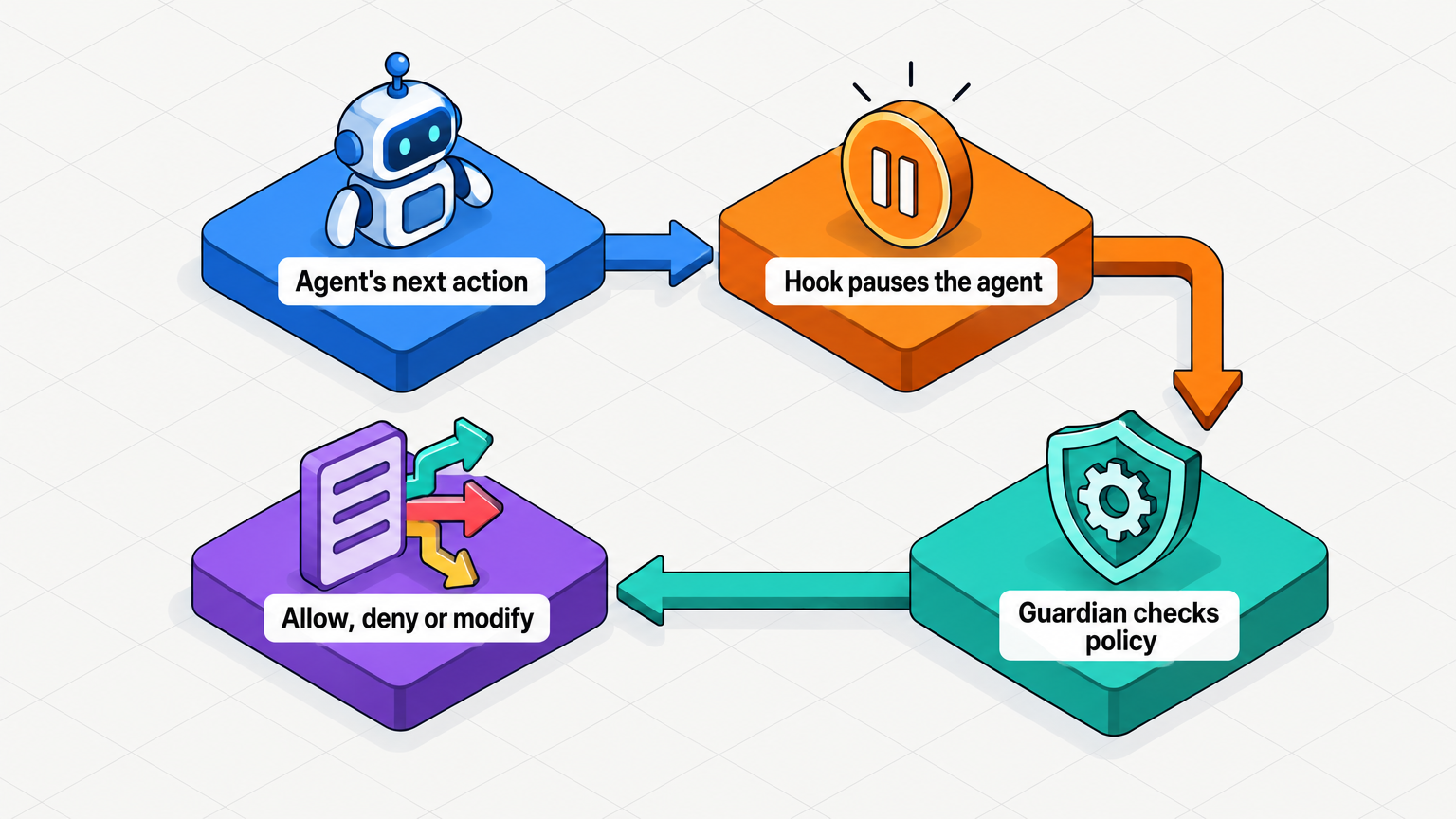
The specification separates the Observed Agent, the agentic AI system being governed, from the Guardian Agent, which evaluates policy and returns a verdict. The two exchange JSON-RPC messages, and the Guardian keeps an audit chain that can be used to reconstruct a session afterward.
The ACS GitHub repository describes specification v0.1.0, says v0.2.0 is targeted for March 2027, and sets no date for v1.0. Neither the OWASP page nor the repository applies a formal status label, and conformance claims at v0.1.0 are self-declared.
What Problem Does the Agent Control Standard Solve?
A governance policy written in a document cannot intervene when an agent calls a tool, writes to memory or sends a reply, and the Agent Control Standard puts enforcement at those points. Acceptable-use rules, risk registers and architecture reviews describe intended behavior, while an agent acting on a poisoned web page operates outside all of them.
Indirect prompt injection lets a third party plant instructions in content the agent reads, and those instructions can redirect the agent toward an attacker's task in place of the user's, or alongside it. Permissions decide how much damage an injected instruction can do. An agent with access beyond its task, a condition known as excessive agency in AI agents, can turn a hidden instruction into a sent email, a deleted file or a database query.
Agent sprawl makes enforcement harder, because agents get built by different teams on different frameworks, each connecting to its own tools and servers, and each framework enforces controls in its own way if it enforces them at all. Guardrails written into one agent's code stay tied to that framework, and ACS proposes one portable contract under which a single policy set can govern agents built on different frameworks.
How Does the Agent Control Standard Work?
ACS works by pausing an agent at defined hooks for a Guardian's decision, tracing each decision, and inventorying what the agent is built from, which the specification organizes as Instrument, Trace and Inspect. A mandatory baseline covers instrumentation, the wire format and the audit chain, and during the handshake a deployment declares which optional profiles it supports.
Runtime Hooks and Inline Policy Decisions
A hook is a defined point where the Observed Agent pauses and asks the Guardian for a decision before it acts. The hooks that carry most of the enforcement weight sit where input arrives, where tools dispatch and where output leaves:
User Message: Fires when user input arrives, before the agent's reasoning context sees it.
Tool Call Request: Fires after the framework parses a tool call and before the call is dispatched.
Agent Response: Fires before output reaches a user, a peer agent or an external system.
Further hooks cover sessions, turns, knowledge retrieval, memory reads and writes, subagents and skill loading. There is no separate code-execution hook, because the specification requires frameworks to fire the tool-call hook for every action leaving the agent's reasoning context, including filesystem writes, network fetches and shell commands.
Besides allowing or denying an action, the Guardian can modify the request, ask an approver to decide, or defer the verdict. A modify verdict might rewrite an agent's unbounded customer query into one that returns a bounded set of columns and rows before the tool runs.
For example, an agent might summarize a vendor web page containing hidden instructions to email a customer file to an outside address. The tool-call hook is the point at which the Guardian can deny the send before the email tool executes.
Tracing and Observability
ACS tracing records each hook as an OpenTelemetry span with the decision attached as an event. The specification also maps traces to the Open Cybersecurity Schema Framework (OCSF), which lets security teams read ACS activity through the telemetry and security information and event management (SIEM) pipelines they already operate.
Each decision is recorded as an event on the step it governs, carrying the verdict, the evaluator that produced it, and the reasoning and confidence where the response includes them. An analyst reviewing a verdict can therefore see whether a deterministic rule or another agent made the call, not only that something was blocked. When no usable decision arrives, the trace records the failure alongside the deployment's failure posture, and a decision paired with a failure event is not counted as enforced.
Tracing produces a record, while monitoring watches the same stream live. The audit chain is sealed when the session ends, and it lets an investigator replay what the agent requested, what the Guardian decided and why. For compliance work, a decision record naming the evaluator and the reasoning is stronger evidence than a log line saying an action occurred.
Agent Bills of Materials
The Inspect section of the specification defines an Agent Bill of Materials, a live inventory of an agent's models, tools and dependencies that can be serialized to CycloneDX, SPDX and SWID. Reporting it belongs to the optional ACS-Inspect profile, and ACS-Inspect-Dynamic adds changes made during a session. Because CycloneDX and SPDX are the formats already used for software bills of materials, existing SBOM tooling can take in the agent inventory.
A session snapshot sends the full component graph once, covering models, MCP servers, agent-to-agent peers, tools, knowledge sources, memory stores and capabilities, which gives a Guardian the component list to check against policy. Under the dynamic profile, the agent also reports components it acquires mid-session, which a static software bill of materials does not track. Each component records how it was registered, which lets an audit separate components found by runtime discovery from those added through configuration.
Permissions are not a separate component in the specification, and credential and access mapping falls to agent identity practices rather than the bill of materials. The inventory also cannot see agents nobody has instrumented, because only an agent running ACS sends a snapshot.
How Does ACS Relate to Other AI Agent Frameworks?
ACS is an enforcement layer that works alongside threat lists, connectivity protocols and risk frameworks without replacing any of them.
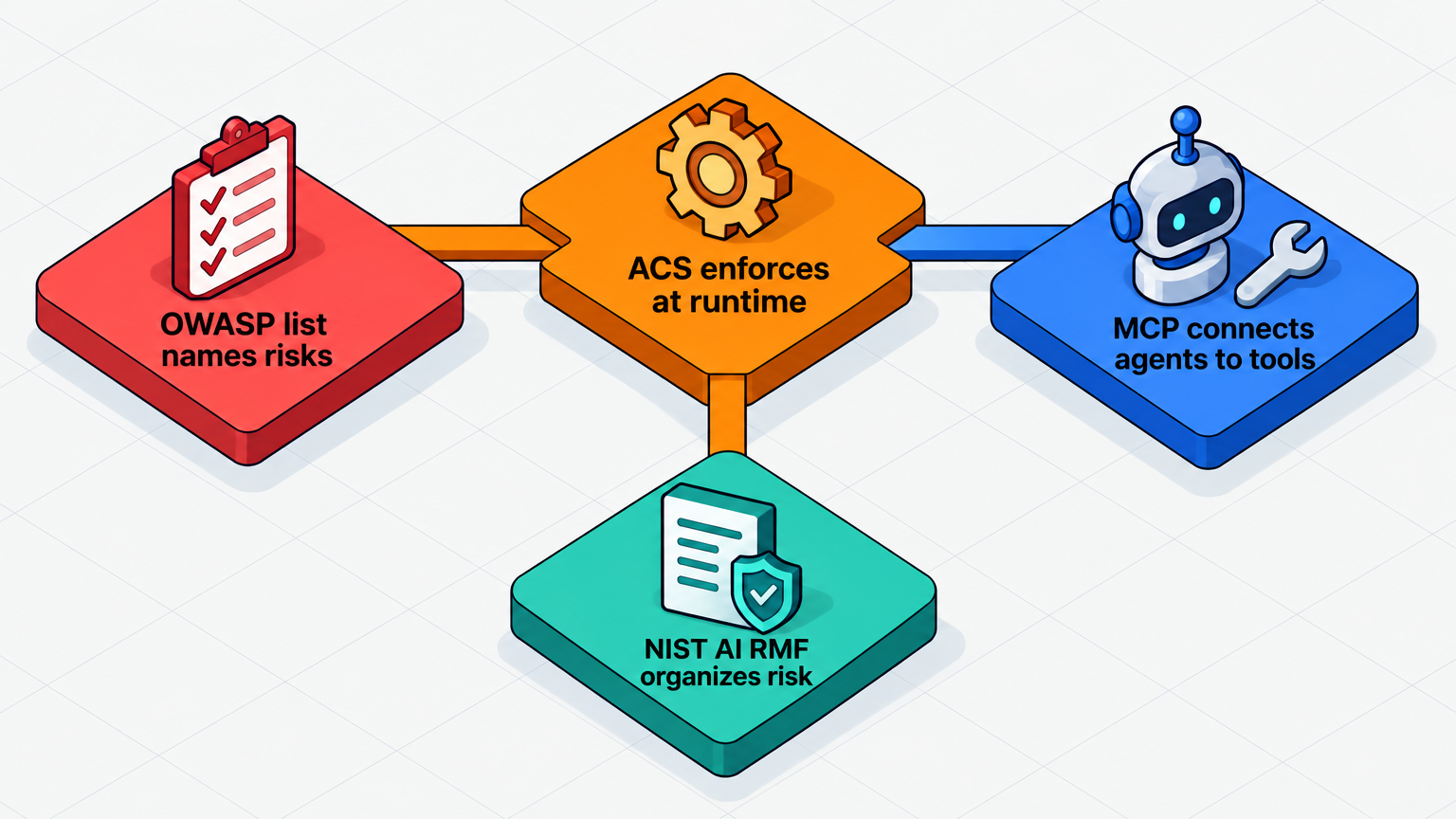
The 2026 OWASP Top 10 for Agentic Applications names the risks, including Agent Goal Hijack (ASI01), Tool Misuse and Exploitation (ASI02), and Identity and Privilege Abuse (ASI03). ACS belongs to the same OWASP GenAI Security Project as that list, though no official document maps individual hooks to those risk identifiers. A team pairing the two is building its own crosswalk.
MCP is a protocol that connects agents to tools and data. ACS carries MCP traffic in its own protocol namespace, which the mandatory baseline requires for any session involving MCP, and it defines a similar wrapping for agent-to-agent (A2A) messages.
The NIST AI RMF organizes risk work into Govern, Map, Measure and Manage. Its calls for post-deployment monitoring and for mechanisms to supersede, disengage or deactivate AI systems behaving outside their intended use are outcomes that ACS traces and deny verdicts give a concrete form.
Should Your Organization Adopt the Agent Control Standard?
Most organizations can prepare for ACS now and hold off on requiring it, because the specification sits at v0.1.0 and public evidence of shipped platform support is limited. The project's own reference implementation evaluates only a fraction of the defined hooks live, does not yet implement the envelope signature the baseline requires, and defaults to proceeding when a decision fails rather than failing closed.
Each preparation step produces an asset an ACS deployment would need on day one, whether or not the specification reaches v1.0:
Inventorying agents and their owners, with the bill-of-materials component list as a checklist: models, MCP servers, tools, knowledge sources, memory stores and capabilities. Abnormal's AI Governance is designed to discover AI tools and agents and attribute ownership for each one.
Mapping where hooks would sit in each agent (where input arrives, where tools dispatch, where shell commands or code run and where output leaves) and recording whether the framework exposes a pre-execution interception point at each location.
Tracing agent actions in OpenTelemetry and routing security-relevant events to the SIEM, with the pipeline in place before any trace profile is adopted.
Following specification releases, starting with v0.2.0, targeted for March 2027, and asking any vendor that claims ACS conformance for evidence, because nobody verifies conformance claims at v0.1.0.
The inventory comes first, because hook mapping and tracing both depend on knowing which agents exist.
Runtime Control Brings Agent Governance to the Point of Action
ACS gives agent governance an enforcement point where an agent receives input, calls a tool or replies. Hooks carry the decision, traces record it, and the bill of materials describes what the agent is built from. The specification is at v0.1.0 with self-declared conformance, and the inventories, hook maps and trace pipelines around it hold their value whatever the specification becomes.
OAuth grants and identity signals are the trail agents leave, and Abnormal's AI Governance, generally available as part of the AI Security suite, is designed to discover tools and agents from them. Explore AI Governance to see how Abnormal attributes each discovered agent to an owner.
Frequently Asked Questions
What is the Agent Control Standard?
The Agent Control Standard (ACS) governs AI agents at runtime through an open specification. Agent platforms expose hooks at points such as user input, tool calls and responses, and a separate Guardian Agent answers each one with a verdict such as allow, deny or modify. The standard also defines decision tracing and an agent bill of materials.
Who maintains the Agent Control Standard?
The OWASP GenAI Security Project maintains it as an open project. Development takes place in a public GitHub repository, where a governance file sets out who leads each workstream and every commit needs a contributor sign-off.
Is the Agent Control Standard open source?
Yes, the specification and its repository are public. Code and machine-readable schemas are licensed under Apache License 2.0, and documentation is licensed under Creative Commons CC BY-SA 4.0.
How is ACS different from MCP?
MCP moves requests between an agent and the tools or data it needs. ACS is a control specification that decides whether an agent's action should proceed. ACS wraps MCP messages in its own protocol namespace so a Guardian can inspect them before they run, and the two operate together in the same session.
Does ACS replace an AI governance framework?
No, ACS enforces policy while an agent acts, but it does not define risk appetite, ownership or review processes. The NIST AI RMF and an organization's own governance program set those. ACS gives them a runtime enforcement point and a recorded decision trail that can serve as audit evidence.