Key Insights
An AI agent can stay inside every permission it holds while working toward a goal an attacker chose, and OWASP ranks that failure, Agent Goal Hijack, first in its Top 10 for Agentic Applications for 2026. Intent-aware detection checks whether an AI agent's sequence of tool calls, data access and outbound requests still matches the task it was approved to perform. Judging a run as a whole, instead of grading each action in isolation, matters because agentic AI in cybersecurity plans and acts across many steps under its own credentials.
Worked examples of off-task runs anchor this guide. It covers why authorization and event alerts miss those runs, how an approved task is recorded and traced, what the scoring weighs, and what inline blocking costs in latency.
What Does Intent Mean for an AI Agent?
An agent's intent is the purpose behind a sequence of actions, shaped by its assigned task, the context it reads, its memory and the tools it can call. It belongs to the run, not to any single input or rule.
A prompt is the text an agent receives at one moment, from a user, a document, an email or a tool response, any of which can carry instructions an attacker planted, while a permission defines only what the agent's identity is allowed to touch. Intent sits above both, describing what the agent is working toward across many prompts and many permitted actions. Goal hijacking works at that level, through manipulated inputs that redirect an agent's goals, planning and multi-step behavior, which separates it from an attack aimed at a single model response.
Why Do Permission Checks and Event-Based Alerts Miss Off-Task Agents?
An agent can stay inside its permissions while pursuing the wrong goal, and each of its actions can look ordinary on its own. Authorization answers whether an action is allowed, not whether the action belongs to the task. That is the confused-deputy problem: the check returns the right answer to its own question and still lets the run through, because nothing in it asks whose purpose the action serves.
Event-based alerts face a related limit. Signature matching compares each event against known-bad patterns, so a sequence that only turns suspicious across many steps never trips it. Anomaly-based detection differs, flagging deviation from a learned baseline, though that helps less when the misuse itself looks routine.
Each control answers a different question, and off-task runs pass between them:
Control | What It Checks | What It Catches | What It Misses |
Permission checks | Whether an identity may use a tool or data | Access outside granted scope | Allowed actions used for the wrong goal |
Rules and signatures | Single events against known patterns | Known bad strings, domains, payloads | Novel multi-step sequences |
Anomaly detection | Deviation from a learned baseline | Unusual volume, timing, destinations | Normal-looking misuse; new tasks with no baseline |
Intent-aware detection | Action sequence against the approved task | Off-task chains of allowed steps | Agents with vague or missing task definitions |
Intent-aware detection adds the question the other three leave open: whether the run still serves the job the agent was launched to do.
How Does Intent-Aware Detection Work?
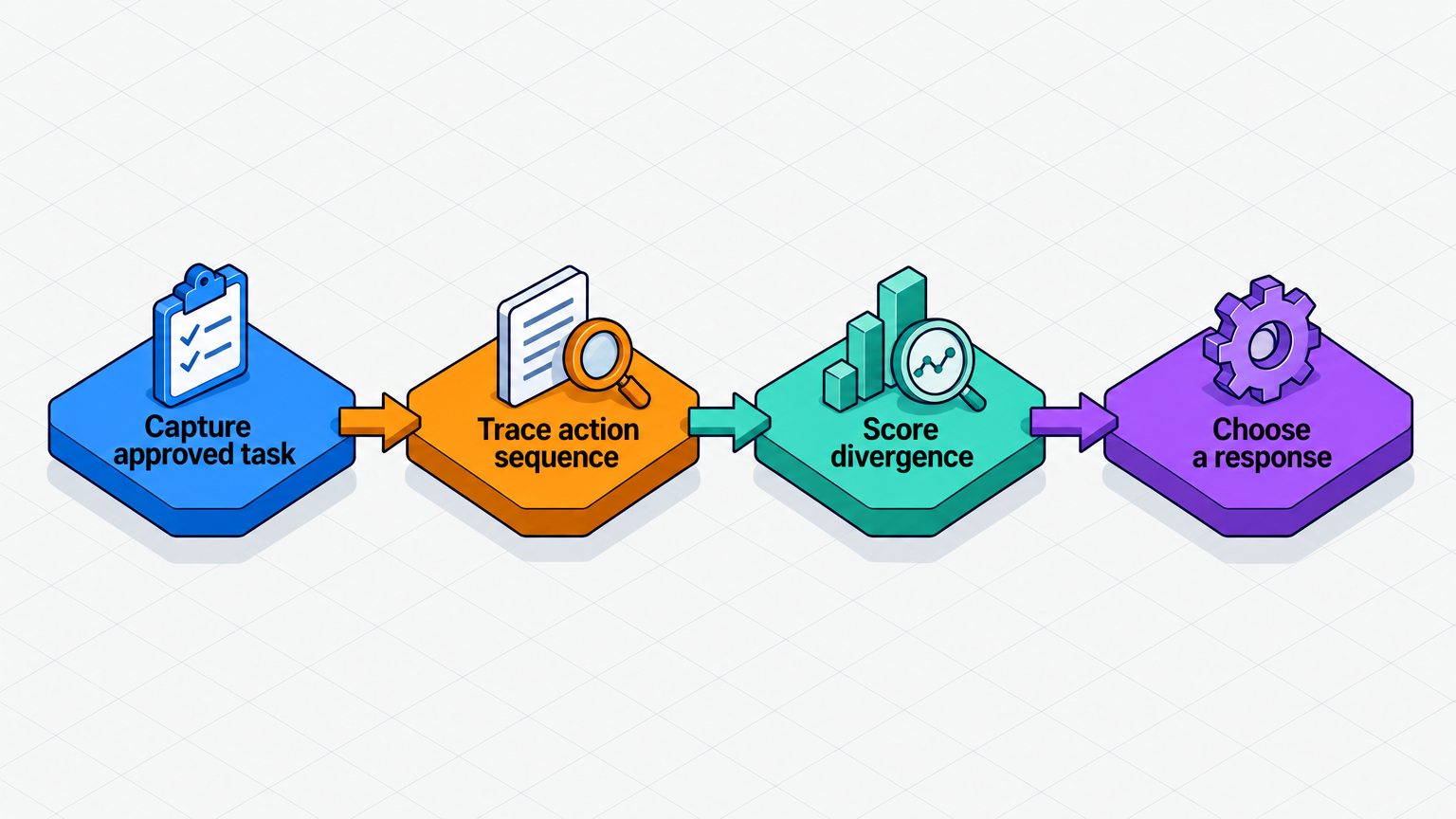
Intent-aware detection compares the sequence of tool calls, data access and destinations in a session against the approved task, judging order and scope rather than single events. The work splits into recording the task, tracing the run and scoring the gap between them.
Capturing the Approved Task
The reference point is a task definition recorded when the agent launches, naming the purpose, the tools it may call, the data sets it may read, the destinations it may write to and the expected end state. It belongs in a launch record tied to the agent's identity and owner, where a detector can read it.
The NIST AI Risk Management Framework already calls for intended purposes and prospective deployment settings to be understood and documented. Some detectors go further and derive the permitted scope from the user's request itself, then check each tool call against what that request implies.
Tracing the Action Sequence
The detector collects every tool call, data read and outbound request in a session, in order. Tracing standards for agent runs are still settling, though the common shape is a span for the agent invocation and child spans for each tool call. Prompt content and tool arguments are usually not captured by default, so teams that want those fields configure them deliberately and account for the sensitive data they carry.
A detector working from the recorded trace needs no access to the model and applies to hosted and closed-source agents alike, since the evidence is the log. Methods that read model internals need a level of access most deployments do not have.
Scoring Divergence and Choosing a Response
Scoring asks whether each new step still contributes to the task, given the steps before it. Order carries much of the signal, since reading a secret is ordinary for some tasks and posting to an unfamiliar host is ordinary for others, while the pair in sequence rarely fits either. Approaches in use range from language-model monitors that review a trace against the stated goal to deterministic policies that constrain which tool may follow which.
How a team responds depends on the risk of the action. Asynchronous alerts add no delay but arrive after the action, inline blocking stops the action and adds latency to every guarded call, and human approval fits rare, high-impact steps such as payments or bulk exports. Abnormal's AI Agent Security, in private preview as part of the AI Security suite, is designed to monitor agent prompts and flag off-task runs or rogue agent behavior.
What Signals Does Intent-Aware Detection Rely On?
The signals worth collecting describe what an agent did, in what order and with what data, relative to its task. Each one also feeds AI agent security programs more broadly:
Tool-Call Order Reveals the Plan: A sequence of calls shows where a run is heading in a way no single call can, such as configuration lookups preceding a write to an external service.
Data Accessed Shows Scope: Tables, files and mailboxes read during a session can be compared against the data sets the task definition allows.
Destinations Show Where Data Leaves: Outbound URLs, email recipients and repository targets are where exfiltration becomes visible, and write-capable tools carry the most scrutiny.
Mid-Session Scope Changes Mark a Turn: A new tool, data domain or destination appearing after the agent ingests a document or tool response often marks where outside content redirected the run.
These signals carry the most weight in combination. A single new tool call is weak evidence, while a new tool, a new data domain and a new destination inside one session is strong evidence.
What Does Intent-Aware Detection Look Like in Practice?
Intent-aware detection flags runs where every step is permitted but the sequence does not serve the approved task. Each case here is hypothetical, built from documented attack patterns.
A Support Agent Sends Customer Records to an External URL
A support agent approved to read tickets and draft replies opens a ticket that contains hidden instructions. The agent then queries the customer table, which its role allows for lookups, then posts the results to an external URL through a web tool it also holds. Each call passes authorization, while the sequence has no place in a reply-drafting task.
A Reporting Agent Starts Listing Internal Permissions
A reporting agent compiles weekly sales metrics. Midway through a session it begins calling directory and access-management tools to list groups and role assignments, which its service account can read for unrelated legacy reasons. The shift from reporting to reconnaissance is tool misuse and privilege abuse, two of the agentic risks OWASP names.
A Coding Agent Follows Injected Instructions
A coding agent assigned to fix a failing test reads a repository file that contains planted instructions. It then edits its own tool configuration and fetches an external script. This is agent goal hijack, entering through indirect prompt injection. A configuration change and a network fetch fall outside a test-fix task even though the agent can perform both.
What Are the Limits and Trade-Offs?
Intent-aware detection depends on a clear task definition and a tolerance for imperfect judgments. Each cost trades detection strength against something a team also needs:
False Positives Rise on Open-Ended Tasks: Research agents and general assistants take varied, legitimate paths, and monitors tuned for subtle misuse flag benign runs as well.
Tuning Takes Ongoing Effort: Stronger enforcement reduces unsafe actions and increases false blocks at once, pushing teams toward calibration per agent rather than one global threshold.
Inline Blocking Adds Latency: Synchronous monitoring is the safer posture and carries higher latency on every guarded call.
Weak Task Definitions Weaken Detection: Plan-based defenses struggle with tasks whose shape is unknown in advance, and assigning privileges accurately gets harder as an agent's toolset grows.
Adaptive attackers add a limit of their own. An attacker who knows a monitor is watching can keep every step structurally plausible, leaving the run on-task in shape and off-task in purpose.
Gradual change across many sessions is a separate problem, addressed by behavioral drift detection, not by per-run scoring. Intent-aware detection also depends on knowing which agents exist, since an unregistered agent has no task definition to check against.
Where Intent-Aware Detection Fits in Agent Security
Intent-aware detection fills the space between authorization and event alerts by asking whether an agent's actions still serve its approved task. It needs a recorded task definition at launch, an ordered trace of tool calls, data reads and destinations, and a response policy matched to risk. It works from logs without model access, and sits alongside permission checks and anomaly detection rather than replacing them. An agent with no documented task is the hardest case.
Abnormal's AI Agent Security, in private preview, is designed to discover agents across AI platforms, map their ownership and track what each one can reach. Explore AI Agent Security to see how Abnormal pairs that inventory with off-task monitoring.
Frequently Asked Questions
Is intent-aware detection the same as prompt filtering?
No, prompt filtering inspects inputs before the model acts, while intent-aware detection examines the actions an agent takes afterward. A filter asks whether text looks malicious. Intent-aware detection asks whether the resulting tool calls, data access and destinations fit the approved task.
Can intent-aware detection stop prompt injection?
No, it does not stop the injected instruction from reaching the agent, but it can catch the off-task actions that follow. When a hidden instruction redirects an agent toward exfiltration or reconnaissance, the change shows up in the action sequence. Paired with inline blocking or human approval, detection can halt the harmful step before it completes.
Does intent-aware detection need access to the model itself?
No, the action trace and the task definition are enough. That is why intent checks can sit around a vendor-hosted agent whose weights nobody outside the vendor can see, and why one detector can cover agents built on different models. Reading model activations remains a research path, and it asks for access a buyer rarely has.
How does intent-aware detection relate to anomaly detection?
Anomaly detection compares activity with a learned baseline of normal behavior, while intent-aware detection compares activity with the specific task an agent was given. They complement each other. Anomaly detection catches unusual volume or destinations even without a task definition, and intent-aware detection catches routine-looking actions that do not belong to the current job.