Key Insights
IBM's 2026 breach cost study reported that more than 20% of studied organizations had a breach targeting AI models or applications. An AI maturity model built for security measures how well that exposure is controlled. It places an organization on a staged scale for how well it sees, governs and protects the AI already in use, not how ambitious its plans are. Assessing where an organization stands means scoring each dimension against those stages using evidence the team already holds, such as inventories and access reviews.
To place an organization on that scale, this guide defines each stage from Ad Hoc to Optimized, the signals for each, a way to score them from evidence, and the move that lifts each stage.
What Is an AI Maturity Model?
An AI maturity model is a staged framework that places an organization at a defined level across several dimensions and shows leaders the next level to work toward. As part of how AI governance works, it tests whether governance decisions hold in practice.
Most published AI maturity models score adoption, measuring strategy, data readiness, talent and use cases in production, with security as one dimension among many. A security maturity model scores something different: how well the organization sees, governs and protects the AI it already runs, approved or not, including tools a business team connected through OAuth without review. A strong adoption score can sit alongside no inventory, no named owner and no logging of AI activity.
AI maturity also differs from AI readiness. AI readiness asks whether an organization can begin a deployment: budget, data, skills and a sponsor. AI maturity asks how well existing deployments run and stay under control. For example, a company may be ready to roll out a coding assistant next quarter while employees already use unapproved writing tools, and its readiness score says nothing about those tools. Maturity is the more useful measure for a security leader because it describes current exposure instead of future plans.
What Should an AI Security Maturity Model Measure?
An AI security maturity model should measure whether the AI in use is known, owned and protected. Each dimension builds on the ones before it, because data, identity and monitoring controls all depend on visibility and ownership first:
Visibility and Inventory: The organization knows which AI tools and agents are in use, who adopted them and what they connect to.
Governance and Ownership: Each tool has a named owner, and a policy states what is sanctioned, tolerated or blocked.
Data Protection: Rules define what data may enter AI tools, with controls over retention and leakage.
Identity and Access: Each agent and integration holds its own identity with scoped, reviewed permissions.
Monitoring and Incident Response: AI activity reaches security monitoring, and AI incidents have documented response steps.
NIST AI RMF 1.0, released in January 2023 and now under revision, organizes outcomes into Govern, Map, Measure and Manage. Its outcomes call for AI inventory mechanisms (GOVERN 1.6), documented roles and post-deployment monitoring that includes incident response. ISO/IEC 42001, the AI management system standard, is the certifiable counterpart, and organizations pursuing it work toward a documented management system with built-in periodic performance evaluation.
The OWASP AI Maturity Assessment, now at Version 1.0, scores eight areas, from Responsible AI, Governance, Data Management and Privacy through Design, Implementation, Verification and Operations, and works as a broader companion to this one.
What Are the Stages of AI Security Maturity?
AI security maturity runs from Ad Hoc to Optimized, and placement depends on evidence an assessor can observe, not on how a team describes itself.
Ad Hoc and Aware Stages: From Unseen AI Use to a Partial List
At the Ad Hoc stage, employees adopt AI tools on their own, and nobody in security can list them. The signals are an absent inventory, no owner for AI risk, staff signing up for assistants with work email, and third-party apps holding unreviewed OAuth grants. Security cannot say what data has gone into public models. Discovery lifts an organization out of Ad Hoc by pulling signup emails, OAuth grant reports and identity provider logs into a first inventory.
At the Aware stage, security knows AI is in use and holds a partial list, but nothing enforces decisions about it. Typical signals include an inventory compiled once from a survey, shadow AI acknowledged in leadership meetings, a draft policy nobody signed off on, and no person accountable for each tool. A survey-based list also ages quickly, because it records only the tools people remembered to report.
The NIST AI RMF assigns responsibility for AI risk decisions to executive leadership, and an organization stays at Aware until that assignment is made. Moving out of Aware takes an executive sponsor plus a business owner for each tool.
Defined, Managed and Optimized Stages: From Written Policy to Measured Controls
At the Defined stage, a documented AI policy exists, owners are named, and written rules say what data may enter which tools. In practice, that looks like tools classified as sanctioned, tolerated or unsanctioned, a policy approved by leadership, data rules that mention AI explicitly and a review step before new tools gain access.
Most controls still live on paper: a policy may forbid uploading customer records to unapproved tools while nothing checks whether it happens. Defined organizations advance by tying each rule to an access control and a log that shows whether it held.
At the Managed stage, controls on AI tools and agents are enforced and produce evidence. The markers are a distinct least-privilege identity for each agent, scheduled reviews of OAuth grants, data controls that block or flag sensitive uploads, and AI events reaching the security information and event management (SIEM) platform. Managed organizations can show privilege limits and just-in-time credentials in access review records, not only in policy, and advance by using automated discovery to keep the inventory current.
At the Optimized stage, AI security runs as a continuous program rather than a series of projects. Signals include discovery that flags new tools, agents and AI features added to approved apps; framework requirements mapped to controls with evidence attached; AI incidents written into response playbooks; and metrics feeding management review under ISO/IEC 42001 Clause 9. Holding the stage means reassessing on a fixed cadence and after major changes.
How Do You Assess Your Organization's AI Security Maturity?
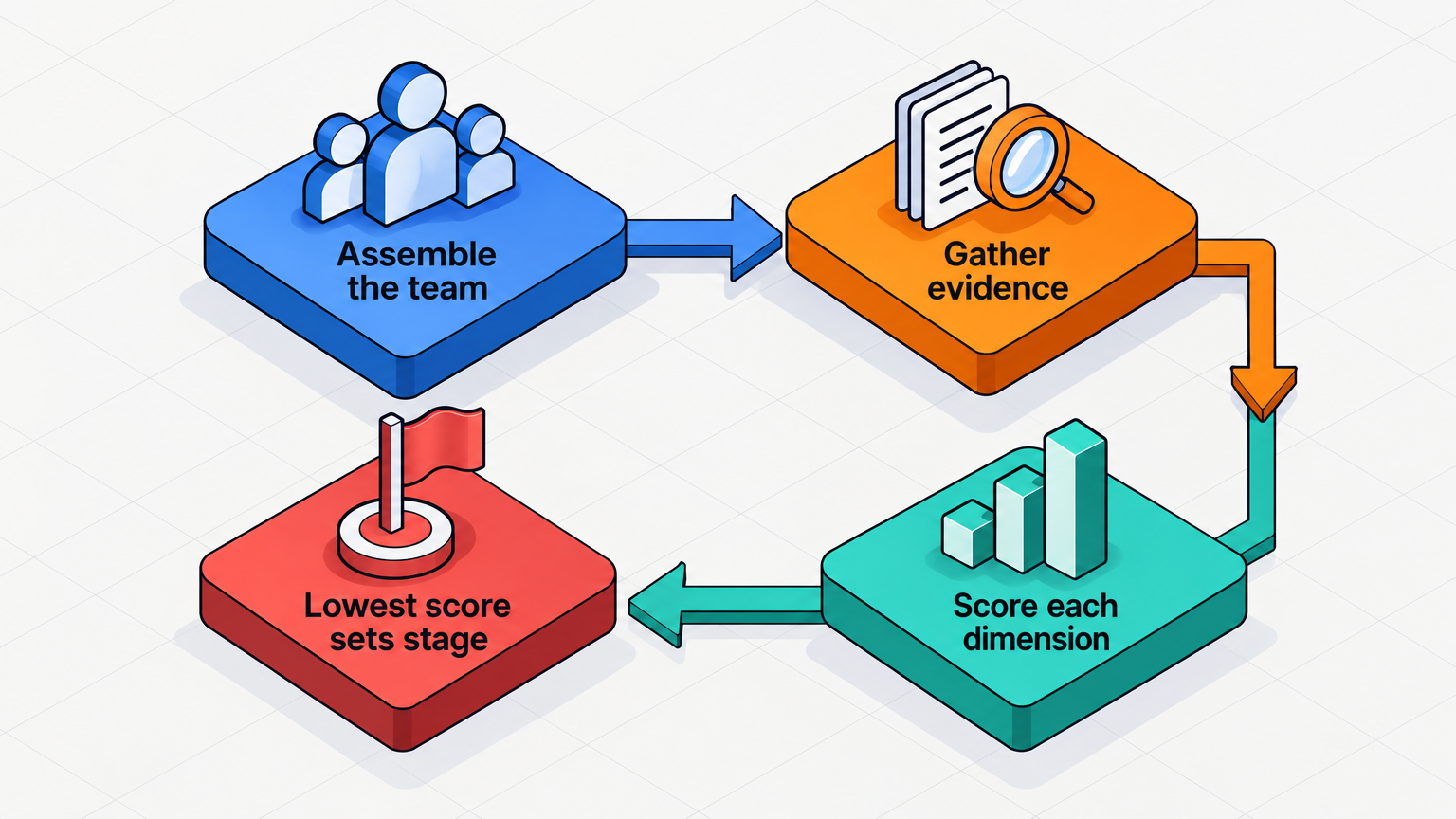
An assessment brings together the people who own AI risk, gathers evidence, and scores each dimension against the stage signals.
Assemble the Team and Gather Evidence
The CISO or a delegate typically leads the assessment, though security alone rarely sees all the AI in use. Risk and compliance, legal, IT and identity teams, data owners and business sponsors each supply evidence for at least one dimension and agree the scores together, in line with the AI governance responsibilities the program documents.
Evidence, not self-assessment, decides each score:
An AI tool inventory, with the date it was last updated.
OAuth grant and identity provider records.
Approved policies and the exceptions granted against them.
Access reviews covering agents and service accounts.
SIEM queries showing which AI events actually arrive.
AI incident or tabletop records.
Missing evidence is itself a finding and usually lowers the score. Collecting records before the scoring session, with each contributing team responsible for its own, keeps the discussion on what the records show rather than on what each team believes. Where two sources disagree, such as a survey list that omits tools found in OAuth grant reports, the system record carries more weight. Repeating the assessment on a set cadence and after major rollouts keeps the score current.
Score Each Dimension Against the Stages
Each dimension gets its own stage score, and a dimension reaches a stage only when the evidence shows that stage's signals in place. The lowest dimension score sets the overall stage. An organization with Managed monitoring and an Ad Hoc inventory is Ad Hoc in practice, because a SIEM cannot alert on tools nobody knows exist.
Reading each stage across every dimension exposes those uneven scores before a team settles on one:
Stage | Visibility and Inventory | Governance and Ownership | Data Protection | Identity and Access | Monitoring and Response |
Ad Hoc | No inventory | No owner or policy | No AI data rules | Unreviewed OAuth grants | AI absent from SIEM |
Aware | One-time partial list | Shadow AI acknowledged | Concerns unwritten | Grants known, unreviewed | Occasional log checks |
Defined | Documented inventory | Policy and named owners | Written AI data rules | Approval before access | Logging requirements set |
Managed | Regularly updated | Policy enforced | Controls enforced | Least privilege, reviewed | AI events in SIEM |
Optimized | Continuous discovery | Framework evidence mapped | Controls measured | Just-in-time credentials | AI in response playbooks |
Each stage describes a recognizable organization, and each dimension has its own improvement path from Ad Hoc to Optimized.
How Do You Move Up a Stage?
Organizations move up by fixing visibility first and ownership second, because a data rule has nothing to act on for a tool nobody has found. Abnormal's AI Governance is designed to discover sanctioned and shadow AI tools, record who adopted them and map compliance frameworks to controls and evidence.
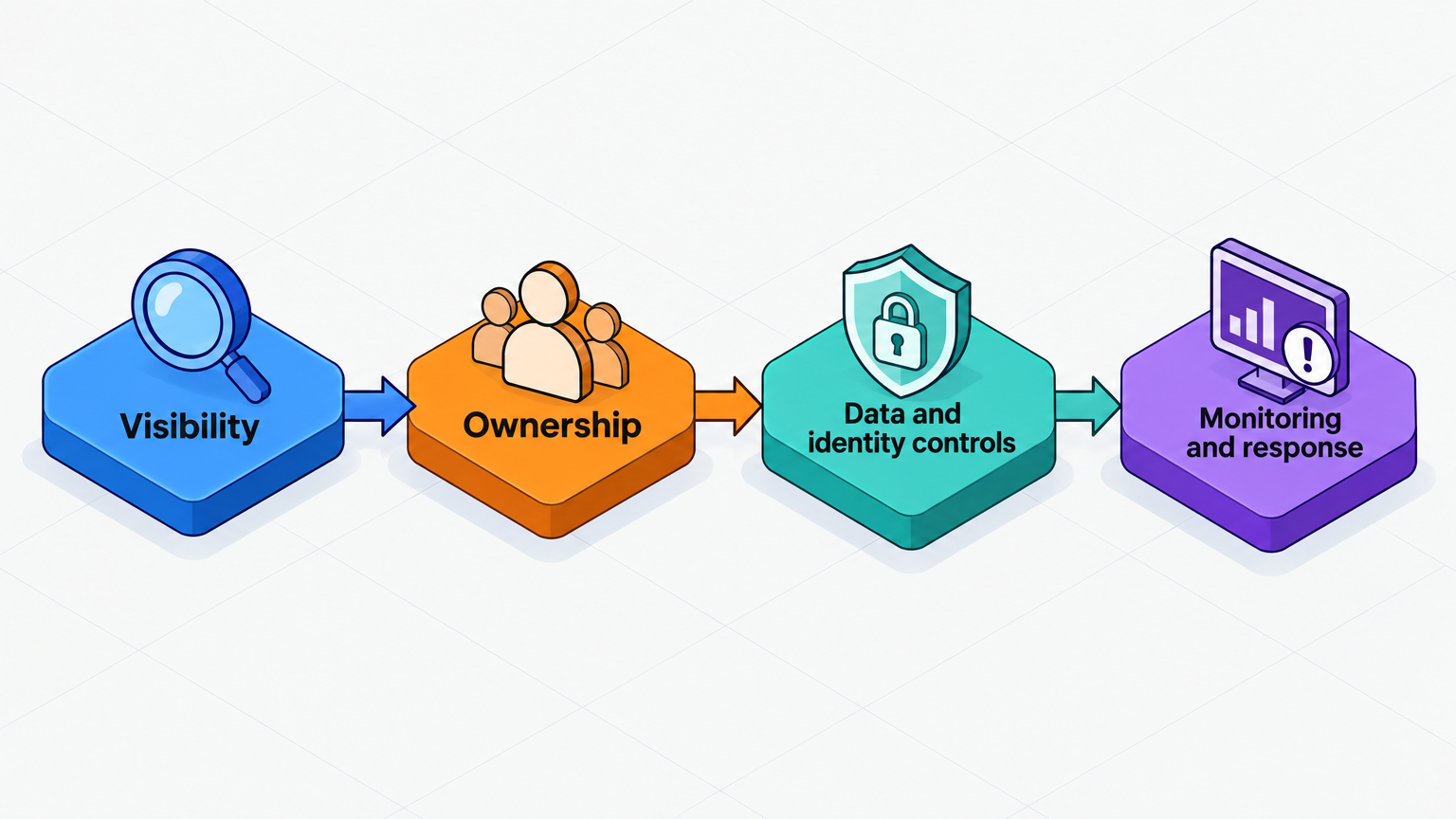
Ownership comes next because an owner can approve, restrict or retire a tool, and every exception then has someone to sign it. Legacy governance models designed for centrally purchased software often do not account for AI that employees adopt themselves.
Programs usually stall on sequencing, not on tooling:
Treating the inventory as a one-time project instead of a standing feed.
Writing policy before naming the owners who will apply it.
Buying enforcement tooling before an inventory exists for it to enforce against.
Pace depends on executive sponsorship, starting visibility, staff and regulatory deadlines. Two organizations with the same tooling can sit a stage apart.
Monitoring and response mature last because they depend on everything before them. Logging across AI pipelines and connected systems produces a useful record only once the inventory names what should be logged.
Using an AI Maturity Model to Plan Security Readiness
Scoring each dimension from artifacts such as inventories, grant reports and access reviews gives a security leader an evidence-backed answer to where the organization stands and a result a board can follow. Starting with inventory and ownership gives the data, identity and monitoring controls a known set of tools to act on.
A maturity assessment needs an accurate picture of what is deployed. Abnormal's AI Governance, generally available as part of the AI Security suite, is designed to discover approved and shadow AI tools and attribute ownership. Explore AI Governance to see how Abnormal helps build that inventory from the AI tools employees already use.
Frequently Asked Questions
What is an AI maturity model?
An AI maturity model rates an organization on a staged scale across several dimensions and names the next step up for each one. Adoption-focused models score strategy, data, talent and use cases; a security-focused model scores how well the organization sees, governs and protects the AI already in use.
What are the stages of AI maturity?
A security-focused model can use Ad Hoc, Aware, Defined, Managed and Optimized. Ad Hoc means AI runs without oversight, Aware means use is known but unmanaged, Defined means policies and owners exist, Managed adds enforced controls, and Optimized means discovery and response improve continuously.
How do you measure AI security maturity?
An assessment scores each dimension against the stage signals, using evidence such as inventories, OAuth grant reports, approved policies, access reviews and SIEM queries rather than self-assessment. Every dimension gets its own score, and the weakest one sets where the organization stands overall.
How long does it take to move up a maturity stage?
There is no fixed timeline for moving up a stage. Progress depends on how much AI use is already visible, whether an executive sponsor is in place, how many people can work on it and which regulatory deadlines apply. Programs that settle inventory and ownership first give later controls something to act on.
Who should own an AI maturity assessment?
The CISO or a named delegate typically owns it, with executive leadership accountable for AI risk. Risk, compliance, legal, IT, identity, data owners and business sponsors each contribute evidence, and scoring the dimensions together keeps the result from reflecting only the security team's view.