Key Insights
OWASP's 2026 Top 10 for Agentic Applications names rogue agents, where an agent deviates from its authorized scope, among the leading risks of running agents in production. An agent usually arrives there gradually, over weeks of approved updates and small permission grants, with no single action that looks wrong on its own. Behavioral drift detection is the continuous comparison of what an AI agent or identity does now against what it has done before, flagging gradual change in its tools, data, destinations and authority.
Teams separate risky drift from normal change by matching each shift against approved deployments, prompt updates and tickets. Drift with no matching record that increases access is the security signal.
Behavioral drift is easy to confuse with model or configuration drift, and this guide separates the three before going further. From there it works through how drift arises, which signals reveal it, and how rolling-window comparison and change records tell risky drift from approved change.
What Does Behavioral Drift Detection Measure?
Behavioral drift detection measures change in an agent's or identity's own actions over time, using that entity's history as the reference point instead of a fleet-wide rule. It looks for a trend, such as a slow widening of the tools an agent calls, not one anomalous event, extending anomaly-based detection across a longer horizon.
Several neighboring terms describe different things. A single action that breaks from the baseline, such as one unusual login, is baseline deviation, and detection that weighs whether an action still serves the agent's assigned task is intent-aware detection. Drift is easiest to pin down beside the terms it is most often confused with:
Drift Type | What Changes | Example | Security Relevance |
Behavioral drift | Actions an agent or identity takes | Agent starts calling an export API | Can indicate hijack, tool poisoning or scope creep |
Model drift | Accuracy of model outputs | Predictions degrade as inputs shift | Mainly a quality issue |
Configuration drift | Settings versus an approved baseline | Policy changed outside change control | Erodes hardened settings |
Configuration drift measures settings against an approved baseline, while behavioral drift tracks what the entity actually did.
Why Does Behavioral Drift Matter for Security?
Slow-moving misuse stays under the per-event thresholds most alerting depends on. The same logic runs through older tradecraft: splitting exfiltrated data into fixed-size chunks to stay under transfer-size alerts, and throttling password attempts to stay below brute-force thresholds.
An agent that pulls a few extra records per day passes every single-event check the same way, and AI agent security practices that review each action in isolation struggle to see the accumulation. The dominant causes are inputs that redirect what an agent does, and authority that grows past what it needs.
Drift From Compromised Tools and Prompts
Compromised inputs change what an agent does without any change to its code. Pre-positioned documents, templates or external data can alter an agent's goals, instructions or decision pathways, and tampered third-party tools, plug-ins and update channels can change its behavior from the supply side.
Tool poisoning is the named case: malicious content planted in a tool's definition, implementation or runtime responses, which can arrive after adoption when a supplier changes a tool that was already approved. Indirect prompt injection and context poisoning reach the agent the same way, through ingested data and stored memory. Not every cause is an attacker, though: a vendor-side model update can shift behavior on its own, which puts correlation against model version changes in the same review.
Drift From Permission Growth and Scope Creep
Authority accumulates in small, individually approved steps. Attackers can also manipulate delegation chains, role inheritance and cached credentials to escalate an agent's access, and right-sizing privileges for service accounts and tokens is slow, difficult work.
Each new scope or role grant may pass review on its own. The combined reach after six months is what a drift view exposes, because it compares the identity against its own earlier footprint instead of the last ticket.
What Signals Reveal Behavioral Drift?
The clearest drift signals are changes in reach: new tools, more data, new destinations and more authority, plus shifts in timing and volume. The severity ratings are illustrative, not standards:
New Tools or APIs Widen What an Agent Can Do: The agent makes a first call to a tool absent from the baseline. Informational for read-only tools, high for tools that write, delete or send.
Growing Data Access Raises Exposure: Records, mailboxes or repositories touched per run trend upward across several windows. High when sensitive stores are involved.
New Destinations Can Mark Exfiltration Paths: The agent reaches outbound domains, webhooks or storage buckets it never contacted before. High when external and unapproved.
Broader Permission Requests Expand Authority: New scopes, role requests or reissued tokens widen what the agent can reach. High by default.
Timing and Volume Shifts Change the Operating Pattern: The agent runs at new hours, bursts after quiet periods, or climbs in steady small increments. Low alone, higher alongside other signals.
Task Refusals and Acceptances Move: The agent declines work it used to complete, or completes work it used to decline. Usually a prompt or model change rather than compromise, and worth correlating before anyone escalates.
Combinations carry the most weight, and an agent adding a new tool and a new external destination inside one window is a different case from one that has only started running at a new hour.
How Does Behavioral Drift Detection Work?
Behavioral drift detection builds a baseline for each agent, compares a recent rolling window against it, and checks every significant shift against change record
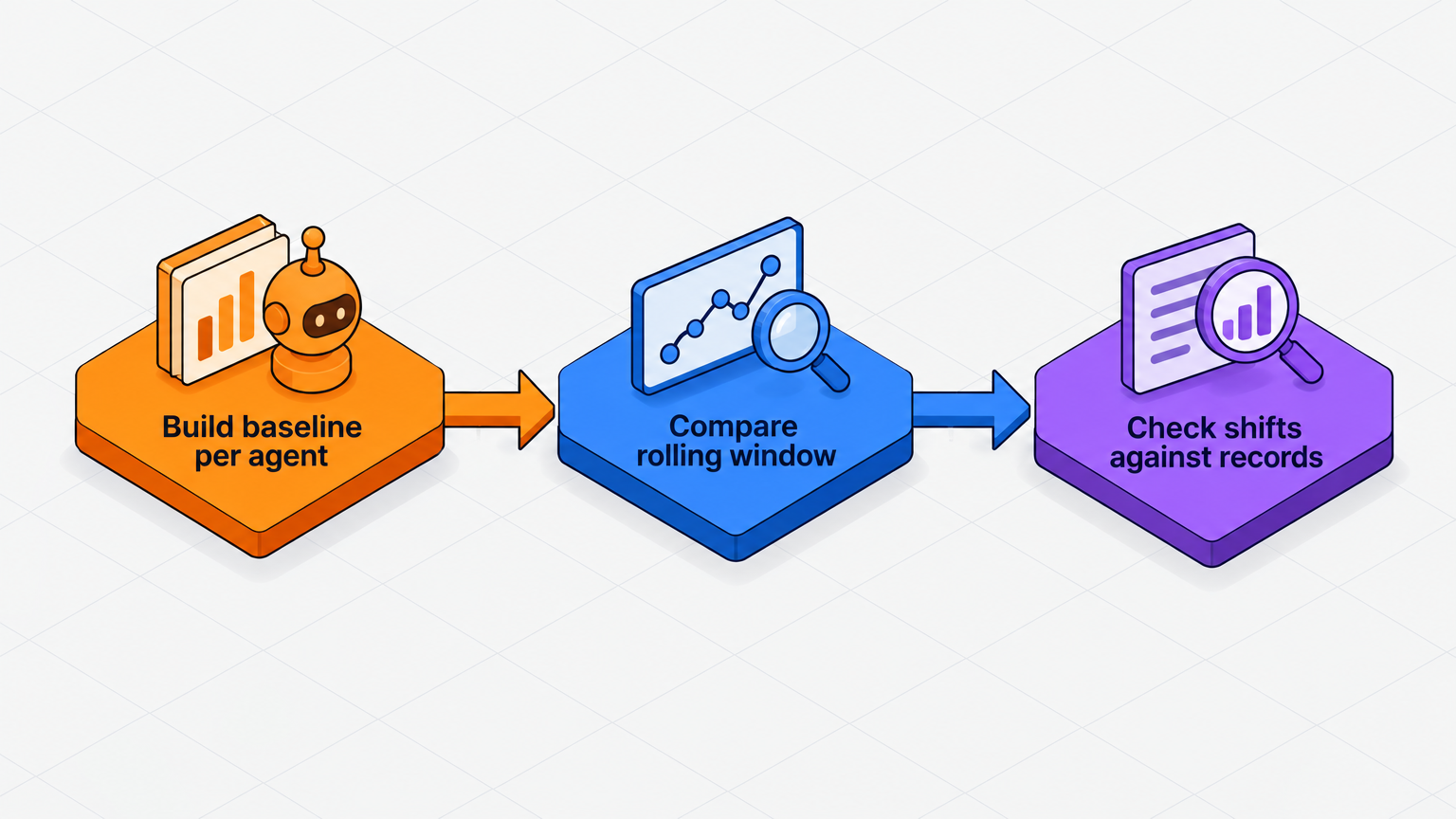
Building Per-Agent Behavioral Baselines
A baseline records the dimensions that drift affects: which tools the agent calls and how often, which data it reads and in what volume, where it sends output, which scopes it holds against which it uses, and when it runs. Each agent needs its own, the same way a per-identity baseline works for human accounts.
No vendor-neutral standard fixes a baseline length. Anomaly-detection training periods run from days into weeks, and a task performed only monthly may never appear during training, then register later as a deviation. A window covering one full business cycle avoids that gap, and low-volume agents need longer. After an approved change ships, teams reset or extend the baseline, which keeps planned work from scoring as drift.
Comparing Rolling Windows Against Change Records
Teams compare the distribution of recent activity against the baseline using a statistical distance measure, choosing one that tolerates categories appearing in only one window, since rarely used tools produce that shape of data.
A score alone does not separate attack from upgrade. Teams correlate drift alerts with deployments, prompt and tool-definition changes, model versions and permission tickets. The NIST Cybersecurity Framework 2.0 supports that scope, asking teams to monitor both technology usage and the activity of external service providers. Abnormal's AI Agent Security, in private preview as part of the AI Security suite, is designed to track each agent's privileges, tool access and data reachability, which is the side of that correlation teams most often assemble by hand.
How Do Teams Tell Risky Drift From Expected Change?
Drift that matches an approved change is expected, while drift with no matching record that increases access or authority is a security signal. These checks apply that rule in practice:
A Matching Change Record Explains the Drift: A deployment, prompt update or permission ticket covering the new behavior classifies the alert as expected.
Actions Outside the Agent's Stated Purpose Raise Risk: A summarization agent that starts editing records has moved beyond its job, whatever the volume.
Higher Privilege Outweighs Higher Volume: A new write scope deserves more attention than twice as many read calls.
Sensitive Data Changes the Stakes: New access to finance, HR or credential stores raises severity even when counts are small.
Timing Relative to the Change Matters: Drift beginning before a ticket was approved, or weeks after deployment, points away from that change.
False Positives Cluster Around Known Events: Quarter-end processing, onboarding waves and vendor model releases produce predictable shifts that can be logged as approved context.
Reviewers weigh the checks together, since a record covering new tools but not a new external destination explains only part of the drift.
One worked case shows how the checks combine. A finance team runs an invoice-summarizing agent with a stable baseline: it reads an invoices mailbox, calls an optical character recognition tool and queries the ledger read-only. Over three weeks it begins calling a vendor-master lookup, then a vendor-record update endpoint, then posting summaries to an external webhook. No single run looks unusual, while the rolling-window score climbs each week.
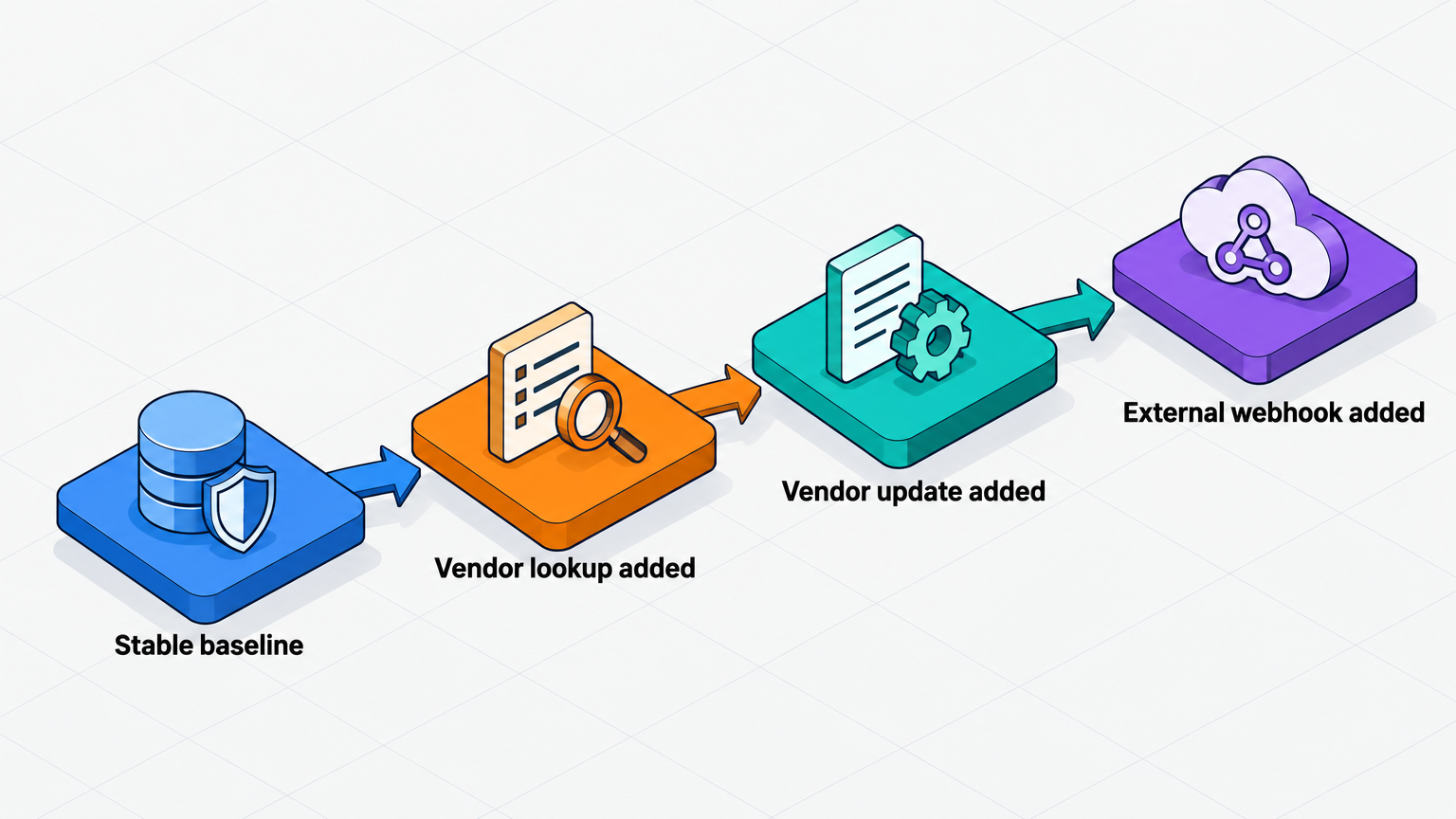
Reviewers find no change ticket, and the agent's last deployment was six weeks earlier. The combination of a write endpoint and an external destination raises the alert to high. Investigation traces it to a third-party tool whose description changed after approval, carrying hidden instructions.
What Should Happen When Drift Is Detected?
Response scales with the authority the agent has gained, moving from review to reduction, pause and rollback, with rebaselining only after approval:
Review the drift with the agent's owner and the change history to confirm whether approved work explains it.
Reduce permissions to those the agent used during the baseline window, revoking credentials and roles it no longer needs.
Pause the agent or block out-of-policy actions, with human approval required for high-impact actions.
Roll back or pin the version, since pinning prompts, tools and configurations by content hash and commit identifier makes a clean reversion possible.
Rebaseline once the change is reviewed and approved, making the new behavior the reference.
Rebaselining waits until the drift is explained, because resetting a baseline on unexplained change records compromised behavior as normal. The sequence follows the NIST AI Risk Management Framework, which calls for mechanisms, with assigned responsibilities, to supersede, disengage or deactivate AI systems whose outcomes are inconsistent with intended use. Deactivation events also call for preserving materials for forensic and regulatory review. A drift record holding the baseline, the scores, the correlated changes and the response taken provides that audit trail.
Behavioral Drift Detection in Everyday Agent Oversight
Slow growth in tools, data, destinations and authority is what per-event alerting misses and behavioral drift detection catches. The method is unremarkable once it is running: a baseline per agent, a rolling window scored against it, and a change record to explain what moved. Drift that no record explains is the case worth a reviewer's time.
Per-agent baselines need a record of what each agent can reach. Abnormal's AI Agent Security, in private preview, is designed to discover agents across AI platforms and map their ownership alongside the privileges and tool access each one holds. Explore AI Agent Security to see how Abnormal keeps that inventory current.
Frequently Asked Questions
Is behavioral drift the same as model drift?
No, behavioral drift tracks changes in the actions an agent or identity takes, while model drift describes a decline in output accuracy as data or concepts shift. A model can drift without changing which tools an agent calls, and an agent can drift sharply after a poisoned tool definition while its model is unchanged.
How long does a baseline need before drift detection works?
Volume and business cycles decide it rather than a fixed number of days. An agent that runs many times a day settles into a recognizable pattern sooner than one whose real work happens at month end, and a baseline that has not yet seen a full cycle will read ordinary work as drift. Resetting or extending it after an approved change keeps that work from scoring.
Can attackers hide in gradual drift?
Yes, low-and-slow tactics such as small data transfers, throttled attempts and one new permission at a time are designed to stay under single-event thresholds. Comparing long baseline windows against recent activity exposes the cumulative change, and correlating drift with change records shows which shifts no approved work explains.
Does drift detection apply to human users too?
Yes, the same method of comparing an identity's recent activity against its own history applies to human users, service accounts and AI agents. The signals differ in detail, such as login locations for people and tool calls for agents, while the logic of baselines, rolling windows and change correlation stays the same.