Key Insights
A July 2026 amendment to the consolidated EU AI Act text moved high-risk obligations to 2 December 2027 for Annex III systems and 2 August 2028 for Annex I products. The extra time shifts the deadline rather than the work of AI compliance, the discipline of meeting external legal, regulatory and contractual requirements, showing how an organization builds, buys and uses AI, and producing records an auditor can retrieve later.
This guide organizes AI compliance around evidence, pairing each requirement area with the question an auditor asks and the record that answers it. It follows the AI inventory through risk assessments, vendor assessments, logs and incident records. Each area ties back to the EU AI Act, data protection law, US state AI laws and the National Institute of Standards and Technology (NIST) AI Risk Management Framework (AI RMF) and separates what those rules require from what each organization decides.
What Is AI Compliance?
AI compliance is conformance an organization can demonstrate, which is what separates it from good practice. A team can follow sound process and still fail an audit if it cannot produce dated records showing that process ran. The work sits inside broader cybersecurity regulatory compliance and reuses its mechanics, from named control owners to an evidence repository and periodic testing.
AI governance is the internal system. AI compliance is meeting external requirements with it. Governance produces the inventory, policies, risk process and accountability structure a mature AI governance program maintains and compliance tests that system against outside obligations for a regulator, auditor or customer.
Good governance lowers compliance costs because the evidence already exists when someone asks. This is not legal advice, and organizations should confirm their obligations with counsel.
Which AI Compliance Requirements Apply to Your Organization?
Which requirements reach a system depends on where its output is used, whose personal data it processes and which decisions it influences, so a single US company's model can fall under EU law, several state laws and a sector regulator at once. Customer contracts add their own AI clauses, such as limits on training with customer data.
The EU AI Act
The EU AI Act (Regulation (EU) 2024/1689) sorts AI systems into four risk levels. Article 5 prohibits certain practices outright, with the original prohibitions applying since 2 February 2025 and new ones covering non-consensual intimate material and child sexual abuse material from 2 December 2026. Article 6, read with Annex I and Annex III, defines the high-risk tier, which covers use cases from biometrics and critical infrastructure through education, employment and law enforcement.
Under the consolidated text cited earlier, Chapter III carries the high-risk obligations now deferred to December 2027 and August 2028. Every high-risk provider control produces a record that a conformity assessment later asks for:
Risk Management: A risk management system (Article 9).
Technical Documentation: Documentation prepared before the system goes to market (Article 11).
Automatic Logging: Systems built to support automatic logging (Article 12).
Human Oversight: Systems designed for human oversight (Article 14).
Post-Market Monitoring: Monitoring that continues after deployment (Article 72).
Deployers carry their own duties, including trained overseers and logs kept for at least six months unless national law provides otherwise. The same consolidated text also reaches beyond Europe. Article 2(1)(c) covers providers and deployers outside the EU whose system output is used in the EU, and Article 99 sets fines for prohibited practices of up to EUR 35 million or 7% of worldwide annual turnover, whichever is higher.
Data Protection Law
Data protection law applies whenever AI processes personal data, and Article 22 of the GDPR gives people the right not to be subject to a decision based solely on automated processing that produces legal or similarly significant effects. Where a decision relies on the contract or explicit-consent exceptions, the controller must offer human intervention, a chance to express a view and a way to contest it. In the 2023 SCHUFA judgment, the Court of Justice held that a credit score can itself count as a decision when a lender relies heavily on it.
Article 35 requires a data protection impact assessment (DPIA) before high-risk processing, extending the core GDPR obligations teams already manage. A pending Digital Omnibus proposal would rewrite Article 22, and its text is not final.
US state privacy laws add parallel duties. The California Privacy Protection Agency's updated CCPA regulations took effect January 1, 2026 and require risk assessments for processing that presents significant privacy risk. Businesses using automated decision-making technology (ADMT) for significant decisions must provide pre-use notices, opt-outs and access by January 1, 2027.
US State AI Laws
State AI laws reach automated decisions about people, and Colorado's has already been rewritten once. The original AI Act (SB 24-205) never reached its compliance date, and after a delay to June 30, 2026, the legislature repealed and replaced it with Colorado SB 26-189, signed May 14, 2026. Effective dates often change, and official state pages show the current status.
The new law targets automated decision-making technology that materially influences consequential decisions in education, employment, housing, lending, insurance, health care and government services. From January 1, 2027, developers and deployers each carry their own duties:
Developer Documentation: Developers give deployers documentation of intended uses, training data categories, known limitations and human review instructions.
Consumer Notices and Review: Deployers notify consumers, explain the technology's role within 30 days of an adverse outcome and offer human review where commercially reasonable.
Compliance Records: Both keep compliance records for at least three years.
Enforcement is subject to a stipulated stay in xAI's federal lawsuit against the state, and the Attorney General's implementing rules were still in progress in late October 2026.
Sector Rules
Sector regulators apply existing rules to AI, so the evidence they expect looks familiar. In financial services, healthcare and employment, those rules already govern the individual decisions AI now shapes:
Financial Services: Fair lending rules require adverse action reasons that are specific and relate to the factors a creditor actually considered or scored, whether a person or a model did the scoring.
Healthcare: A business associate agreement must govern a vendor's use and disclosure of protected health information. Federal nondiscrimination rules also expect covered entities to identify patient care decision support tools whose inputs measure protected characteristics, and to mitigate discrimination risk.
Employment: New York City bars use of an automated employment decision tool without a bias audit in the past year, a public audit summary and candidate notice.
Across all three, auditors want to see the specific decision, the factors behind it and the person who could override it.
Standards Customers Ask For
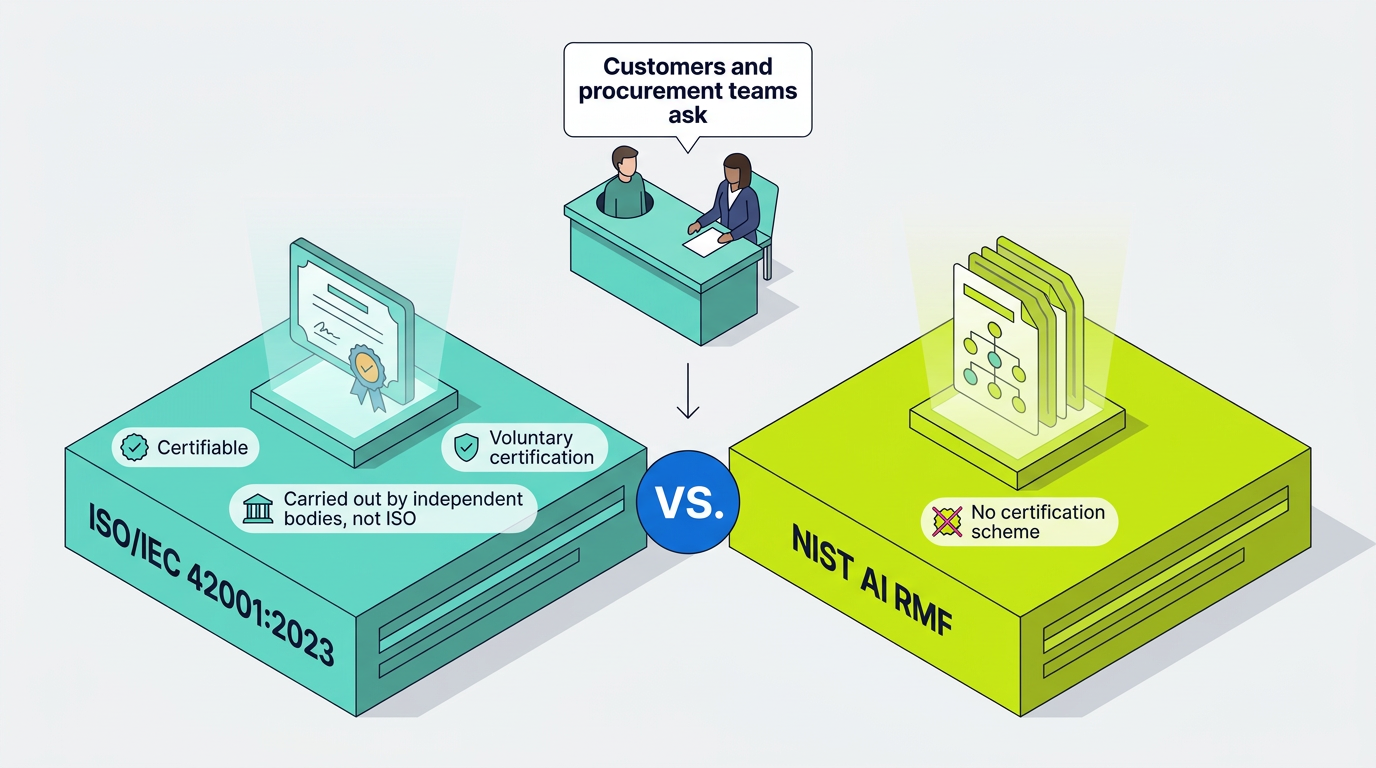
Customers and procurement teams most often ask about ISO/IEC 42001:2023 and the NIST AI Risk Management Framework, and only the first is certifiable. ISO's explainer, ISO/IEC 42001 explained, states that certification is voluntary and carried out by independent bodies, not ISO. The NIST framework has no certification scheme.
How Do You Prove AI Compliance?
Organizations prove AI compliance with records that show a control existed, ran as designed and was reviewed, stored so an auditor can retrieve them by AI system and date. Each requirement area raises its own questions, and a specific record answers each one:
Requirement area | What auditors ask | Evidence to keep |
AI use across the organization | Which systems are in use, who owns each, what data does each touch? | AI inventory with owner, purpose, data categories, vendor and risk tier |
EU AI Act, high-risk providers | Is it classified correctly, and do risk management, logging and oversight run as documented? | Classification rationale, risk assessments, technical documentation kept 10 years, logs, post-market monitoring records |
EU AI Act, deployers | Are overseers trained, logs retained, and serious incidents reported? | Oversight and training records, logs kept at least six months, fundamental rights impact assessments where Article 27 applies, incident records |
GDPR and state privacy rules | Is there a lawful basis, a completed DPIA and a working opt-out? | Data processing records, DPIAs, CPPA risk assessment reports, opt-out and access request logs |
US state AI laws | Did consumers get notice, and can you show human review after an adverse outcome? | Notices, adverse outcome explanations, human review records, developer documentation retained three years in Colorado |
Sector rules | Do adverse action reasons match model factors, and was bias tested? | Reason-code mappings, bias audit results, business associate agreements, decision support tool assessments |
Third-party AI vendors | Has each vendor been assessed and bound by contract? | Vendor assessments, contracts with AI clauses, certificates with verified scope |
ISO/IEC 42001 and NIST AI RMF | Does the management system run, and does leadership review it? | AI policy, risk and impact assessments, internal audit results, management review records |
The same core records recur across requirement areas, from risk and impact assessments to logs and human oversight records, all tied to the AI inventory. One repository indexed by AI system can therefore serve several auditors at once. Teams that already collect evidence for security frameworks, as this cybersecurity compliance guide outlines, can extend that repository to AI systems instead of building a parallel one.
How Do You Build an AI Compliance Program?
An AI compliance program turns the requirement map into owned controls that produce evidence on a schedule. The steps run in order, because the inventory decides what every later step can see:
Inventory AI Use: Record every AI system the organization builds, buys or uses, including tools employees adopt on their own, with an owner, purpose, data categories and vendor for each. Shadow AI is where the inventory usually falls short, because sign-ups never pass through procurement. Abnormal's AI Governance is designed to discover approved and shadow AI tools, attribute ownership and track compliance gaps.
Map Requirements: Classify each inventoried system against the EU AI Act tiers, privacy rules, state laws, sector rules and contract terms. A hiring screener used on EU candidates may be high-risk under Annex III, subject to GDPR Article 22 and covered by Local Law 144 in New York City.
Assign Controls and Owners: Assign a control and a named owner to each requirement. Security typically owns logging and access, legal owns classification and contracts, privacy owns DPIAs and notices, and data science owns testing and model documentation.
Collect Evidence Continuously: Generate records as controls run, through log exports, ticketed reviews and timestamped approvals, rather than reconstructing them before an audit. Evidence produced at the time of the event is harder to dispute.
Review: Test controls on a fixed cycle and report results to leadership. Set a retention period for each record type based on the requirements that apply, and check at every review that records are kept that long. Update the inventory whenever a system changes purpose, data or vendor.
The review step feeds the inventory that started the sequence, which is what keeps the map accurate as systems change hands.
How Do You Keep Up as AI Rules Change?
Keeping up requires a named owner who tracks regulatory change and a crosswalk that maps each control to every requirement it satisfies. In 2026 alone, the EU moved its high-risk dates, and Colorado replaced its AI law before the original took effect. A team that checks rules once a year will miss changes like these.
Each of these primary sources publishes the change before the commentary does:
EU Sources: The consolidated AI Act text on EUR-Lex, Commission guidance and the Official Journal, which also publishes the references to harmonized standards supporting the Act.
US State Sources: Legislature bill pages and Attorney General rulemaking dockets, which show signed text, effective dates and rule status.
US Federal Sources: The Federal Register, where agencies publish executive orders, guidance withdrawals and final rules.
Changes found this way go through the step that maps each inventoried system to the requirements reaching it, so a new rule lands on an existing control instead of a new spreadsheet. Crosswalks keep that mapping manageable, because one logging control can support EU AI Act Article 12, the ISO/IEC 42001 monitoring requirements, the NIST Measure and Manage functions and Colorado's three-year retention at once.
Third-party crosswalks between these frameworks are easy to find, but each mapping needs checking against the primary text before a control depends on it.
Evidence Is What Makes AI Compliance Defensible
AI compliance holds up when every requirement traces to a control, an owner and a dated record. The EU AI Act, GDPR, Colorado SB 26-189 and sector rules ask different questions, yet they draw on the same core evidence, starting with the AI inventory. Compliance owners who build around that evidence absorb a new rule by updating the crosswalk rather than starting over.
Abnormal's AI Governance, part of the AI Security suite, is designed to discover sanctioned and shadow AI tools and attribute ownership. Explore AI Governance to see how it builds the inventory the rest of the evidence hangs on.
Frequently Asked Questions
Is there a single AI compliance standard?
No, AI compliance draws on several sources at once, including the EU AI Act, GDPR, US state statutes, sector regulations and voluntary standards such as ISO/IEC 42001 and the NIST AI RMF. Most organizations map one control set to all of them and keep evidence that answers each requirement.
Does the EU AI Act apply to US companies?
Yes, it can. Article 2 covers providers placing AI systems on the EU market wherever they are established, and third-country providers and deployers when their system's output is used in the EU. A US company selling into Europe, or whose model outputs reach EU users, should assess its exposure with counsel.
How long must AI compliance records be kept?
Retention follows each requirement reaching a record, not one universal period. The EU AI Act sets minimum retention periods for provider documentation and logs, and Colorado has requirements for compliance records. Write a rule per record type from its requirements and confirm it with counsel, since national law, especially data protection law, can override the AI Act's log period.
Is ISO 42001 certification required?
No, ISO describes certification as voluntary, and none of the laws covered here require it. Customers may still request it in contracts or security questionnaires. A certificate covers only its stated scope, which varies by product and entity. A buyer should read that scope before treating the certificate as evidence.
Who is responsible for AI compliance?
Accountability usually sits with a named executive, such as the CISO, chief privacy officer or general counsel, supported by control owners in security, legal, privacy and data science. The EU AI Act also assigns duties by role. Providers and deployers each carry their own obligations however, the organization structures ownership internally.