Key Insights
According to IBM's Cost of a Data Breach research, breaches at organizations with high levels of shadow AI cost around 670,000 dollars more than the average breach. A tool nobody has recorded is hard to price, and harder to contain.
Shadow AI risks come down to where company data goes and who controls it after it leaves. Employees adopt unapproved tools to work faster, and a ban often pushes that use onto personal devices, further out of view.
This guide works through the risks that matter most, from records pasted into public chatbots to agents holding standing access to mailboxes and drives, and pairs each one with the control that addresses it first. It also covers why conventional tooling misses shadow AI, how to rank what to fix when the most sensitive data meets the widest use, and how to cut exposure without driving the problem underground.
What Makes Shadow AI a Security Risk?
Shadow AI is a security risk because company data leaves the organization inside prompts, uploads and connected accounts that security teams often cannot see or govern. The UK NCSC guidance on shadow AI, published in September 2026, defines it as "the use of AI technology which isn't captured in an organization's approved systems and processes," a form of shadow IT, and says it is unlikely to disappear.
Unapproved shadow SaaS applications create inventory and access problems, but AI tools also retain what employees send them. The NCSC post cited earlier notes that consumer AI services may store, retain or use that information to improve the service, outside established governance unless specific privacy controls are in place.
What Are the Biggest Shadow AI Risks?
Shadow AI risk concentrates wherever data leaves supervision, which happens in prompts and uploads, personal accounts and extensions, regulated data sitting outside logging, vendor retention terms, AI switched on inside approved suites, unowned agents, and output nobody checked. What they share is a cause, because in each case the employee is trying to get work done, and the control that holds is the one that offers a safe way to keep doing it.
Sensitive Data Exposure Through Prompts and Uploads
Employees paste customer records, source code and internal documents into public chatbots to summarize, debug or rewrite them. Once personal data enters an unapproved tool, the organization faces a reportable data breach rather than a policy lapse.
A rule on which data classes may enter which AI tools, backed by data loss prevention inspection of uploads and pasted content in managed browsers, is the first control, and it can follow existing guidance on sensitive information disclosure risks.
Personal Accounts, Plugins and Browser Extensions
Personal accounts move company work onto consumer terms, outside corporate single sign-on and logging. Browser extensions with page access can also read whatever the employee sees in an AI chat, including anything typed into a form.
Enterprise accounts for approved AI tools under enforced single sign-on close the first gap. Where browsers allow it, blocking personal sign-ins and running an extension allowlist that reviews permissions before installation closes the second.
Compliance and Privacy Violations
Compliance exposure follows the data an employee shares, and European regulators have already received breach notifications after staff entered patient records and customer addresses into chatbots. Under HIPAA, a service that creates, receives or maintains electronic protected health information for a covered entity is a business associate, and a business associate agreement is exactly what an unapproved chatbot lacks.
Unapproved tools also sit outside the organization's logging and eDiscovery, and NIST AI 600-1, the Generative AI Profile, defines Data Privacy risk as "leakage and unauthorized use, disclosure, or de-anonymization" of personal or sensitive data. Tying data classification to AI rules and enabling prompt logging in approved tools addresses both disclosure and the missing record.
Unvetted Vendors and Data Retention Terms
A tool can pass a features review while its contract terms go unread. Consumer and business tiers of the same product diverge sharply on what happens to inputs. Business and enterprise tiers commonly commit that customer content is not used to train models and offer a data processing agreement, while the consumer tier of the same service may train on inputs unless the user opts out and may keep human-reviewed conversations for years after the user deletes their activity.
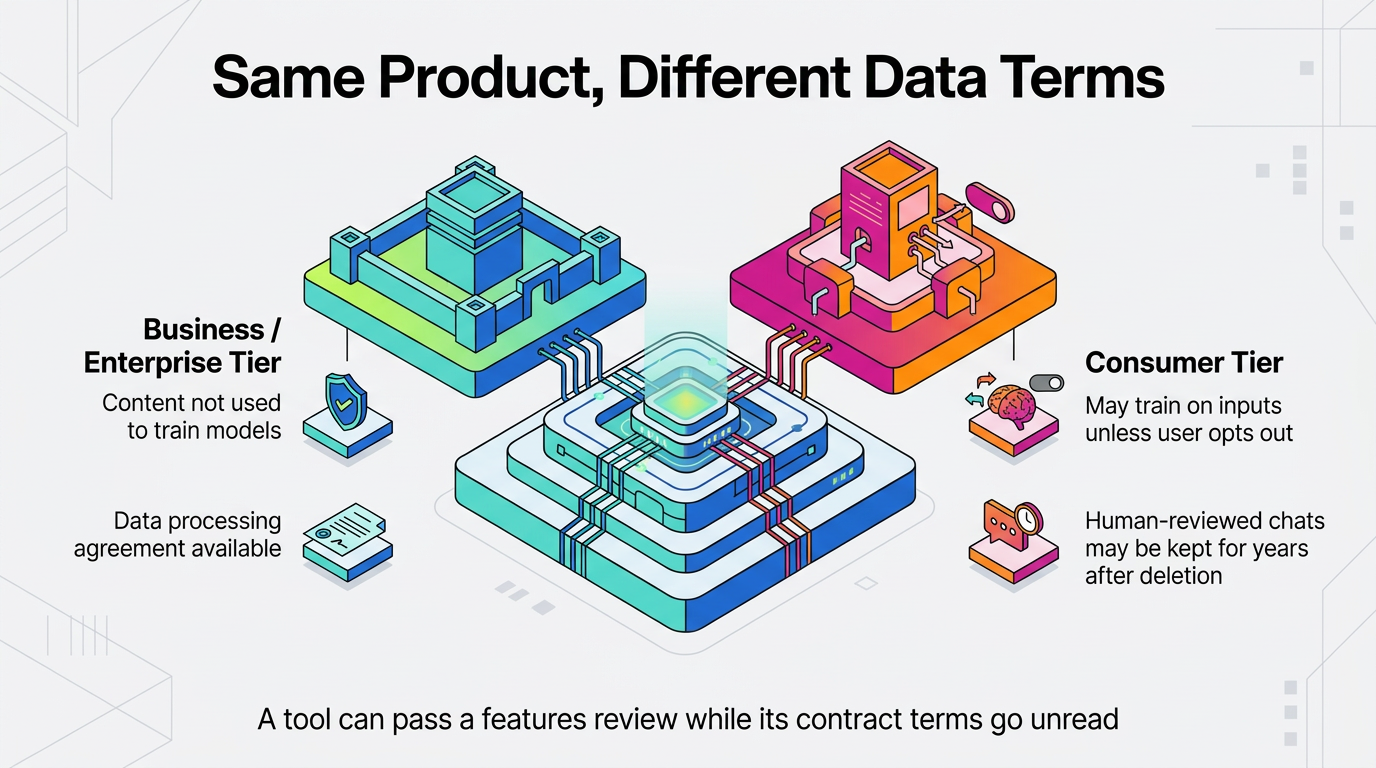
Terms also change after approval, which is why the review has to repeat. Procurement and legal should check retention, training on inputs, the subprocessor list and agreement availability before approval and again whenever terms change.
AI Features Switched On Inside Approved Apps
Shadow AI also appears inside software the organization already approved, where major productivity suites now pin an AI assistant in the navigation by default for eligible users and switch assistant access on by default for new business and enterprise tenants. Administrators can move a tenant off the default, but vendor documentation is not always clear that the assistant can be removed from the interface entirely.
None of this is malicious, and enterprise data protection terms usually apply, but each change still moves data without a new approval decision. Reviewing tenant-level AI settings in every sanctioned suite on a schedule, and watching for new features and changes to terms of service, keeps that decision with the organization.
Unsanctioned Agents and Integrations With Access to Company Data
Agents and integrations hold standing access, so connecting an AI assistant to a mailbox or drive grants an OAuth token that can keep reading data after the task ends, and nothing in that grant forces a second look when the assistant's reach later widens.
The joint guide Careful Adoption of Agentic AI Services, published on 1 May 2026 by CISA, NSA, ASD's ACSC and Five Eyes partners, recommends that organizations "clearly assign responsibility and accountability." Reviewing OAuth grants regularly, limiting scopes to least privilege, and requiring a named owner for each agent turn that recommendation into practice.
Inaccurate Output Used in Business Decisions
AI output carries risk when people act on it without checking, and NIST AI 600-1 calls this confabulation, meaning "confidently stated but erroneous or false content" that can mislead users. Courts have sanctioned lawyers for briefs built on citations that did not exist, and consultancies have refunded clients after delivering reports with invented references.
The OWASP Top 10 for LLM Applications, now in its 2026 edition, lists misinformation among its named risks. Requiring human review, with the reviewer recorded, is the control for high-stakes output such as legal text, financial figures, customer communications and production code.
Why Do Traditional Security Controls Miss Shadow AI?
Traditional controls often miss shadow AI because most use happens in browsers, under personal identities, over encrypted connections or inside already allowed software.
Browser-Based Tools: Chatbots run as web apps, which endpoint agents and installed-software allowlists may not register.
Personal Accounts: Accounts outside the corporate directory sit beyond organizational identity systems, network monitoring and security controls.
Encrypted SaaS Traffic: Prompts travel over TLS to popular domains, and reading them requires TLS inspection.
AI Embedded in Approved Software: An assistant built into a sanctioned suite runs on an already trusted domain, so URL filtering may not separate it from the suite.
These gaps compound the generative AI security risks facing sanctioned tools, and closing them means combining signals rather than adding one more control. AI vendor signup emails, OAuth consent grants, browser extension inventories, network logs and AI subscriptions on expense reports each show part of the picture. Abnormal's AI Governance is designed to pull that picture together by discovering approved and shadow AI tools and attributing ownership for each one.
How Do You Prioritize Shadow AI Risks?
Shadow AI risks rank highest where the most sensitive data meets the widest use. Teams can score each tool on data sensitivity, from public to regulated, and on breadth of use, measured by users or connected systems. Agents deserve extra weight because their access persists between sessions.
Scoring sets the order, and the risk-to-control mapping sets the work, because each risk has something specific at stake, a control that addresses it first, and a team that usually owns it:
Risk | What Is Exposed | First Control to Apply | Usual Owner |
|---|---|---|---|
Sensitive data in prompts and uploads | Customer personal data, source code, IP | Data rules for AI use plus DLP | Security with data owners |
Personal accounts and extensions | Chat content, page content, sessions | Enterprise accounts and extension allowlist | IT and endpoint team |
Compliance and privacy violations | Regulated personal, health and payment data | Data classification and prompt logging | Privacy, legal and compliance |
Vendor retention terms | Retained inputs, training data | Terms review before approval | Procurement and legal with security |
AI features in approved apps | Data inside sanctioned suites | Tenant setting reviews and change monitoring | SaaS administrators |
Unsanctioned agents and integrations | Mailboxes, drives, connected systems | OAuth review and least privilege | Identity team and named agent owner |
Inaccurate output | Decisions, filings, code | Human review for high-stakes output | Business process owners |
Where those functions already exist under different names, the owner matters more than the label, because an unowned row stays open.
How Do You Reduce Shadow AI Risk Without Blocking AI?
Approved alternatives and clear data rules tend to reduce shadow AI risk where bans do not, because bans leave the original need unmet. The NCSC states that restrictions "can mean employees turn to using AI tools that have not been approved." Each control shortens the distance between what an employee needs and a sanctioned way to get it:
Get Visibility: An inventory of every AI tool, extension, agent and OAuth grant, with its adopter and the data it touches, is the control the others depend on.
Offer Approved Tools: Enterprise accounts for tools employees already prefer provide a sanctioned option.
Set Data Rules for AI Use: The AI security policy states which data classes may enter which tools, enforced through the data loss prevention program.
Review Vendor Terms: Procurement and legal check retention, training defaults, subprocessors and agreement availability before approval and again when terms change.
Assign an Owner to Every Tool and Agent: The owner approves access, reviews permissions and retires credentials when the work ends.
Coach at the Moment of Use: A short prompt, triggered by a sensitive paste or an unapproved tool, points to the approved alternative.
Keep a Fast Approval Path: A published request route with a defined review time encourages people to ask first. The NCSC notes that staff otherwise adopt services before teams can assess them.
Progress shows up in inventory coverage, approval turnaround, and the share of AI use running through sanctioned accounts.
Shadow AI Risk Is Manageable When Every Tool Has an Owner
Shadow AI risks stay contained when security teams know which tools are in use, what data each may receive and who answers for each tool and agent. A named owner turns vendor reviews, tenant setting checks, and credential retirement into assigned tasks, including shutting down agents a departed employee left running.
Shadow AI stays unmanaged only while it stays invisible. Abnormal's AI Governance, part of the AI Security suite, is designed to discover the AI tools in use across an organization and attribute each one to an owner. Explore AI Governance to see what a first inventory turns up.
Frequently Asked Questions
Is using shadow AI against the law?
Using an unapproved AI tool is not illegal in itself, though legal exposure follows the data involved. Entering personal data into an unapproved tool can create GDPR breach duties, and sharing protected health information with a service that has no business associate agreement raises HIPAA questions, and contract and confidentiality obligations can also apply to customer data.
Can you block shadow AI completely?
Complete blocking is difficult to sustain, because employees can reach AI tools from personal devices and accounts, and AI features now ship inside approved suites by default. Visibility, approved alternatives, and clear data rules reduce risk more reliably than a blanket ban, which is the point the NCSC makes when it says restrictions can push staff toward unapproved tools.
What data is most at risk from shadow AI?
Customer personal data carries the most risk, along with health records, payment card data, source code, contracts and credentials. Regulated data deserves first priority because exposure can trigger notification duties and commercial harm, and those duties run on a clock the organization does not control.
How is shadow AI different from shadow IT?
Shadow IT is any unapproved software or service, and shadow AI is a subset with an added problem, because the data employees type or upload can be retained by the vendor and, on some consumer tiers, used to train models. Agents and integrations also keep standing access to company systems after the original task ends.
Who is responsible for managing shadow AI?
Responsibility is shared, which is why gaps open when no one function is named. Security usually leads visibility and controls, IT runs accounts and SaaS settings, legal and privacy review vendor terms and regulated data, and procurement manages contracts. Each approved tool and agent also needs a named owner who approves access, monitors use and retires credentials when the work ends.