Key Insights
The National Institute of Standards and Technology (NIST) says on its AI Risk Management Framework page that it is revising AI RMF 1.0 as part of the White House AI Action Plan. Until that revision lands, anyone adopting it works from the AI risk management framework as it stands.
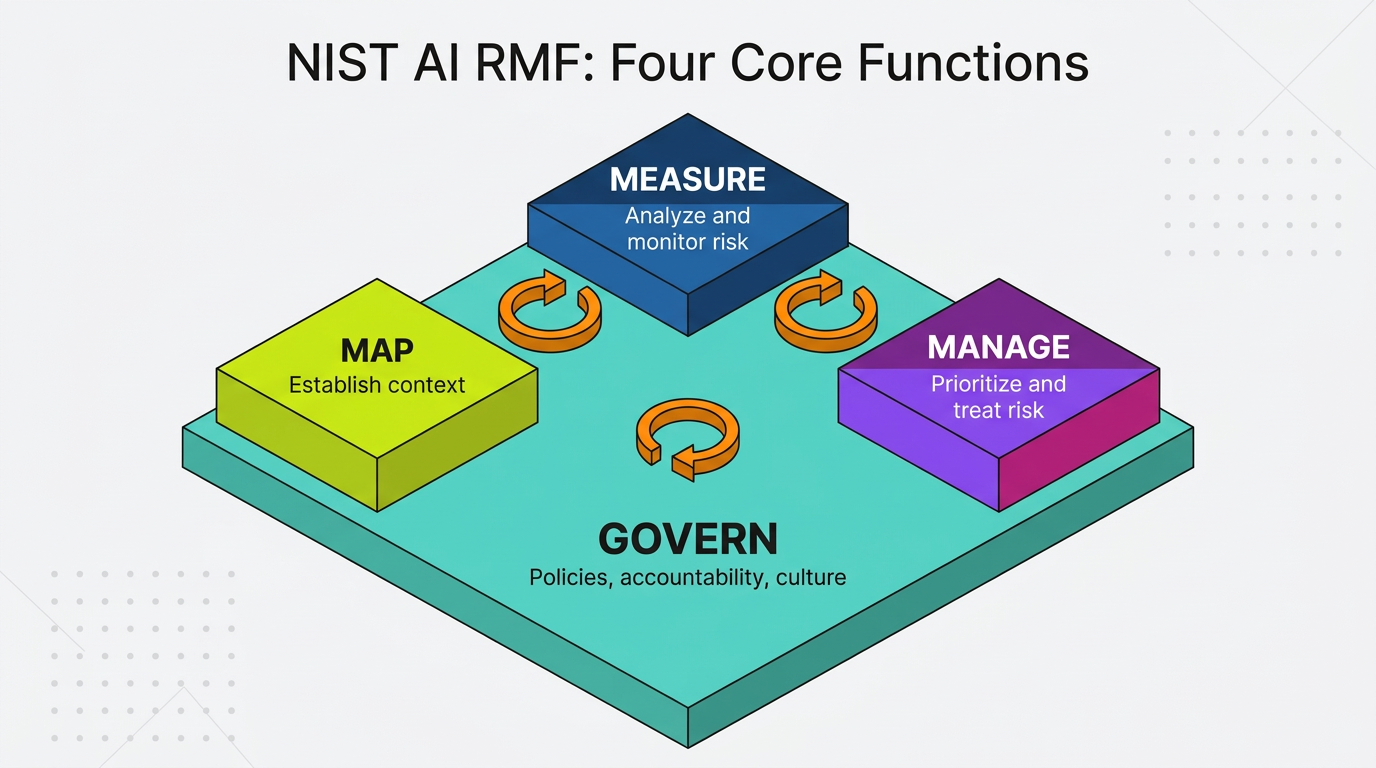
The AI RMF is voluntary guidance, and it sorts AI risk into Govern, Map, Measure and Manage. Govern sets policy and accountability, while Map establishes context. Measure tests and tracks risk, and Manage prioritizes and treats it.
This guide works through what each function asks in practice, the activities it covers, who typically owns it and the evidence it leaves behind. It compares the four side by side, then covers what the Generative AI Profile adds and how the framework sits against ISO/IEC 42001, the EU AI Act and NIST CSF 2.0.
What Is the NIST AI Risk Management Framework?
The NIST AI RMF is guidance for identifying and managing AI risk. NIST published it on January 26, 2023, after the National Artificial Intelligence Initiative Act of 2020 required it to build one.
NIST's framework document describes it as "voluntary, rights-preserving, non-sector-specific, and use-case agnostic", covering AI systems from planning and design through deployment, operation and monitoring. For teams already tracking NIST compliance requirements, it sits beside other NIST guidance as a reference model rather than a regulation.
The four functions exist to produce trustworthy AI, which NIST defines through characteristics that teams balance against each other for each use case. Those characteristics are validity and reliability, safety, security and resilience, accountability and transparency, explainability and interpretability, privacy enhancement, and fairness with harmful bias managed.
Validity and reliability sit beneath the rest as a necessary condition of trustworthiness, while accountability and transparency relate to all the others. NIST treats a system that is strong on one characteristic and weak on another as undesirable. A hardened model that is unreliable or unexplainable still fails the framework's test.
Who Should Use the NIST AI RMF?
Any organization that designs, develops, deploys or uses AI systems should use the NIST AI RMF, whatever its size or sector. That includes buyers of third-party AI, since a developer releasing a pre-trained model may see risk differently from the organization deploying it.
The AI RMF's value is a shared vocabulary across functions that must agree on AI risk. NIST also publishes crosswalks that map it to other standards, which is useful for teams already working within another security framework.
What Are the Four Core Functions of the NIST AI RMF?
The four core functions are Govern, Map, Measure and Manage. Govern applies to every stage of AI risk management, while Map, Measure and Manage attach to specific systems and repeat as conditions change. NIST says that once governance is in place, the functions can run in any order, though most users start with Map, and that the process should be iterative.
The Govern Function
Govern asks for the policies, accountability structures and culture that make the other functions work, which is why NIST calls governance a cross-cutting function infused throughout AI risk management. Its named outcomes give Govern a tolerance-based policy, a named decision-maker and an inventory.
Processes set the level of risk management activity according to the organization's risk tolerance, and executive leadership takes responsibility for decisions about development and deployment risk. In practice, an AI risk committee approves, conditionally approves or rejects each new use case against that documented tolerance, with a ceiling above which no system deploys.
The inventory outcome underpins both, because an AI tool adopted without approval never reaches the committee. Abnormal's AI Governance, which is generally available, can help close that gap by discovering approved and shadow AI tools and attributing each one to an owner.
The Map Function
Map establishes the context needed to judge a system's risk before anyone measures it. Teams document intended purposes, user types, applicable laws and deployment settings, and categorize the system by task, such as classifier or generative model.
Teams then map risks in third-party software, data and intellectual property, and rate the likelihood and magnitude of each impact. Without that record, the Measure team has no agreed scope to test against, and a narrowly defined task is far easier to map than a broad one.
The Measure Function
Measure applies quantitative, qualitative or mixed methods to analyze, benchmark and monitor the risks the Map identified. Teams select metrics starting with the most significant risks and document any risk they cannot measure.
Those teams then record the test sets, metrics and tools used in test, evaluation, verification and validation (TEVV) and monitor the system once it is in production. NIST also asks that the owning TEVV or model validation team sit apart from the developers whose work it checks.
NIST sets no numbers of its own, since the framework does not prescribe risk tolerance. Each team chooses its own methods instead, such as control limits, confidence intervals and alerts when production distributions drift from pre-deployment test outcomes. A TEVV team might pass a model only when its error rate stays at or below 2% on the validation set, then raise a drift alert once the weekly rate moves outside those limits.
The Manage Function
Manage prioritizes and treats the risks that Map and Measure surfaced, weighing impact, likelihood and available resources before choosing among mitigating, transferring, avoiding or accepting each one. Teams document the residual risk, keep mechanisms to supersede, disengage, or deactivate a system behaving outside its intended use, and maintain post-deployment monitoring plans covering user input, appeal and override, and incident response.
Each organization sets severity tiers based on its risk tolerance. An AI risk committee might define tiers based on who acts next.
The system owner logs a low-severity issue, the committee decides when risk exceeds documented tolerance, and executive leadership takes over when a system must be deactivated. That top tier gives the deactivation mechanism a defined trigger and carries the responsibility NIST assigns to executives under Govern.
How Do the Four Functions Compare?
Govern differs from the other three because it sets the rules for every AI system, while Map, Measure and Manage run on each system in turn, and each produces evidence the next one needs. Set side by side, they show where one team's output becomes the next team's input:
Function | Purpose | Example activities | Typical owner | Evidence produced |
Govern | Set policy, accountability and risk tolerance | Define roles, approve use cases, maintain the AI inventory | CISO or chief risk officer with AI risk committee | Risk policy, tolerance statement, approval records |
Map | Establish context and impacts | Document intended use, categorize the system, assess third-party components | System or product owner | Context document, impact assessment, component register |
Measure | Test and monitor risk | Select metrics, run TEVV, monitor for drift | Independent TEVV team | Test plans, model cards, alert logs |
Manage | Prioritize and treat risk | Choose responses, deactivate systems, run incident response | System owner and incident response team | Risk register, residual risk statements, incident log |
The owners listed are illustrative, since NIST assigns outcomes rather than job titles.
What Does the Generative AI Profile Add?
The Generative AI Profile, released in July 2024, applies the AI RMF to generative AI with a defined risk list and suggested actions tied to the four functions. It centers on 12 risks that generative AI creates or worsens, including chemical, biological, radiological, and nuclear (CBRN) information, confabulation, data privacy, harmful bias and homogenization, information integrity, information security, and value chain integration. NIST defines confabulation as confidently stated but erroneous or false content.
Each suggested action carries a function prefix and a subcategory number so it traces back to the function it serves. One of them suggests checking baseline benchmark performance before fine-tuning a model, tagged to information security and confabulation. That tagging connects the profile to AI security vulnerabilities that a Measure or Manage outcome already covers.
How Does the NIST AI RMF Relate to Other Standards?
The AI RMF is voluntary guidance that provides a method for managing AI risk. The certifiable ISO/IEC 42001 standard and the binding EU AI Act supply the formal requirements an auditor or regulator checks against.
ISO/IEC 42001 sets requirements for an AI management system that independent bodies audit and certify, which suits organizations that need a certificate to show customers or regulators. The EU AI Act is binding law whose obligations phase in over several years, while NIST CSF 2.0 sits alongside the AI RMF as the cybersecurity framework that added governance as a function of its own.
Using the AI RMF as a Shared Language for AI Risk
The AI RMF gives security teams a common set of terms, owners and evidence that every AI system can be held to. A CISO can report AI risk to the board in Govern and Manage terms while an engineer shows the matching drift alerts and impact ratings underneath. Teams building AI governance practices can attach each record to the outcome it satisfies, turning voluntary guidance into something an auditor can follow.
AI Governance, generally available in Abnormal's AI Security suite, is designed to track compliance and regulatory gaps across the AI tools already in use. Explore AI Governance to see how that tracking adds to the evidence an auditor follows.
Frequently Asked Questions
Is the NIST AI RMF mandatory or certifiable?
No, NIST describes the framework as voluntary and does not validate or endorse any organization's use of it. Organizations that want a formal certificate can look to ISO/IEC 42001, which independent bodies audit.
What does the NIST AI RMF Playbook contain?
The Playbook is a companion resource offering suggested actions, references and documentation prompts for each subcategory of the framework. It is not a checklist, and teams select the actions that suit their context rather than working through all of it. It sits alongside the framework rather than inside it, and using it is voluntary.
How long does it take to adopt the NIST AI RMF?
NIST sets no adoption timeline. Teams can select from the categories and subcategories or apply all of them, and the timeline depends on how many AI systems are in scope and which governance outcomes already exist. Organizations that already run an AI inventory and an approval process tend to move faster.
Does the NIST AI RMF cover generative AI?
Yes, AI RMF 1.0 is use-case agnostic and names generative models as a task type when categorizing a system. NIST's Generative AI Profile, released in July 2024, adds risks such as confabulation, data privacy and information security, plus suggested actions tagged to Govern, Map, Measure and Manage.