Key Insights
IBM researchers found in 2026 that only 40% of organizations use access controls on AI models and data. Access control is a long-settled expectation for most other systems these teams run.
An AI transformation strategy often stalls for organizational, not technical, reasons. Teams build it around use cases and platforms, then find that adoption has outrun their ability to see, own and control what is running
This guide maps what the strategy needs and where it breaks when oversight lags. It also explains why security belongs at the table early, how risk tiers move low-risk AI faster, and which metrics show a board that transformation is happening safely.
Why Is AI Transformation a Governance Problem?
AI transformation is a governance problem because adoption moves faster than oversight. The gaps that open concern visibility, ownership and enforcement more than model quality.
The pattern that tends to stall programs is unclear ownership, weak data foundations, and policies that exist on paper but aren't enforced where employees and agents act. NIST wrote the same principle into the AI Risk Management Framework 1.0, which it is now revising, calling GOVERN "a cross-cutting function that is infused throughout AI risk management and enables the other functions." In practical terms, that makes governance the layer underneath every other decision rather than a gate at the end, which is the starting point for any overview of AI governance.
How Do You Build an AI Transformation Strategy?
Building an AI transformation strategy means settling a sequence of decisions, each one closing a question the next would otherwise reopen. Leaders agree the objectives AI is meant to serve, pick priority use cases against them, establish data readiness for those cases, build the skills and platform to run them, decide how governance applies at each step, set the measures that show scale arriving with control, and only then move a proven pilot into production.
Every element carries a governance decision, and the decision is cheapest at the moment the element is settled:
Objectives and Success Criteria: The executive sponsor states what AI is meant to change and how the business will know it worked. Those criteria set the bar for every later use case.
Priority Use Cases: Leaders name a short list tied to business outcomes, and assign each one an accountable owner and a risk tier before funding it.
Data Readiness: Teams classify the data each use case will touch, and use its sensitivity to set review depth and which tools may receive it.
People and Skills: Training covers how to use AI tools well, what employees may enter into them and how to request a new tool.
Platform Choices: Selection criteria include how a platform authenticates users and agents, what it logs, and whether the vendor may train on customer data.
Governance and Security: An inventory, an ownership model, enforceable policy and an incident path support every other element.
Measures of Success: Value metrics sit beside risk metrics, so leaders can see whether scale is arriving with control.
Scaling Pilots into Production: A pilot moves to production when its owner, risk tier and controls are settled, not when the demonstration lands well.
When governance is held back to a final review gate, it becomes a blocker. Built into each element, most of its decisions are already made by the time a request lands.
What Breaks When Governance Lags Behind Adoption?
When governance lags, the failures cluster around tools nobody sees, agents nobody owns and features nobody approved, and each carries a security cost that grows with AI use. Regulators, standards bodies and vendors' own published changes point to the same patterns:
Shadow AI and Data Exposure: In The hidden risks of shadow AI, the UK NCSC warns that staff who move sensitive information into consumer AI services reduce the organization's visibility and control over that data, which the service may store, retain or use for its own improvement.
Agents with Live Credentials and No Owner: The joint CISA and ASD guide Careful Adoption of Agentic AI Services, published on 1 May 2026, describes privilege compromise, where an agent gains more access rights than its function needs, and recommends ephemeral credentials in place of long-lived secrets.
AI Switched On Inside Approved Products: Vendors add AI capabilities to software an organization has already approved, through product updates and changes to terms, without a new approval decision.
Audit Gaps: The EU AI Act requires high-risk systems to log events automatically and deployers to keep logs under their control for at least six months, unless applicable law provides otherwise. Annex III obligations now apply from 2 December 2027, and without an inventory, no one can say which systems those duties cover.
Duplicate Spend: AI subscriptions bought on corporate cards add up through duplicated capabilities and fragmented contracts, which is the core concern of AI spend management.
Most of these failures share a missing artifact, an inventory that names what is running and who answers for it.
Why Does Security Need a Seat in the AI Transformation Strategy?
Security belongs in the AI transformation strategy because it already runs the systems that show where AI operates and what it can reach. Identity providers record OAuth grants to new AI apps, email carries tool signups and vendor invoices, and data loss and SIEM pipelines show data flowing to AI services, so a governance program built without those feeds starts blind.
Bringing security in early also speeds approvals, because when security helps define risk tiers and pre-approved patterns at the outset, a team requesting a low-risk tool follows a known path instead of waiting for an improvised, case-by-case review.
NIST assigns AI risk decisions to executive leadership, and security leaders use telemetry to ground those decisions in deployed systems. Defining who signs off at each tier means setting AI governance roles and responsibilities, and that work is harder than it sounds because AI arrives through browsers, plugins and vendor updates rather than procurement, which is why existing governance models break.
What Does a Governance-First AI Transformation Strategy Look Like?
A governance-first AI transformation strategy builds its controls before scale arrives and keeps them light where risk is low, with each principle turning a policy statement into an operating control:
Visibility Before Scale: Before any program expands, the organization knows which AI tools, agents and embedded features are in use, who adopted them, and what data and permissions they hold. NIST makes this inventory an explicit outcome of its Govern function.
An Owner for Every Tool and Agent: A named person answers for each tool's and agent's permissions, renewals and retirement. Without it, NIST's decommissioning requirement has nobody to fall to.
Risk Tiers That Fast-Track Low-Risk Use: Review depth scales with data sensitivity, external exposure, autonomy and permissions.
Policy Enforced at the Point of Use: Security engineering enforces a written AI security policy through controls at signup, upload or credential grant, where they can warn the user, redirect to an approved alternative or block the action.
AI Incidents in Existing Incident Response: AI incidents belong in the existing cybersecurity incident response plan, with scenarios added for the ways AI systems fail, rather than in a separate plan nobody rehearses.
Evidence the Board Can Read: Governance teams compile inventory counts, tier assignments, exceptions and incidents into a short recurring report.
Visibility is the principle the rest depend on, because an owner, a tier and a control each need a named tool or agent to attach to. Abnormal's AI Governance is designed to discover approved and shadow AI tools, attribute ownership, and track compliance gaps.
Does Governance Slow AI Down?
Governance slows AI down when one heavy process applies to every request, and speeds adoption up when review effort scales with risk. The objection behind the question has real evidence, because blanket bans and long reviews push employees toward personal accounts, recreating the shadow AI exposure governance was meant to reduce.
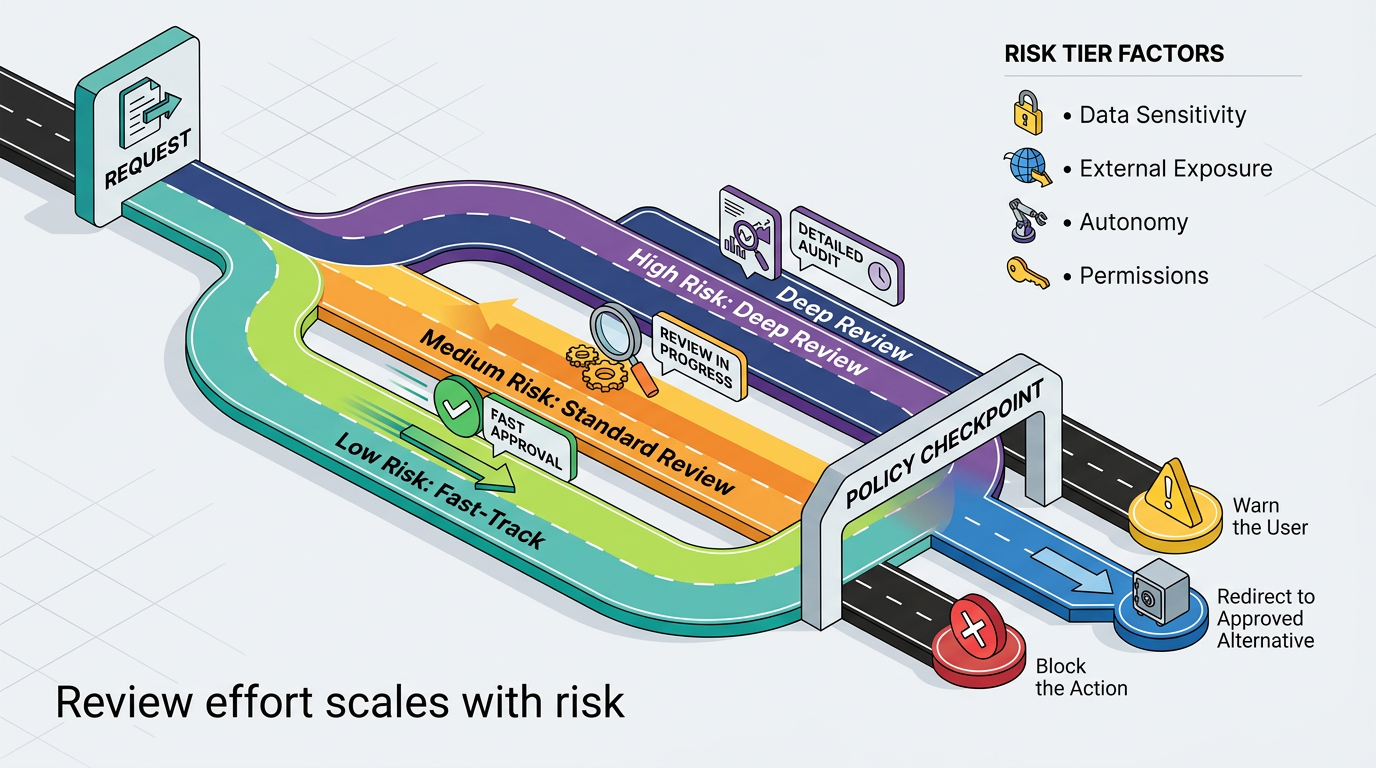
Risk tiers address the objection directly, and in a Harvard Law School Forum on Corporate Governance post on 14 September 2026, PwC's Dan Priest, Jenn Kosar and Barbara Berlin state that "A single governance process for every AI use case creates bottlenecks." Their suggested tier criteria are sensitive data use, external exposure, autonomous action, business impact and regulatory sensitivity, with a shorter review for lower-risk uses and deeper review, controls and escalation for higher-risk systems. Under that model, a drafting assistant with no access to customer data follows a pre-approved path, and an agent holding production credentials gets full review.
How Should Leaders Measure AI Transformation Safely?
Leaders can measure AI transformation safely by pairing each adoption metric with a risk metric, so growth and control appear in the same report. The Harvard Law School Forum guidance cited earlier lists adoption measures such as the percentage of priority use cases deployed and the percentage risk-tiered, and these risk measures belong beside them:
Approved Versus Unsanctioned Tools in Use: The ratio shows whether the approved catalog meets demand.
Time to Approve a New Tool: A falling approval time directly counters the claim that governance slows adoption.
Open Policy Exceptions: An AI inventory records the exceptions granted against policy, and their count and age show where practice has drifted from the rules.
AI Incidents: The Harvard guidance tracks significant incidents and exceptions escalated to senior leadership, and the share remediated within target timeframes.
A board reading both sets together can tell whether approvals are keeping up with demand or quietly falling behind it.
Governance Is What Lets AI Transformation Scale
The gaps that stall AI transformation are organizational rather than technical, showing up as tools nobody inventoried, agents nobody owns and policies nobody enforces at the moment of use, and each new tool widens them. Building visibility, ownership, tiered review and enforcement into each element of the strategy gives the business a faster path to approval and gives the board evidence it can trust. Security leaders who join early can make that case with telemetry they already collect.
Abnormal's AI Governance, part of the AI Security suite, is designed to attribute discovered AI tools to the teams using them, which is the ownership step most transformation strategies leave implicit. Explore AI Governance to see how ownership is attributed as your toolset grows.
Frequently Asked Questions
What is an AI transformation strategy?
An AI transformation strategy is the plan an organization uses to move AI from scattered pilots into core operations. It covers objectives, priority use cases, data readiness, skills, platform choices, governance and security, and measures of success, with governance running through every element to keep adoption from outpacing visibility and control.
Who should own AI governance during a transformation?
Executive leadership owns AI risk decisions, as the NIST AI Risk Management Framework states, while day-to-day responsibilities are shared. Business owners are accountable for their use cases, security provides visibility and enforcement, legal and privacy cover regulatory duties, and each tool and agent has one named accountable owner.
What should an AI risk tier be based on?
Tier criteria usually cover sensitive data use, external exposure, autonomous action, business impact and regulatory sensitivity, as PwC set out on the Harvard Law School Forum on Corporate Governance. A drafting assistant with no customer data sits in a low tier, while an agent holding production credentials sits in the highest.
How do you measure AI transformation risk?
Track risk metrics alongside adoption metrics, among them the ratio of approved to unsanctioned tools in use, the time it takes to approve a new tool, the number and age of open policy exceptions, AI incidents escalated to leadership, and the share of use cases assigned a risk tier.
When should security get involved in AI transformation?
Security should be involved from the start, when use cases, platforms and risk tiers are defined. Security already runs the identity, email, data loss and logging systems that show where AI operates. Joining early lets the team design approval paths before adoption spreads, instead of retrofitting controls onto tools already in use.