Key Insights
ACM Transactions on Software Engineering and Methodology published a 2025 study of security weaknesses in Copilot-generated code that found them in 29.5% of the AI-generated Python snippets it examined in GitHub projects. Code that passes every functional test can still carry those weaknesses, and closing that gap is the work of vibe coding security.
Vibe coding security covers what happens when someone builds software by prompting an AI model and shipping what it writes. The builder may never read the result.
This guide traces each risk back to the part of the workflow it enters through, from the code a model writes to the packages it names and the access an agent holds. It explains why commit-time scanning and pull request review miss work that never reaches a repository, then outlines the controls that reduce each risk and names who runs them.
What Is Vibe Coding, and Why Does It Create Security Risk?
Vibe coding is building software by describing goals in natural language and accepting AI-generated code with minimal review, which creates risk because the builder judges the result by whether it runs rather than by how it works. That leaves "it works" as the only acceptance test, and security flaws rarely break functionality.
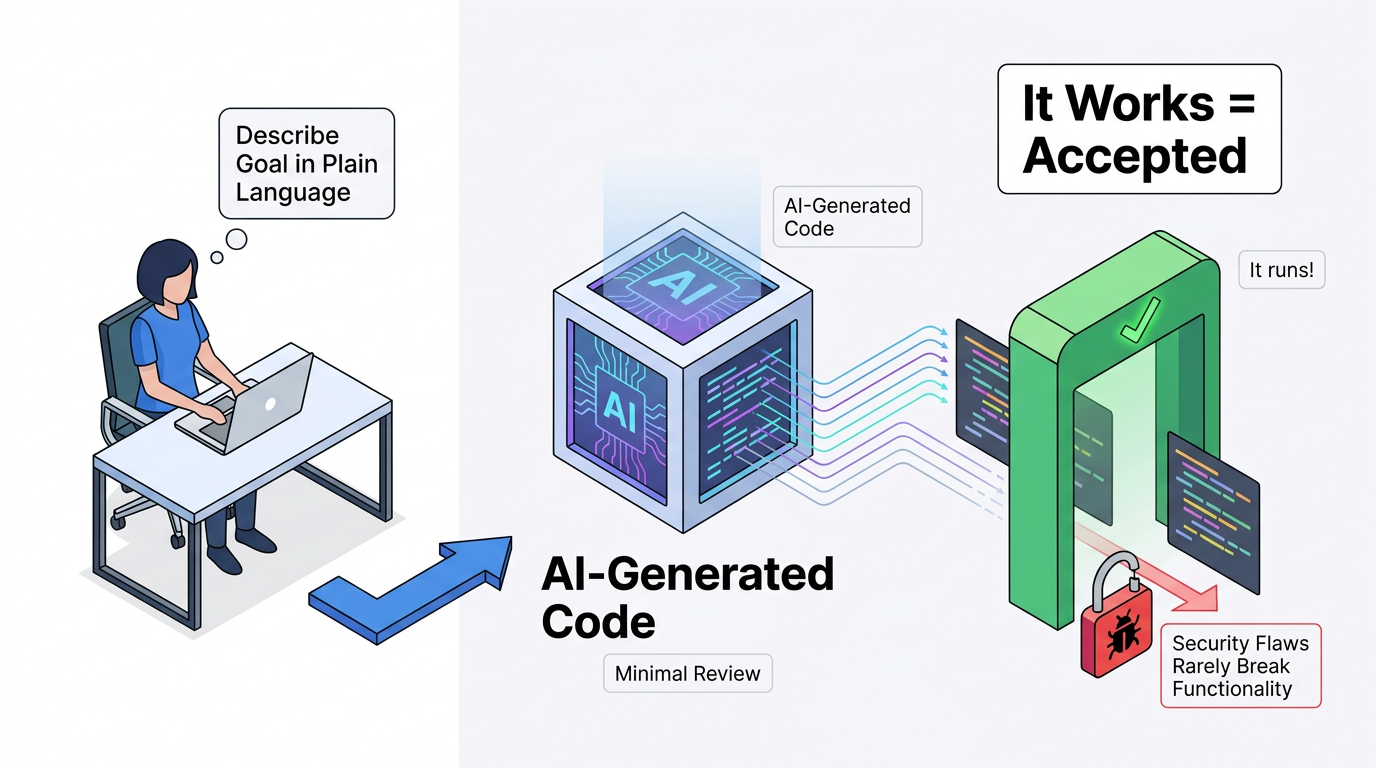
An API that returns every customer's records to any logged-in user still works, and a functional test confirming it returns records will pass. Many common AI security vulnerabilities stay hidden until someone tests adversarially.
What Are the Main Security Risks of Vibe Coding?
The main security risks of vibe coding are insecure generated code and hardcoded secrets, hallucinated dependencies, over-permissioned agents, apps deployed outside engineering review, and sensitive data pasted into prompts. The model provides code, packages and agent access, while hosting choices and pasted data come from the person prompting it.
Insecure Generated Code and Hardcoded Secrets
AI models reproduce insecure patterns from the public code they learned from, and the ACM study cited earlier found them across a wide spread of categories, including insufficiently random values, code injection and cross-site scripting (XSS). Weak authentication and access control tend to show up as defaults that look reasonable in a demo.
A builder might ask for an admin page restricted to the office network, and the model reads the client IP from the X-Forwarded-For header and checks it against an allowlist. A client can set that header to any value, so unless a trusted proxy overwrites it, a request with an internal address passes the check. That is a textbook authentication bypass by spoofing.
The same inattention puts secrets into the code. Generated code often writes API keys, database passwords and tokens directly into source files, client-side configuration and front-end bundles.
Sometimes the model learned the habit from public repositories that committed secrets, and sometimes a user pasted a key into the chat to get an integration working. A key inside a client-side bundle is served to every visitor, and a builder who never reads the code has no reason to rotate it.
Unvetted or Hallucinated Dependencies
AI models sometimes recommend packages that do not exist, and attackers can register those names. A USENIX Security 2025 paper that generated 576,000 code samples found open-source models hallucinated packages at an average of 21.7%, far above the rate for commercial models, turning up 205,474 unique hallucinated package names. Many fake names recurred when the same prompts were repeated.
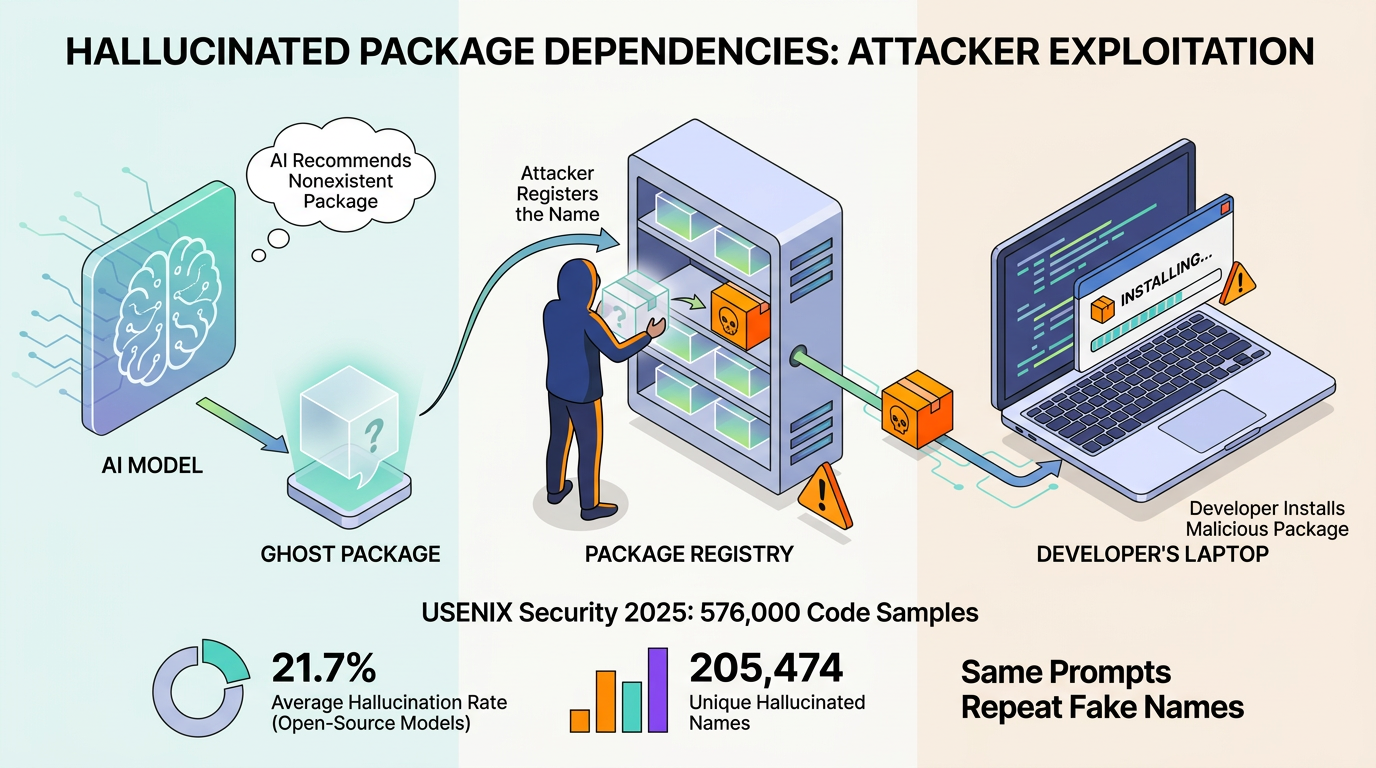
Registering a hallucinated package name with malicious code is known as slopsquatting. The exposure survives either way, since a builder who installs whatever the assistant names has no step where a fake or days-old package gets questioned.
Over-Permissioned Coding Agents and MCP Servers
Coding agents often run with the filesystem, shell and credential access of the person who launched them, so a manipulated agent acts with that person's reach. They read repository files, documentation, issues and tool descriptions, any of which can carry prompt injection attacks such as instructions hidden in a rules file or a README. Model Context Protocol (MCP) servers add tool poisoning, in which malicious instructions sit in a tool's description, parameter schema or return values.
The damage depends on what the agent can reach, and an agent with an unscoped cloud token and unrestricted egress can delete data or exfiltrate secrets. An agent holding more access than its task needs is a case of excessive agency in AI, and for a platform team its permission set defines the blast radius of a successful injection.
Apps Built and Deployed Outside Engineering Review
Vibe coding lets employees with no engineering background ship internal tools that have no owner of record, no inventory entry and no pipeline. An operations analyst might build a scheduling app over a weekend, connect it to a shared database and share the link, all without code review.
An app with no owner of record decays quietly and acts under the wrong name. Builders forget the apps they create, leaving a growing pile of stale tools that may still expose business data. Because those apps usually run under the creator's identity, monitoring also attributes their actions to that person rather than to the app.
A November 2026 workshop report from NIST lists vibe-coded applications alongside shadow AI tools and shadow MCP servers among the ungoverned AI systems organizations need to account for. When the builder changes roles, the app keeps running, and nobody is assigned to patch it.
Sensitive Data Pasted into Prompts
Building and debugging with AI often means pasting real data into a conversation, and that data leaves organizational control when the tool is unapproved. A developer might paste proprietary source code in to find a bug, upload a spreadsheet of customer records to clean it, or paste a credential to get an integration working. Each is a reasonable attempt to finish a task, yet all three leave the organization's control once submitted.
Vibe coding adds pressure here, since a generated app needs test data, connection strings and keys before it will run. Pasted prompts are a direct route to the sensitive information disclosure risks that large language model applications carry.
Why Do Traditional Application Security Controls Miss Vibe Coding?
Traditional application security controls miss vibe coding because they check code once it reaches a repository and pipeline, while much of vibe coding happens before that point or never gets there. Each gap opens somewhere the pipeline never looks:
Scanning Happens After the Fact: Continuous integration scanning checks code at commit or build time, by which point a hallucinated package may already be installed on a laptop and an agent may already have run commands in the editor.
Volume Outpaces Review: AI tools produce code faster than people can read it, and changes spanning many files go unreviewed.
Non-Engineers Sit Outside the Pipeline: An app a finance employee builds on a no-code platform may never reach a repository a scanner can see.
Neither Builders Nor Scanners Judge the Logic: In a CCS 2023 user study, participants with an AI assistant wrote less secure code than those without one and were more likely to believe it was secure. Static and dynamic testing tools were never designed to judge whether an access rule makes sense.
What connects the four is visibility. Application security posture management can show security teams what is deployed, but it covers only the apps someone has registered.
How Do You Reduce Vibe Coding Security Risk?
Security, engineering and platform teams can reduce vibe coding security risk by placing a check where AI-built code, data or credentials enter the business. Each control sits at one of those entry points, and each names the team that runs it:
Approve Tools and Configure Them Securely: Platform teams set approved AI coding tools to use sandboxed shell commands, egress allowlists, deny rules for destructive commands, and managed settings that block modes skipping approval prompts.
Find and Inventory Employee-Built Apps: Platform teams surface what is already running by working from the AI coding and hosting tools employees use. An intake form records the owner, purpose, data and credentials for new apps, and recertification retires those whose owner has left.
Set Data Rules for Prompts: Security states which data classes may go into which tools, barring customer records, credentials and regulated data from consumer AI services and requiring synthetic test data.
Gate Generated Code Through Engineering: Engineering runs secret scanning in the editor and in pre-commit hooks and verifies that each package exists and matches the intended name. Any app that holds user or customer data also gets a named reviewer and an access control check.
Scope Agent and MCP Permissions to Least Privilege: Platform teams run agents in containers limited to the project directory, with short-lived, task-scoped tokens and a restricted set of MCP servers an agent may connect to.
Each control needs a team to run it, and prompt data rules hold only where they are enforced at the moment an employee sends data to an AI tool. Abnormal's AI Employee Guardrails, currently in private preview, apply that enforcement point to employee use of AI tools, guiding or blocking risky actions under policy.
Matching Each Vibe Coding Risk to the Team That Owns It
Vibe coding lets more people build useful software, and a ban risks pushing that work onto personal accounts and tools that security cannot see. Insecure patterns, exposed keys, fake packages and over-scoped agents each have a matching control, and the teams that run those controls already exist.
AI Employee Guardrails, part of Abnormal's AI Security suite and currently in private preview, is designed to log employee use of AI tools and act on it under policy, keeping that work visible without a ban. Explore AI Employee Guardrails to see how prompt data rules can hold while employees keep building with AI.
Frequently Asked Questions
Is vibe coding safe for production code?
Yes, vibe-coded software can run safely in production when it passes the same gates as any other code. Those gates are review by someone who understands it, secret and dependency scanning, and access control testing. Functional tests confirm that an app works, but they do not confirm that it resists attack.
Can non-developers vibe code securely?
Non-developers can build useful internal tools at lower risk when the organization supplies what they lack. That means approved tools with secure defaults, synthetic test data, and an intake form recording the owner and the data involved. An engineering review should follow before the app touches production data or is shared beyond its builder.
How should teams review AI-generated code?
Code reviewers can treat AI-generated code as untrusted input from a fast but inexperienced contributor. Review should prioritize authentication and authorization logic, security decisions based on request headers, hardcoded secrets and every new dependency. Scanners help, but logic and access control flaws usually need a human who knows what the app should allow.