Key Insights
IBM's 2026 Cost of a Data Breach Report puts the global average breach cost of an AI model inversion attack at $6 million. IBM ties that figure to the difficulty of protecting training data and sensitive information. An AI system spreads that data far beyond its original record, into the territory of AI data governance.
AI data governance is the set of controls that determines which data may enter an AI system, which people and agents may access it, and how long copies survive. AI governance asks whether a use case should exist, while AI data governance asks what that approved use case may read, store and return.
This guide sets AI data governance apart from AI governance and traditional data governance, then follows data through every copy an AI system makes. It sets out the controls at each boundary, from classification and agent identity to retention and audit logging.
What Is AI Data Governance?
AI data governance is the discipline of classifying, permitting, monitoring and expiring data wherever it enters or leaves an AI model, agent or application. It extends ordinary data security with rules written for the way AI handles data.
A traditional application stores a record in one place under one access list. An AI system copies it into prompts, retrieval indexes, embeddings, outputs and logs, and each copy can outlive the controls on the original.
Once a model has indexed a document, its file-share permissions no longer govern who can read its contents. The National Institute of Standards and Technology (NIST) frames the related risks in NIST's Generative AI Profile as data privacy, information security, and value chain and component integration.
How Does AI Data Governance Differ From AI Governance?
AI data governance controls the data an AI system touches, while the broader AI governance program decides whether and how the organization uses AI. Traditional data governance sits alongside both, managing data quality and ownership whether or not AI is involved. The three differ most in who owns them and which question each one answers:
Dimension | AI data governance | AI governance | Traditional data governance |
Focus | Data entering, moving through and leaving AI systems | Whether and how the organization uses AI | Data quality, ownership and lifecycle |
Scope | Training data, prompts, retrieved content, outputs, embeddings, logs | Purpose, models, vendors, people and outcomes across the AI lifecycle | Records in databases, warehouses and business applications |
Typical owner | Shared across security, data owners and privacy | Privacy, legal and compliance, or a dedicated AI governance function | Chief data officer and data stewards |
Key controls | Approved-data lists, agent identity, retrieval permissions, prompt and output logging, vendor terms | Use-case approval, risk assessment, model evaluation, human oversight | Cataloging, quality rules, lineage, retention schedules, access reviews |
Example question | Can this agent retrieve HR files when a user asks about payroll? | Should we use a model to screen job applicants? | Who owns the customer table, and how long do we keep it? |
AI governance approves a use case, traditional data governance names the data owner, and AI data governance decides what the approved system may read and return.
What Data Does AI Data Governance Cover?
AI data governance covers every copy an AI system makes, and each copy leaves by a different route:
Training and Fine-Tuning Data: Records used to build or adapt a model. A model trained on personal data cannot safely be treated as anonymous, since that data may be extractable through queries.
Prompts and Uploaded Files: Questions, pasted text and attachments sent to a model, which, once in an unapproved tool, fall under the vendor's retention and training terms rather than the organization's controls.
Retrieved Content: Documents a retrieval-augmented generation (RAG) system pulls from internal sources at runtime, governed by the retrieval permissions security teams set.
Outputs: Generated text, code, images or actions, which can reproduce memorized or retrieved personal data and warrant monitoring for personally identifiable information (PII).
Embeddings and Vector Stores: Numerical representations of text kept for search. Embeddings can be inverted to recover much of the original text, and a vector store warrants the same classification as the documents it was built from.
Logs and Backups: Records of prompts, retrievals, outputs and tool calls that support investigations and also serve as a second store of sensitive data.
Most of these types are unstructured, and governing unstructured data is harder because documents and chat text lack fixed fields.
Which Controls Does AI Data Governance Need?
Classification governs data before it enters an AI system, while access control and content vetting apply as it moves through prompts, retrieval and agents. Retention and vendor terms govern where data rests or leaves, and logging spans every boundary.
Classification and Approved Data for AI Use
Data teams classify and approve data for AI use before any model, connector, or index reaches it, labeling personal data, regulated records and intellectual property. They then publish an approved-data list naming which sources an assistant may index, which a fine-tuning job may use, and which stay out.
Data security posture management tools can supply the discovery and labeling layer, and NIST adds that inventories should document data provenance and any special rights attached to the data. The list then doubles as the allowlist a security architect applies to every connector. No new source reaches an AI system until someone classifies it and records where it came from.
Access Control for Models, Agents and Vector Stores
Access control for AI decides which identity each model, agent or index uses to reach data and how much it can do. Permission inheritance creates exposure, since a copilot or agent acting through a signed-in user's session can use that user's access. Giving each agent its own identity with task-scoped, time-bound permissions keeps it from borrowing a person's full reach.
Vector stores need permission-aware retrieval and partitioning, so one group's embeddings don't appear in another group's queries. An agent with its own identity also changes what a security operations center (SOC) analyst sees, because the alert becomes attributable to that agent rather than to the employee whose session it borrowed.
Protection Against Poisoned or Injected Content
Poisoning and injection both turn data into an attack path, one at training time and the other at retrieval time. Data poisoning manipulates pre-training, fine-tuning or embedding data to plant vulnerabilities, backdoors or biases, while indirect prompt injection hides instructions in content a model later reads, and neither has a single dependable fix.
The Cybersecurity and Infrastructure Security Agency (CISA) and partner agencies published joint guidance on AI data security in May 2025, treating the data supply chain and maliciously modified data as two of its three risk areas. The guidance recommends reliable sourcing, provenance tracking and digital signatures to authenticate trusted revisions. Segregating untrusted external content and accepting knowledge-base data only from verified sources narrows both routes, with every RAG connector declaring its trusted sources before ingestion begins.
Retention and Deletion
Retention rules for AI must name every copy, because deleting a source document rarely deletes the prompts, embeddings or log entries derived from it. A policy sets separate periods for prompts, outputs, embeddings, logs and backups, and NIST lists retention requirements and data leakage after decommissioning among the factors to weigh when retiring a generative AI system.
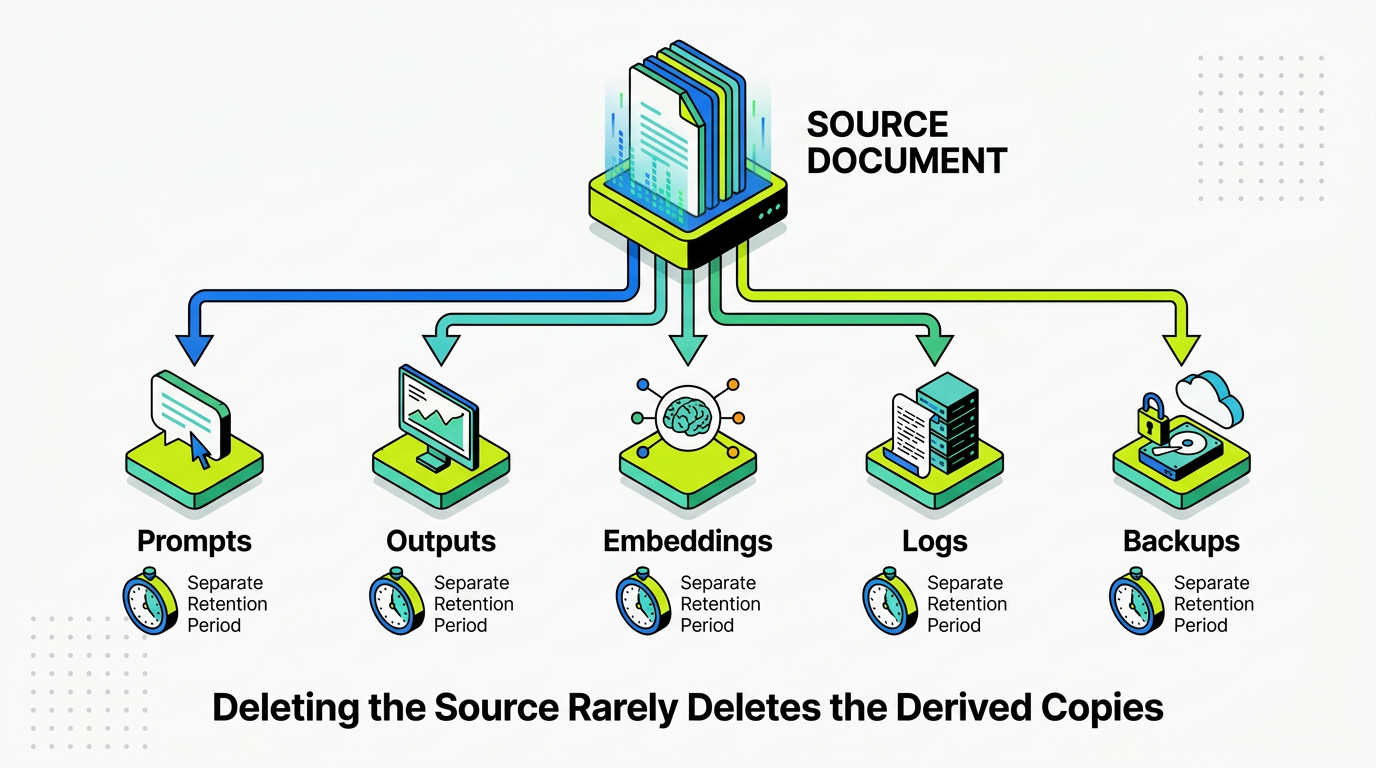
Downstream deletion is harder, since erasing a record from a training dataset resembles deletion from any large dataset, while erasing it from a trained model does not. Excluding personal data from fine-tuning, or retraining on cleaned data, reduces the problem.
Vendor Terms for Data Sent to Third-Party Models
Vendor terms decide what a third-party model provider may do with data once it leaves the organization. A review settles each of these before data leaves, because afterward the provider's terms are the only ones that apply:
Training Use and Retention: Whether inputs train the provider's models, how to opt out, and how long prompts and outputs are kept.
Processing Location and Subprocessors: Where the data is processed and which third parties handle it on the provider's behalf.
Contract Changes: What notice the provider gives before changing its data processing agreement (DPA).
Terms also change, and a quiet revision that lets a provider train on submitted data alters every approved tool at once. Periodic re-review catches those changes, but only for tools the organization knows it is using. Abnormal's AI Governance, which is generally available, can help complete that list by discovering shadow AI tools alongside approved ones.
Logging and Audit
Audit logs for AI should let an investigator trace any answer from the identity that asked back to the document that produced it. Each entry needs to connect the requester, the evidence and the result:
Identity and Prompt: The human or agent that made the request, and the text submitted.
Sources and Output: The documents retrieved, their versions, and what the system returned.
Actions and Policy Decision: Any tool call taken and the rule applied.
Retrieval activity belongs in detailed, immutable logs. For high-risk systems, the EU AI Act requires automatic recording of events over the system's lifetime, with providers and deployers keeping those logs for at least six months. Because logs hold prompts, they inherit the classification of their most sensitive contents and need the same access controls as any other store of sensitive data.
Which Regulations Shape AI Data Governance?
The General Data Protection Regulation (GDPR) governs personal data in any AI system, and the EU AI Act governs high-risk systems. Under the GDPR's core data principles in Articles 5, 6 and 17, a team needs a lawful basis for each use, must limit data to what the purpose requires, keep it no longer than necessary and honor erasure requests.
EU AI Act Article 10 requires data governance practices that cover design choices, data origin, preparation and bias examination, and data sets that are relevant, sufficiently representative and, to the best extent possible, free of errors and complete. Those obligations apply to high-risk systems, and each maps onto a control an AI data governance program already runs.
Governing Data at Every Point It Enters or Leaves AI
AI data governance works when each data boundary has a named owner and a control that produces evidence. Security usually owns agent identities, access policies and logging, data teams own classification and the approved-data list, and legal and privacy own lawful basis, vendor terms and retention. A written responsibility matrix assigns each data type to a team and names the evidence it must produce.
Abnormal's AI Employee Guardrails, currently in private preview as part of the AI Security suite, is designed to apply data policies at the moment data reaches an AI tool and log each decision for audit. Explore AI Employee Guardrails to see how a data boundary can produce its own evidence.
Frequently Asked Questions
What happens when no team owns a data boundary?
No control applies at that boundary, and no team can show what happened to the data. A retention setting can stay at the vendor default, an agent can keep acting through a borrowed user session, and embeddings can outlive the deleted source file. When an auditor or a data subject asks where the data went, no team holds the record.
Can companies use customer data to train AI models?
Sometimes, depending on the lawful basis and the promises made when the data was collected. Under GDPR, legitimate interest can support AI training when a documented three-part test is passed. Changing terms after the fact to permit training carries its own legal risk.
How do you stop sensitive data going into AI tools?
Teams stop sensitive data reaching AI tools by classifying it, publishing a list of approved AI tools, filtering prompts and uploads for personal or regulated data, and turning off vendor settings that use inputs for training. Enterprise accounts configured to prevent inputs from being used for training close the vendor side, and discovering shadow AI use covers the remaining tools.