Key Insights
IBM's 2026 Cost of a Data Breach findings show that 92% of organizations reporting an AI-related breach lacked proper AI access controls. Agents are where that gap gets expensive, because they act on credentials the organization issued.
AI agent governance settles who owns an agent, what it may touch and which of its actions need human sign-off, before the agent runs. Ownership rules, permission policies and approval controls are what hold those decisions in place, and the limits they set are enforced outside the agent itself.
Agents now send email, update records and call third-party APIs, and those actions need the discipline applied to any account with real access, adjusted for software that chains tools without pausing. This guide sets out an accountability model, the core policies, approval tiers with target turnaround times, lifecycle controls and the standards behind them.
What Is AI Agent Governance?
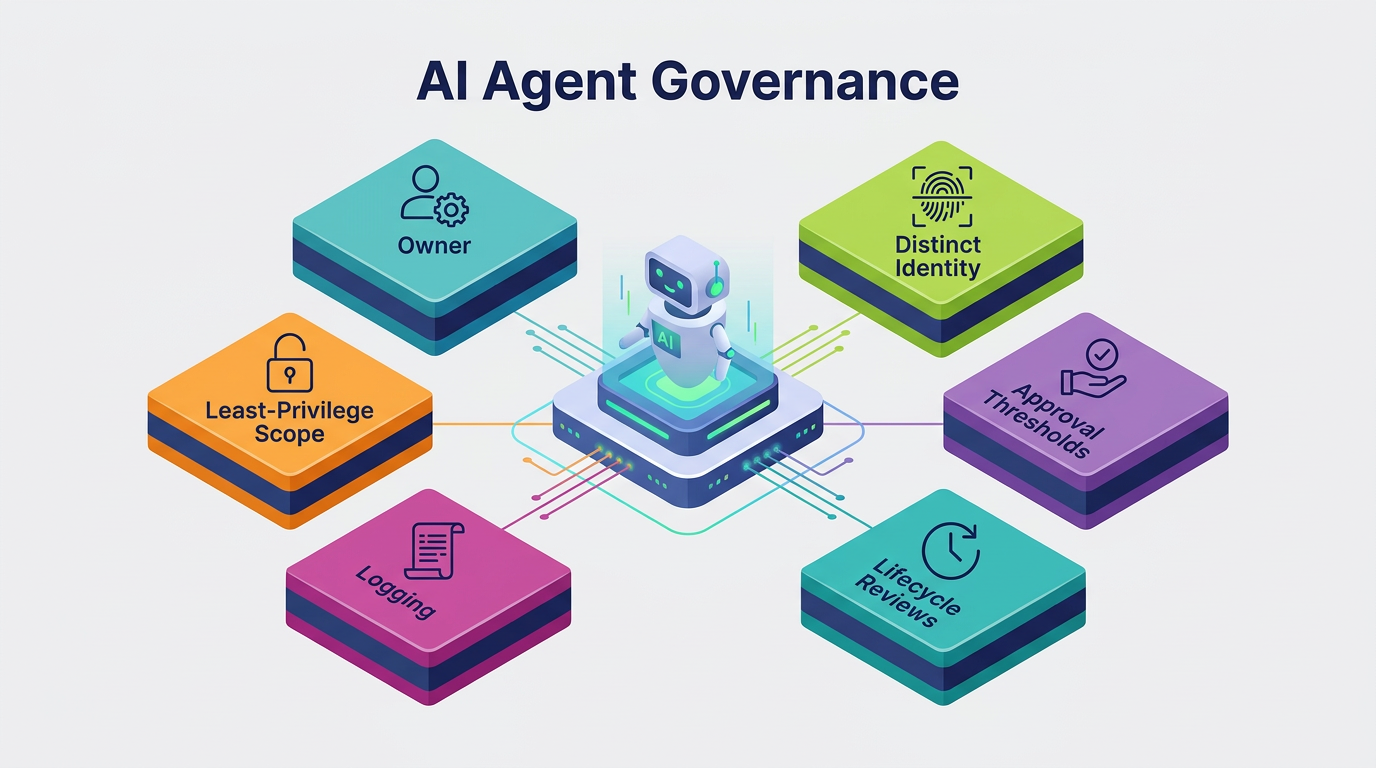
AI agent governance gives every autonomous agent an owner, a distinct identity, a least-privilege scope, approval thresholds for consequential actions, logging requirements and scheduled lifecycle reviews. Broader AI governance programs ask whether a system's outputs are accurate, fair and safe to show people. Agent governance inherits those questions and adds one more, which is what the system is allowed to do.
An agent that drafts a reply creates a review problem. An agent that sends the reply, updates a CRM record and files a ticket creates an authorization problem, because each action runs on credentials and touches a live system. Once a system acts rather than answers, the controls that matter shift toward identity, permissions and approval.
Why Do AI Agents Need Their Own Governance Model?
AI agents need their own model because they hold credentials, chain tools and act without a reviewer watching every step, and model governance was not built for that combination. One agent may carry an OAuth grant to a mailbox, an API key for a billing system and a service account in a data warehouse, and one misread instruction can travel across all three before a person sees the result.
OWASP calls this pattern the excessive agency risk and traces it to excessive functionality, excessive permissions and excessive autonomy.
Delegation also blurs accountability, because the employee who requested the agent, the developer who built it and the team that granted its credentials can each assume someone else owns the outcome.
Who Is Accountable for an AI Agent?
A named business owner is accountable for each agent, and delegating work to an agent never transfers that accountability to the software or to its builder. NIST expects roles and lines of communication for AI risk to be documented and clear, and for responsibility for deactivating a misbehaving system to be assigned before it is needed.
Accountability only holds when each decision has one owner, and the responsibility matrix splits the roles across the decisions an agent generates, using A for accountable, R for responsible, C for consulted and I for informed:
Decision | Business owner | Agent developer | Security team | Identity team |
Approve deployment | A | R | C | C |
Set permissions | A | C | C | R |
Review access | A | I | C | R |
Approve scope changes | A | R | C | C |
Respond to incidents | C | C | A/R | R |
Retire the agent | A | C | I | R |
The security team has override authority and can suspend an agent or revoke its credentials during an incident without waiting for sign-off. The business owner is informed immediately and decides whether the agent returns to service.
What Policies Should Govern AI Agents?
Written policy gives every agent the same baseline, from the record that registers it to the plan that retires it, and a policy set for agents can cover these controls:
Registration Before Deployment: No agent reaches production until it has an inventory entry naming its owner, purpose, credentials, tools and risk tier, which is the inventory outcome NIST's Govern function asks for. Registration also has to reach AI tools and agents employees adopt on their own.
Least-Privilege Permissions: Each agent runs on its own identity with permissions scoped to its task, never a shared account or a human's credentials, a model covered in agentic identity security practices. OWASP adds that authorization should live in downstream systems rather than in the model's judgment.
Data Access Boundaries: The policy names which data classes an agent may read, which it may write and which it may never touch, such as regulated records unrelated to its task.
Human Approval for High-Impact Actions: Actions are tiered by impact, and the tier decides when a person must approve. CISA's agentic guidance says that the decision belongs to system designers or operators, never to the agent.
Logging Requirements: Every tool call, permission change and approval is recorded in human-readable form tied to the agent's identity, and any request to delete logs waits for review.
Retirement Rules: Every agent carries an end condition, such as project completion or the departure of its owner, plus a revocation checklist written before launch.
Each policy should name the role that enforces it and the system where its evidence lives, which gives auditors something concrete to test.
Which Agent Actions Need Human Approval?
Actions that write to systems of record, reach outside the organization or cannot be undone need human approval, while reads inside an approved scope can run on their own. CISA's joint agentic AI guidance recommends starting with low-risk, non-sensitive use cases.
Teams can classify agent actions by impact, likelihood and reversibility, and the targets that follow are starting points each team can tune against its own queue data:
Read: The agent queries data inside its scope without approval, and the business owner reviews samples after the fact.
Write: Reversible changes to internal systems run under pre-approved patterns. Anything outside a pattern goes to the business owner or a delegate in a batch, with a target of four business hours.
External: Sending email, calling a third-party API or sharing a file outside the organization needs real-time approval from the business owner, with a target of 15 minutes during business hours.
Irreversible: Deleting records, moving money or changing permissions needs the business owner plus the security team, with a target of 30 minutes and a default of deny if the window expires.
The tiers rest on a distinction OWASP draws. Human-in-the-loop oversight requires explicit human approval before an agent executes a sensitive action, while human-on-the-loop oversight lets the agent act with a person watching who can intervene, which suits reads and routine writes.
An action should escalate one tier when it falls outside the agent's usual pattern, reaches a new destination or follows instructions pulled from external content.
How Do You Enforce Agent Governance Across the Lifecycle?
Enforcement holds when controls attach to each stage of an agent's life. Before deployment, the controls are review, registration and a scoped identity. In operation, they are permission reviews, a formal path for scope changes and logs that reconstruct each action. At retirement, they are revocation and record-keeping. The owner stays the same throughout, connecting the stages to one accountable person.
Review and Register an Agent Before Deployment
An agent should pass review, registration and testing before it touches production data. The identity team issues a unique identity and credentials scoped to its inventory record. Shared API keys break the link between an action and the agent that took it, so responders cannot tell which agent acted.
Registration only covers the agents someone remembered to register. Abnormal's AI Governance is designed to close that gap by discovering approved and shadow AI tools and attributing ownership to each one.
Stress-testing follows. The developer and security team run the agent against risks in the OWASP Top 10 for Agentic Applications, especially goal hijacking through injected instructions and misuse of its own tools. They then confirm that approval gates block actions rather than display warnings. Starting on low-risk, non-sensitive use cases gives the owner real performance evidence before the agent's scope grows.
Review Permissions and Scope Changes in Operation
Running agents need scheduled permission reviews, a formal path for scope changes and logs that reconstruct each action. NIST leaves review frequency to the organization, and a quarterly minimum for service account reviews is the common baseline.
Between reviews, any request to add a tool, data source or permission counts as a scope change. It returns to the business owner for approval and to the identity team for provisioning, which stops permission drift from building up one exception at a time.
Logs should capture each tool call, its inputs and its result, linked to the agent's identity and the approval that authorized it. That record gives AI agent security practices something to detect.
Revoke Credentials and Keep the Record at Retirement
At retirement, the identity team removes every path an agent could use to act and keeps the record of what it did. The team works through each type, revoking OAuth access and refresh tokens at the authorization server, deleting API keys, removing service account keys and withdrawing tool grants.
Disabling the identity instead of deleting it preserves the audit trail, the same practice applied to departing employees' accounts. Log retention follows the strictest applicable rule: at least six months for providers of high-risk systems under the EU AI Act, and longer where payment card or sector rules apply. Conversation history and persistent agent memory also need an explicit disposition decision.
Which Standards Apply to Agent Governance?
NIST AI RMF, ISO/IEC 42001, and the EU AI Act cover most agent governance controls, although none was written only for agents.
NIST AI RMF 1.0 covers the governance side, asking for documented roles, defined human oversight of AI, an inventory, a decommissioning process and named authority to deactivate a system. Its companion profile for generative AI adds deactivation protocols and removal of user access.
ISO/IEC 42001:2023 covers the management side, setting requirements for a certifiable AI management system with defined AI roles and responsibilities, impact assessments and lifecycle controls.
OWASP covers the threat side, and its 2026 agentic list names identity and privilege abuse, tool misuse and exploitation, and exploitation of the trust people place in agents, each detailed in this breakdown of the OWASP agentic Top 10.
None of the three assigns an owner to a given agent, which remains an internal decision every control depends on.
Clear Ownership Makes AI Agents Safe to Scale
An agent with a named owner, a registered identity and an approval tier for each action can take on more work, because every expansion of its scope passes through people who know what it already holds. The owner approves growth, the identity team provisions it, and security can revoke credentials during an incident.
Abnormal's AI Agent Security, currently in private preview, is part of the AI Security suite and is designed to help keep each agent inside the scope its owner approved. Explore AI Agent Security to see how agent discovery and ownership fit together.
Frequently Asked Questions
What is the difference between AI governance and AI agent governance?
AI governance covers how an organization builds and uses AI systems, including the quality, fairness and safety of their outputs. AI agent governance adds controls for systems that take actions, among them a named owner, a separate identity, permissions scoped to a task, approval thresholds by impact and lifecycle reviews through credential revocation.
Who is accountable for an AI agent's actions?
A named business owner is accountable for each agent's actions, even when the agent acts without a prompt. The developer builds and tests it, the identity team provisions and reviews its credentials, and the security team responds to incidents and can suspend it. Delegating a task to an agent leaves accountability with the owner.
What happens when an approval window expires?
For irreversible actions, the default is deny, so the agent takes no action when nobody answers in time. Treating a missed window as a refusal rather than consent keeps an unattended queue from becoming an approval path, and repeated expiries signal that the tier or approver list needs revisiting.
How often should agent permissions be reviewed?
Review frequency should follow risk, so a quarterly minimum suits ordinary service accounts, while agents with standing access or high privilege warrant a shorter cycle. A scope change, owner change or security incident should trigger an immediate review outside the regular schedule.
Does the EU AI Act cover AI agents?
Yes, depending on the use case, since the Commission's AI Act Service Desk says the bans on harmful manipulation apply, and Article 50 transparency rules apply from 2 August 2026 when an agent interacts with people. High-risk requirements apply from 2 December 2027 or 2 August 2028 for agents classified as high-risk, though the Commission calls its own agent guidance preliminary.