Key Insights
In The Attacker Moves Second, a 2025 arXiv paper, researchers from OpenAI, Anthropic, Google DeepMind, ETH Zürich and other institutions bypassed 12 recent defenses, most at attack success rates above 90%. Most of those defenses were originally reported to have near-zero attack success rates. AI agent guardrails are the controls that decide what an agent may see, what it may do on its own, and what waits for a person.
Guardrails work best when each control's strength matches the impact of the action it governs. Uniform controls fail in both directions, since a check on every call adds latency and approval fatigue while a single filter at the prompt leaves tool calls and credentials exposed.
This guide outlines where guardrails belong, how to tier actions by impact, and how to keep slow controls on the few actions that justify them.
What Are AI Agent Guardrails?
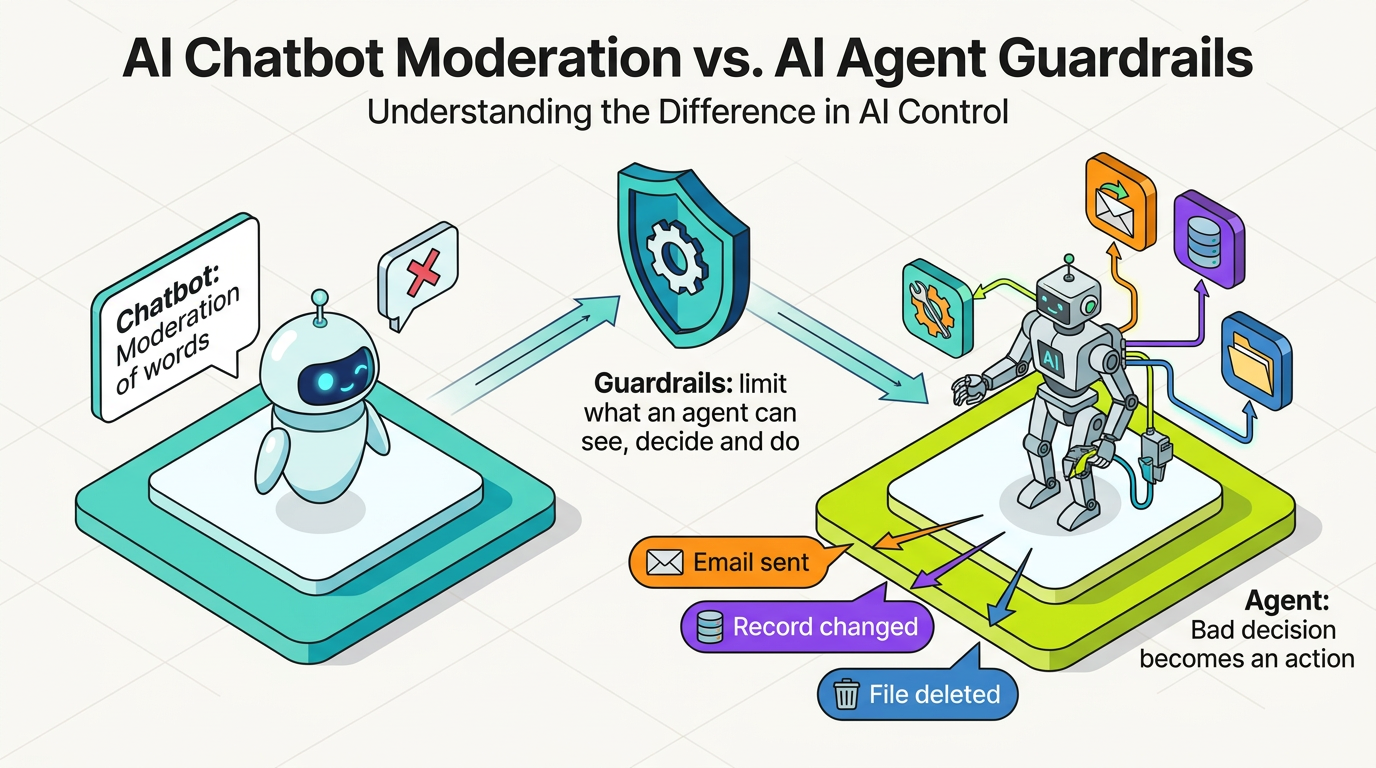
AI agent guardrails are the technical and policy controls that limit what an agent can see, decide and do. Unlike chatbot moderation, an agent calls tools, so a bad decision becomes an action like an email sent, a record changed or a file deleted.
The risk of excessive agency covers the damaging actions that follow unexpected, ambiguous or manipulated large language model (LLM) output, and it comes from excessive functionality, permissions or autonomy. Authorization therefore belongs in the downstream system rather than in model judgment, because a target system's permission checks apply whatever instructions the model received. The wider overview of AI agent security builds on the same principle, and every guardrail layer rests on it.
Where Should Guardrails Sit in an Agent?
Guardrails belong at the input, tool-call, data-access, output and human-approval layers, because each layer catches the failures the others miss:
Layer | What it controls | Example control | Speed cost |
Input (prompts and retrieved content) | Instructions and data entering the model's context | Classifier screening user prompts, emails, web pages and tool output for injected instructions | Low |
Tool and action calls | Which tools the agent invokes and with what arguments | Pre-execution policy engine that validates intent, schema and rate limits | Medium |
Data access | Which records and systems the agent can read or change | Read-only, task-scoped credential enforced by the target database | Low |
Output | What the agent returns to users or passes downstream | Policy scoring of responses before release or handoff to another tool | Medium |
Human approval | High-impact actions before they execute | Named approver confirms a payment after viewing a dry-run diff | High |
No single layer is enough, since input classifiers miss injections arriving through tool output or retrieved documents, output-only checks see an action only after its side effect, and a parallel check can return its verdict after the call has fired.
How to Design AI Agent Guardrails Step by Step
Designing guardrails means deciding what each agent can reach, what its actions could cost, and how much friction that cost justifies.
Step 1: Map Each Agent's Actions and Data Reach
The map lists every tool, API, data store, and credential each agent can use, the user or system it acts for, and its content sources, such as inboxes, shared drives, web pages and other agents' outputs. Each source is a path for indirect prompt injection, where hidden instructions in a document or email change the agent's behavior.
A replaced development extension may still be reachable, and one believed read-only may also be able to modify and delete, so the map records what each tool can actually do rather than what it was meant to do. The result is an action and data map with one owner per agent.
Keeping that map accurate as agents and permissions change is the harder part. Abnormal's AI Agent Security, currently in private preview, is designed to discover agents across AI platforms and track the privileges, tool access and data reachability of each one.
Step 2: Tier Actions by Impact
Each impact tier offers stronger controls than the last, matching the check to what the action can do.
Read: Lookups and summaries with no side effects run freely, with logging and asynchronous review.
Write: Internal changes such as updating a ticket or editing a file pass through an inline policy check.
External: Actions that reach outside the organization, such as sending email or calling a partner API, get an inline check plus an egress allowlist.
Irreversible: Payments, deletions and publishing require human approval, with a pre-execution plan or dry-run diff.
Reversibility settles most cases, since a compensating action can undo a database write but nothing recalls a sent email.
Step 3: Apply Least-Privilege Credentials and Tool Allowlists
Credentials follow the tier and task, and the 2026 agentic list from the Open Worldwide Application Security Project (OWASP) recommends per-tool least-privilege profiles covering scopes, maximum rate and egress allowlists, written as authorization policy rather than instruction, alongside per-agent identities, short-lived task-scoped tokens and human confirmation for destructive actions. Where possible, tools run in the user's own context, as with a mailbox-summarizing agent granted read-only scope and no permission to send.
Allowlists block unlisted tools regardless of prompt content, and regular access reviews confirm the access is still necessary, flag orphaned agent identities and long-lived secrets, and close with owner sign-off. That review cycle is the same one agentic identity security applies to every machine identity an organization runs.
Step 4: Put Inline Checks Only Where Risk Is High
Blocking checks belong on write, external and irreversible actions, while read-tier review stays asynchronous. Because a blocking check holds the tool call until its verdict returns, validation sits next to the tool that creates the side effect, where agent-level checks do not reach.
A deterministic rule check evaluates policy in code and adds little delay, while an LLM-based judge runs a model call per decision and is far slower, which is why deterministic policy handles allow, deny and schema decisions and model judges are kept for ambiguous intent.
Step 5: Define Human Approval With Named Approvers, Thresholds and an Audit Trail
Approval only works when the approver has the competence, training and authority to say no, which in practice means routing refunds above a threshold to a finance lead and messages to new external domains to the business owner.
Approval timers keep requests from stalling, with unanswered ones escalating to a backup approver after a fixed window and then expiring, and inline checks rerun once approval lands.
Each audit log entry should name the agent and the user it acted for, the tool, arguments and data touched, the policy verdict and the rule behind it, and the approver, timestamps and outcome, so an investigator can rebuild the decision. The EU AI Act record-keeping article requires high-risk systems to allow automatic recording of events across their lifetime. Logs should be append-only and outside the agent's reach, since a compromised agent with write access could tamper with them.
Step 6: Test Guardrails Against Attacks and Tune False Positives
Red-teaming should cover the whole agent, including its tools, credentials and retrieved content as well as the model, and each task feeds the next:
Attack Coverage: Tests cover direct prompt injection, indirect injection through emails, documents and tool output, and jailbreaks, with both injection paths explained in the primer on how prompt injection works.
Test Sets: The team keeps two labeled sets, one of attack cases and one of benign traces from real workflows.
Threshold Tuning: The team sets each detection threshold on the benign set at a tolerable false positive rate, then checks how many attacks pass.
On the AgentDojo prompt injection benchmark, a tool filter sharply cut targeted attack success against GPT-4o, while a prompt injection detector produced too many false positives and degraded utility.
Risks from the OWASP Agentic Skills Top 10, such as over-privileged skills, belong in the attack set too. Because static scores overstate protection against adaptive attackers, the set needs adaptive cases and a refresh each cycle.
How Do You Keep Guardrails From Slowing Teams Down?
Guardrails stay fast when the slow checks sit only on the actions that could do real harm, and everything else runs without waiting:
Asynchronous Checks for Low-Risk Actions: Read-tier actions run immediately, with logs reviewed afterward.
Pre-Approved Action Patterns: Recurring bounded actions get standing approval tied to fixed arguments and reviewed on schedule.
A Clear Exception Path: One documented route with a named owner and response time reduces workarounds.
Friction Measurement per Layer: Track latency per layer and approval prompts per user, because approvers who are prompted constantly stop reading the prompts.
When a tier's approval prompts or added latency climb, adjust that tier's thresholds or standing approvals first.
How Do You Know Your Guardrails Work?
Guardrails are working when risky actions keep getting blocked at a false positive rate the team accepts, and red-team success does not climb back after each change:
Risky Actions Blocked: Count blocks by tier and layer.
False Positive Rate: Reviewers confirm legitimate actions blocked or escalated in benign samples.
Approval Turnaround: Track decision time per tier and the share that time out.
Bypass Attempts: Log detected injection attempts and drift, since a sudden shift in approval rates or refusal reasons can signal that an attacker has found a way through.
Retest Results: Compare red-team success rates across cycles, including time-to-bypass, a metric the National Institute of Standards and Technology (NIST) suggests tracking in its AI Risk Management Framework Playbook.
NIST also calls for assessment by internal experts who did not build the system or by independent assessors. A security architect outside the agent team can review retest results after each cycle and any model, prompt, tool or permission change, with the security operations center (SOC) manager reviewing the metrics monthly.
Risk-Tiered Guardrails Keep Agents Fast and Accountable
Guardrails hold up when controls match what the action can cost. Reads run without waiting, writes clear a fast deterministic policy check, and irreversible actions wait for a named approver with an audit trail. Scoped credentials limit what a successful injection can reach.
AI Agent Security, part of the AI Security suite, is currently in private preview and is designed to map each agent's privileges and tool access, detect off-task runs, and support automated response and containment. Explore AI Agent Security to see how it fits a risk-tiered design.
Frequently Asked Questions
What is the difference between guardrails and permissions?
Permissions define what an agent's credentials can reach in a target system, while guardrails are the wider set of controls around the agent, from input screening to human approval. Permissions are often the most dependable layer because the target system enforces them regardless of what the model outputs.
Can guardrails stop prompt injection?
Guardrails reduce prompt injection risk but do not remove it, since no known method prevents it completely and adaptive attacks have bypassed many published defenses. The most dependable approach limits the damage of a successful injection through least-privilege credentials, tool allowlists and approval for irreversible actions, while filters catch the obvious attempts.
How do guardrails affect agent performance?
Well-placed guardrails add delay only to the few writes, external calls and irreversible actions that pass a blocking check or wait for a person, because most agent work is read-tier and runs untouched.