Key Insights
IBM X-Force, in a July 2026 analysis of the Cost of a Data Breach findings, says roughly one in five organizations reported an AI-related breach. AI governance is the set of owners, policies and controls that decide which AI tools, models and agents an organization uses, what data they may touch, and who answers when one of them causes harm.
The AI governance challenges that most often stall programs include limited visibility into AI tools, unclear ownership, policies with no enforcement, opaque AI decisions, regulatory change, AI agents with credentials, AI inside vendor products, and skills gaps.
This guide works through each challenge in the order a program meets it and pairs it with a fix that runs on processes a security team already operates, including identity, logging, contracts and incident response, with each one tied back to what published guidance expects.
Why Is AI Governance Hard?
AI governance is hard because AI enters the business through several doors at once, and most of them bypass procurement. An employee signs up for a chatbot with a work email, and a SaaS vendor switches on a generative feature in a product bought years ago.
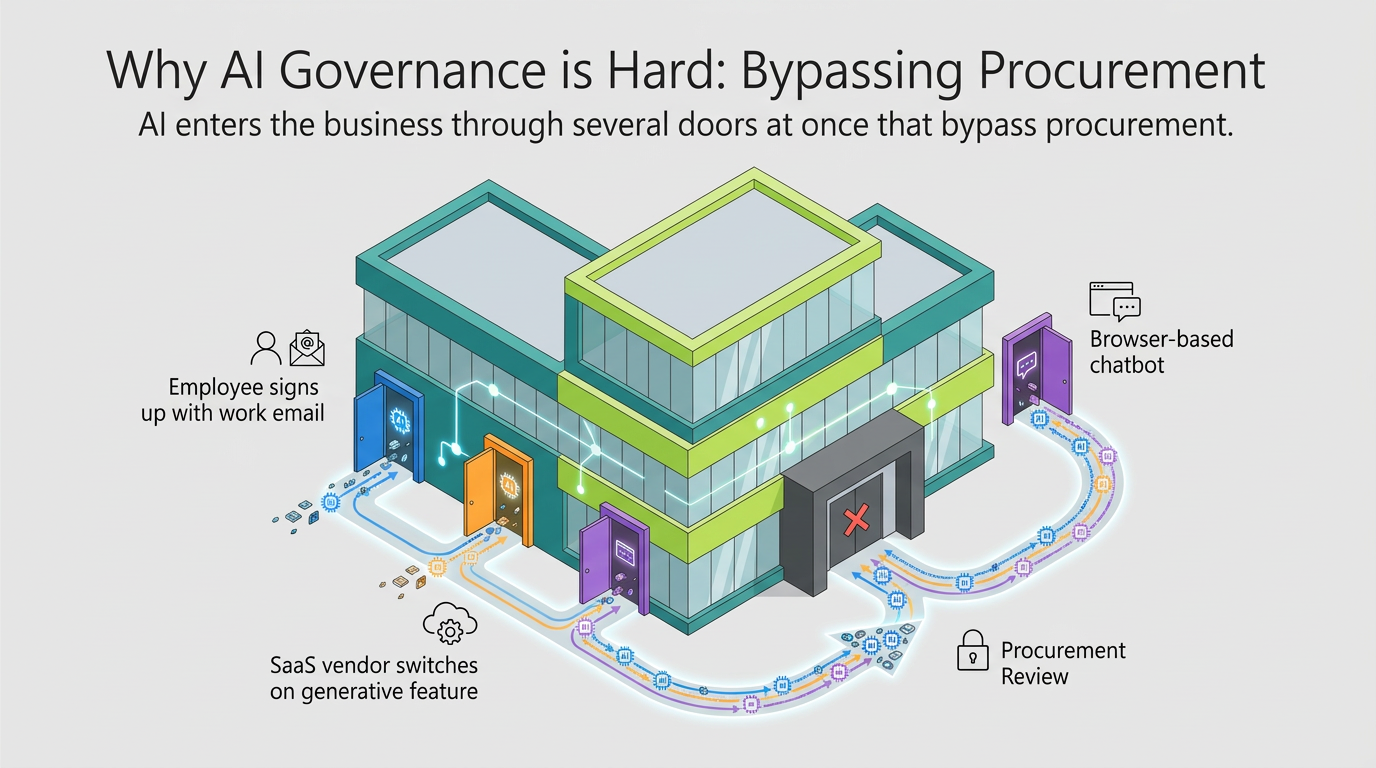
A developer connects an agent to a code repository with a long-lived API key, and a data team fine-tunes a model on internal records. Because each path has a different owner and leaves different evidence, an AI governance program built around a single intake form sees one door and misses the other three.
What Are the Biggest AI Governance Challenges?
The biggest AI governance challenges share one cause, in that each appears where AI adoption moves faster than the review, identity and contract processes built for conventional software. Each also closes the same way, when one of those existing processes is extended to cover AI rather than replaced.
Limited Visibility into AI Tools and Agents
Shadow AI grows because adopting a tool takes a work email and a few seconds, while approval can take weeks. Survey-based inventories go stale quickly, so discovery has to run continuously from evidence the organization already collects:
OAuth grant and consent logs in the identity provider
SaaS audit logs and signup emails from AI vendors
Procurement and expense records, including card purchases
Browser and network egress telemetry
The National Institute of Standards and Technology (NIST) asks organizations to keep a mechanism for inventorying AI systems in its AI Risk Management Framework (AI RMF), and each entry should record an owner, the data touched, permissions and approval status. The share of discovered tools carrying both an owner and a decision becomes the program's first metric. Abnormal's AI Governance is designed to discover approved and shadow AI tools, attribute ownership and track compliance gaps.
Unclear Ownership and Accountability
Ownership blurs because AI risk spans security, privacy, legal, data, and the business units buying tools, and each function assumes another one holds it. Accountability has to sit with an executive program owner who reports to the board, a cross-functional committee that sets policy and approves exceptions, and a system owner for every inventoried AI system, because each answers a different question. NIST places responsibility for AI risk decisions with executive leadership.
A responsible, accountable, consulted and informed (RACI) chart then names who approves new tools, who reviews vendor terms, and who revokes access. The familiar three-lines structure then shows where assurance sits: management operating controls, risk and compliance functions challenging them, and internal audit testing them independently. A breakdown of AI governance responsibilities by role covers each seat in more detail.
Policies That Exist Only on Paper
Policies stay on paper when they state intentions without naming the control that enforces them or the test that proves it works, so an AI security policy limiting staff to approved AI tools means little without a mechanism that flags or blocks other signups. The same IBM X-Force analysis reported that only 40% of organizations used access controls on AI models and data.
The fix maps each policy statement to a technical control, an owner and a test schedule, which gives the quarterly report something countable:
Inventory coverage
Open exceptions and their age
The share of controls that passed their last test
Time to decide on a newly found tool
Every exception should carry an expiry date and a named approver, with the count of open exceptions reported beside the other measures.
Opaque AI Decisions and Weak Audit Trails
AI decisions become hard to audit when nobody records the model version, the input data or the person who reviewed the output. NIST expects models to be explained, validated and documented, along with their bias and fairness results and suggests model cards and datasheets as the formats.
A practical decision log captures input, output, model version, timestamp and any human override, stored alongside other audit evidence so a reviewer can reconstruct a single decision months later.
AI incidents belong in that same evidence trail rather than in a parallel process. With AI categories added to the existing taxonomy, triage, escalation and EU serious-incident reporting run through paths the security operations center already tests.
Regulatory Change Across Jurisdictions
AI rules change faster than most policy cycles, which is why Regulation (EU) 2026/1744, dated July 2026, moved the EU AI Act's obligations for Annex III high-risk systems from 2 August 2026 to 2 December 2027. Rewriting policy for each change leaves a program permanently behind, so the durable answer is one internal control set mapped out to the frameworks rather than rewritten for each:
Teams can anchor controls to the ISO/IEC AI management system standard and to the NIST AI RMF functions, then map each control onto EU AI Act obligations and US state requirements.
When a law changes, compliance updates the mapping and the controls stay put.
A quarterly review with security and legal keeps the mapping current as new rules arrive.
AI Agents with Their Own Credentials
Agents raise a problem that chat assistants do not, because agents take actions. An agent holding an API key can read files, send messages and change records, and a manipulated agent will use every permission it holds, which the Open Worldwide Application Security Project (OWASP) calls excessive agency in AI.
The fix registers each agent as a non-human identity with a human owner, then applies the controls that the Australian Signals Directorate, the Cybersecurity and Infrastructure Security Agency, the National Security Agency and allied agencies set out in their May 2026 joint guidance on the careful adoption of agentic AI:
Task-scoped least privilege, with elevated rights revoked when the task ends
Ephemeral credentials instead of long-lived secrets
No ability for agents to change their own privileges
Human-readable logs of agent tool usage
Human approval for high-impact or hard-to-reverse actions
Incident response playbooks should cover a misbehaving agent by suspending it, revoking its credentials, and reviewing its action log against its approved scope.
AI Supply Chain and Features Inside Vendor Products
Vendor AI escapes review because assessments happen at onboarding, before a supplier adds generative features or changes its terms. Contracts and monitoring close that gap, and the terms that matter most govern what a vendor may do with customer data and when it has to speak up:
Training Use: No customer inputs or outputs train the vendor's public or commercial models without explicit consent, a term the White House acquisition memorandum on AI already requires of federal agency contracts.
Retention: The vendor collects and keeps customer data only as long as the contract requires.
Feature Notice: The vendor discloses new AI features before switching them on in a product already under contract.
After signing, teams can watch for new AI features, revised terms or data processing agreements, and new OAuth scopes on vendor apps, routing each change for review within existing third-party risk management cycles.
Skills and Capacity Gaps
Few security teams were hired to evaluate models, read AI vendor terms or test for bias, and the work lands on top of current duties. NIST calls for AI risk training matched to each person's responsibilities, which in practice means tracks built around what each role will actually have to do:
Security operations analysts learn agent and AI incident triage.
Governance, risk and compliance staff learn framework mapping.
Procurement learns the contract terms.
Legal, privacy and IT staff sit on the governance committee alongside security, setting policy and approving exceptions rather than following a training track. Staffing then scales with size.
A smaller organization can add AI governance to an existing governance, risk and compliance role and bring in a managed security service provider (MSSP) or outside assessor for audits. A large enterprise can justify a dedicated AI risk lead, a standing committee and system owners inside business units. Training progress is easiest to report as completion rates by role.
Which Challenges Should You Tackle First?
Visibility and ownership come first, because every other fix depends on knowing what AI exists and who answers for it, and each is a precondition for work that cannot start without it:
Visibility: The inventory scopes policy enforcement, identifies the vendors and agents needing contract and credential review, and shows auditors which systems need decision logs.
Ownership: Named owners give exceptions an approver, incidents an escalation path and the board one accountable executive.
With both in place, you can assign and measure the other six challenges. Teams that begin with policy writing instead tend to learn later that the policy covered a fraction of real use.
Give Every AI Governance Challenge an Owner, a Control and a Metric
Every challenge in this guide ends in the same place, with a named owner, a control that enforces the decision and a metric showing whether the control works. That metric is inventory coverage for shadow AI, contract coverage and change alerts for vendor AI, and the share of agents registered as scoped non-human identities. Reported that way, AI governance reads like any other security program to a board.
Abnormal's AI Governance, part of the AI Security suite, is designed to discover approved and shadow AI tools, attribute ownership and track compliance gaps. Explore AI Governance to see how it builds an AI inventory from signals an organization already collects.
Frequently Asked Questions
What is the biggest challenge in AI governance?
Limited visibility, because every other control depends on it. Few teams can produce a current list of the AI tools, agents and vendor features in use without running a fresh survey, and that gap undermines everything built on top of it.
Why do AI governance programs stall?
Programs stall when no one owns them, when policies name rules without controls that enforce them, and when nothing is measured. A committee without an executive owner tends to debate instead of decide.
Who should own AI governance?
Ownership usually lands with the CISO or the chief risk officer, though the deciding factor is who already reports AI risk to the board rather than the job title itself. Where privacy or legal exposure dominates, some organizations pair that owner with a chief privacy officer as co-sponsor. What matters more than the choice is naming the role in writing before the first exception request arrives.