Key Insights
A January 2026 announcement from the United Kingdom Accreditation Service confirmed its first AIMS accreditation for certifying AI management systems, which made accredited ISO 42001 certificates available in the UK. Buyers who previously could only ask about the standard can now ask to see an ISO 42001 certificate, the international standard that specifies how an organization establishes, maintains, and improves an AI management system (AIMS) over time.
This guide treats ISO 42001 as a commercial decision rather than a technical one, weighing whether customers, contracts or regulators want independent assurance. It traces the standard from its clauses and Annex A controls through scoping, audit stages and recertification in the third year. Each stage ties back to ISO's own documentation and the accreditation rules certification bodies follow, and separates what the standard requires from what each organization chooses.
What Is ISO/IEC 42001?
ISO/IEC 42001:2023 is a certifiable management system standard for AI, published in December 2023. ISO's ISO/IEC 42001:2023 standard page says it "specifies requirements for establishing, implementing, maintaining, and continually improving an Artificial Intelligence Management System (AIMS) within organizations."
ISO's explainer says the standard applies to organizations of any size and sector that develop AI systems, integrate AI into products or services, use AI for decisions or automation, or manage AI supplied by third parties. ISO certifies none of them itself. Independent certification bodies perform the audits, and national accreditation bodies may in turn accredit those bodies. Certification assesses the policies, processes and records an organization uses to govern AI, giving an existing AI governance program an external benchmark.
What Does ISO 42001 Require?
ISO describes implementing the standard through the Plan-Do-Check-Act methodology, combining a management system structure, Annex A reference controls, and AI risk and impact assessment in a format familiar to teams that run other common security frameworks.
Clauses 4 to 10
Clauses 4 to 10 follow the harmonized structure ISO uses across management system standards, running from context of the organization through leadership, planning, support, operation and performance evaluation to improvement.
Clause 4.3 sets the AIMS scope. AI risk assessment, risk treatment and impact assessment appear in planning (6.1.2 to 6.1.4) and again in operation (8.2 to 8.4). Internal audit sits in clause 9.2, management review in 9.3, and corrective action for nonconformities in clause 10.
Annex A Controls and Annex B Guidance
Annex A sets out reference control objectives and controls, with themes such as AI policy, roles, data quality, human oversight and suppliers, while Annex B provides implementation guidance. The clauses also require documented information on the AI policy, scope, risk and impact assessments, monitoring results, internal audits and management reviews. Those documents are what a Stage 2 auditor samples.
AI Risk and Impact Assessments
An AI impact assessment records how a system and its foreseeable applications may affect individuals, groups or society across the AI system life cycle. A useful assessment also sets when to repeat it in the life cycle and how its results feed into the AI management system.
One workable approach is to give each in-scope AI system a named owner, supported by risk or compliance staff. For every system, the owner documents the foreseeable use, the people or groups affected, the impacts identified, the treatment decisions and a review date. The owner refreshes that record whenever the system, its intended use, its data or its deployment context changes.
How Does ISO 42001 Relate to Other Standards and Laws?
ISO 42001 and ISO/IEC 27001 are certifiable management system standards. The NIST AI RMF is voluntary guidance, and the EU AI Act is binding law. Type, certification route, focus and intended users separate them:
Framework | Type | Certifiable | Focus | Who uses it |
ISO/IEC 42001 | International management system standard (2023) | Yes, by independent certification bodies | Governing AI development, provision and use | Organizations of any size that develop, provide or use AI |
ISO/IEC 27001 | International management system standard (2022 edition) | Yes, by independent certification bodies | Information security, covering confidentiality, integrity and availability | Organizations running an information security management system (ISMS) |
NIST AI RMF | Voluntary US framework (AI RMF 1.0, January 2023) | No NIST certification program described | AI risk through Govern, Map, Measure and Manage | Organizations designing, developing, deploying or using AI |
EU AI Act | EU regulation (Regulation (EU) 2024/1689) | Not a certificate, but legal obligations apply | Prohibited practices, general-purpose AI models, high-risk AI systems | Providers and deployers of AI in the EU market |
The shared harmonized structure links the first two rows, while NIST guidance and EU law serve different purposes:
Integrated Management Systems: ISO/IEC 42001 and ISO/IEC 27001 share the same clause structure. An organization already running an information security management system (ISMS) can extend it to cover AI instead of building a second system.
Voluntary Risk Guidance: The NIST AI RMF is written to apply across sectors and use cases, with no certificate at the end. Teams already mapping NIST compliance requirements can find crosswalks between the AI RMF and other frameworks, though each mapping needs to be checked against the primary text.
Legal Conformity: The consolidated EU AI Act works differently again, because under Article 40 the presumption of conformity comes only from harmonized standards whose references appear in the Official Journal. A certificate against any other standard, including ISO/IEC 42001, does not carry that presumption on its own.
The four can work together, with ISO/IEC 27001 and ISO 42001 providing the management systems, the NIST AI RMF informing risk practice, and the EU AI Act setting the legal requirements those systems must meet.
Do You Need ISO 42001 Certification?
ISO's ISO/IEC 42001 explainer states that certification is voluntary, which makes the decision commercial and contractual rather than legal. Each of these conditions raises what an independent certificate is worth:
Customers Ask for It: When security questionnaires or contracts request ISO/IEC 42001, a certificate from an accredited body can answer many of them.
You Build or Sell AI: Organizations that develop or provide AI products sit at the center of the standard's scope.
You Operate in a Regulated Sector: Where regulators already examine governance, an independently audited AI management system gives them a recognized record to review.
You Are Preparing for the EU AI Act: High-risk obligations now apply from 2 December 2027 for Annex III systems, and 2 August 2028 for Annex I systems, and an AIMS gives the Act's quality management requirements a base to build on.
These conditions describe who is likely to be asked for proof. The clearest test is what happens when a questionnaire arrives.
With a certificate, a buyer can check its status in the International Accreditation Forum (IAF) CertSearch certificate database, which shows whether it is active, suspended, withdrawn or expired, and the organization commits to annual surveillance audits in return. Without one, the security or compliance team answers each questionnaire item from its own records, such as the AI policy, risk and impact assessments, internal audit results and management review outputs. The buyer then judges that evidence with no independent auditor standing behind it.
Either way, the scope statement sets the limit. A certificate covers only the systems, business units, locations and roles it names. A question about an AI tool outside that scope still needs the organization's own evidence.
If none of these conditions apply, aligning without certifying is a defensible choice, and a cybersecurity compliance guide can help place that choice within the wider compliance program. The same ISO explainer says adopting the standard already delivers significant value, and that certification adds independent confirmation for stakeholders.
How Does ISO 42001 Certification Work?
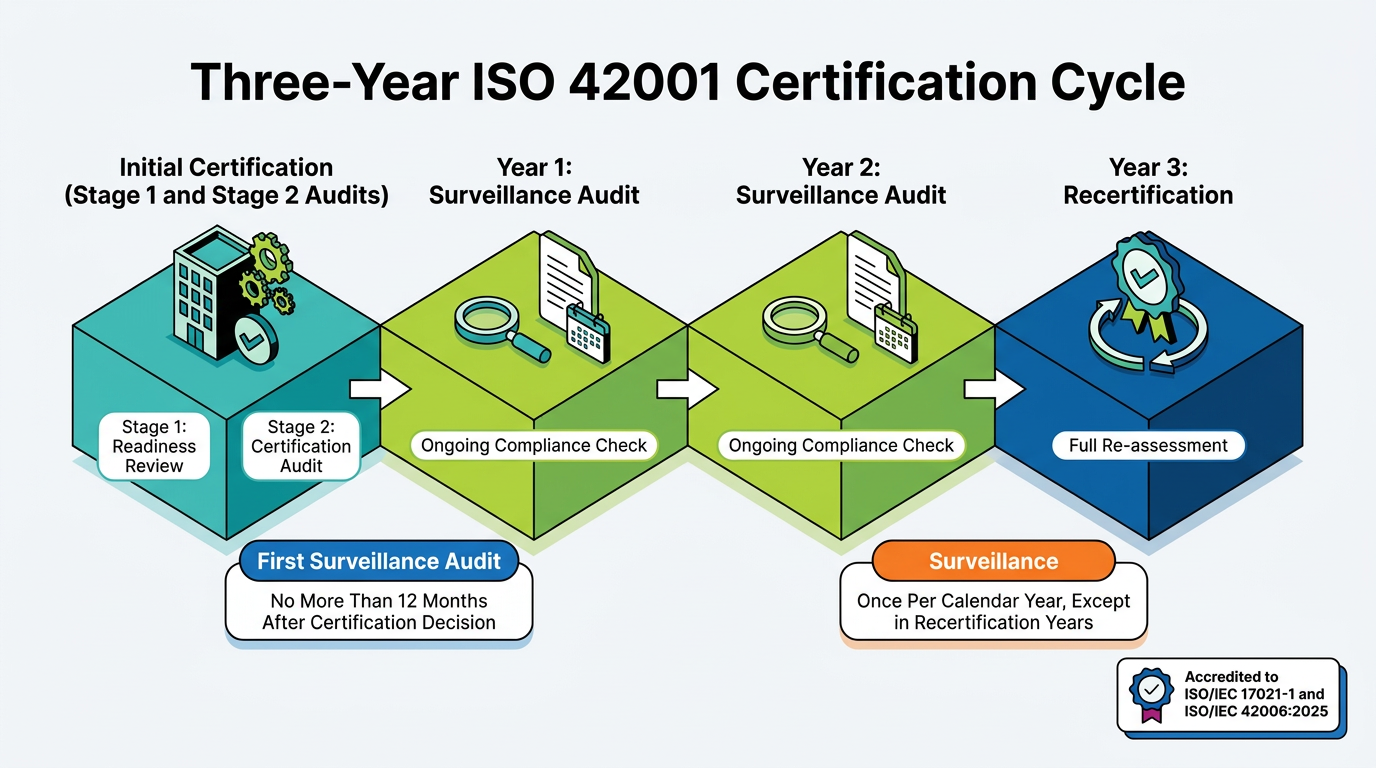
Certification runs on a three-year cycle, built from a two-stage initial audit, surveillance audits in years one and two, and recertification in year three.
Define the Scope of the Management System
Clause 4.3 requires the organization to determine the scope of its AIMS, and every later audit tests against that boundary. A starting inventory lists the AI systems the organization builds, AI embedded in products it sells, third-party tools employees use, and the business units and locations involved.
For each one, identify whether the organization acts as developer, provider or user, or more than one, since the role can differ by system. A company might develop one product and only use a supplier's AI tool elsewhere. The scope statement then names the systems, products, business units, locations and roles covered. A reader can tell from it what the certificate leaves out.
Run a Gap Assessment
A gap assessment compares current practice against clauses 4 to 10 and the Annex A controls. A useful output is a written register or workplan listing each gap, the related clause or control, the responsible owner, the evidence required, a target date and a priority.
A simple way to set priority is to address gaps tied to in-scope AI systems first, along with gaps that affect a buyer requirement, a contract term or a regulatory need. Organizations certified to ISO/IEC 27001 can build on existing management-system documentation and review practices. Teams that have prepared for SOC 2 audit requirements will recognize how to tie each control to an owner and a record.
Implement Controls and Impact Assessments
The organization documents its AI policy and objectives, runs AI risk assessments, records treatment decisions, and lists the applicable Annex A controls in the statement of applicability. Named system owners, with risk or compliance support, complete an impact assessment for each in-scope system and update it whenever that system changes.
Auditors ultimately test whether those controls operated, and every one of these records traces back to an accurate AI inventory. Abnormal's AI Governance is designed to discover approved and shadow AI tools, attribute ownership and track compliance gaps.
Hold an Internal Audit and Management Review
The organization audits itself before a certification body does, working from clause 9.2 for the internal audit program and clause 9.3 for management review. That means assigning auditors who can review each area objectively and documenting any limits on their independence.
Under ISO's harmonized structure, top management then reviews the system at planned intervals for continuing suitability, adequacy and effectiveness. That review takes in the status of previous actions and changes in internal and external issues, while nonconformities are corrected and their causes evaluated. The resulting audit reports, review minutes and corrective action records become the Stage 2 evidence.
Pass the Stage 1 and Stage 2 Audits by an Accredited Body
A certification body accredited to ISO/IEC 17021-1 performs the initial audit, with ISO/IEC 42006:2025 adding the AI-specific requirements these bodies must meet. Stage 1 focuses on documentation and readiness, and its results go into a written report that the certification body reviews before deciding whether to proceed.
Stage 2 then tests whether the AIMS operates as documented. The certification body sets the gap between the two stages, and a long gap can mean repeating Stage 1.
National accreditation bodies such as the ANSI National Accreditation Board (ANAB) and UKAS accredit the certification bodies, UKAS was the first AIMS accreditation cited earlier.
Maintain Surveillance Audits and Recertification
Certification runs on a three-year cycle. The first surveillance audit must fall no more than 12 months after the certification decision, and surveillance happens at least once per calendar year except in recertification years.
Each visit samples whether the organization still operates the documented AIMS, covering current risk and impact records, follow-up from internal audits, management-review actions and corrective actions. Recertification occurs in the third year and must be completed before the certificate expires, with an on-site audit of the system's effectiveness and progress on objectives.
ISO 42001 Certification Pays Off When Customers or Regulators Ask for It
ISO 42001 certification is a commercial choice, since ISO states it is voluntary. Certification gives buyers and auditors independent, third-party confirmation that the AIMS meets the standard's requirements within the certified scope. When customers, contracts or regulators do not ask for that confirmation, alignment supports internal AI governance, but the organization must then demonstrate its practices itself.
Abnormal's AI Governance, part of the AI Security suite, is designed to discover approved and shadow AI tools and attribute ownership. Explore AI Governance to see how it keeps an AIMS scope statement accurate between audits.
Frequently Asked Questions
Is ISO 42001 mandatory?
No, no law requires it. The pressure is commercial and comes through procurement, in security questionnaires that name the standard, contract clauses that require third-party assurance, and sector guidance that points regulators to an AIMS as an audit reference. An organization can meet all of that without a certificate, but then it carries the burden of proof.
How long does ISO 42001 certification take?
The audit rules fix the spacing rather than the total. The certification body sets the gap between Stage 1 and Stage 2, and the first surveillance audit falls within 12 months of certification. No accreditation or standards body publishes typical durations by organization size. An existing ISO/IEC 27001 system can reduce preparation work because the standards share a structure.
Can one audit cover both ISO 42001 and ISO 27001?
Yes, under the International Accreditation Forum's mandatory IAF MD 11 document, a certification body can plan one audit against two or more standards. It calculates audit time for each standard separately, then may reduce the combined total based on how integrated the systems are. The document covers integrated systems generally and does not name ISO 42001.
Does ISO 42001 certification mean EU AI Act compliance?
No, and treating it as a substitute is a common mistake. The Act grants its conformity presumption through a separate route, and the standard built for that route is designed to layer on top of an AIMS rather than replace it. A certificate is useful groundwork for the obligations arriving in 2027 and 2028, not evidence of meeting them.
Who can certify against ISO 42001?
Independent certification bodies issue ISO 42001 certificates. ISO itself does not certify organizations. Accredited certificates come from bodies accredited to ISO/IEC 17021-1 and ISO/IEC 42006 by national accreditation bodies such as ANAB or UKAS. An unaccredited body is not automatically disreputable, but its certificates do not carry an accreditation body's confirmation of the certifier's competence.