Key Insights
The EU AI Act sets fines of up to EUR 35 million or 7% of an undertaking's total worldwide annual turnover, whichever is higher, for prohibited AI practices. AI GRC applies governance, risk and compliance (GRC) to the AI systems an organization builds, buys and lets employees use. It assigns owners to AI decisions, assesses AI-specific risks such as bias, confabulation and model drift, and produces evidence that those systems meet legal and internal requirements.
Most programs extend the enterprise risk management (ERM) an organization already runs rather than replacing it. The harder part is getting existing risk committees and registers to see the AI already in use.
This guide maps what GRC covers for AI, which frameworks shape a program and how it fits existing ERM. It then follows a program from the first inventory to audit evidence, and the weak points that most often undermine one.
What GRC for AI Covers and Who Expects It
GRC for AI covers the policies, risk assessments and compliance evidence for the AI an organization depends on. Governance teams set AI policy and accountability, risk managers treat failure modes specific to models and AI tools, and compliance teams map those systems to binding obligations and chosen standards. AI in GRC is a different thing, machine learning inside a GRC platform, and an organization can buy it while still having no oversight of the models its teams depend on.
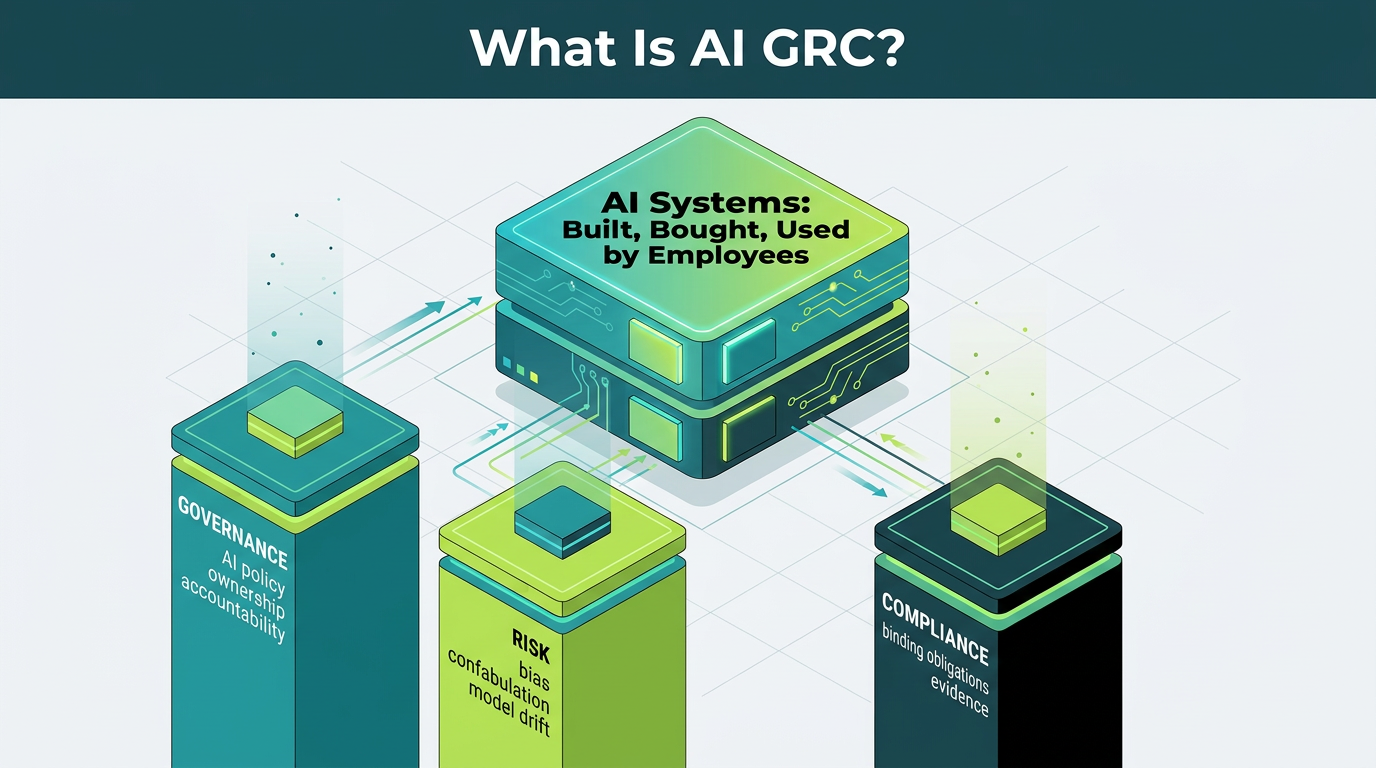
Scrutiny usually starts with the governance half, because an auditor's or regulator's first question about any AI system is who owns it and who approved it. A program that cannot answer has nothing to build the risk and compliance work on.
How AI Changes Each Part of GRC
Each GRC component keeps its purpose, while AI adds new owners, risk categories and regulatory duties. Most organizations can therefore extend existing GRC roles rather than build a separate AI function.
Governance Covers AI Policies and Ownership
AI governance starts with an acceptable use policy that names approved tools, the data employees may enter, and the uses that need review. A cross-functional AI risk committee drawn from security, legal, privacy, compliance and business units approves tools and accepts residual risk, and an existing risk committee can often take on this role rather than a new body.
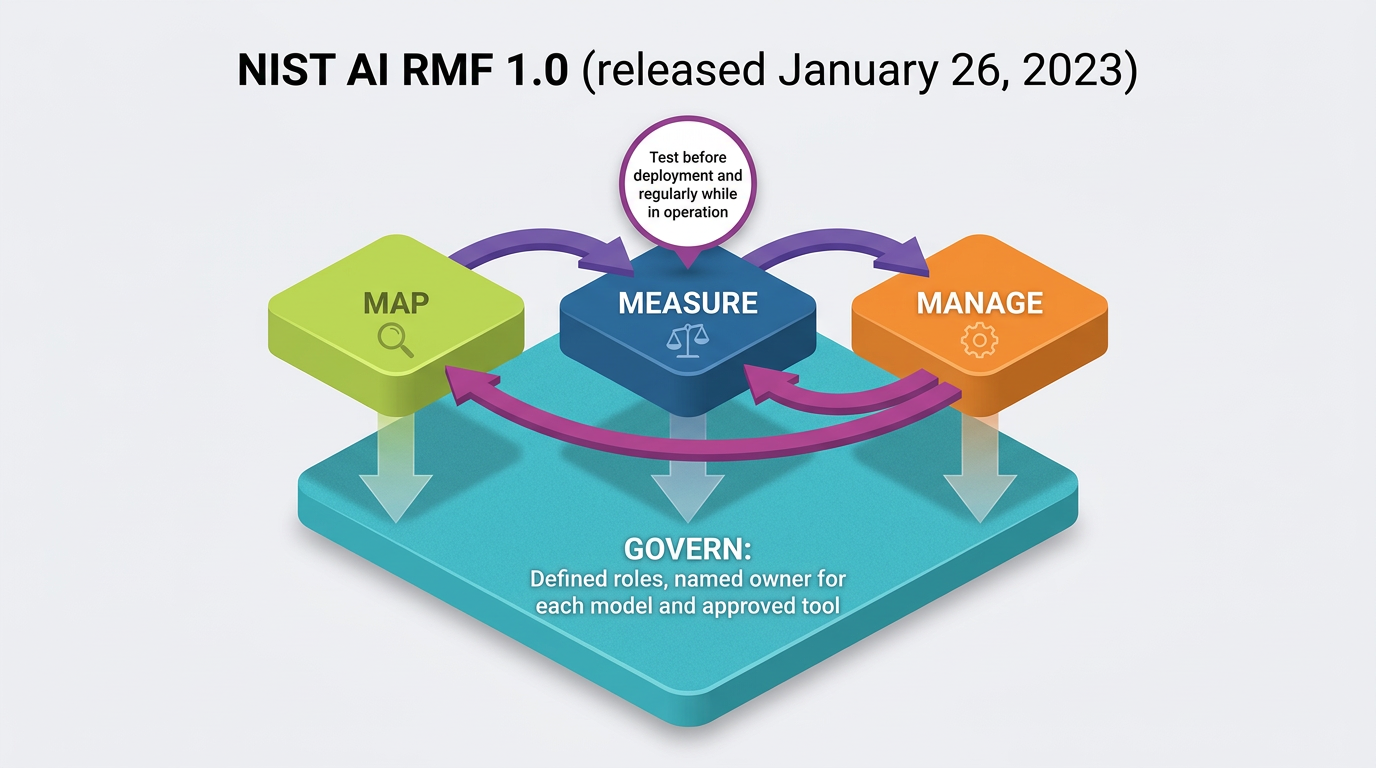
Accountability then reaches individual systems through the GOVERN function of the National Institute of Standards and Technology (NIST) AI Risk Management Framework (AI RMF), which asks for defined roles and responsibilities. In practice, that means a named owner for each model and approved tool.
Risk Management Covers AI-Specific Failure Modes
A model the organization builds or a third-party tool its employees adopt can surface any of these risks:
Bias: The NIST AI RMF groups AI bias into systemic, computational, statistical, and human-cognitive categories, any of which can produce unfair outcomes.
Hallucination: Confidently stated but false output, which NIST calls confabulation, can mislead staff who act on it.
Model Drift: Performance and trustworthiness can shift after deployment as data and conditions change.
Data Privacy: Generative AI can leak, misuse or re-identify personal and sensitive data.
Explainability: NIST separates explainability (how a decision was made) from interpretability (why it was made), and defending an AI-driven decision needs both.
Third-Party AI Exposure: Upstream models, datasets and components can enter a system without traceable provenance, including data that was obtained improperly.
Bias and explainability can be evaluated before release, while drift and changes to third-party components emerge only after deployment. The AI RMF accordingly says AI systems should be tested before deployment and regularly while in operation.
Compliance Covers AI Regulatory Obligations
The EU AI Act concentrates obligations on high-risk systems and the providers that place them on the market. Providers must maintain a risk management system, govern training and testing data, keep technical documentation, design systems that record events, give deployers instructions for use, design for human oversight and complete conformity assessment before market placement (Articles 9 to 14 and 43).
Deployers carry their own duties under Article 26: they must use systems according to instructions, assign oversight to people with the competence and authority to act, keep logs under their control for at least six months and inform workers before workplace use. Article 4 requires providers and deployers to support staff AI literacy, and Regulation (EU) 2026/1744 amended that duty so it no longer requires a guaranteed level of literacy for any individual.
Which Frameworks Shape AI GRC Programs
AI GRC programs typically combine a voluntary risk framework, a certifiable management standard and binding regulation and knowing which is which shows a chief information security officer (CISO) where the program has room to adapt and where it does not:
Framework | Type | Scope | Core Obligation |
|---|---|---|---|
NIST AI RMF 1.0 | Voluntary framework | Any AI system | Govern, Map, Measure, Manage |
ISO/IEC 42001:2023 | Certifiable standard | Organizations developing, providing or using AI | AI management system with Annex A controls |
EU AI Act | Binding regulation | Providers and deployers in the EU | Duties set by risk tier |
NIST released AI RMF 1.0 on January 26, 2023, as a voluntary framework built on four functions. ISO/IEC 42001, published on December 18, 2023, is the first international standard for AI management systems and follows the Plan-Do-Check-Act structure of ISO 27001, with independent certification bodies issuing certificates.
EU AI Act prohibitions and AI literacy duties have applied since February 2, 2025, and general-purpose AI model obligations have applied since August 2, 2025. Regulation (EU) 2026/1744, in force since July 27, 2026, sets Annex III high-risk duties to apply from December 2, 2027 and product-embedded high-risk duties from August 2, 2028.
How AI GRC Fits Into Existing GRC and ERM Programs
AI GRC works best as an extension of the ERM program the organization already runs, with AI risks feeding the same registers, committees and assurance cycle. The three lines model familiar from internal audit divides the work:
First Line: Business owners who deploy a model or adopt a tool own and manage the risk.
Second Line: Specialist roles provide expertise, monitoring and challenge, with the CISO covering access, data exposure and shadow AI adoption and the chief privacy officer covering personal data and data protection impact assessments.
Third Line: Internal audit gives independent assurance that the first two lines are working.
Above all three lines, the board or its risk committee sets the risk appetite that each AI system is judged against.
How to Build an AI GRC Program
An AI GRC program builds in sequence: find the AI in use, rank it by risk, apply mapped controls, then watch it continuously and keep the evidence. Skipping the inventory leaves every later step working from an incomplete list.
Build an Inventory of AI Systems and Third-Party Tools
A complete AI inventory covers internally built models, AI features embedded in SaaS applications and employee use of chatbots and copilots. The NIST AI RMF calls for mechanisms to inventory AI systems, resourced according to risk priorities. Shadow AI, meaning AI use not captured in approved systems and processes, usually holds the tools security teams know least about. Abnormal's AI Governance, generally available as part of the AI Security suite, is designed to discover sanctioned and shadow AI through signup emails, OAuth grants and identity signals.
Tier AI Use Cases by Risk and Map Their Controls
Systems can be assigned to risk tolerance levels by combining the impact of a failure with its likelihood. EU AI Act categories sit on top: prohibited, high-risk, transparency-risk such as chatbots and minimal-risk and under Article 6(3) an Annex III system that profiles natural persons is always high-risk.
Mapping each control once lets one set serve all three frameworks. Human oversight, for example, answers the EU AI Act's duty for deployers to assign oversight, NIST's call for ways to supersede or deactivate a system and ISO/IEC 42001's controls on the use of AI systems.
Monitor AI Systems and Collect Audit Evidence
Monitoring covers production behavior, third-party AI risks and post-deployment plans for incident response and decommissioning, all of which the NIST AI RMF calls for. Checks should flag approved SaaS applications adding AI features, changed vendor terms and usage outgrowing its review.
Evidence comes from the work itself: approval records, risk assessments, system logs and model documentation such as model cards and dataset datasheets. ISO/IEC 42001 adds internal audits at planned intervals and management review. For AI literacy, the European Commission's AI literacy Q&A states that no certificate is needed and that organizations can keep an internal record of training. Board reporting works best with a few indicators, such as the share of AI systems with a named owner, AI incidents logged and time to remediate findings.
Common Weak Points in AI GRC Programs
AI GRC programs tend to weaken where ownership, visibility or review cadence lags behind how fast AI enters the business, and each one leaves part of the AI estate without an owner, a review or evidence:
No AI Owner: Without a named owner, no one accepts residual risk or answers an auditor's question about a specific system.
Shadow AI Blind Spots: Tools employees adopt on their own never reach the inventory and never receive a risk tier or controls.
Vendor AI Features Unreviewed: An application approved before it added AI capabilities may now process data under terms the original review never assessed.
Point-in-Time Reviews: An annual assessment can miss the drift and third-party changes NIST expects organizations to monitor.
Most of these weaknesses trace back to an incomplete inventory of the AI systems in use. A system missing from the inventory never receives an owner, a tier or a review date.
Turning AI Visibility Into Governed AI Use
An AI inventory gives every later step something to act on, because risk tiers attach to listed systems, controls attach to tiers, and monitoring watches what the inventory recorded. With that chain in place, a GRC team can answer a regulator or the board system by system.
Explore Abnormal's AI Governance to see how it is designed to discover approved and shadow AI tools with ownership attribution and track compliance and regulatory gaps across them.
Frequently Asked Questions
Who owns AI GRC in an organization?
Ownership is shared across several roles, with an executive sponsor, often the CISO or a chief AI officer, accountable for the program and the board or risk committee setting risk appetite. Business owners stay responsible for each AI system they deploy.
Is AI GRC the same as using AI in GRC software?
No, the two address different problems, since AI GRC governs the AI an organization builds, buys and lets employees use, while AI in GRC software automates tasks such as evidence collection inside the GRC function. Only AI GRC answers a regulator's questions about the organization's own AI systems.
How should a GRC team handle an approved SaaS application that adds AI features?
A GRC team should treat the new AI feature as a change that reopens the original review. The team re-tiers the application, confirms its inventory entry and named owner, and checks whether the vendor's updated terms allow customer data to be used for training. It then documents the decision, as the NIST AI RMF expects for third-party AI risks.