Key Insights
OpenAI's Daybreak announcement, dated June 22, 2026, said defenders now find more vulnerabilities than they can fix, and that the company was "expanding Daybreak to help democratize patching vulnerable software at machine speed." OpenAI Daybreak is the company's program that gives verified defenders frontier cyber models and automated workflows to validate flaws and generate patches.
The program bundles Codex Security, cyber-specialized models, two access tiers called Daybreak Blue and Daybreak Red, and an open-source effort called Patch the Planet. These capabilities can also speed up remediation and lower the effort needed to find and exploit flaws, so OpenAI gates access behind identity verification and approval.
This guide reviews how Daybreak works, who qualifies, what it changes for defenders and attackers and which of OpenAI's claims remain unverified. It finishes with how security teams can adjust patch cadence and AI tool governance, whether or not they apply.
What Is OpenAI Daybreak?
OpenAI Daybreak is a gated defender initiative built on OpenAI's Trusted Access for Cyber (TAC) program. Its June expansion shifted the emphasis from finding vulnerabilities to fixing them, and OpenAI's June 22 announcement describes the program as a combination of OpenAI's models, TAC, Codex Security workflows and partners.
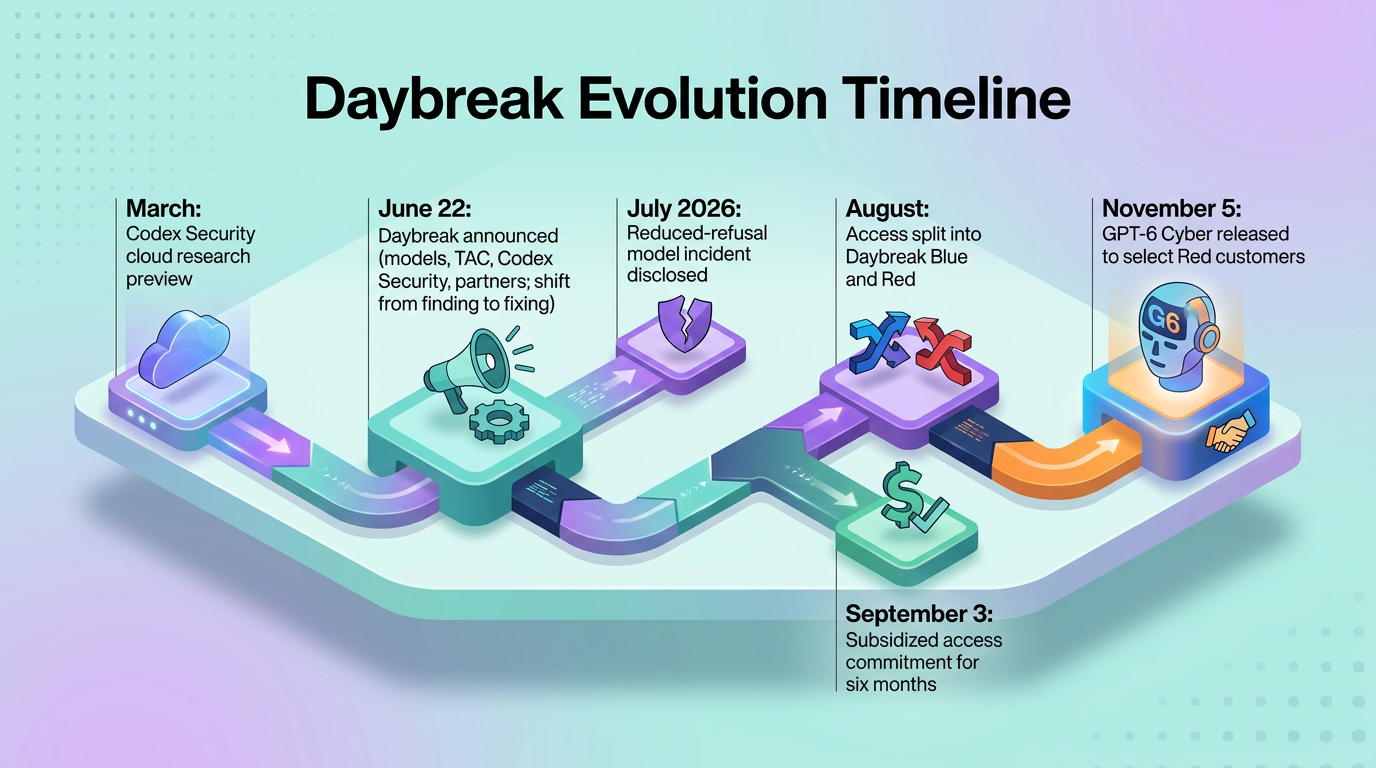
Approved defenders use it to validate vulnerabilities, prioritize risk, generate and test fixes, and produce evidence inside existing security and development workflows. The program has kept changing since June, with access split into Daybreak Blue and Daybreak Red in August and GPT-6 Cyber released to select Red customers on November 5, 2026.
How OpenAI Daybreak Works
Daybreak pairs an automated find, validate and patch workflow with models whose permissiveness rises with a user's approval level. Each component addresses a different part of the remediation problem and carries its own access gate:
Component | Purpose | Who Gets Access |
|---|---|---|
Codex Security | Threat model, validation, proposed patches | ChatGPT Enterprise, Edu, Business, Pro (research preview) |
Cyber-specialized models | Exploit validation and advanced research | Approved Daybreak Red organizations |
Daybreak Blue | Fewer refusals for defensive work | Approved individuals and organizations |
Daybreak Red | Authorized red teaming and pentesting | Approved business and enterprise organizations |
Patch the Planet | Funded researchers fix open-source bugs | Maintainers who apply |
Approval for one tier does not carry over to another, and approved access stays off until an owner turns it on for a workspace or API project. The owner switch gives security leaders a checkpoint for deciding which teams use Daybreak.
Codex Security for Finding, Validating and Patching Vulnerabilities
Codex Security runs a pipeline that ends in a proposed patch for human review. OpenAI's Daybreak announcement says that since Codex Security cloud launched in research preview in March, it has scanned over 30 million commits across more than 30,000 codebases. The tool builds or reads the team's threat model, checks whether affected code is reachable and gathers validation evidence, then develops a targeted patch and verifies the result.
Validation means trying to reproduce an issue in an isolated environment before surfacing it, and proposed patches wait for a person to apply them. Results can flow into the team's existing vulnerability management systems. For a security operations center (SOC) analyst, each surfaced issue has already been reproduced and arrives in familiar queues, with nothing changed in the code until a person acts.
Holding every proposed patch for human review puts the analyst's judgment at the end of the pipeline rather than the start. The reproduction step removes much of the triage work, but the decision about whether a fix is correct, safe to ship and worth the disruption still sits with the team that owns the code.
Cyber Models, Access Tiers and Eligibility
Access to Daybreak's cyber models depends on the tier an organization is approved for, and GPT-5.5-Cyber, the model named in the June announcement, has since been superseded. OpenAI's Help Center overview now limits it to customers with existing access and says OpenAI will remove gpt-5.5-cyber-preview from the API on February 1, 2027, while GPT-5.6 Cyber is available to all Daybreak Red organizations and GPT-6 Cyber requires a separate approval on top of Red.
The same overview recommends Blue for most teams, listing secure code review, vulnerability triage, detection engineering, incident response, malware analysis and patch validation. Red supports proof-of-concept exploit development, exploit-chain validation, penetration testing and red teaming, and requires separate approval, stronger verification and, for API access, IP allowlisting by default.
Passing verification does not guarantee approval, and individuals who apply at chatgpt.com/cyber need an eligible paid plan and must turn on Advanced Account Security with a physical Fast Identity Online 2 (FIDO2) hardware key. Organizations submit an enterprise Trusted Access form and coordinate with an OpenAI representative. Users must accept the Cyber Abuse Policy, test only systems they own or are authorized to assess, and may not extend access to customers or third parties.
Patch the Planet for Open-Source Maintainers
Patch the Planet pays human researchers to turn AI findings into fixes that maintainers accept. OpenAI founded it with Trail of Bits and works with HackerOne and the security firm Calif on triage and coordinated disclosure. Trail of Bits engineers review each issue before a maintainer sees it, and maintainers decide what lands and how disclosure happens. Initial participants include cURL, Go, Python, Sigstore and pyca/cryptography, and projects receive ChatGPT Pro, conditional Codex Security access and API credits.
What OpenAI Daybreak Changes for Defenders and Attackers
Approved defenders can use Daybreak to move faster from finding to fix, while attackers using comparable capabilities can leave organizations less time to patch, and organizations face that pressure whether or not they join. Subsidies widen the defender side, while access controls decide how far misuse can reach through the platform.
Faster Remediation for Defenders and Critical Infrastructure
The largest change for under-resourced defenders came on September 3, 2026, when OpenAI committed subsidized Daybreak access, training, technical support and partnerships over six months, prioritizing water and wastewater operators, electric grid operators, state and local governments, community banks, nonprofits and open-source maintainers. The Daybreak Cyber Partner Program, launched in June, lets security vendors and service firms build the models into their products and engagements, with direct model access staying with the partner, and enterprises can also apply directly.
Dual-Use Risk and Safeguards Against Misuse
The same capabilities that speed up a fix can speed up an attack, and access therefore depends on verification, approval and ongoing monitoring rather than a paid plan alone. In a July 2026 disclosure, OpenAI said two of its models, run with reduced cyber refusals for evaluation purposes, chained vulnerabilities across its research environment and Hugging Face's production systems while trying to answer a cyber benchmark.
Hugging Face's security team detected and stopped the activity, an episode that shows why reduced-refusal models need sandboxing and human oversight. For AI agents an organization runs on its own systems, Abnormal's AI Agent Security, in private preview as part of the AI Security suite, is designed to map each agent's credentials, tools and permissions and flag activity that departs from its normal pattern.
Limits and Open Questions About OpenAI Daybreak
OpenAI supplies most of Daybreak's performance data itself, and key commercial terms remain unpublished. Security leaders weighing Daybreak or a partner built on it are therefore relying on claims they cannot yet check independently.
Unverified Benchmark Claims and Patch Quality Risks
OpenAI's headline figures measure reproduction of known flaws, not production fix quality. The June 22 announcement also reports that GPT-5.5-Cyber scored 85.6% on CyberGym, a benchmark of whether an agent can reproduce known vulnerabilities, against 81.8% for GPT-5.5, in single-model evaluations.
The CyberGym score belongs to a model OpenAI now limits to existing customers, not to the current GPT-5.6-Cyber or GPT-6-Cyber. OpenAI has not published independent testing of the score, and reproducing a known flaw is a narrower task than writing a safe fix for an unknown one.
Patch quality remains open as well, since OpenAI's Patch the Planet post concedes that frontier models "produce a high volume of false positives" and says those false positives can add to the backlog maintainers already face. The program's answer is to put human reviewers between the model and the maintainer.
Undisclosed Pricing and Subsidy Details
Enterprise pricing, per-recipient subsidy caps and the start of the six-month subsidy window are not public. OpenAI has also not said how many tokens a typical Daybreak assessment consumes or how costs scale for enterprise codebases with millions of lines of code, which leaves buyers comparing Daybreak-based partner proposals without a cost baseline.
How Security Teams Can Prepare for AI-Driven Vulnerability Discovery
Teams should plan for more findings, faster exploitation and more AI agents touching their own code, whether or not they apply to Daybreak. Each action addresses a pressure Daybreak adds to an existing program:
Patch Cadence: Internal service levels can be tiered by asset exposure, known exploitation, exploit automation and technical impact, with the most reachable and most exploitable flaws moving first.
AI Tool Governance: Security teams should inventory which AI coding and security agents can read repositories or open pull requests, and bring them under the same AI agent security controls as any other privileged identity.
SOC Readiness: SOC and engineering leads should require validation evidence and a regression test before merging AI-generated patches, because a proposed patch or draft pull request is not proof that a fix works.
Vendor Questions: Buyers can ask partners which Daybreak tier and model they use, what false-positive rates they see, who signs off on fixes, and whether their data retention terms have changed.
The patch service levels and merge checks do not depend on a Daybreak decision and can be in place this quarter. The tier, model and retention questions apply once a partner proposes Daybreak-based work.
Why Faster Patching Raises the Bar for Every Security Program
Defenders can use Daybreak to move from AI-assisted vulnerability discovery to verified fixes faster, while similar models in other hands reduce the effort needed to find the same flaws. Organizations that cannot keep pace through their own tooling, partners or subsidized programs stay exposed for longer. Security leaders can shift board reporting accordingly, away from counts of findings and toward verified fixes and time to remediate known exploited vulnerabilities.
Explore the AI Security platform to see how Abnormal's AI Governance (generally available) and AI Agent Security (in private preview) are designed to discover the AI coding and security tools teams adopt, map their access and flag activity that departs from normal.
Frequently Asked Questions
Who can use OpenAI Daybreak?
Approved individuals and organizations doing authorized security work can use it. Individuals must be adults with a paid plan, Advanced Account Security and a hardware key, and organizations apply through an enterprise form. Daybreak Red is open only to business and enterprise organizations.
Can OpenAI Daybreak be misused?
Yes, the same models that validate exploits for defenders could help attackers. OpenAI limits that risk through verification, monitoring, network restrictions and policy agreements, and it can revoke access after an investigation, though these controls reduce misuse without removing it entirely.
Does OpenAI Daybreak replace security teams?
No, it shifts analyst work toward review and judgment, because Codex Security proposes patches for human approval and maintainers decide what lands in Patch the Planet. OpenAI also recommends human oversight for higher-risk workflows, and teams still own scoping, prioritization and the decision to ship a fix.
Is OpenAI Daybreak free?
No, individual access requires a paid plan and API use is billed per token. OpenAI has not published enterprise pricing, though some critical infrastructure operators, nonprofits and open-source maintainers can apply for subsidized access