Key Insights
Anthropic's Project Glasswing announcement on April 7, 2026, introduced a model it restricted to vetted defenders because of how well it finds and exploits software flaws. Claude Mythos shortens the time between a flaw existing in code and someone holding a working exploit for it, shifting pressure to patch speed, exposure reduction and the capacity to validate findings.
For most organizations, the Claude Mythos cybersecurity impact arrives through the vendors and open-source projects they depend on, because Anthropic limits access to the model itself. The UK AI Security Institute (AISI) confirms in its independent evaluation that Mythos Preview represents a step up in capability, while noting that its test ranges had no active defenders.
This guide sets out what Anthropic has confirmed about the model, who can use it and what the published findings and government evaluations show. It ends with the patch, exposure and validation practices that matter whether or not an organization ever touches the model itself.
What Claude Mythos Is and Who Has Access
Claude Mythos is Anthropic's restricted line of cyber-capable frontier models, available only to organizations Anthropic has approved for defensive work. Both the model line and the route to access have changed since the first preview in April 2026, and the access rules matter as much as the capability for most security teams.
What Anthropic Has Confirmed About Claude Mythos
Anthropic has confirmed that Mythos Preview found thousands of zero-day vulnerabilities in every major operating system and every major web browser, and that it does not plan to make Mythos Preview generally available. Its October 2026 update adds that a later model, Claude Mythos 5.1, is offered through an expanded Cyber Verification Program. The capability described in April has therefore carried forward into the models defenders can reach today.
Why Access Is Limited to Project Glasswing Partners
Anthropic restricted Mythos because of its cyber capability, and the Glasswing announcement frames the program as a way for maintainers of foundational software to find and fix flaws before similar capability spreads. Launch partners included Amazon Web Services, Apple, Cisco, Google, the Linux Foundation and Microsoft, and Anthropic extended access to more than 40 additional organizations.
Access has since moved into the expanded Cyber Verification Program, which Anthropic describes as having three access tiers. For a security leader, direct use of the model depends on Anthropic approving the organization, while most of the model's effect still reaches enterprises through patches their vendors ship.
How Claude Mythos Finds and Exploits Vulnerabilities
Claude Mythos finds flaws and builds working exploits with almost no human direction, and Anthropic's Glasswing announcement says the model found nearly all of its reported vulnerabilities and developed many related exploits "entirely autonomously, without any human steering." At least one browser maintainer's advisory confirms part of that record.
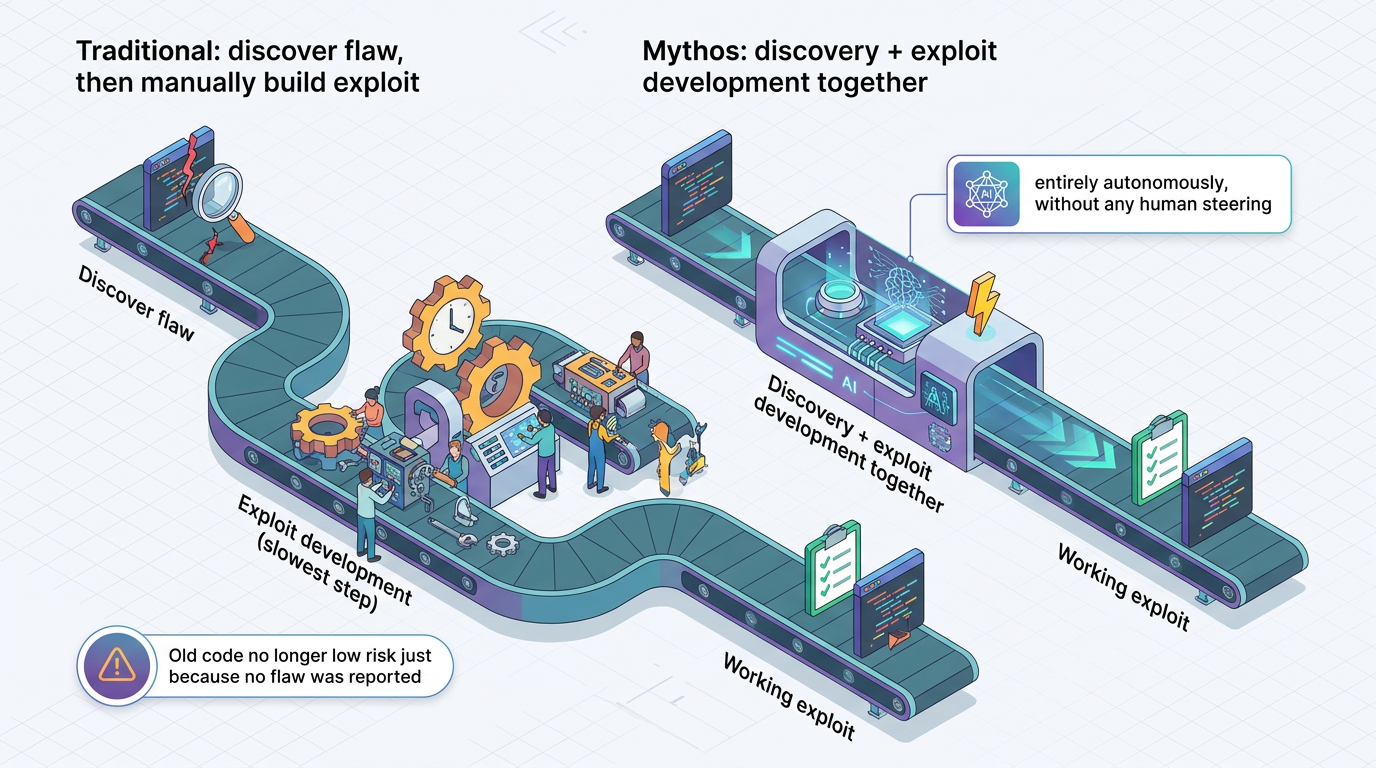
Pairing flaw discovery with exploit development removes the step that used to slow attackers most, the work of turning a discovered flaw into code that reliably exploits it. Autonomous discovery also changes the economics of old code, since software that has gone years without a reported flaw can no longer be treated as low risk on that history alone.
Reported Zero-Day Findings in Open-Source Software
Anthropic's Glasswing announcement highlights findings in widely used software, and one maintainer has published its own record:
OpenBSD: Anthropic cites a 27-year-old vulnerability in OpenBSD that let an attacker remotely crash a machine.
FFmpeg: Anthropic cites a 16-year-old vulnerability in FFmpeg, the media library embedded in a large share of video software.
Firefox: Mozilla Foundation Security Advisory 2026-30, announced April 21, 2026, lists CVE-2026-6746, a high-impact use-after-free in the Document Object Model (DOM), as fixed in Firefox 150 and credits reporters using Claude from Anthropic.
The age of the OpenBSD and FFmpeg flaws matters more than the count, because both projects had been reviewed by human experts for years. Credit practices also vary by project, and public records cannot yet show how much of each discovery was the model's own work rather than the work of the researchers running it.
Benchmark Results and Independent Evaluation
Benchmarks and government testing show a clear capability gain, with limits the testers name themselves. On the CyberGym vulnerability reproduction benchmark, the Glasswing announcement reports what it calls a "substantial difference" between Mythos Preview and Anthropic's next-best model, Claude Opus 4.6.
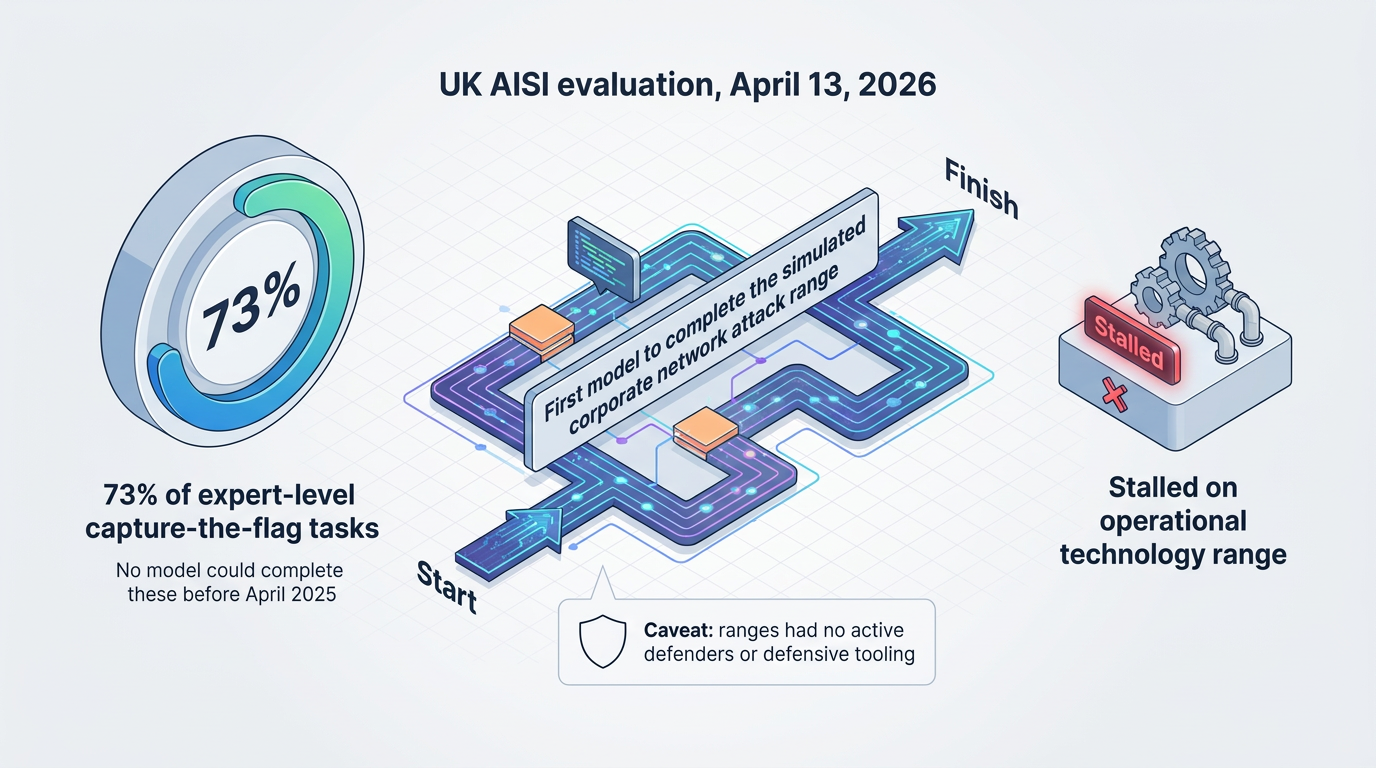
AISI's evaluation, dated April 13, 2026, found Mythos Preview was the first model to complete its simulated corporate network attack range from start to finish. It also succeeded on 73% of expert-level capture-the-flag tasks that no model could complete before April 2025, although it stalled on an operational technology range.
AISI added that its ranges lacked active defenders and defensive tooling, so it could not say whether Mythos could attack well-defended systems. The caveat points straight at the controls defenders already run.
What Changes for Enterprise Defenders
Defenders can expect more disclosed flaws, faster exploit development and heavier pressure on patch deployment, the slowest stage of vulnerability management. Those pressures land on teams whose patch timelines were already slipping before Mythos arrived.
According to the Verizon 2026 Data Breach Investigations Report (DBIR), the median time for organizations to fully resolve vulnerabilities in the Cybersecurity and Infrastructure Security Agency (CISA) Known Exploited Vulnerabilities (KEV) catalog rose to 43 days, from 32 the year before. CISA Binding Operational Directive 26-04, dated June 10, 2026, replaced fixed KEV deadlines for federal agencies with timelines set by public exposure, KEV status, exploit automation and technical impact.
Gated access slows the spread of the strongest models, but it does not guarantee that comparable capability stays out of attackers' hands. Security teams should plan patch capacity on the assumption that it will not, and treat any model they bring into their own defensive work as another privileged system to govern. Abnormal's AI Governance, generally available as part of the AI Security suite, is designed to discover sanctioned and shadow AI tools across an organization and attribute an owner to each one.
Patch pressure arrives unevenly, with internet-facing systems, widely deployed open-source components and products from vendors with slow release cycles at the front of the queue. A published fix for any of them gives attackers a precise map of what to target on systems that have not yet applied it.
How Security Teams Can Prepare for Mythos-Class AI
Preparation means shrinking exposure first, then speeding patches and validation for whatever remains exposed. A system attackers cannot reach does not need the fastest patch, and that frees patch capacity for the systems they can.
How to Tighten Exposure and Patch Management
Each of these controls shortens the time an exploitable flaw stays reachable, and the timelines are suggestions to set against an organization's own risk tolerance:
Control | Why It Matters More | Suggested Timeline |
|---|---|---|
Asset inventory | Unknown systems miss patch windows | Continuous discovery |
Internet-facing patching | Public exposure drives exploit urgency | Days, not weeks |
Actively exploited flaws on critical, exposed systems | Exploits arrive fastest here | Hours, with incident response on standby |
Compensating controls (virtual patching) | Blocks exploitation until a patch ships | While a verified patch is unavailable |
Management interface segmentation | Limits what one exploit reaches | Off the public internet |
Endpoint security, including EDR | Detects exploitation before patching catches up | Ongoing |
Patching after exposure may not remove a compromise that has already happened. Systems that sat exposed before a fix often need forensic triage as well, and exposure history deserves as much attention as the patch date.
How to Validate AI-Found Flaws and Report the Risk to the Board
AI-generated reports need a validation gate before they enter the patch queue. Treating each external report as a finding that may be false, then deduplicating, validating and triaging it, keeps a rising volume of machine-generated reports from swamping the people who apply fixes. Security teams can require a working proof of concept (PoC), confirm reachability in their own environment and log rejected findings to track false-positive rates. Over time, that log shows which sources of AI-generated reports deserve fast-track handling and which need closer review.
A board report built on exposure windows and patch velocity gives a chief information security officer (CISO) numbers to track against an agreed risk tolerance. A CISO can report time-to-patch for internet-facing KEV entries against a target, the count of exposed assets and the dependence on third-party patch timelines, which together show whether the organization is keeping pace.
Why Security Fundamentals Decide the Impact of Claude Mythos
Claude Mythos shows that a model can find long-hidden flaws and build working exploits with little human help, while Anthropic limits direct access to vetted defenders. For most organizations, the effect arrives as a heavier stream of vendor and open-source patches and less time between disclosure and exploitation.
The best teams track their internet-facing assets, set patch timelines based on exposure and known exploitation, and ask vendors how they handle AI-found flaws. Those measures show whether patching keeps pace with faster disclosure and exploitation.
Explore the AI Security platform to see how Abnormal's AI Governance (generally available) and AI Agent Security (in private preview) are designed to discover the AI tools and agents security teams adopt, map their access and flag activity that departs from normal.
Frequently Asked Questions
How does Claude Mythos compare with earlier AI models?
Mythos is stronger than earlier Claude models at the step that used to need a skilled person: turning a known flaw into a working exploit. Labs measure their models in different ways, which makes head-to-head rankings across companies unreliable. Security teams learn more from what a model's findings do to their own patch queue than from any single score.
What should security teams ask software vendors about AI-discovered flaws?
Security teams should ask how each vendor validates AI-generated reports and decides which confirmed findings to fix first as report volume rises. They can also ask whether the vendor publishes a CVE record when the fixed release ships. Patch timing matters most for internet-facing products, because the vendor's release sets the earliest point at which a customer can fix.
Can my organization join Project Glasswing?
Yes, by applying to Anthropic's expanded Cyber Verification Program, which took over from the original Glasswing partner list and offers three access tiers. Approval depends on Anthropic verifying the organization and its defensive use, and most enterprises will therefore feel the model's effect through vendor patches rather than direct access.
Should organizations without Mythos access change their patching plans?
Yes, because the model's effect reaches them through other people's findings. Every flaw a vetted defender finds and a vendor fixes becomes a public patch, and a published patch shows attackers where to look on systems that have not applied it. Shorter internet-facing patch targets and better asset inventory help regardless of who finds the next flaw.
Will AI like Claude Mythos replace penetration testers and security analysts?
No, these roles shift toward validation and judgment, because models can generate findings and exploit drafts quickly. Someone still has to confirm reachability, assess business impact, coordinate disclosure and decide what to patch first, which makes exploit verification and triage of machine-generated reports more valuable skills.