Key Insights
According to an IBM analysis of breach data from the 2026 Cost of a Data Breach Report, security incidents involving unapproved AI use rose from 20% to 43% of organizations studied. A shadow model is an AI or machine learning model that people in an organization build, fine-tune, deploy or use outside the approved model inventory, review and monitoring process.
No one has registered a shadow model's owner, validated its outputs or recorded the data it learned from, yet it may still be answering customers, scoring records or processing confidential files. For a chief information security officer (CISO), an unregistered model is both a governance and a security problem. A model outside the inventory is hard to validate, patch or retire on schedule, and incident responders have no record to work from when it misbehaves.
This guide explains where shadow models come from, how they differ from shadow AI and shadow IT and the data, output, compliance and audit risks they create. It closes with how security teams can find them and bring each one under governance.
What Makes a Model a Shadow Model
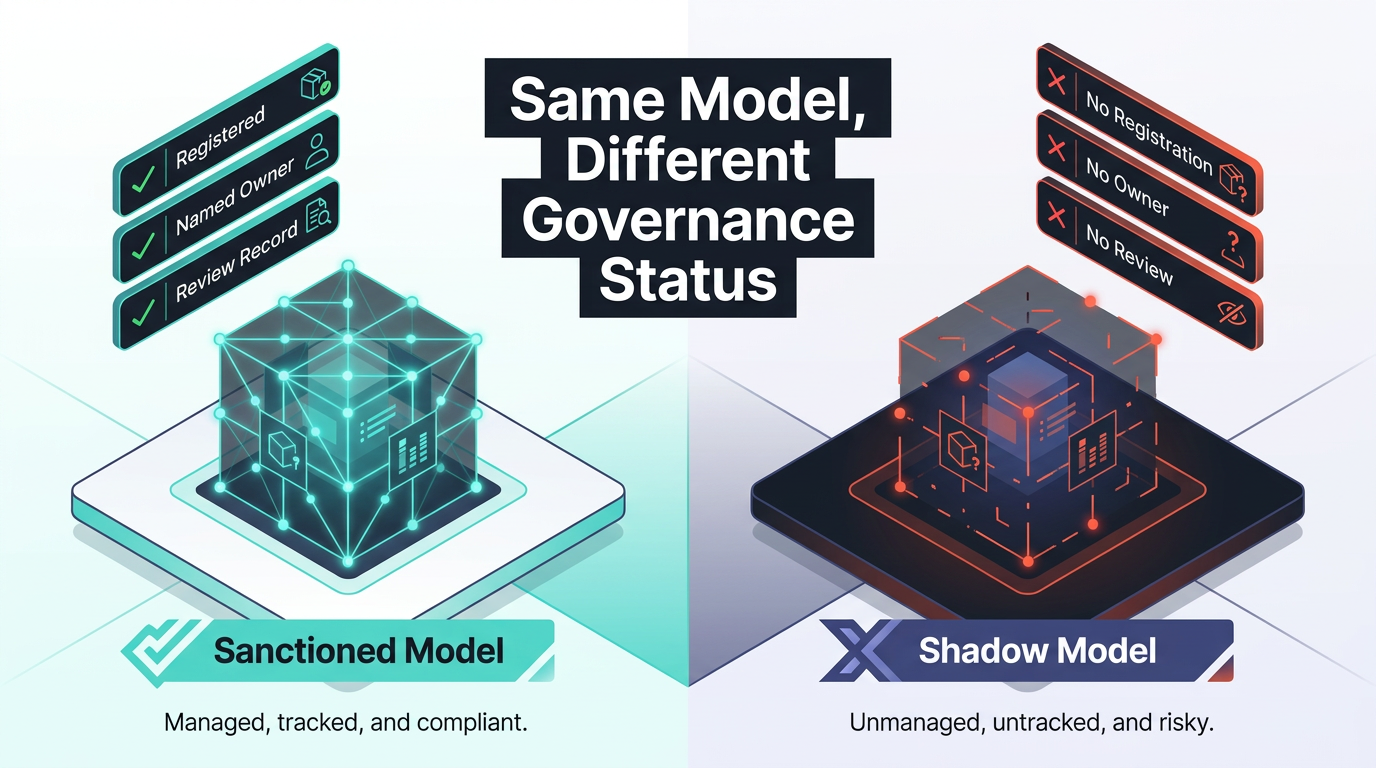
A model becomes a shadow model when it runs without registration, an owner or a review, regardless of where the model came from. The same open-weight model can be sanctioned in one team, with a named owner and a review record, and be a shadow model in another team that downloaded it separately. A vendor feature or a fine-tuned copy can fall on either side, depending on whether it went through review.
Machine-learning privacy research uses the same term for something unrelated: a model an attacker trains to imitate a target model during a membership inference attack. Security teams act on the governance meaning, because that is the one that leaves unregistered models running inside the business.
Common Examples of Shadow Models in the Enterprise
Shadow models start as reasonable shortcuts by people trying to get work done, and each type creates a different blind spot:
Fine-Tuning on Personal Accounts: An employee uploads customer tickets or contract text to a provider's fine-tuning API to build a better assistant. The uploaded files can stay with the provider until someone deletes them, and a fine-tuned model can repeat fragments of its training data in later answers.
Open-Weight Models on Unmanaged Servers: A team runs a downloaded model on a spare graphics processing unit (GPU) instance or a workstation. The UK National Cyber Security Centre (NCSC) secure AI development guidance says imported models or serialized weights should be treated as untrusted code that could allow remote code execution, yet on an unmanaged server no one scans the file format or verifies a hash.
Models Embedded in SaaS Features: A vendor adds generative AI to an already approved application whose original review covered a product without that model. The new feature brings in a dependency the organization never assessed, often without any change to the contract.
Notebooks Promoted to Production: A data scientist's prototype starts answering live requests through a quick API wrapper. Unmanaged cloud test environments and unmanaged code repositories are familiar forms of shadow IT, and a notebook model often sits in both.
None of these routes passes through the approved model inventory, and each leaves its traces in cloud, network or code systems instead.
How Shadow Models Differ From Shadow AI and Shadow IT
A shadow model is the narrowest of the three terms because it names the model artifact itself, whereas shadow AI and shadow IT name the wider use of unapproved tools and assets. Shadow IT covers unknown assets used for business purposes outside asset management, and shadow AI covers AI use that is not captured in approved systems and processes. The terms nest, and each points to a different control:
Term | What It Covers | Typical Example | Main Risk |
|---|---|---|---|
Shadow IT | Any unapproved asset or service | Personal cloud storage | Data outside asset management |
Shadow AI | Unapproved AI tools and services | Chatbot on a personal account | Prompts leaking data |
Shadow model | Unregistered model artifacts | Fine-tuned or self-hosted model | Unvalidated outputs, no audit trail |
The distinction affects ownership, because shadow AI tools can often be handled with an acceptable-use policy. Shadow models also need model-risk practices such as validation, versioning and monitoring, because the organization, or one of its employees, is now running the model.
Why Shadow Models Appear in Organizations
Shadow models appear when building or switching on a model is faster than getting one approved:
Accessible Tuning Workflows: Cloud AI platforms document fine-tuning jobs that a user with the right access permissions can start from a console or an API.
Slow Approval Processes: When a review takes weeks, and a download takes minutes, people route around the review.
Vendor-Embedded AI: SaaS vendors add model-backed features to existing products after the original procurement review.
Open-Weight Models: Once an open-weight model is released, anyone can download a copy and run it on private systems that no one monitors.
Each driver points to an unmet need, and addressing it for models means a fast intake review and a vetted model catalog. Abnormal's AI Governance, generally available as part of Abnormal's AI Security suite, is designed to discover sanctioned and shadow AI tools and agents through email signup messages, OAuth grants and identity signals to support that intake review.
The Security and Compliance Risks of Shadow Models
Shadow models concentrate risk because they combine sensitive data, unchecked behavior and missing records in one unmanaged asset. Each gap also weakens the organization's position when an auditor or regulator asks what a model did.
Data Exposure and Unvalidated Outputs
Training or prompting a model with personally identifiable information (PII), source code or contract data places that data somewhere the organization cannot see. The rise in breaches involving unapproved AI shows how often that exposure now ends in an incident.
An unregistered model's behavior goes just as unchecked, since models are software and can carry vulnerabilities or malicious code. Downloaded models add a second issue, because safeguards are easier to strip from a copy someone controls than from a hosted service. A modified copy can therefore behave differently from its documented version, and no one outside the team running it would know.
Compliance Exposure and Missing Audit Trails
AI regulation, voluntary frameworks and bank model risk guidance all assume the organization can name each model it runs, and each regime turns that assumption into a different duty:
EU AI Act:Regulation (EU) 2026/1744 moved high-risk obligations to December 2, 2027 for Annex III systems and August 2, 2028 for Annex I systems. Article 26 requires deployers of high-risk systems to monitor operation, and Article 26(6) requires them to keep logs under their control for at least six months.
Voluntary Risk Framework: The National Institute of Standards and Technology (NIST), in its AI Risk Management Framework (AI RMF), calls for mechanisms to inventory AI systems, resourced according to organizational risk priorities.
Bank Model Risk Guidance: On April 17, 2026, the Federal Reserve and other US bank regulators replaced SR 11-7 with SR 26-2, which covers traditional and non-generative AI models and excludes generative and agentic AI.
Only the EU AI Act sets legal duties, while NIST AI RMF is voluntary and SR 26-2 states that it does not set enforceable standards, with most relevance to banks above $30 billion in total assets. When an incident involves a shadow model, responders also have no record of its owner, version or training data, and cannot reproduce an output or show a regulator what the model did.
How to Find and Govern Shadow Models
Security teams find shadow models by correlating network, cloud and identity signals, then govern each one by enrolling it in a single inventory with a named owner, an intake review and ongoing monitoring. Discovery has to come first, because a model nobody has found cannot be enrolled or monitored.
Discover Models Through Network, API and Identity Signals
Discovery works best when signals from network logs, cloud audits and code repositories are correlated. Logging AI traffic separately from other network traffic makes model use easier to spot, and egress logs can show calls to model provider APIs. Cloud audits can look for GPU instances, inference endpoints and model registries, while repository scans surface AI software development kit (SDK) imports, model download scripts and embedded API keys.
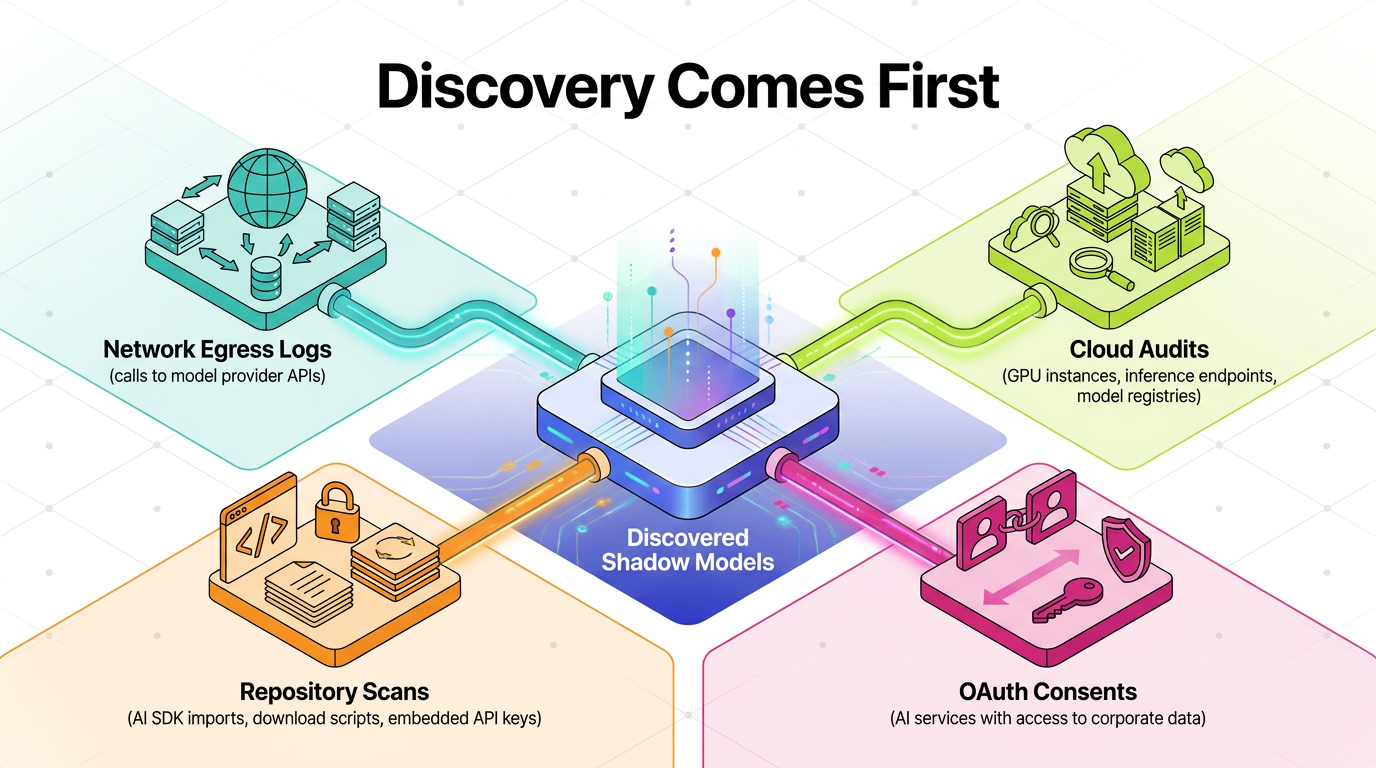
OAuth consents often show which AI services have access to corporate data, making application permission reviews both a discovery source and a hardening step. Regularly reviewing excessive or unused grants catches tools that connected quietly and never came back through security.
Enroll Each Model in an Inventory and Monitor It
The inventory needs a named individual or team responsible for it, and each record should name the owner, business purpose, data sources, model version, file hash and risk tier. Recording a cryptographic hash for each model file lets a team confirm that the model in production is the one that was reviewed.
The intake review should be quick enough that employees use it. Reviewers check data sensitivity, provenance and license, and new models can run in a sandbox until there is enough assurance to trust them. After approval, SR 26-2 gives a usable monitoring standard: evaluate whether the model still performs as expected as data, products and conditions change, and adjust or redevelop it when it does not.
Bringing Shadow Models Under Governance
A shadow model stops being a shadow model once it has a named owner, a version record, a review decision and a monitoring plan. Discovery supplies the list, the inventory holds those records, and a fast intake review keeps new models from slipping back outside it. The same records answer an auditor, a regulator or an incident responder asking what a model did.
Explore Abnormal's AI Governance to see how it is designed to discover sanctioned and shadow AI tools and agents and record a Sanction, Tolerate or Unsanction decision for each one.
Frequently Asked Questions
How is a shadow model different from shadow AI?
Shadow AI covers any unapproved use of AI, including employees pasting data into a public chatbot. A shadow model is the narrower case where a model artifact exists and runs without registration, such as a fine-tuned copy or a self-hosted download. Remediating a shadow model therefore means deletion, validation or formal adoption rather than a policy reminder.
Are open-source models riskier than proprietary ones?
No, not in every case, because the evidence on the added risk of open weights is mixed. Open-weight safeguards are easier to remove, but closed models carry their own data handling and vendor risks. The risk of a given model depends on whether it went through provenance checks, format scanning and inventory enrollment before anyone used it.
What is a shadow model in a membership inference attack?
In privacy research, a shadow model is an attacker's stand-in for a target model. The attacker trains it on data with known membership and uses its responses to train a classifier that estimates whether a specific record was part of the real target's training data, a technique unrelated to unsanctioned enterprise models.