Key Insights
According to Verizon's 2026 Data Breach Investigations Report (DBIR), 45% of employees are now regular users of AI on their corporate devices, up from 15% the previous year. Enterprises secure AI for business by finding every AI system in use, limiting the identities and data each one can reach, and monitoring how those systems behave. Most of that work extends identity, data and detection programs the organization already runs.
This guide covers the AI systems in scope, the risks each one introduces and a control framework mapped to the main AI risk and security standards. It also sets out the regulations that apply and who owns each part of the work, from the first inventory to incident response.
What Counts as an AI System in the Enterprise
An enterprise AI system is any tool, model, agent or cloud workload that processes company data through a machine learning model, and each type puts a different asset at risk:
Employee AI Tools: Chat assistants, coding assistants and AI features inside approved software as a service (SaaS) apps expose whatever employees type, paste or upload.
Custom and Third-Party Models: Models a company trains, fine-tunes, or downloads carry risk in their weights, their training data and the files used to load them.
AI Agents: Systems that plan and act through tools and credentials can read mail, query records and call APIs without a person approving each step.
AI Workloads in the Cloud: Inference endpoints, retrieval pipelines and model hosting add service identities, storage and network paths to the cloud environment.
An assistant mainly needs account and data rules, a downloaded model needs provenance checks before it loads, and an agent needs identity limits and a way to halt it. Programs designed only around chat assistants leave agents and cloud workloads without owners.
The Main Security Risks AI Systems Introduce
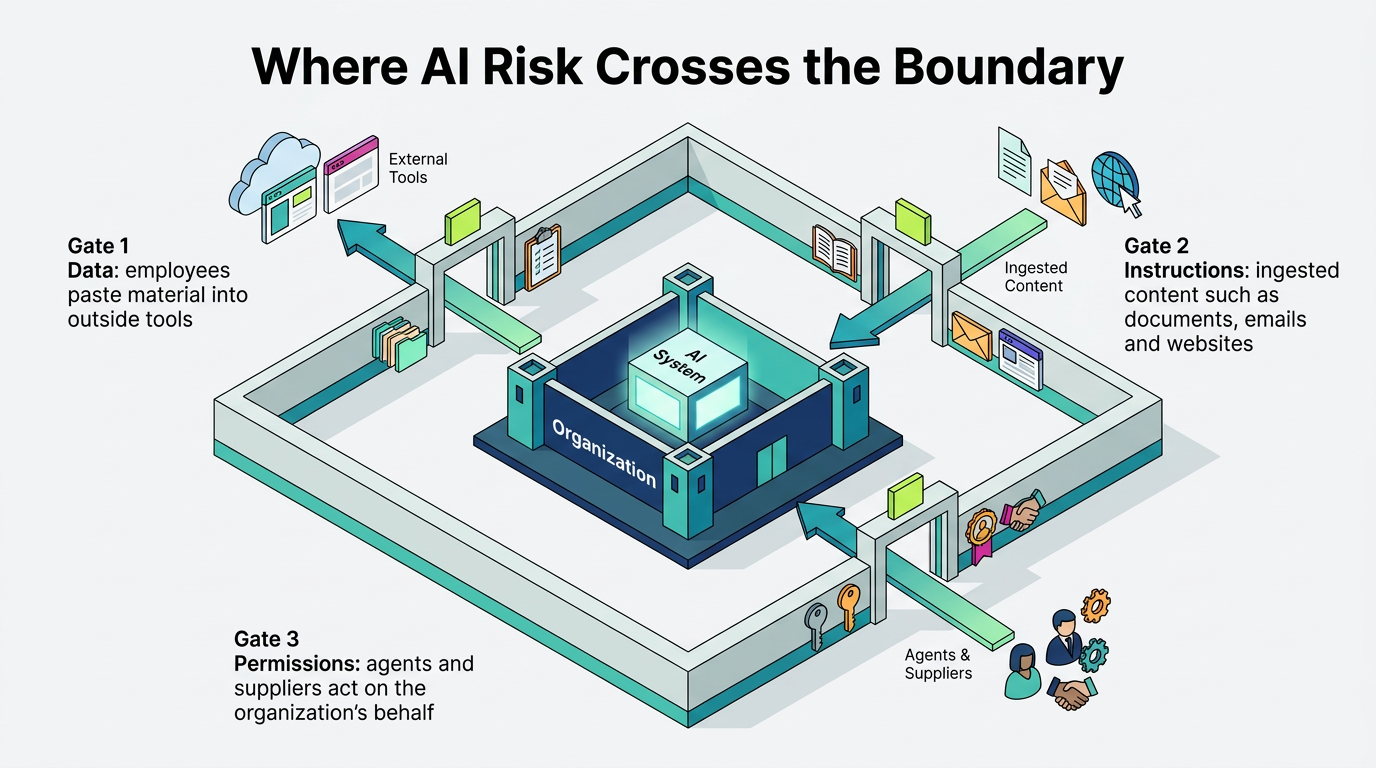
AI systems introduce risk wherever data, instructions or permissions cross a boundary the organization does not control. Data crosses it when employees paste material into outside tools, instructions cross it through ingested content, and permissions cross it when agents and suppliers act on the organization's behalf.
Data Exposure and Shadow AI
Data exposure starts when an employee pastes sensitive material into an AI tool whose retention and training terms the company has not reviewed. The 2026 DBIR reports that source code was the most common data type submitted to external generative AI models, and it ranks shadow AI third among non-malicious insider actions in its data loss prevention dataset.
The Open Worldwide Application Security Project (OWASP) maintains a top 10 risk list for large language model (LLM) applications. Its 2026 edition ranks Sensitive Information Disclosure second, covering personally identifiable information (PII), financial details and confidential business data.
Shadow AI arrives through personal accounts, OAuth grants and new features in approved apps. Personal accounts sit outside single sign-on (SSO), corporate retention settings and offboarding, while OAuth grants give AI apps standing access to mail, files and customer records. Those tokens become targets, and an FBI Internet Crime Complaint Center advisory reports that in August 2025 a threat group exploited compromised OAuth tokens for Salesloft Drift, an AI chatbot integrated with Salesforce.
Prompt Injection and Data Poisoning
Prompt injection attacks manipulate a model through its inputs, and OWASP ranks prompt injection first on its 2026 list. Direct injection comes from a user typing instructions to the model, while indirect injection arrives through documents, emails, databases or websites, and the attacker inherits whatever privileges the AI system holds. Every source an AI system ingests is therefore a possible route for instructions.
The UK AI Security Institute's public agent red-teaming competition reports that more than 60,000 of 1.8 million submitted prompt-injection attacks against frontier AI agents elicited policy violations. Data poisoning works on the other side of the model, corrupting the data it learns from or retrieves and OWASP's Data and Model Poisoning entry covers manipulated pre-training, fine-tuning or embedding data that introduces backdoors, vulnerabilities or biases.
Over-Permissioned Agents and Model Supply Chain Risk
An over-permissioned agent turns a manipulated or mistaken output into a real action across every system its credentials reach. Excessive Agency climbed from sixth place in the 2025 OWASP list to third in 2026, and OWASP traces it to excessive functionality, permissions and autonomy. Permissions also tend to accumulate over time, as an agent picks up access for one task and keeps it after the task ends.
Third-party models, plugins and AI vendors bring risk the organization inherits along with their capabilities. A compromised model can reach a public model hub through the hub's normal publishing features, without anyone breaching the hub itself. Scanning pre-trained models for unsafe file formats before anyone loads them narrows that route.
A Practical Control Framework for Securing AI for Business
A practical control framework groups the work into inventory, access, data protection, monitoring and governance, and maps each area to a function of the National Institute of Standards and Technology (NIST) AI Risk Management Framework (AI RMF) and the OWASP risk it reduces. One mapping then gives engineers, auditors and the board a shared reference for the same controls:
Control Area | NIST AI RMF Function | OWASP LLM Risk Addressed |
|---|---|---|
Inventory and discovery | Map | Supply Chain |
Access and identity | Manage | Excessive Agency |
Data protection | Map, Manage | Sensitive Information Disclosure |
Monitoring, testing, response | Measure, Manage | Prompt Injection, Data and Model Poisoning |
Policy, training, vendor review | Govern | Supply Chain, Improper Output Handling |
Govern cuts across the other four areas, because policy sets the approval rules and risk tolerances that the other controls enforce. Weak policy therefore weakens every other control.
Inventory AI and Control Access to It
An inventory of AI tools, models, agents and owners comes first, because every later control depends on it. It should record how those assets depend on one another as well as what they are.
Discovery signals include AI vendor sign-up and billing emails, OAuth consent grants, identity provider sign-in logs and browser activity, and each entry records the owner, data classes, permissions and approval status. Abnormal's AI Governance, which is generally available, can help discover sanctioned and shadow AI through signup emails, OAuth grants and identity signals.
Least privilege then gives each user, agent and service account only what its task requires, layered with other controls so that one failure does not expose everything. Security teams should enforce SSO and multi-factor authentication (MFA) through the identity provider and use role-based access control (RBAC) to limit who can install AI apps or grant OAuth consent. Service accounts need named owners, scoped permissions and credential rotation, and API keys or permission rules never belong in system prompts, where a manipulated model can reveal them.
Protect Data and Monitor AI Activity
Data protection begins with the account tier, because enterprise and consumer versions of the same assistant often carry different training and retention terms. Teams can also classify data before it reaches AI tools, apply data loss prevention (DLP) policies to prompts and uploads, and track the provenance of any data used to train or ground a model.
Monitoring means logging inputs, outputs, intermediate states and errors, with automated alerts, and sending those logs to the security information and event management (SIEM) platform alongside other security data. Red teaming tests whether safeguards hold under deliberate attack, and penetration tests should cover plugins, integrations and retrieval sources. Incident response adds revoking agent credentials and OAuth tokens, disconnecting inbound connections and restoring a known good state.
Govern AI With Policy, Training and Vendor Review
An acceptable use policy should name approved tools, the data classes each may receive, the corporate-account requirement, human review of outputs, prohibited uses and the process for requesting a new tool. Training works best when it is tailored to each staff role. Vendor review gives procurement evidence that an AI supplier will protect the data it receives, and the evidence worth asking for covers security, AI management and data handling:
SOC 2 Report: A current System and Organization Controls 2 (SOC 2) report is an attestation by a licensed certified public accountant.
ISO/IEC 27001: Certification shows the supplier runs an information security management system.
ISO/IEC 42001: Certification from an independent body shows the supplier runs an AI management system.
Data Terms: A data processing agreement (DPA), data residency options and stated training and retention defaults set how data is handled.
Health Data: A business associate agreement (BAA) is needed where protected health information is involved.
Change Notice: Advance notice of changes to terms or data processing gives the reviewer time to reassess.
Running these checks inside the acceptable use policy's single approval path means every new AI supplier is reviewed before production data reaches it. Where a supplier offers a SOC 2 report but no ISO/IEC 42001 certificate, the reviewer should ask how it governs its own AI, because a SOC 2 examination covers security, availability, processing integrity, confidentiality and privacy controls rather than AI management.
How Securing AI Agents Differs From Securing AI Tools
Securing an AI tool centers on what people send to it, while securing an agent centers on what the agent can do with its own credentials and how quickly someone can stop it. Agent controls therefore start with a separate identity for each agent, short-lived credentials scoped to the task, human approval for high-privilege or irreversible actions, a way to halt the agent and revoke its credentials, and tamper-resistant logs of every tool call.
Agents also need an inventory entry recording each agent's owner, credentials, tools and reachable data, and that record is what surfaces broad or unrestricted access, especially to sensitive data or critical systems, before it causes harm. Abnormal's AI Agent Security, in private preview as part of the AI Security suite, is designed to inventory first- and third-party agents and their owners, map credentials, tools and permissions, flag off-baseline activity, such as an agent calling a new tool and support automated response and containment.
Regulations and Frameworks That Apply to Enterprise AI
Privacy law already governs enterprise AI use, and AI-specific rules and standards add obligations by risk level, role and sector:
General Data Protection Regulation (GDPR): Article 35 requires a data protection impact assessment before high-risk processing, and Article 22 restricts solely automated decisions with significant effects.
Health Insurance Portability and Accountability Act (HIPAA): Covered entities need a BAA with AI vendors handling protected health information.
California Consumer Privacy Act (CCPA): California's regulations on automated decision-making technology add duties for businesses that use such tools to make significant decisions about consumers.
EU AI Act: The Act sorts systems by risk, with prohibitions applying from February 2, 2025 and general-purpose AI model obligations from August 2, 2025. Regulation (EU) 2026/1744, in force since July 27, 2026, moved Annex III high-risk obligations to December 2, 2027, and Annex I high-risk obligations to August 2, 2028.
NIST AI RMF and ISO/IEC 42001: Both are voluntary, and ISO/IEC 42001 certification gives buyers independent evidence of an AI management system.
The EU dates are the firmest deadlines on the list, and they arrive while privacy duties already apply. NIST AI RMF and ISO/IEC 42001 set no deadlines of their own, but they give teams one structure for the controls that meet every regime at once.
How to Start Securing AI and Who Owns Each Part
Securing AI starts with finding what is in use, then adds identity, data and monitoring controls in that order, with security, IT, legal, privacy and business teams each owning part of the work. Teams typically begin with an AI inventory, an acceptable use policy and one approval path, then add SSO and MFA, move users off personal accounts and apply DLP to prompts. SIEM logging and red teaming follow, and agents come last, each registered with an owner and scoped credentials.
Security duties split across developers, system operators, data custodians and end users, and one organization often holds several of those roles at once. The chief information security officer (CISO) owns the AI security program, monitoring and incident response, while the chief information officer (CIO) and IT own provisioning, SSO and operation.
Legal and privacy own DPAs, impact assessments and regulatory mapping and data owners act as data custodians. An AI governance committee approves tools and exceptions, and engineering teams carry developer duties such as documentation and supply chain checks.
Building a Secure Foundation for Enterprise AI Adoption
An owner makes someone accountable for each AI system, scoped access limits how far a manipulated agent or stolen token can reach, and logged activity records what happened. A policy mapped to NIST AI RMF functions and OWASP risks ties these controls together. In an incident, teams with those controls in place can show who owned each system and what it exposed.
Explore the AI Security platform to see how Abnormal's AI Governance (generally available) and AI Agent Security (in private preview) are designed to help security teams discover the AI tools and agents in use, map their access and govern how they are used.
Frequently Asked Questions
Who should own AI security in an enterprise?
The CISO is usually the accountable executive and reports AI risk to the board alongside other cyber risk. The governance committee handling daily decisions needs authority to approve, restrict or retire tools, plus a clear tie-breaker for disputes with business units.
How do you find AI tools already in use?
Security teams combine technical signals with expense reports and direct conversations, because paid tools and personal accounts often escape the logs. An amnesty that lets people report use without penalty surfaces more tools and builds trust in the approval process.
How should teams handle an approved app that adds AI features after review?
Teams should treat the new AI feature as a change to the original approval and route it through the same review a new tool gets. The reviewer confirms which data classes the feature can reach, whether the vendor trains on or retains that data and whether an admin can keep it off until cleared, while contract terms requiring advance notice buy time for that review.