Key Insights
The Office of Management and Budget issued OMB memorandum M-25-21 on April 3, 2025, requiring each Chief Financial Officers Act agency to run an AI governance board. The chair sits at Deputy Secretary level, with the agency's Chief AI Officer as vice-chair. Private organizations face the same question without the mandate, and they answer it with an AI governance committee.
Whether that committee decides or only meets depends on written decision rights, a risk-tiered intake path and an escalation ladder ending with named executives. Without them, use cases wait in a queue while employees adopt AI tools on their own.
This guide builds one step by step, covering who holds each seat and what belongs in the charter. It follows how use cases arrive and get tiered, where decisions escalate, and the measures that show what it has become.
What Is an AI Governance Committee?
An AI governance committee sets AI policy and risk appetite, approves high-risk use cases and exceptions, owns escalation and reports to executives or the board. Its defining feature is decision authority within the wider AI governance program, and it turns the governance function of the NIST AI Risk Management Framework into recurring decisions rather than a policy document.
Neighboring bodies get confused with it. An AI steering committee sets strategy and prioritizes investment, while an AI ethics board reviews ethical implications and usually advises. Because organizations use these labels loosely, what separates a decision body from an advisory one is whether its charter grants authority to approve or block a use case.
Who Should Sit on an AI Governance Committee?
An AI governance committee should seat leaders from security, legal, privacy, compliance, data and AI engineering, the business and HR, each with the authority to stop or reshape an AI deployment. Seats go to leaders rather than delegates, because a member who cannot commit their function to a decision can only advise. Each seat carries a distinct share of organization-wide AI responsibilities, owning the part of the review no one else can sign off:
Security: Control requirements, threat modeling and the AI incident path.
Legal: Regulatory obligations, contract terms and intellectual property risk.
Privacy: Data protection review and personal data in prompts, training and outputs.
Compliance: Policy mapping, audit evidence and exception tracking.
Data and AI Engineering: Technical feasibility, model evaluation and the AI inventory.
Business Owners: The use case, its benefits and the residual risk they accept.
HR: Workforce impact, AI literacy training and employee-facing policy.
A chief information security officer (CISO) may chair or co-chair with a legal or data leader. Roughly seven to nine voting members, with specialists invited per agenda item, keeps quorum reachable and accountability clear.
How to Build an AI Governance Committee Step by Step
Building an AI governance committee starts with an executive mandate, moves through structure, charter, intake and decision rights, and ends with a link into incident response. The order matters because each step depends on the authority the previous one established, and a charter cannot allocate a mandate the sponsor has not yet granted.
Step 1: Secure an Executive Sponsor and a Mandate
Leadership can choose an executive who owns enterprise risk or operations, such as the chief operating officer or chief information officer, as sponsor. Because NIST places decisions about AI risk with executive leadership, the written mandate should state whether the committee decides or advises.
The mandate should also name which decisions leadership delegates and which it keeps, and which board body receives committee reports. The chair points to that mandate when a business unit pushes back on a rejected tool.
Step 2: Split the Committee Into Two Tiers
A working group handles day-to-day reviews such as new tool requests, low- and medium-risk use cases, vendor questionnaires and routine exceptions. An executive group meets less often to decide high-risk use cases, risk appetite changes and contested escalations. The working group needs practitioners who can read a data flow diagram and a contract, the executive group needs leaders who can accept risk for the business, and the chair sits in both to carry context.
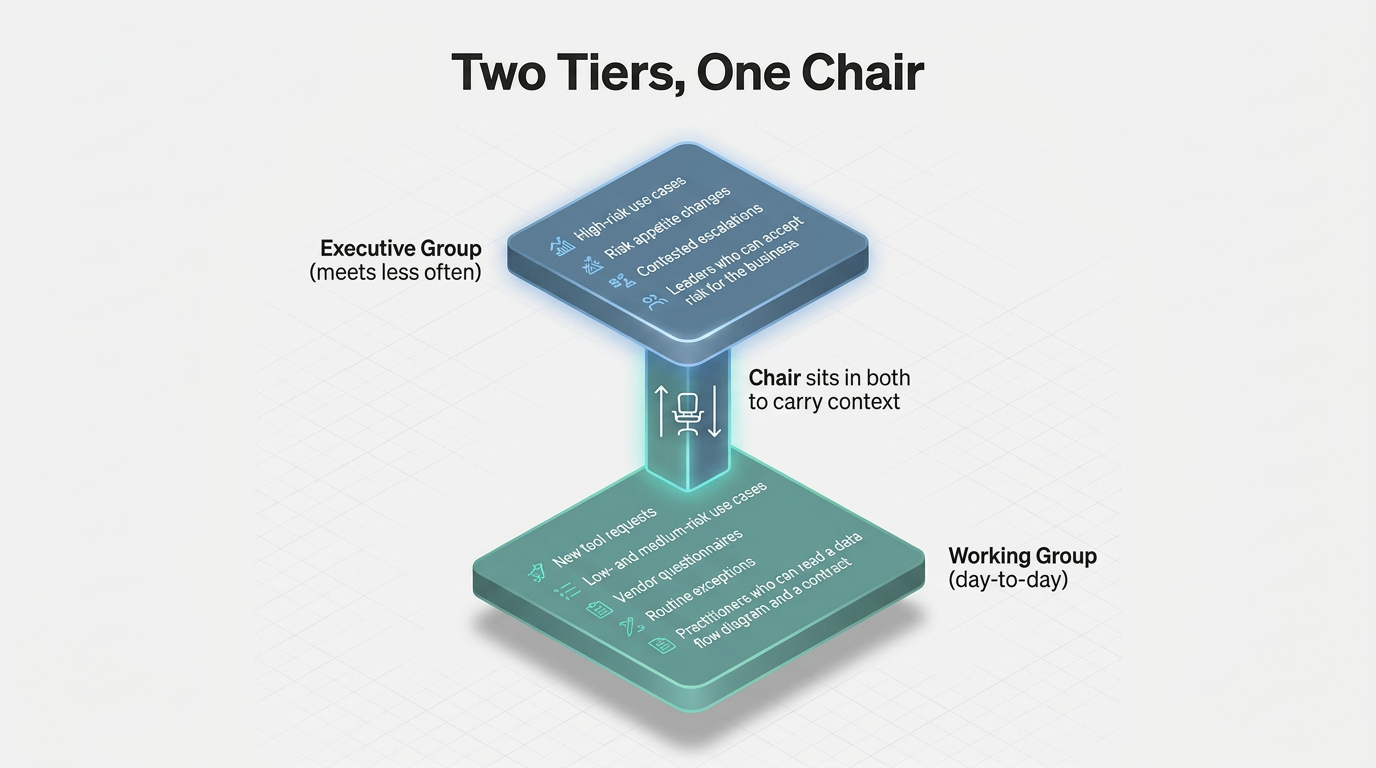
A smaller company can run one group with a single executive approver, while a large enterprise may need business-unit working groups feeding one executive group. Routing every decision upward backfires at any size, because leaders rubber-stamp routine items they lack time to read.
Step 3: Write the Charter
The charter turns the mandate into rules the committee applies without renegotiating them each meeting. The working group drafts it, the sponsor approves it because it assigns authority the committee does not hold on its own, and the chair publishes it where requesters can find it.
The first version is usually wrong about review timelines or tier ownership, so the sponsor can treat the opening quarter as a trial and amend it where requests stall. A charter copied from a board committee misses the decisions an AI committee makes most often, among them use-case intake, exceptions and incident escalation. Beyond those, a workable charter fixes the points that otherwise get argued mid-request:
Purpose and Scope: The risks it governs, across internal builds, third-party tools, embedded features and agents.
Membership and Chair: Seats by role, plus the chair, vice-chair and alternates.
Decision Rights and Escalation: What the committee decides, delegates and escalates, and the thresholds for each.
Quorum and Voting: Majority quorum, tie-breaks and electronic votes for urgent decisions.
Intake and Cadence: The intake form, risk tiers, fast path, target timelines and meeting frequency per tier.
Review and Amendment: Annual review, with sponsor approval of amendments.
Aligning the charter with the broader cybersecurity governance program keeps AI decisions in the risk language the board already knows.
Step 4: Set Up Use-Case Intake and a Risk Rubric
One short form can capture the business owner, data types, vendor, model or tool, whether the system acts autonomously, and who the output affects, with every approved request joining the AI inventory NIST asks organizations to maintain. Reviewers then score requests against a rubric of three or four tiers covering data sensitivity, external exposure, degree of autonomy and whether outputs drive decisions about people. M-25-21 takes a similar approach, with a single high-impact category for heightened review.
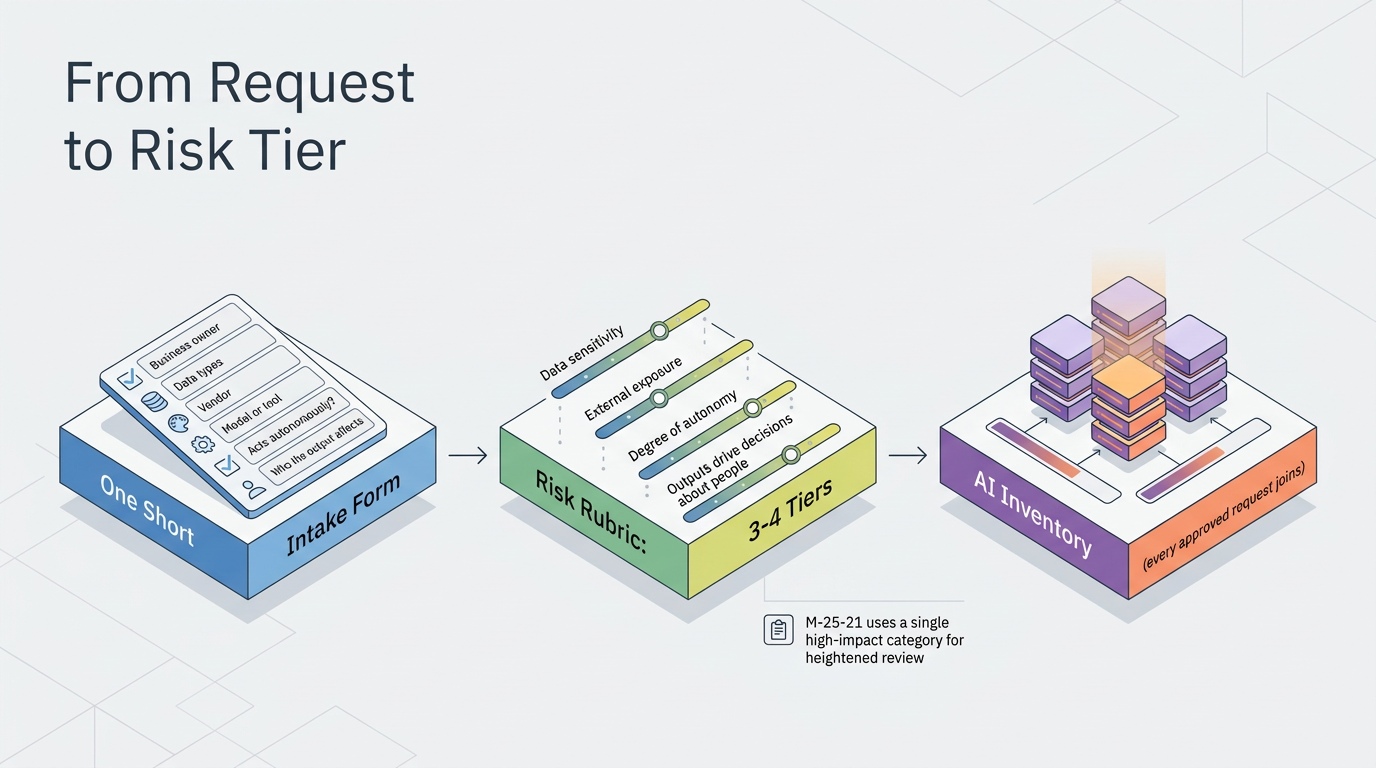
Low-risk requests should get a fast path with pre-approved controls and a published timeline, and the rubric should tie back to the AI security policy so requesters know the rules beforehand. A slow queue pushes employees toward unapproved tools, and those never reach intake. Abnormal's AI Governance, which is generally available, can help surface them and their owners so they enter review instead of staying hidden.
Step 5: Define Decision Rights and Escalation
Every decision type needs a single accountable owner, and NIST asks that roles, responsibilities and lines of communication for managing AI risk be documented and clear across the organization. Escalation then climbs only as far as a decision's risk requires, with each rung taking the decision further from the people closest to the request:
The committee decides alone within approved risk appetite.
The chair or sponsor decides ties, out-of-appetite requests and exceptions above a set threshold.
The board audit or risk committee receives material incidents, risk appetite changes and accepted high residual risk.
Thresholds written into the charter keep escalation routine, and M-25-21 requires waivers to rest on a written, system-specific risk assessment, tracked centrally and recertified annually. Private organizations can adopt the same discipline by adding an expiry date to every exception, the rung most often left undefined.
Step 6: Set the Operating Cadence
The working group can meet every two weeks or monthly and the executive group quarterly, with an ad hoc session when a high-risk request or incident cannot wait. A standing agenda covers open requests by tier, expiring exceptions, recent incidents and near misses, vendor changes and inventory gaps.
The chair logs each decision, its owner, conditions and review date, which gives auditors evidence and feeds the committee's own periodic reviews. The charter should also define how urgent decisions happen between meetings, such as electronic votes, since without that provision holding a decision for the next scheduled meeting turns a two-week cadence into a two-week delay.
Step 7: Connect the Committee to Security Operations and Incident Response
The committee sets AI incident policy and the security operations center (SOC) runs the response. Building on the existing incident response and recovery process, the plan should define an AI incident, add AI-specific triage steps and name the handoffs between SOC and committee. Without those handoffs, AI incidents stay out of SOC runbooks until the first one arrives.
Under EU AI Act Article 73, providers of high-risk AI systems must report a serious incident within 15 days of becoming aware of it. That deadline falls to two days for a widespread infringement or a serious disruption of critical infrastructure.
Agents need threat modeling before approval. The Open Worldwide Application Security Project (OWASP) lists goal hijack, tool misuse, and identity and privilege abuse among the risks in its Top 10 for Agentic Applications. Approval conditions that address those risks include least-privilege credentials, human approval for consequential actions and a tested way to halt the agent.
Who Is Accountable for Tool, Use-Case, Exception, Incident and Vendor Decisions?
The committee chair is accountable for approving new AI tools, granting exceptions, responding to AI incidents and reviewing vendors, while the executive sponsor is accountable for approving high-risk use cases. Exactly one role is Accountable (A) for each decision, and the others are Responsible (R), Consulted (C) or Informed (I):
Decision | Executive Sponsor | Committee Chair | Working Group | Legal and Privacy | Security Operations | Business Owner |
Approve a new AI tool | I | A | R | C | C | C |
Approve a high-risk use case | A | R | C | C | C | C |
Grant a policy exception | I | A | R | C | C | C |
Respond to an AI incident | I | A | C | C | R | I |
Review an AI vendor | I | A | R | C | C | I |
When two roles both claim Accountable, the chair names one owner and writes it into the charter before the next request of that type arrives.
How Do You Know the Committee Is Working?
A committee is working when reviewers decide on time, owners close exceptions, and AI use outside the inventory falls. Each measure is one the chair can pull monthly from the decision log:
Decision Turnaround: Median days from intake to decision, by risk tier.
Open Requests and Exceptions: How many are awaiting a decision, and how many are past expiry.
AI Incidents Reviewed: Incidents and near misses with a completed after-action review.
Shadow AI Discovered: AI tools found in use without approval.
The chair sets a turnaround target per tier from the committee's own cadence, with fast-path requests closing before the next working-group meeting and high-risk ones at the next executive session.
The same measures show when a committee drifts back into being a meeting. Rising turnaround and rising shadow AI together point to endless deliberation, which reviewers address with the fast path and decision deadlines.
Approvals running near total and carrying no conditions point to rubber-stamping, which the chair addresses by requiring written risk rationales for high-risk decisions. Decisions arriving without a named owner point to accountability by committee, and the chair addresses those by rejecting the record until someone signs it.
The Records a Working Committee Leaves Behind
A committee that decides leaves a trail of dated exceptions, named owners against every decision, and a SOC runbook that says when an AI incident goes to the chair. Those records are what the sponsor reads when judging whether the committee has earned the authority its charter gave it.
Part of Abnormal's AI Security suite, AI Governance is generally available and designed to track compliance and regulatory gaps across the AI tools a committee oversees. Explore AI Governance to see how that view feeds the record behind every intake and exception decision.
Frequently Asked Questions
What should the committee do when a business unit ignores a rejection?
The chair escalates to the executive sponsor, whose written mandate gives the decision its force, and the outcome goes into the decision log. If the tool stays in use, the working group treats it as shadow AI and offers the business owner an approved alternative or a dated exception.
How should the committee handle an AI agent already in production?
The working group runs the agent through the same intake form and risk tier as a new request, adds it to the inventory and threat-models it. Until least-privilege credentials, human approval for consequential actions and a tested way to halt it exist, the chair carries it as a dated exception, or the committee retires it.
Does a small company need an AI governance committee?
Yes, a small company needs the functions of an AI governance committee, though not necessarily a large formal body. One group of three to five people, a short intake form, a risk rubric and one executive approver for high-risk decisions can cover the core work.