A social engineering risk assessment measures how susceptible people are to manipulation and how that susceptibility could affect an organization. Because human susceptibility shifts with circumstances, organizations face a difficult question: how can they measure something so variable before a real attacker exploits it? Getting that measurement right determines whether a security program can prioritize human-focused defenses with the same rigor it already applies to technical ones.
Key Takeaways
A social engineering risk assessment evaluates susceptibility to manipulation. It belongs in a different category from vulnerability scans and network penetration tests.
Your human attack surface includes employee roles and access levels, publicly available staff information, individual behavioral tendencies, and third parties working inside your environment.
A credible assessment requires legal authorization, open-source reconnaissance, simulations across multiple channels, and measurements that account for scenario difficulty.
Training produces limited measurable change on its own, so human-focused programs work best alongside technical controls.
What a Social Engineering Risk Assessment Measures
A social engineering risk assessment tests decisions under simulated manipulation.
A vulnerability assessment examines systems and configurations. A social engineering assessment examines whether an employee will act on a plausible instruction from an impostor. It can measure whether employees click, submit credentials, approve a request, disclose information, or report the interaction through an approved channel. These findings belong alongside technical findings in the organization's record of important risks, often called a risk register.
A misconfigured firewall behaves the same way on a Tuesday morning and a Friday afternoon, but a finance manager three days from quarter close may not. Workload, timing, authority, and familiarity can all change how an employee responds. Measuring those differences shows where manipulation could bypass established controls and which safeguards could reduce the impact.
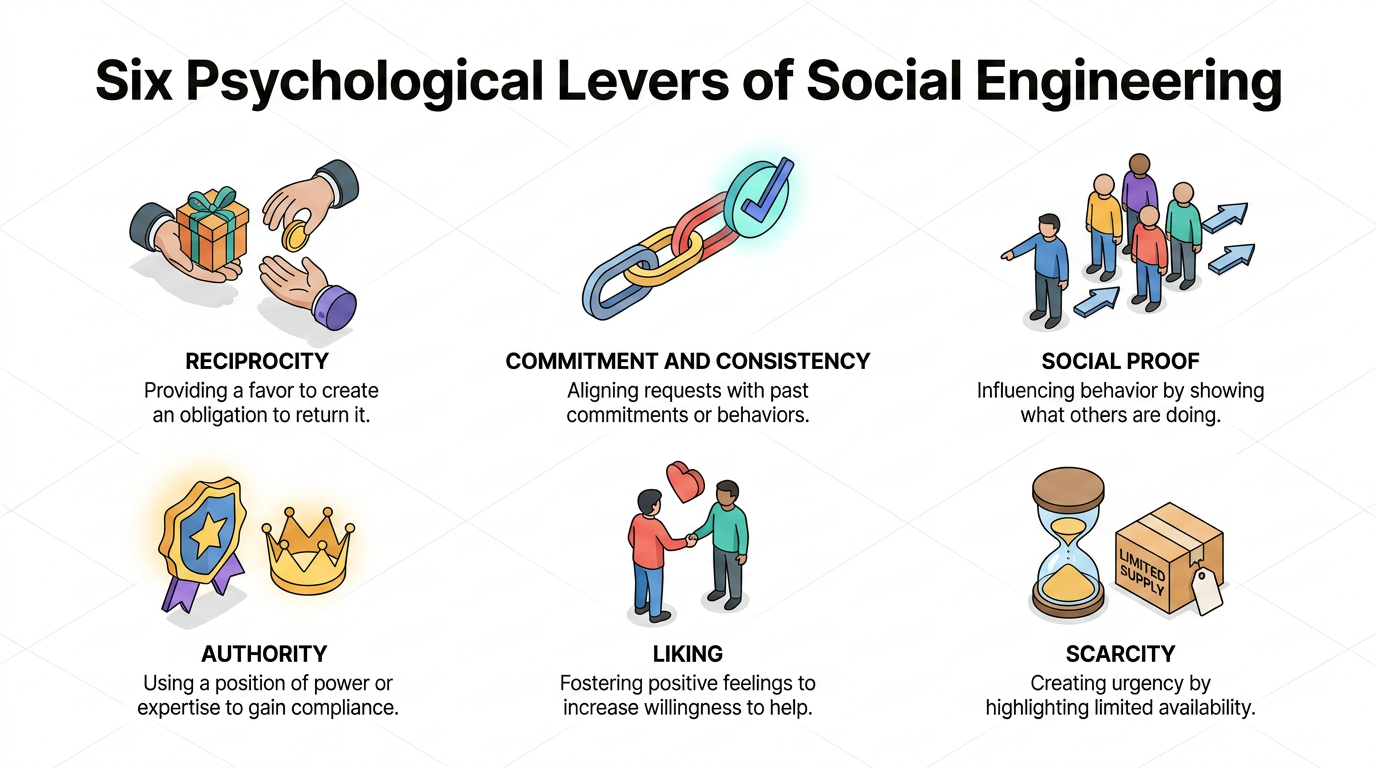
Social engineers rely on six psychological levers to move people toward unsafe actions:
Reciprocity
Commitment and consistency
Social proof
Authority
Liking
Scarcity
An employee may comply with a caller who claims to be the chief financial officer or an information technology employee closing a support ticket, even though no technical exploit is involved. Voice calls intensify that pressure because the employee has less time to inspect the request, consult a colleague, or notice inconsistencies. A realistic assessment therefore tests whether context and persuasion can move an employee toward an unsafe action. Detecting a misspelled domain measures only one cue.
What Shapes Your Human Attack Surface
Your human attack surface reflects who attackers can reach, what those people can access, what public information reveals, and how circumstances influence behavior.
Roles and Access Define Potential Impact
Wire-transfer authority creates a different attack path from domain administration or help desk credential resets. Administrators, finance approvers, help desk staff, executives, and third parties with sensitive access therefore warrant more focused testing than the wider population. Contractors and vendors also belong in the assessment because authorized access determines potential impact. A manipulated person using authorized access can harm people, systems, information, facilities, or the organization's mission.
Public Exposure and Behavioral Context Shape Susceptibility
Public exposure makes those attack paths easier to personalize. Open-source intelligence (OSINT) from professional profiles can reveal positions, reporting relationships, projects, and interests. Scattered Spider has used social media to research staff before calling targeted organizations to elicit sensitive and actionable information. The Cybersecurity and Infrastructure Security Agency (CISA) describes this pattern in a CISA advisory about actors posing as company information technology or help desk staff and persuading staff to reset passwords and multi-factor authentication (MFA) tokens. Leaked credentials in breach dumps or public channels create additional exposure that staff training cannot remove.
Behavior also shifts with workload, role, context, and individual habit. Heavy email volume can trigger automatic rather than deliberate processing. Quick mental shortcuts can then weaken conflict detection. One organization-wide figure hides that variation, so useful reporting groups staff by similar responsibilities and records failures and the work employees were performing. It also identifies the persuasive technique that influenced the outcome.
Attack Types Your Assessment Should Cover
A useful assessment covers message-based, voice, physical, and multi-stage manipulation.
Email and Financial Impersonation Exploit Familiar Context
Phishing uses fraudulent messages to pressure recipients into unsafe actions such as clicking or disclosing information. Broad phishing often creates urgency or curiosity by exploiting fear of missing a deadline, while spear phishing researches a target and tailors the message. Whaling applies the same method to executives and other privileged accounts. Business email compromise (BEC) often adds a fraudulent payment or transfer request, sometimes from a legitimate account that the attacker already controls.
According to the Federal Bureau of Investigation (FBI), its IC3 annual report states that the Internet Crime Complaint Center (IC3) recorded $3.046 billion in reported BEC losses for 2025. Assessment scenarios can test whether recipients verify financial requests through a separate channel. Familiar sender details alone do not validate a request. That verification principle also applies beyond email.
Voice, Physical, and Incentive-Based Tactics Test Other Defenses
Other methods expose weaknesses that an email campaign cannot represent:
Vishing uses voice calls to exploit authority and real-time pressure, while smishing delivers similar manipulation through text messages.
Pretexting builds a plausible story across one or more conversations and often uses details gathered during reconnaissance.
Tailgating applies manipulation to physical access by following authorized staff through a controlled door and relying on the social reflex to hold it open.
Baiting offers something desirable, such as a free download or planted universal serial bus drive, while quid pro quo trades a service for information and relies on reciprocity.
Together, these methods expose different weaknesses, which is why one phishing campaign cannot represent the full human attack surface.
Frameworks That Anchor Human Risk Testing
Existing risk and security-testing frameworks establish boundaries for assessing human risk, so organizations do not need to invent a methodology from scratch.
Human-factor findings belong alongside risks to organizational operations, assets, and individuals. Written authorization letters and rules of engagement define what testers may do, who may participate, and how the organization will manage sensitive information. An awareness program should consider multiple forms of manipulation, including phishing, pretexting, impersonation, baiting, quid pro quo, social media exploitation, and tailgating.
The National Institute of Standards and Technology (NIST) connects employee behavior to a wider cybersecurity program through the NIST framework, which places awareness and training within the Protect function. Similar risk-management practices apply to organizations that work across jurisdictions or follow international standards. These frameworks give human-focused findings the same governance context as technical findings and integrate simulations into the wider cybersecurity program.
In practice, the frameworks help an assessment identify possible failures and estimate their likelihood and harm. They also help select controls that would reduce the risk and clarify accountability before testing starts. When authorization, data handling, permitted techniques, and escalation procedures follow a recognized risk process, the organization can conduct realistic simulations without creating unnecessary legal, ethical, or operational exposure.
How to Conduct a Social Engineering Risk Assessment
A credible social engineering risk assessment progresses through authorization, reconnaissance, controlled execution, reporting, and remediation testing.
Define Scope and Authorization
Scope definition identifies the employee groups and channels under review. It also sets limits on the techniques testers may use. Typical exclusions cover threats, real harm, personal crises, and employee categories that require special handling. Written rules of engagement establish the date range and permitted activities and name the operators and emergency contacts. They also define the approval process for changes.
The plan also explains how the testing team will store and destroy captured credentials and personal data. These procedures make authorization and privacy boundaries explicit before activity begins.
Conduct Reconnaissance and Controlled Testing
Reconnaissance follows because it shows what an attacker could learn from public sources and which scenarios would appear realistic. Testers can then conduct phishing email and vishing calls to help desk and vendor contacts. Testers may attempt tailgating and examine discarded information. Unattended workstations present another physical test. This sequence reflects actual exposure without exceeding legal, ethical, or operational limits.
Report Findings and Retest Controls
Organizations can keep the exercise non-punitive through private feedback and refresher training after a failure. An open reporting channel provides further support. Public shaming can discourage the prompt reporting that security teams need. Reports should explain the scope, method, findings, supporting evidence, and specific fixes, after which remediation continues through retesting.
Technical controls work alongside behavioral measures during that loop. Current CISA guidance identifies phishing-resistant MFA as a primary control for credential phishing, while application controls and endpoint detection can limit malware delivery. Retesting shows whether those combined changes reduce either the likelihood or impact of a successful manipulation attempt.
Metrics That Quantify Human Susceptibility
Useful measurement adjusts observed unsafe actions and defensive reporting for scenario difficulty.
Action and Reporting Metrics Separate Different Outcomes
Three metrics separate different outcomes of the same simulation:
Click Rate: The share of recipients who selected a simulated link, though lure difficulty can influence it as much as employee capability.
Report Rate: The share who flagged the message through an approved channel, revealing defensive behavior that click rate misses.
Credential-Submission Rate: The share who typed a password into the landing page, a materially different failure from a curious click.
A person might click and then report the message, while another might ignore it without recognizing or reporting the threat; those outcomes provide different evidence about susceptibility and about whether detection leads to recovery.
Difficulty-Adjusted Scores Make Campaigns Comparable
Difficulty-adjusted scoring adds the observable cues in a simulated message and the scenario's fit with the recipient's organizational context. The NIST Phish Scale provides a structured way to evaluate those factors. Without that context, a low click rate can create false confidence because an email was too easy or familiar.
Comparing campaigns therefore requires context for the percentages. A convincing, role-specific request and an obvious generic lure do not test the same skill, nor do campaigns sent to populations with different responsibilities. Recording difficulty helps decision-makers determine whether results reflect the tested population and scenario difficulty rather than stronger detection. Over time, balanced measurement produces a clearer picture of susceptibility and reporting behavior while preventing the program from focusing only on a low click rate.
Common Misconceptions About Human Risk Assessment
Training cannot eliminate human error, and phishing simulations cannot represent every meaningful form of social engineering.
A UC San Diego Health trial found that embedded phishing training reduced click likelihood by only about 2%. The Institute of Electrical and Electronics Engineers (IEEE) published a related IEEE study covering employees at a large healthcare organization. It concluded that such programs "in their current and commonly deployed forms, are unlikely to offer significant practical value in reducing phishing risks." Completion logs measure attendance. Behavioral outcomes require separate measurement.
Organizations should continue awareness work while planning for some phishing attempts to succeed. They should pair awareness with passwordless authentication and thorough email filtering. Incident response should assume compromise is possible. Blaming users can undermine that approach because employees who fear consequences may hide mistakes. This gives attackers more time and deprives security teams of the reports they need.
Email simulations also cover only one channel. A complete assessment considers voice calls, text messages, physical access, and multi-stage impersonation, particularly where staff handle payments, credentials, confidential information, or privileged access. It should measure both susceptibility and detection behavior across roles and privilege levels. Simulations at varying difficulty show how context influences decisions, while a campaign made only of easy lures says little about whether staff can identify a convincing request from someone who appears to understand the organization.
How AI Is Reshaping Assessment Scope
Generative artificial intelligence (AI) makes existing social engineering methods cheaper, faster, and more convincing. This changes what a credible assessment should simulate.
Scalable Lures Make Polished Messages Easier to Produce
The FBI warning explains that AI can augment schemes attackers already use. It increases automation, which lets attackers work faster and at larger scale. Machine-written lures can arrive with proper grammar, correct spelling, tailored details, and enough volume to reach many potential targets. The underlying manipulation remains the same, and the cost of producing polished, personalized content has fallen.
A program that sends only obvious, typo-filled lures may therefore measure resistance to unrealistic attacks. Modern scenarios should test whether employees verify a polished request when its tone and contextual details appear credible. Voice assessments now require the same realism because synthetic audio weakens the value of recognizing a familiar speaker.
Synthetic Voices Require Independent Verification
An IC3 alert documents malicious actors impersonating senior United States officials since April 2025 and contacting current and former federal and state officials and their contacts through text messages and AI-generated voice messages. Voice familiarity alone can no longer provide dependable proof of identity. One protective approach uses a pre-agreed verification word or phrase for sensitive requests, while another requires independent confirmation through a known channel.
Organizations can test an equivalent process for requests involving payments, credentials, confidential information, or privileged access. The assessment then measures whether employees follow that process under pressure. Detecting synthetic media by sound alone is a separate and less dependable measure.
Building a Measurement Practice That Holds Up
Durable programs combine repeated, difficulty-adjusted susceptibility data with reporting behavior, exposure tracking, and technical controls sized to catch what people inevitably miss. Start with the reconnaissance an attacker could perform, then evaluate what an attacker could do with that exposure. Over time, repeated assessments show whether those safeguards are actually reducing risk, not just whether the program looks active.
Frequently Asked Questions
How Often Should an Organization Run a Social Engineering Risk Assessment?
Cadence depends on what the organization needs to measure. Quarterly simulations can reveal behavioral trends, while continuous exposure monitoring can account for staff turnover, new public posts, and newly exposed credentials.
Who Should Be Included in the Scope of a Social Engineering Assessment?
Coverage should reflect access. People with privileged system access, payment authority, credential-reset capability, or public-facing responsibilities belong in scope, along with contractors and vendors working inside organizational systems.
What Is the Difference Between a Phishing Simulation and a Social Engineering Penetration Test?
A phishing simulation uses fake emails to measure behavior within one channel. A social engineering penetration test can combine email, voice calls, pretexting, physical access attempts, and multi-stage scenarios involving real systems or data.
Can This Kind of Testing Violate Employment Law or Privacy Rules?
Testing can create legal or privacy concerns if it lacks clear authorization and limits. Written rules should define data handling, excluded employee categories, permitted pretexts, and the process for approving changes after testing begins.
What Should an Organization Do First if It Has Never Assessed Human Risk?
Map public exposure before testing employees. This shows what an attacker could assemble from public sources, which people are easiest to impersonate, and which roles deserve the most attention in later simulations.