Key Insights
Threat detection in hospitality now shapes revenue continuity, compliance exposure, and guest trust, since criminals target the reservation systems and guest data collected at every check-in, and outages can freeze bookings, halt payment processing, and overwhelm front-desk teams during peak periods. The Storm-1865 campaign, active since 2023, shows the stakes: it impersonates Booking.com with fake guest-review and account-verification notices to trick hotel staff into running credential-stealing malware. Five practical strategies can strengthen hospitality security without requiring enterprise-level budgets.
Key Takeaways
- Behavioral email analysis helps flag unusual payment requests and wire fraud attempts that traditional filters often miss.
- Shift-based micro-learning keeps hospitality staff alert to phishing without disrupting guest service.
- Layered controls such as multi-factor authentication, domain authentication, and network segmentation cut off entire categories of attacks at low cost.
- Auditing and consolidating overlapping security tools frees budget and reduces the alert noise that can bury real threats.
Why Threat Detection in Hospitality Cannot Be Deferred
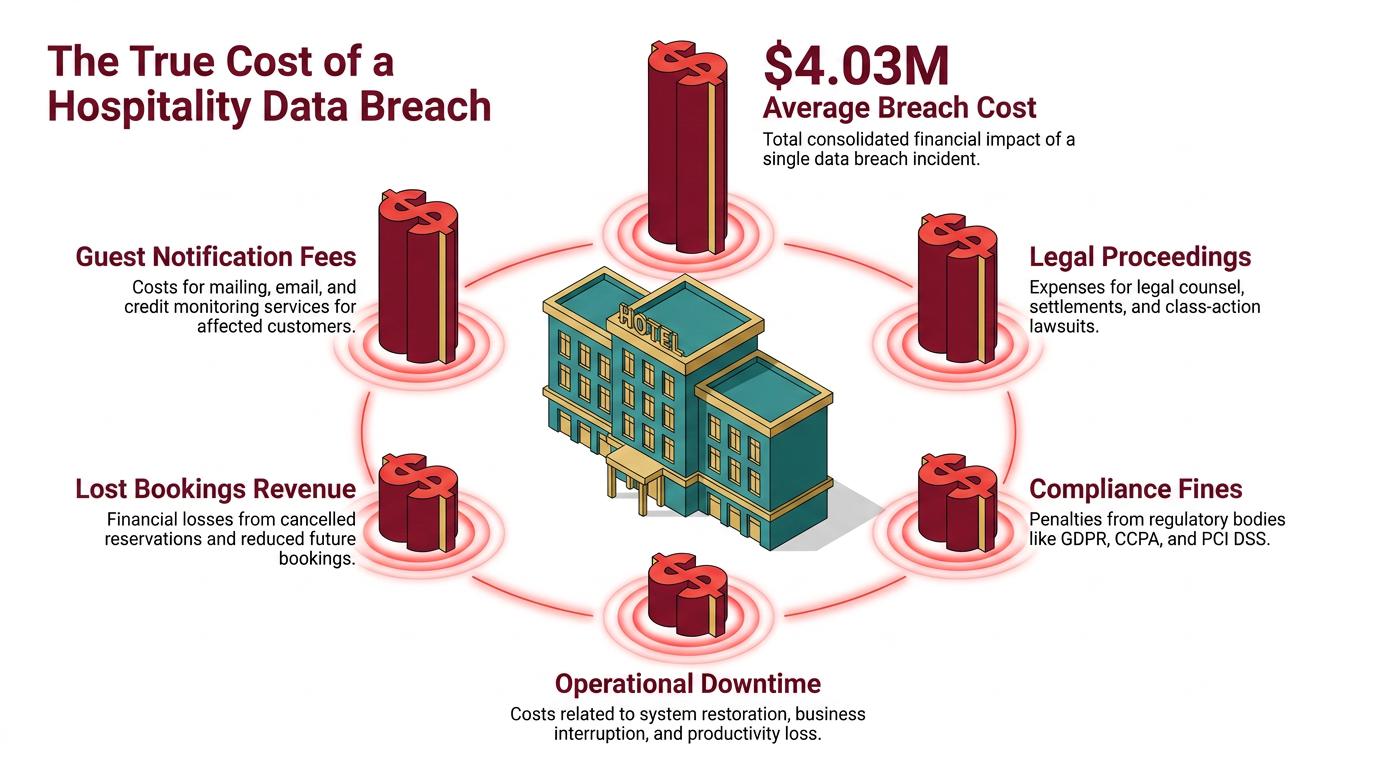
Security failures in hospitality create financial, operational, and compliance damage that can far exceed the cost of prevention. IBM's breach report puts the average hospitality breach at $4.03 million, a figure that excludes guest notifications, legal proceedings, and the revenue lost when travelers stop trusting a brand. Outages compound that cost by freezing reservations, guest preferences, and room assignments, pushing staff into manual processes that frustrate guests and slow operations, while payment card rules, privacy laws, and state regulations add compliance exposure on top.
The Storm-1865 campaign shows how these losses start. Active since 2023, it impersonates Booking.com with fake reviews, account-verification notices, and prospective-guest inquiries that lead to a spoofed CAPTCHA page instructing staff to paste a command into Windows Run, launching credential-stealing malware against targets spanning North America, Europe, Oceania, and South and Southeast Asia. A related campaign identified in early 2026 used fake system-crash pages to deliver a remote access trojan to hotel staff across Europe.
Not every attack needs malware, though. The FBI's Internet Crime Complaint Center has documented business email compromise (BEC) as a major attack method, with criminals impersonating vendors to redirect payments or posing as executives to authorize fraudulent transactions that traditional email filters often miss since the messages appear legitimate and carry no malware at all. Behavioral analysis can flag these threats by catching communication patterns and payment requests that deviate from established business relationships.
Five Practical Strategies for Cost-Effective Threat Detection
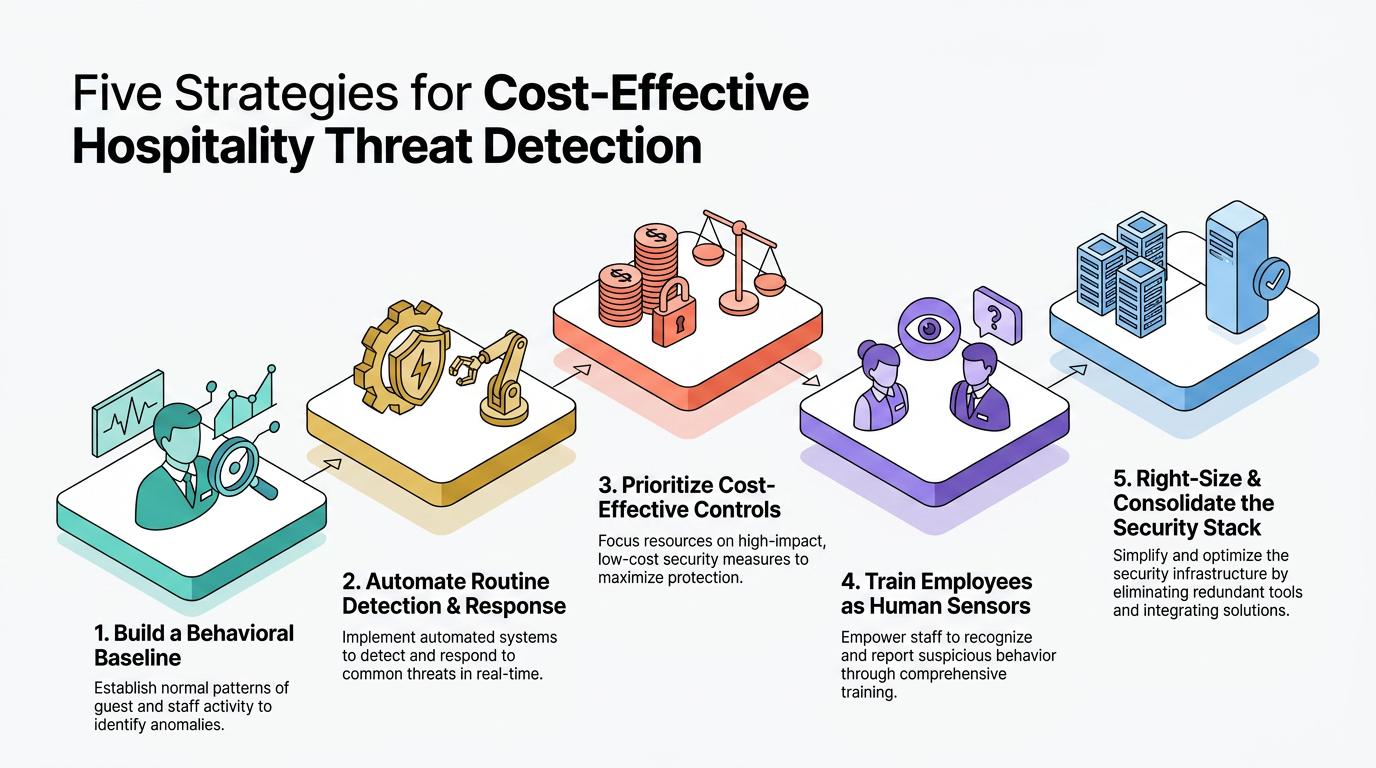
Cost-effective threat detection in hospitality means prioritizing controls that deliver the most risk reduction for the least spend, building from visibility toward a leaner, better-focused security stack.
Build a Behavioral Baseline
Mapping normal activity first makes unexpected behavior easier to investigate before it escalates. Anomaly detection works with data organizations already collect, including email, network, and identity logs, with no new sensors or appliances required. Behavioral AI can learn patterns like message timing, vendor engagement, and access behavior, so a wire request sent outside normal business context or an account showing signs of credential stuffing stands out immediately.
Getting started means inventorying data sources such as property management system (PMS) logs, mail flow, VPN records, and point-of-sale transactions, defining key indicators like expected reservation volumes and normal vendor communication flows, then creating alerts that trigger when activity strays outside those boundaries and refining thresholds as the model matures.
Behavioral baselines can expose ransomware footholds, insider fraud, and vendor compromise before significant damage occurs, keeping team attention on what actually falls outside the norm.
Automate Routine Detection and Response Tasks
Automating routine detection and response tasks lets security teams focus on strategic priorities while improving consistency across operations. In the hospitality sector, several repetitive activities work well for automation:
- Phishing Triage: Automated workflows can route suspicious user-reported messages for review and escalation.
- Domain Verification: Repeatable checks can help validate sender domains and reduce manual lookup work.
- Password Resets: Standardized reset processes can reduce delay when staff accounts show suspicious activity.
- Log Review: Scheduled analysis can help surface unusual activity across systems already in place.
Teams can build custom workflows that strengthen their security posture without adding headcount. Tracking response time, analyst hours saved, and reductions in after-hours incident responses helps quantify automation's impact. This approach lets personnel shift focus from repetitive tasks to complex, strategic challenges while maintaining consistent protection standards. Because these workflows run on systems already in place, automation can scale across properties without major infrastructure investments.
Prioritize Cost-Effective Controls
Multi-factor authentication (MFA), Domain-based Message Authentication, Reporting, and Conformance (DMARC), network segmentation, and AI-powered email security can reduce exposure to entire classes of attacks without expensive hardware refreshes.
- MFA at Very Low Cost: MFA can help reduce credential theft and account takeover risk that could expose guest records. It makes stolen passwords less useful for accessing reservation systems, payment platforms, and loyalty databases.
- DMARC at Low Cost: DMARC helps reduce domain spoofing and vendor or guest fraud before malicious emails reach inboxes. CISA's performance goals call for DMARC set to reject alongside SPF and DKIM, so spoofed emails are rejected at the mail server before delivery.
- Network Segmentation at Moderate Cost: Separating guest Wi-Fi from corporate systems, isolating payment processing networks, and segmenting property management systems limits the blast radius of a successful attack.
- Behavioral Email AI via Subscription: AI-based behavioral email security can detect BEC and ransomware precursors that often evade traditional filters, helping reduce wire fraud and operational downtime by analyzing normal communication patterns for vendors, staff, and partners.
Implementation works best in phases: secure headquarters and back-office systems first, extend to flagship or high-revenue properties next, then finish with the remaining portfolio. This phased approach delivers continuous risk reduction at each stage while spreading costs across budget cycles.
Turn Employees Into Human Sensors With Training
Front-desk agents, reservations teams, banquet coordinators, and housekeeping staff interact with unknown senders daily, making them prime targets for phishing and deepfake-assisted social engineering. These campaigns increasingly blend email with voice calls, text, and video, but the inbox remains the primary control point, so behavioral email analysis should pair with additional controls for voice, SMS, and videoconferencing channels.
A randomized trial by researchers at UC San Diego and the University of Chicago found that embedded, post-click phishing training reduced the likelihood of clicking a phishing link by only 2%, and CISA guidance states plainly that advising users to avoid clicking isn't sufficient without technical controls behind it. Treat training as one layer alongside the behavioral and authentication controls described above.
Training also has to fit daily operations, through brief videos during shift handovers, quick quizzes in the property management app, or posters at staff entrances that build awareness without disrupting guest service. Tracking metrics like declining phishing clicks, faster incident reporting, and rising voluntary threat reports turns a trained workforce into a detection network that scales with each new hire.
Right-Size and Consolidate the Security Stack
Single-purpose security tools can drain budgets and still leave gaps, since a patchwork of overlapping products rarely beats one intentional stack. A structured audit exposes those redundancies: pull every security subscription, including secure email gateway, spam filters, sandboxes, security orchestration and automated response (SOAR) playbooks, and endpoint agents, then map each one to the risk it actually solves.
- Usage Analysis: Review which tools your team actively uses and which features duplicate existing coverage.
- Contract Review: Identify overlap areas while reviewing renewal dates, contract terms, and property-level licensing models.
- Vendor Negotiation: Renegotiate terms and pursue volume discounts once tools are combined.
Focus on platforms that bundle detection, response, and compliance reporting rather than maintaining separate tools for each function. This reduces integration complexity while improving threat correlation across your infrastructure, and cloud-native platforms in particular tend to scale well with seasonal occupancy spikes.
Protecting Guest Trust Through Consistent Vigilance
Cost-effective threat detection in hospitality comes from layering behavioral monitoring, automation, targeted controls, trained staff, and a right-sized security stack rather than chasing the newest tool. Each strategy closes a different gap in the attack chain, and together they address risks that budget constraints alone cannot excuse. Properties that treat these five practices as an ongoing discipline, not a one-time project, protect guest trust and revenue continuity as threats continue to change.