Información clave
Security teams regularly process high-volume security alert queues, and security information and event management (SIEM) logging pipelines still let some phishing messages evade detection. Advanced email threats can remain inside an environment while attackers harvest credentials and pivot to sensitive inboxes. Across breach types, IBM's 2026 breach report puts the mean time to identify and contain a breach at 247 days.
Email-focused behavioral AI addresses this gap by pairing broad log collection with models of normal communication patterns. The payoff depends on ingesting the right email events, connecting the analysis to the SIEM already in place, and measuring the result with security performance indicators that a board will accept.
This guide shows where traditional SIEM rules miss business email compromise (BEC) and account takeover, which email signals matter most, how behavioral scoring sharpens triage, and what an API-based integration with Microsoft Sentinel or Splunk looks like in practice. It also covers how PCI DSS, NIS2, GDPR, and the SEC disclosure rule shape log retention, and how a pre-deployment baseline builds a clear ROI case for shorter dwell time, fewer false positives, and more analyst hours for higher-value work.
Key Takeaways
Traditional SIEM correlation rules often struggle with message content, attachments, and sender relationships, which leaves gaps that BEC and account takeover attacks can exploit.
Behavioral scoring models usual recipients, timing, writing style, and workflow cadence so analysts can prioritize higher-confidence email alerts.
Authentication results, message metadata, user interactions, security verdicts, and Open Authorization (OAuth) grants provide the context needed for effective behavioral scoring.
The Payment Card Industry Data Security Standard (PCI DSS), the Network and Information Security Directive (NIS2), the General Data Protection Regulation (GDPR), and U.S. Securities and Exchange Commission (SEC) rules shape email-log retention and reporting requirements.
A consistent pre-deployment baseline for detection rate, mean time to respond, false positives, and analyst hours makes artificial intelligence return on investment measurable.
SIEM Logging Limits in Modern Email Security
Traditional SIEM platforms can ingest basic email headers and timestamps, but many do not interpret message bodies, attachments, and relationship context. Those gaps can affect detection of BEC campaigns and other advanced email threat patterns. Rule engines recognize known attack patterns. Social engineering threat actors continually adapt their language and infrastructure to get around them.
Two common limitations illustrate the challenge:
Static Correlation Context: Policies can overlook sender relationships, communication timing, and content semantics. In a typical BEC case, a finance team may discover fraud only after questioning an unusual wire transfer, even though relevant behavioral indicators appeared throughout the email chain.
Adaptive Message Content: Attackers can craft messages that evade keyword filters and reputation-based controls. According to the FBI Internet Crime Complaint Center, reported BEC losses reached $3.046 billion in 2025, making it the second costliest crime category in the report.
Teams can feed communication-pattern, relationship, and content context into existing SIEM workflows as enriched findings. Analysts can then correlate that context with established controls and account takeover attack signals rather than evaluate each log in isolation.
SIEM Logging vs. Log Management for Email Telemetry
Log management collects and stores events for search. SIEM logging correlates events across sources to produce alerts. For email, normalization maps mailbox audit log records, workspace events, and security verdicts into common fields for sender, recipient, timestamp, and action before they reach the correlation engine.
Two operating choices determine how effectively the SIEM can use this telemetry:
Normalization Gaps: Without normalization, a sender address in an email feed may not join with a related sign-in record. The inbox-rule change that follows a compromised login can then resemble routine administrative activity rather than part of an attack chain.
Storage Tiering: Teams can classify records by investigative value and query frequency. Higher-signal authorization and mailbox-control records, including new OAuth-based application access, can remain in the hot tier queried first by the SIEM. Spam disposition and other high-volume, low-signal records can move to less expensive storage and remain available for forensic review.
This structure keeps priority records accessible through a defined SIEM audit log strategy without treating all email telemetry as equally urgent.
Core Email Security Events for SIEM Ingestion
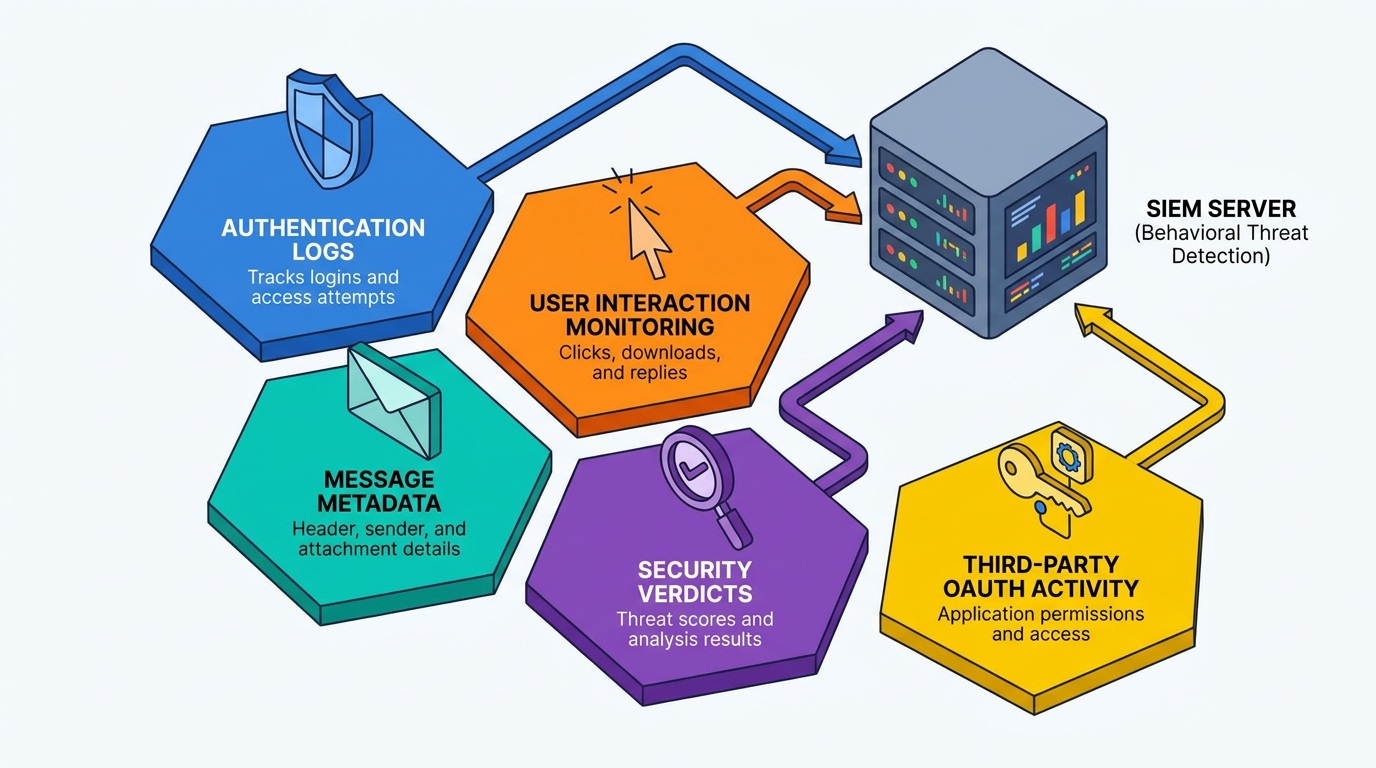
Capturing the right signals gives the SIEM enough context to support higher-confidence email threat analysis. The core telemetry categories include:
Authentication Logs: DomainKeys Identified Mail (DKIM), Sender Policy Framework (SPF), and Domain-based Message Authentication, Reporting and Conformance (DMARC) results help assess message authenticity and expose potential email spoofing indicators. They can also support analysis of domain lookalike attack patterns and authentication failures that traditional filters may miss.
Message Metadata: Sender and recipient addresses, header anomalies, originating network data, and other message attributes can help identify compromised accounts. A mismatch between the envelope sender and visible From header can indicate sender impersonation attack activity.
User Interaction Monitoring: Link clicks, replies, external forwarding, and new inbox rules can reveal credential-harvesting campaigns that hide behind clean headers. These signals may indicate that credential phishing attacks succeeded and warrant further investigation.
Security Verdicts: Spam scores, sandbox results, and attachment hashes help analysts determine whether a benign-looking invoice or document may carry malicious content.
Third-Party OAuth Activity: New tokens, scope changes, and dormant app activations can help surface supply-chain compromise warning signs. Authorization records also show which applications received access and what permissions users granted.
The Cybersecurity and Infrastructure Security Agency (CISA) specifically highlights mailbox-access events. The agency's expanded cloud logs playbook explains how teams can enable mail-items-accessed, mail-items-sent, and user-search events in cloud productivity environments and ingest them into Microsoft Sentinel and Splunk.
How Behavioral AI Improves SIEM Email Threat Detection
Abnormal's email-focused behavioral AI is designed to learn observable patterns such as typical recipients, timing, vendor interactions, workflow cadences, and engagement flows. It can then assign risk based on deviations from that history, including messages with no known email malware signatures to match.
Two illustrative scenarios show how this context supports detection:
Unexpected Vendor Contact: A finance user might email an unfamiliar vendor domain outside normal business hours. The combination of recipient behavior, timing, and identity signals can raise the message's risk score without relying on a single static indicator.
Changed Payment Instructions: A compromised supplier might alter banking details within an established invoice thread. Legacy rules may classify the message as routine correspondence because the headers and attachment hash appear familiar.
In the second scenario, the model can weigh the sudden change in instructions and unusual urgency around it, then help route the message for higher-priority review. These email anomaly detection methods give analysts context that individual log records cannot provide on their own.
Integration Architecture for SIEM Logging and Email Analysis
An effective integration creates a data flow that turns raw email telemetry into prioritized findings. An application programming interface (API)-connected architecture can use the following components:
API Event Streaming: This component pulls authentication, message, and user-interaction events from Microsoft 365 and Google Workspace to support faster API-based email threat detection. Teams can monitor the pipeline for provider delivery delays and ingestion failures.
Structured Event Delivery: JavaScript Object Notation (JSON), syslog, or representational state transfer (REST) delivery feeds normalized events to the SIEM without requiring a separate manual export process.
Enrichment Layer: This layer appends relevant threat, identity, and risk context before logs reach storage, helping analysts open investigations with supporting details already attached.
Normalized Schema: A shared schema aligns email, identity, and endpoint records so teams can use normalized anomaly detection fields to identify attack chains spanning connected systems.
Least-Privilege Tokens: Scoped integration tokens limit access to required permissions, helping teams maintain visibility without granting unnecessarily broad privileges.
This architecture complements the SIEM rather than replacing it. Abnormal's own SIEM audit log export follows this pattern, designed to work with major platforms such as Microsoft Sentinel and Splunk Enterprise Security alongside broader SIEM and security orchestration, automation, and response (SOAR) workflows. Its API-based deployment lets Abnormal work alongside existing infrastructure and contribute SIEM audit log events without requiring an inline mail-flow change.
Accelerating Email Investigation and Response
Behavioral scoring can sort alerts, add risk context, and support prebuilt response playbooks. This prioritization pushes higher-confidence incidents toward analysts and can reduce the noisy queues that contribute to cybersecurity alert fatigue.
Two workflow changes can help teams investigate and respond more efficiently:
Investigation Context: When a team investigates a malicious message, connected telemetry can bring mailbox activity, suspicious email, identity signals, and supported collaboration activity into the same investigation context. This broader view helps analysts assess potential lateral movement without claiming that a single tool reconstructs unsupported activity across unrelated systems.
Response Automation: SOAR workflows can coordinate approved response actions based on an organization's policies and integrated controls. This automation can improve mean time to respond (MTTR). It also leaves analysts more time for strategic email threat hunting.
Teams can validate each action against available product documentation and test response playbooks before using them in production.
SIEM Logging Retention and Compliance Requirements
Retention policies determine whether email logs remain searchable when an investigation or audit requires them. Security and compliance teams can align their email security control records with several overlapping obligations:
PCI DSS: The standard requires organizations to retain audit history, keep a recent portion readily available, and review relevant security logs on a defined schedule.
NIS2: Covered entities must support staged incident reporting, including early notification, supporting indicators, and a final report.
GDPR: Controllers must notify regulators promptly after becoming aware of qualifying personal-data breaches and document the facts, effects, and remedial actions associated with each incident.
SEC Cybersecurity Disclosure Rule: Registrants must evaluate material cybersecurity incidents without unreasonable delay and meet the disclosure obligations described in the SEC cybersecurity disclosure rule.
Default cloud-audit retention may not satisfy every regulatory or investigative requirement. Forwarding relevant email telemetry to a SIEM with documented audit log retention controls can give regulated organizations a clearer and more consistent evidence trail.
Measuring Success After AI Integration
A focused scorecard helps security leaders measure whether email analysis improves detection, response, and analyst efficiency. Teams can capture a consistent pre-deployment snapshot and track the following metrics after integration:
Detection Rate Improvement: Teams can compare successful detections before and after integration to determine whether previously missed attack patterns now surface.
Mean Time to Detect and Respond: Separate detection and response measurements show how quickly threats move from initial alert to containment.
False Positives Per Analyst: Tracking alerts that require manual investigation against automated dismissals helps quantify changes in analyst workload and cybersecurity alert fatigue.
Analyst Hours Saved: Teams can calculate time freed from false-positive investigation and redirected toward hunting, hardening, and higher-value analysis.
Continuous Dashboard Reporting: Executive dashboards provide ongoing visibility into detection quality, response performance, and operational capacity.
Analyst hours and mean time to respond translate operational results into budget language. A stable measurement method also gives leadership a defensible basis for comparing performance over time.
Why Behavioral AI Strengthens Email Security
Email-focused behavioral AI is designed to help identify advanced email threats that traditional detection may miss. By analyzing communication patterns rather than relying only on static signatures, it can help reduce false positives and accelerate response as a complementary layer on top of the SIEM and email gateway (SEG) already in place.
Abnormal was named a Customers' Choice in the 2026 Gartner® Peer Insights™ Voice of the Customer for Email Security, its third consecutive year. Ready to cut email threat dwell time and catch threats faster? Get a product demo to see how email-focused behavioral AI can complement your SIEM logging pipeline.
Frequently Asked Questions
What Specific Email Log Fields Need to Be Normalized Before Ingestion Into a SIEM to Effectively Correlate Email Events With Identity and Endpoint Records?
Split sender addresses into envelope-from and display-from, standardize timestamps with timezone offsets, convert authentication results into pass/fail fields, and map user actions into a controlled vocabulary. Extract IPs and autonomous system numbers from Received headers, and represent OAuth scopes as structured permission arrays. With these fields aligned, a suspicious sign-in, a new inbox rule, and an outbound message to an external domain can surface in a single SIEM query.
How Do You Establish a Behavioral Baseline for Email Communication Patterns Before Deploying AI-Based Email Threat Detection?
Grant read-only API access and let the platform observe 30 to 90 days of historical email to profile sender-recipient pairs, timing, content, and workflow sequences without generating alerts. Capture cyclical patterns like quarterly reporting and payroll runs so legitimate rhythms don't trigger anomalies later. Before switching to active detection, validate the baseline against known benign and malicious samples to confirm the model separates normal activity from genuine threats.
What Are the Recommended Storage Tiering Strategies for Email Telemetry to Balance SIEM Costs With Forensic Investigation Readiness?
Place high-urgency records (authentication failures, OAuth grants, mailbox rule changes, external forwarding) in the hot tier for active correlation. Move message metadata and security verdicts to a warm tier for pattern analysis and audits, and shift spam dispositions and routine delivery logs to cold storage for compliance retention. Automated lifecycle policies tied to regulatory mandates and incident-response needs keep critical telemetry queryable while controlling SIEM costs.
How Does Behavioral AI Detect Business Email Compromise Attacks That Pass Traditional DKIM, SPF, and DMARC Authentication Checks?
DKIM, SPF, and DMARC confirm a message came from an authorized server, but they can't judge whether the request inside is legitimate, which is why a compromised supplier account passes all three. Behavioral AI compares each message against historical relationship patterns, workflow timing, and recipient behavior, so signals like a sudden banking change in an established thread or an off-hours financial request can raise the risk score even when authentication succeeds.
What Pre-Deployment Metrics Should Security Teams Capture to Accurately Measure the ROI of Integrating Behavioral AI With Their Existing SIEM Platform?
Capture monthly analyst hours spent triaging email alerts, the volume of email incidents contained versus missed, and the full cost of email-related incidents (forensics, productivity loss, regulatory exposure). Record current SIEM query latency for email investigations and total tooling spend, including training and integration overhead. This baseline turns post-deployment gains into board-ready ROI numbers rather than anecdotal claims.