Key Insights
Regulation (EU) 2026/1744, in force since 27 July 2026, moved the EU AI Act's Annex III high-risk duties to 2 December 2027. The extra time helps only the organizations that can already say which of their AI systems those duties will cover.
A working AI governance framework decides who approves AI, which uses are allowed and how each system is watched after launch. It rests on named owners, an inventory of every AI tool and agent, risk tiers for use cases, controls tied to each tier, and monitoring that continues after launch.
This guide gives security teams a build sequence anchored to NIST AI RMF, ISO/IEC 42001 and the EU AI Act, with an owner and a deliverable at every step. It also covers the AI-specific security risks general frameworks leave out and the measures a CISO can report to the board.
What Is an AI Governance Framework?
An AI governance framework is the structure of ownership, policies, risk processes and controls through which an organization decides how to approve, use and monitor AI. It turns what AI governance means in principle into decisions a specific team makes every week.
An AI policy is narrower, stating the rules people follow, such as approved tools and data that must never go into a prompt. Through the framework, leaders decide who writes those rules and who approves exceptions. A standard such as NIST AI RMF describes outcomes any organization could aim for, and the framework records the owners, tiers and controls this organization chose.
What Components Does an AI Governance Framework Need?
An AI governance framework needs executive ownership, an AI inventory, risk tiers, written policy, controls mapped to standards, monitoring and a review cadence. Each component answers a different operational question, and a framework missing one leaves that question to be settled case by case:
Ownership and Decision Rights: Who can approve, block or retire an AI system, and who accepts residual risk.
AI Inventory: What AI is in use, including sanctioned tools, shadow AI and agents holding their own credentials.
Risk Classification: How much scrutiny a use case gets, based on its data, its autonomy and the regulations that reach it.
Policies and Acceptable Use: What employees, developers and vendors may do with AI at each tier.
Data Protection: How prompts, outputs and training data are protected.
Third-Party and Vendor AI Review: Whether an outside model, plugin or new AI feature in an approved app meets the internal bar.
Monitoring, Incident Response and Audit Evidence: How the team spots drift or misuse, responds to failures and proves controls ran.
Ownership of AI decisions comes first in the build, because every other component needs a named executive with the authority to approve its outputs.
Which Standards Should the Framework Build On?
Most security-led frameworks anchor to NIST AI RMF 1.0 with its Generative AI Profile, ISO/IEC 42001:2023 and the EU AI Act. NIST released AI RMF 1.0 on 26 January 2023 and states it is being revised, and its companion NIST AI 600-1, published in July 2024, covers generative AI risks. ISO/IEC 42001 remains in its first edition from December 2023, and the three differ in what each one obliges a team to do:
Standard | Type | What it gives you | Who it applies to | Best used for |
|---|---|---|---|---|
NIST AI RMF 1.0 and NIST AI 600-1 | Voluntary guidance | The Govern, Map, Measure and Manage functions, their subcategories and a Playbook | AI actors who design, develop, deploy or use AI | Designing the risk process |
ISO/IEC 42001:2023 | Certifiable standard | Plan-Do-Check-Act requirements in clauses 4 to 10, plus Annex A controls | Organizations of any size that develop, provide or use AI | Running governance as an auditable system |
EU AI Act | Law | Prohibitions, high-risk requirements, deployer duties, transparency rules | Providers and deployers in the EU, and outside it when AI output is used in the EU | Meeting legal obligations |
Only the ISO standard can be certified, and only the EU AI Act carries legal force, which is why the evidence a security team has to keep depends on which of the three it is answering to.
The EU AI Act's dates shifted in 2026, which matters to any framework built around its deadlines. Prohibitions and AI literacy have applied since 2 February 2025, general-purpose AI model rules since 2 August 2025, and Article 50 transparency rules from 2 August 2026. Regulation (EU) 2026/1744, in force since 27 July 2026, moved Annex III high-risk duties to 2 December 2027 and product-embedded Annex I systems to 2 August 2028.
Teams usually combine the three, with AI RMF shaping the risk process, ISO/IEC 42001 running it as a management system, and the EU AI Act setting obligations where it applies. ISO states that 42001 does not replace laws or regulations, keeping certification (issued by independent bodies) and legal compliance on separate tracks.
How Do You Build an AI Governance Framework Step by Step?
A security-led team builds the framework in order, from executive ownership through continuous monitoring, and each step produces the artifact the next one needs.
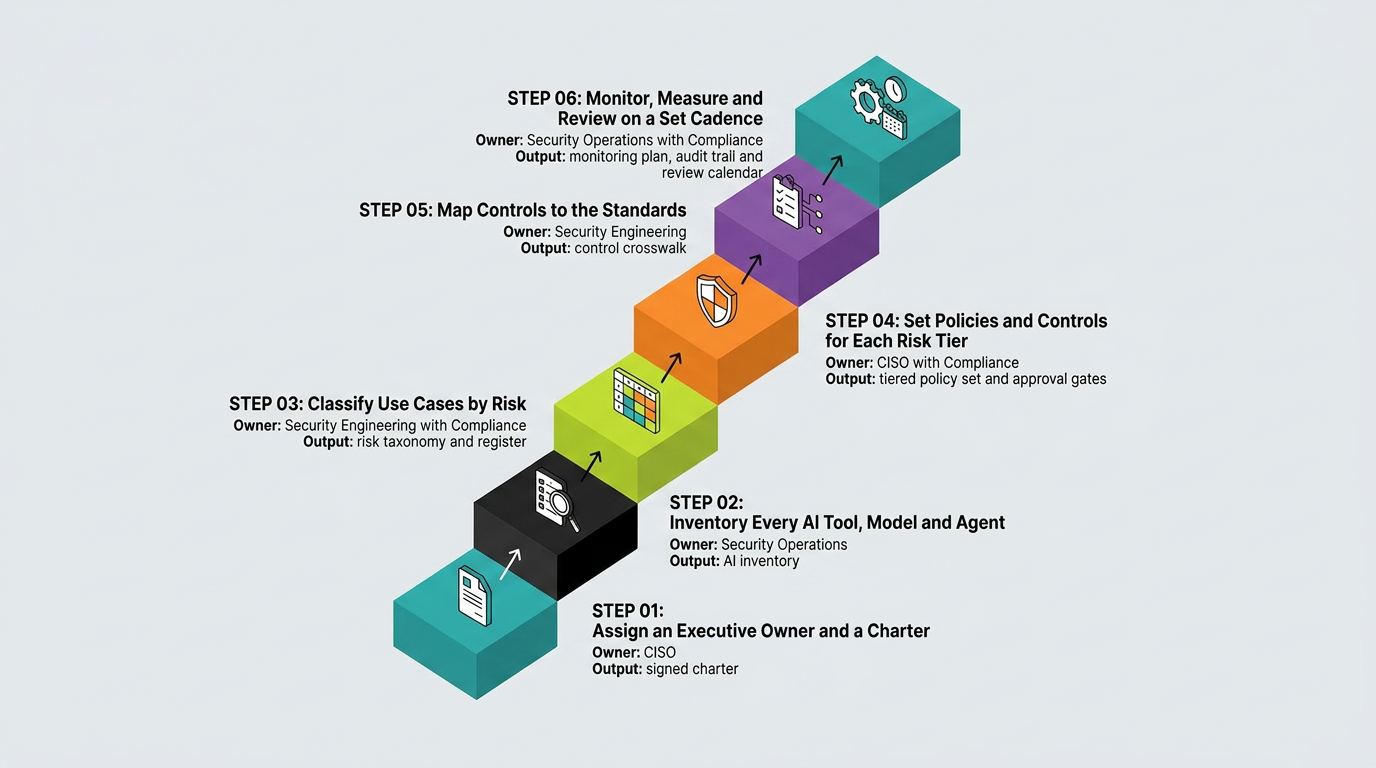
Step 1: Assign an Executive Owner and a Charter
Owner: CISO.
Output: a signed charter.
The executive who reports AI risk to the board, usually the CISO, should own the framework and get a charter signed by leadership. The charter sets scope, meaning which business units, tools, models and agents count as AI. It names who approves new tools, who grants exceptions and who can shut a system down and lists the committee roster across security, legal, privacy, compliance and the business, following the split of AI governance roles and responsibilities. NIST AI RMF's Govern function calls for documented roles and executive responsibility for AI risk decisions.
Step 2: Inventory Every AI Tool, Model and Agent, Including Shadow AI
Owner: security operations.
Output: an AI inventory with a named owner per entry.
Security operations builds the inventory from signals already available, including OAuth grants, identity provider logs, signup emails and SaaS activity. NIST's AI RMF Playbook describes an AI system inventory as an organized database of artifacts relating to an AI system, including documentation and contacts for responsible people. Each entry records the tool, business owner, data touched, first-seen date and sanction status. Agents need rows for the credentials and permissions they hold, and approved apps that add AI features belong here too. Abnormal's AI Governance is designed to discover approved and shadow AI tools and attribute ownership.
Step 3: Classify Use Cases by Risk
Owner: security engineering with compliance.
Output: a risk taxonomy and register.
Security engineering defines tiers based on data sensitivity, autonomy and effect on people, and compliance confirms which legal categories apply. Where the EU AI Act applies, tiers map to its categories of prohibited practices, high-risk systems, systems with transparency obligations and minimal risk. Annex III covers biometrics, critical infrastructure, education and law enforcement, and deployers of those systems must assign competent human oversight, keep automatically generated logs for at least six months and inform workers before workplace use. The register lists each use case, its tier, the reason for it and the reviewer who approved it.
Step 4: Set Policies and Controls for Each Risk Tier
Owner: CISO with compliance.
Output: a tiered policy set, acceptable use rules and approval gates.
Controls scale with the tier, so low-risk tools move quickly, and high-risk ones get scrutiny. A low tier might need only acceptable use rules, while a middle tier adds vendor review, logging and limits on sensitive data in prompts. The high tier adds pre-launch review, an impact assessment, named human oversight and a rollback plan. Approval gates state who signs at each tier and the target decision time, every exception needs an owner and an expiry date, and the drafting itself follows the guidance for writing an AI security policy.
Step 5: Map Controls to the Standards
Owner: security engineering.
Output: a control crosswalk.
Security engineering maps each control to NIST AI RMF subcategories, ISO/IEC 42001 clauses, Annex A controls, and any EU AI Act articles in scope. One control often satisfies several references at once, so the Step 2 inventory maps to GOVERN 1.6 and to Annex A.4, Resources for AI systems. Vendor review maps to GOVERN 6.1 and 6.2, which cover third-party policies and contingency plans, and to Annex A.10, Third-party and customer relationships. Each crosswalk row lists the control, its owner, the references it satisfies and the evidence it produces.
Step 6: Monitor, Measure and Review on a Set Cadence
Owner: security operations, with compliance for evidence.
Output: a monitoring plan, audit trail and review calendar.
NIST AI RMF MANAGE 4.1 calls for post-deployment monitoring plans covering appeal and override, decommissioning, incident response and change management. MEASURE 2.4 asks for monitoring of system behavior in production, and the Playbook describes drift as a system no longer meeting the assumptions of its original design. A workable cadence pairs continuous alerting on new tools and policy violations with monthly exception reviews, quarterly drift and bias reviews of high-risk use cases, and an annual charter review. ISO/IEC 42001 clause 9 adds an internal audit that tests whether it all ran.
What Security Risks Should the Framework Cover?
General frameworks rarely reach the risks that arrive with AI itself and sensitive data in prompts, prompt injection, over-permissioned agents and unvetted third-party models each need a named component to handle them. The OWASP GenAI LLM Top 10 2026 and the joint AI Data Security guidance from CISA, NSA, FBI and Five Eyes partners supply the technical detail. Each risk maps to a component:
Sensitive Data in Prompts: OWASP ranks sensitive information disclosure at the top of its list, covering personal data, credentials and confidential records. Data protection handles it through tier-based prompt rules and vendor retention terms.
Prompt Injection: OWASP ranks this highest of all, and it occurs when input alters a model's behavior or output in unintended ways. Policies limit what a model can act on, and monitoring logs its actions.
Over-Permissioned AI Agents: OWASP moved excessive agency up its 2026 list, tracing it to excessive functionality, permissions and autonomy, which is also the subject of this guide to securing AI agents. The inventory handles it, by recording every agent's owner, scoped credentials and shutdown path.
Unvetted Third-Party Models and Plugins: The CISA guidance says data poisoning must be addressed from a supply chain perspective, recommending provenance tracking and digital signatures. Vendor review handles it, using the same bar applied to other AI security vulnerabilities.
Mapping each risk to a component is what gives it an owner, a control and a place in the monitoring plan.
How Do You Know the Framework Is Working?
The framework is working when a CISO can report operational measures that improve quarter over quarter. These pair coverage with speed, so a board sees how far governance reaches and whether it slows anyone down:
Inventory Coverage: The share of discovered AI tools, models and agents with a named owner and a risk tier.
Pre-Launch Review Rate: The percentage of high-risk use cases reviewed before launch.
Policy Exceptions: Open exceptions and their median age against expiry dates.
Time to Approve a New AI Tool: Median days from request to decision, since long waits push employees toward shadow AI.
Audit Evidence on Request: The share of crosswalk controls whose evidence compliance can produce within a set window.
The first quarter's readings become the baseline for every board report after it.
Turning an AI Governance Framework Into Daily Practice
Security teams put the framework into daily practice by assigning owners to every component and producing an artifact at every step. The charter, inventory, register, crosswalk and monitoring plan then do double duty, defining what security operations works on and giving auditors concrete artifacts to test.
Abnormal's AI Governance, part of the AI Security suite, is designed to track compliance gaps across the AI tools an organization runs, approved and unapproved alike, and attribute each one to an owner. Explore AI Governance to see which inventory and monitoring steps can run without manual upkeep.
Frequently Asked Questions
Is an AI governance framework required by law?
Several laws require AI governance outputs, starting with the EU AI Act, which sets duties for providers and deployers, including non-EU organizations whose AI output is used in the EU. NYC Local Law 144 requires bias audits for automated employment decision tools, and Colorado's replacement AI law takes effect on 1 January 2027.
Who should own the AI governance framework?
An executive who reports AI risk to the board, often the CISO, should own it, supported by a committee spanning legal, privacy, compliance and the business. Security operations runs inventory and monitoring, security engineering maps controls, and compliance holds audit evidence.
What is the difference between an AI governance framework and an AI policy?
An AI policy states the rules people follow, such as approved tools and data barred from prompts. The framework is the structure that produces and enforces those rules through owners, inventory, risk tiers, controls and evidence, which makes the policy one output of the framework.
Can NIST AI RMF and ISO 42001 be used together?
Yes, security and compliance teams often use NIST AI RMF to design the risk process and ISO/IEC 42001 to run it as an auditable management system. NIST hosts a community-submitted crosswalk mapping the two, without endorsing it, and ISO/IEC 42001 adds optional certification by an independent body.
How long does it take to build an AI governance framework?
Timelines depend on how much AI is already in use and how many high-risk systems exist. Neither NIST nor ISO publishes a benchmark duration. Inventory usually takes the longest because shadow AI keeps surfacing, and most programs complete the first three steps before adding the crosswalk.